The Gerar Gazette
Mr. and Mrs. Abraham are pleased to announce the birth of their first child, a bouncing baby boy- Isaac son of Abraham. Welcoming the little lad into the world were Father Abraham (100), mother Sarah (90), his half-brother Ishmael (14), “Auntie” Hagar, “Uncle” Eliezer of Damascus, and hundreds of family servants. All friends and family are invited to celebrate with them at this joyous – and frankly miraculous occasion. Mrs. Sarah is registered at PharoahMart, Babel Baby, and Canaanite Kids.
The effervescent joy of Sarah leaps off the page with her declaration: “God has brought me laughter. All who hear about this will laugh with me. Who would have said to Abraham that Sarah would nurse a baby? Yet I have given Abraham a son in his old age!” Genesis 21:6-7 NLT
Isaac’s baby years are skipped over and we go straight to a party to celebrate that he has been weaned. Abraham and Sarah may be old, and even though they have Ishmael, they still act like typical parents of a first child. There’s a party and a social media post for every “first.” Don’t tell the latte moms of suburbia that “weaning parties” are a thing or it will become another trend. It still blows my mind that otherwise normal adults get together for gender-reveal parties.
At the weaning party, Ishmael is caught “mocking” little brother. This is a play on words. The word translated “mocking” is tsachaq (tsaw-khak, to laugh outright in merriment or scorn; by implication, to sport:–laugh, mock, play, make sport). The object of his tsachaq is Yitschaq (Itzchak/Isaac, which means: laughter, mockery). Ishmael is laughing at Laughter.
Ishmael is being the typical annoying big brother. He’s a teenager. He’s been the only child. And now there’s a new baby in the tent. Maybe he was trying to get some attention. Whatever his teasing looked like, it seems to have been mean-spirited enough that Sarah puts her foot down.
You know how most people reach a certain age and they basically quit caring what other people think? Sarah is 90. She’s been drug hither and yon by her husband, conscripted and rescued from not one but two harems, survived the regional fire & brimstone apocalypse, and has had to live with “the other woman” in the tent next door. She’s a tough broad. Does. Not. Care. What. You. Think. Now combine that with becoming a first-time momma bear. It would be inadvisable to mess with her baby.
Hagar and Ishmael are sent packing.
The Apostle Paul uses this incident in his Epistle to the Galatians:
“These two women serve as an illustration of God’s two covenants. The first woman, Hagar, represents Mount Sinai where people received the law that enslaved them. And now Jerusalem is just like Mount Sinai in Arabia, because she and her children live in slavery to the law. But the other woman, Sarah, represents the heavenly Jerusalem. She is the free woman, and she is our mother. And you, dear brothers and sisters, are children of the promise, just like Isaac. But you are now being persecuted by those who want you to keep the law, just as Ishmael, the child born by human effort, persecuted Isaac, the child born by the power of the Spirit. But what do the Scriptures say about that? “Get rid of the slave and her son, for the son of the slave woman will not share the inheritance with the free woman’s son.” So, dear brothers and sisters, we are not children of the slave woman; we are children of the free woman.”
Galatians 4:24-26, 28-31 NLT
Did you notice that there was no laughing in Paul’s version of the story? Paul was a highly educated OT scholar. And he used the word “persecute” to describe what Ishmael was doing to Isaac.
So Hagar and Ishmael wander in the desert until they are out of water. She abandons him under a bush so she won’t have to watch him die. And then YHWH shows up.
This passage is a bookend to her earlier experience in chapter 16. Remember how Sarah sent the pregnant Hagar away and the Lord met her by a spring of water in the desert? Look at these two events.
“Thereafter, Hagar used another name to refer to the Lord, who had spoken to her. She said, “You are the God who sees me.” She also said, “Have I truly seen the One who sees me?” So that well was named Beer-lahai-roi (which means “well of the Living One who sees me”). It can still be found between Kadesh and Bered.”
Genesis 16:13-14 NLT
“And God heard the cry of the boy and the angel of God called to Hagar from the heavens and said to her, “What is the matter Hagar? Do not be afraid, for God has heard the cry of the boy from where he is. Get up, take up the boy and take him with your hand, for I will make him a great nation.” And God opened her eyes, and she saw a well of water. And she went and filled the skin with water and gave a drink to the boy.”
Genesis 21:17-19 LEB
Those parallels are intentional. It’s like poetry that rhymes. Running from Sarah. Wilderness. Thirst. Finding water. Eyes that see. Ishmael & Hagar. The Angel of YHWH. Oh- by the way, notice how in the second passage the Angel of YHWH says that God has heard (as if God is distinct from himself), but then He says “I will make him a great nation.” (as if He has the divine ability to direct the future). This is no average angel. This is another appearance of the embodied Word of YHWH. We’re not even halfway through Genesis and He’s already making regular appearances.
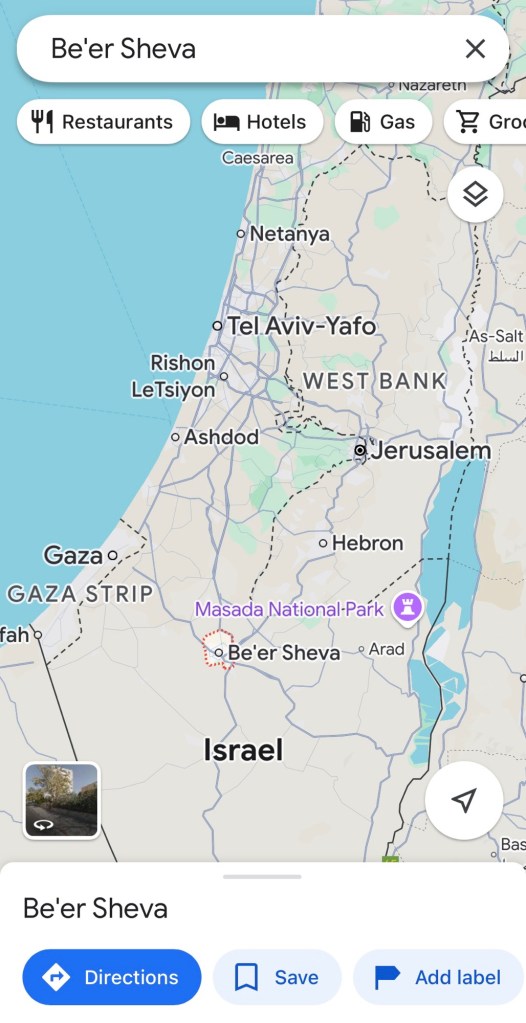
The chapter ends with Abraham and Abimelech making a covenant at a well with 7 sheep as evidence. You may have already picked up the Hebrew word for well. It’s beer. And no, it’s not pronounced like the adult beverage. 🍺 It’s pronounced like the French name Pierre but with a B. The word sheba (sheh-bah or sheh-vah, not shee-buh) is the Hebrew number 7. Shabbat is the 7th day. Elisabeth means God of the oath because ancient oaths were made by repeating a promise 7 times. So, Beersheba (be-air-sheh-vah, not beer-she-buh) means well of the 7 or well of the oath.
Chapter 22… The Test.
Let’s clear up a a major misconception about this chapter. Isaac was not a small boy. Scholars generally estimate that he was in his early to mid 30s. That’s suspiciously the same age as Jesus when He died.
What is the implication of a strapping young man being bound to be sacrificed?
He did not attempt to get away. If he’s bound, it’s because he has chosen to be so.
Isaac was a man of faith like his father. God had made a covenant with Abraham. Those are unbreakable. Remember the animals cut in two? Isaac HAS to become a father and have offspring of his own or Abraham will have the right to kill God and cut Him in two. Isaac knows all about this covenant.
Now, if they know….
- God has guaranteed that Isaac will carry on the seed of Abraham.
- God has told Abraham to offer Isaac up as an offering.
What is the only logical inference?
A) God can’t make up His mind.
B) Abraham is a psycho nut.
C) God HAS to raise Isaac from the dead.
If you answered C, you are correct. This is exactly the conclusion the writer of Hebrews arrived at:
“By faith Abraham, when he was tested, offered Isaac, and the one who received the promises was ready to offer his one and only son, with reference to whom it was said, “In Isaac your descendants will be named,” having reasoned that God was able even to raise him from the dead, from which he received him back also as a symbol.”
Hebrews 11:17-19 LEB (emphasis mine)
I offer for your consideration this idea:
Isaac was a willing participant. He trusted God. Even to death.
Now where else do we see a young, 30ish year old man, carrying a heavy load of wood up a hill? The wood upon which he would die- knowing that he would be resurrected from death?
Oh- and that hill? The land of Moriah? It’s where Salem is- where Melchizedek brought out the bread and wine. It’s Jerusalem. I have zero reasons to doubt that this offering of Isaac probably took place on the very spot where Jesus was crucified.
And what is caught in the “thicket?” A ram. Have you ever seen an animal caught in a fence? They often thrash around until they hurt themselves. This ram is caught by his horns. In a “thicket.” It means a “copse” or cluster. The root word means to entwine. There’s a scruffy tree all over southern Israel called the Acacia tree. It’s about to become quite important in Exodus. My friends in Texas have one that’s very similar- the Mesquite. Drought and heat tolerant. Small and scruffy. And thorny. Very thorny.
I have a theory- that the ram was caught in some acacia branches. I suspect that the ram had thrashed around until its head was bloodied and it was essentially wearing a crown of thorns. On Calvary. Near a young man who was born of a miracle, who carried a heavy load of wood up a hill to partner with his Father in an act of obedience and submission to death.
🥹🙌🏼
This isn’t just a cute Bible story. This is God telling humanity the future. Moses didn’t make a lucky guess when he wrote this. I have no clue how unbelievers explain this. This is history written in advance in picture form. In minute detail. Genesis was finished and attested thousands of years before the crucifixion of Christ. It was copied into Greek centuries before. There is no way around this. God is real. And He wrote this book. And He is outside of time. And He directs the affairs of mankind. And He knows and declares the end from the beginning. This one narrative proves ALL of that.
I don’t know how much Abraham and Isaac understood about what they were doing, but it’s possible that they knew it was prophetic in some way. It won’t be the last time that God has prophets act out a prophetic scene. (Wait til we get to Isaiah going nudist for 3 years as a prophetic sign… 😳)
When Isaac asks Abraham in verse 8, “where is the lamb for the sacrifice?” Abraham said, “My son, God Himself will provide a lamb for the burnt offering.”
God will personally provide the Lamb. 🐑
Indeed He did.
And once Abraham had offered the ram (which will later in Leviticus be called the Sin Offering)…
“Abraham called the name of that place The Lord Will Provide. And it is said to this day, On the mount of the Lord it will be provided.” Genesis 22:8, 14 AMPC
What will be provided on the mount of the Lord? What’s the “it?” How about the final Sin Offering? The sacrifice. The supernatural son. Rescue from death. The One Who dies so another may live. In a word: salvation. On this mountain “it” (salvation) will be provided. Y’all- the whole Gospel is right here. It’s a prophetic declaration of what will come about 2000ish years later.
Because of Abraham’s obedience, God swears by Himself that He will bless Abraham. (God swears by Himself. I mean, what else is He gonna swear on? The Bible? He basically IS the Bible.)
The blessing repeats the promise of Gen. 12:2-3 and emphasizes Abraham’s “seed” as the recipient of the blessing. And all the nations of the earth may be blessed and participate IF they are IN the seed.
“Therefore if anyone is in Christ, he is a new creation; the old things have passed away; behold, new things have come. And all these things are from God, who has reconciled us to himself through Christ, and who has given us the ministry of reconciliation, namely, that God was in Christ reconciling the world to himself, not counting their trespasses against them, and entrusting to us the message of reconciliation.”
2 Corinthians 5:17-19 LEB
That- ☝️ is what the offering of Isaac is all about. Oh- and one more cool thing…
Something interesting that Dr. Chuck Missler pointed out… from this point in the story- from the figurative death and resurrection of Isaac, he disappears from the narrative until the servant of his father returns bringing him a bride.
☺️
Bonus points if you noticed Uz & Buz in v21- from Job: The Land of Uz (ootz) and Elihu the Buzite (Boozite).
 To The Reader