Joseph brings 5 of his brothers and Jacob to meet Pharaoh. I want someone to find some ancient Egyptian artifact that records this meeting. Wouldn’t THAT be cool?! I wonder what Jacob looked like. Pharaoh seems to be rather astonished at his age of 130 but Jacob lets Pharaoh know that his age is nothing compared to his ancestors. His grandfather Abraham lived 175 years and Grandpa Abraham personally knew Shem who lived to be 600!!
The years of the famine pass. Joseph keeps everyone alive. And the children of Israel spread out in the best part of Egypt and begin to multiply.
Jacob makes Joseph swear that when he dies, his body will be buried in Canaan. And he tells him the name of God who appeared to him (El Shaddai) and the promises God made to him and the family. This will be important later.
Then we get an echo of the Isaac-blessing-Jacob story. This time it is Jacob who cannot see and who wants to pass on his blessing. And there is one final bit of trickery in this story.
Now think about this- Joseph is technically not Jacob’s firstborn. That would be Reuben. Joseph is, however, the firstborn with his beloved Rachel. Joseph is also far and away the best man among all Jacob’s sons. Reuben slept with Bilhah, one of Jacob’s wives. Simeon & Levi committed genocide. Judah- well, his two eldest sons were so bad that God struck them dead and he got his daughter-in-law pregnant when he thought she was a prostitute.
But instead of blessing Joseph, Jacob adopts Joseph’s sons- Manasseh and Ephraim – as his own and blesses them both so Joseph gets double what his brothers do. The boys are probably teens at this point. Possibly older. And Jacob intentionally places the younger brother first and gives him the blessing of the firstborn with his right hand.
“Then Jacob looked over at the two boys. “Are these your sons?” he asked. Jacob was half blind because of his age and could hardly see. So Joseph brought the boys close to him, and Jacob kissed and embraced them. Joseph moved the boys, who were at their grandfather’s knees, and he bowed with his face to the ground. Then he positioned the boys in front of Jacob. With his right hand he directed Ephraim toward Jacob’s left hand, and with his left hand he put Manasseh at Jacob’s right hand. But Jacob crossed his arms as he reached out to lay his hands on the boys’ heads. He put his right hand on the head of Ephraim, though he was the younger boy, and his left hand on the head of Manasseh, though he was the firstborn.” Genesis 48:8, 10, 12-14 NLT
Second-sons-favored-over-firstborns list:
- Abel over Cain
- Isaac over Ishmael
- Jacob over Esau
- Ephraim over Manasseh
- Coming up: Moses over Aaron
Joseph tried to correct his father but Jacob knew exactly what he was doing. (You can’t out trick the trickster) He blesses Ephraim as the next head of the family. I think we kinda forget this. Ephraim will in fact become so powerful and important that his name will be used interchangeably in the OT with Israel to stand for the whole nation or sometimes the northern 10 tribes when we get to that. This is a very important moment.
And then there’s this one last verse, a seemingly tacked on little bit (and y’all should know by now what I like to do with those).
😏😉
Jacob says to Joseph:
“And I give you one portion more than your brothers, which I took from the hand of the Amorite with my sword and my bow.”
Genesis 48:22 NASB2020
M’kay… Don’t remember reading that part.
I found some info on blueletterbible.org. Fantastic free reference. Bookmark it. You can thank me later. I looked up the great Matthew Henry’s Commentary on it. He pointed to 2 texts. Interestingly, we have to go forward to get details about the past.
“Now they buried the bones of Joseph, which the sons of Israel brought up from Egypt, at Shechem, in the plot of land which Jacob had bought from the sons of Hamor the father of Shechem for a hundred pieces of money; and they became the inheritance of Joseph’s sons.” Joshua 24:32 NASB2020
Remember that whole nasty incident with Dinah? Shechem was the name of the prince who took Dinah and either seduced or raped her. That city was called Shechem after him. Jacob had lived near the city and apparently bought some land there. Jacob says he took it “from the hand of the Amorite with my sword and my bow.” A couple of options here.
Either it was kind of a Homestead Act kind of thing where Jacob bought the rights to the land but then had to go settle it and fight the natives, OR once they moved out of the area, the Amorites settled there as squatters and Jacob had to go back and forcibly remove them. Either way, it was a special piece of land to Jacob and he deeded it specifically to Joseph.
Another passage tells us that this is where Joseph went initially to check in on his brothers. They weren’t there, but Shechem is where Jacob had sent Joseph the last time he saw him alive before Egypt.
“Now his brothers went to pasture their father’s flock near Shechem. And Israel said to Joseph, “Are not your brothers pasturing the flock at Shechem? Come, I will send you to them.” And he said to him, “Here I am.”
Genesis 37:12-13 ESV
There’s another text that tells us that this property had a really good well:
“So he came to a town of Samaria called Sychar, near the field that Jacob had given to his son Joseph. Jacob’s well was there; so Jesus, wearied as he was from his journey, was sitting beside the well. It was about the sixth hour.” John 4:5-6 ESV
Yup. THAT well.
The ancient, ancient well where Jacob had probably splashed water with his young sons when they first arrived back in Canaan after leaving Laban’s house- that’s the piece of land he wants Joseph to have. A well that may have reminded him and Rachel of the place they first met.
And 2000 years hence, a young rabbi will “need to go through” this area. Just as Joseph was sent by his father to this place, Christ was also sent by His Father to this same location to see how his brethren are doing. Jesus meets a woman at this well. He will ask her for a drink as Isaac’s servant asked Rebecca for a drink. She will give him that drink. From Jacob’s (Joseph’s) well.
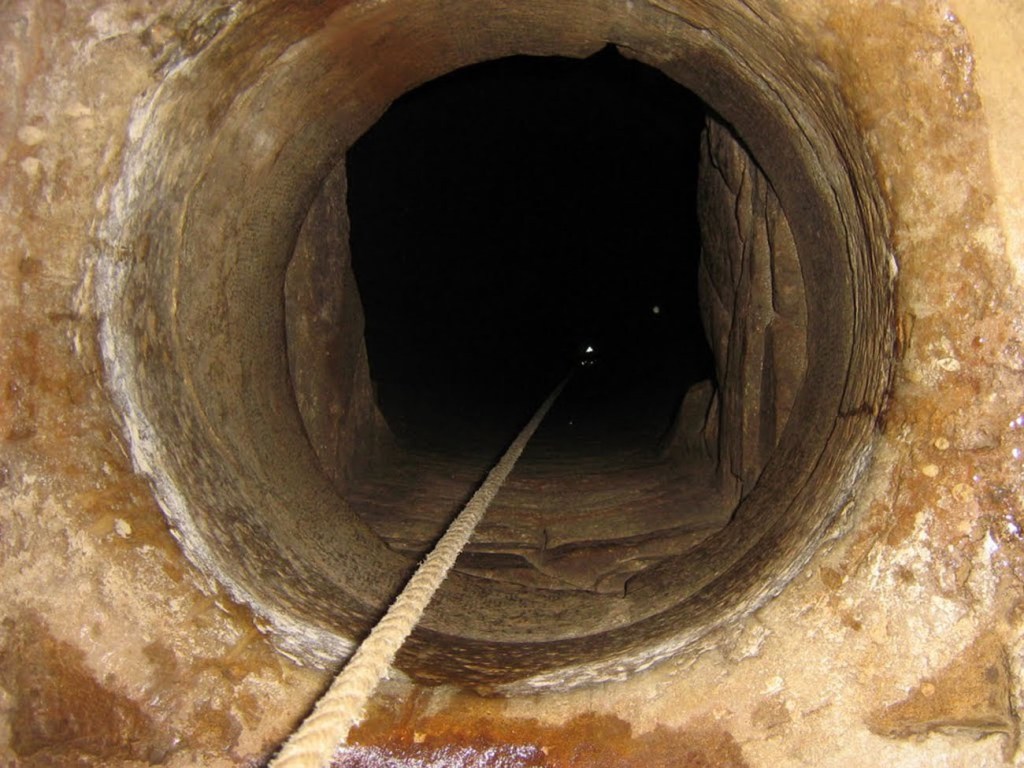
Joseph’s story begins in a pit- a dry well. A well with no water. He was drawn out by his brothers and rejected. And it ends at a well where a woman (also rejected by the men in her life) draws out water for the One of Whom Joseph’s life was a picture. But the well didn’t have water that could satisfy her soul. As far as her soul went, this was a dry pit. So the Savior offers her living water- salvation. Just as Joseph provided life-giving sustenance for the body, Jesus provides life-giving sustenance for the soul.
Christ is our Joseph. He was despised and rejected. He was falsely accused and a man of sorrows. But it was God Who sent Him to save our lives.
 To The Reader