We have come to the burning bush. 🔥
First, we again have an appearance of the “Angel of Yahweh” but this time, there is a fascinating ambiguity in the text.
“And the Angel of Yahweh appeared to him in a flame of fire from the midst of a bush, and he looked, and there was the bush burning with fire, but the bush was not being consumed. And Moses said, “Let me turn aside and see this great sight. Why does the bush not burn up?” And Yahweh saw that he turned aside to see, and God called to him from the midst of the bush, and he said, “Moses, Moses.” And he said, “Here I am.” And he said, “You must not come near to here. Take off your sandals from on your feet, because the place on which you are standing, it is holy ground.” And he said, “I am the God of your father, the God of Abraham, the God of Isaac, and the God of Jacob.” And Moses hid his face because he was afraid of looking at God.”
Exodus 3:2-6 LEB (emphasis mine)
Dr. Michael Heiser points out in his book, The Unseen Realm, page 142, “The text quite clearly states that “the Angel of Yahweh” was in the bush (v.2). But when Moses turns to look at the bush (v.3), the text has Yahweh observing him and calling to him – “from the midst of the bush” (v.4). Both the Angel – the visible form of Yahweh in human form – and the invisible Yahweh are characters in the burning bush scene. Interestingly, verse 6 tells us that Moses was afraid to look at God. This suggests that he had discerned something other than fire in the bush- most likely, the human form of the angel. The New Testament affirms this description in Acts 7:30-35. The martyr Stephen twice tells us that there was an angel in the bush. In the conversation that ensues, Yahweh (v.7) reveals his covenant name to Moses: I AM (Ex. 3:14). If Yahweh is speaking to Moses, one has to wonder why the Angel was needed. If Yahweh is doing the talking, why does he need a messenger? Or perhaps when the writer says Yahweh is speaking, he means the Angel. Like the passages in Genesis we’ve already seen, Exodus 3 includes Yahweh and his Angel in the same scene as distinct figures, but then creates ambiguity between them. Are the two one? Are the two the same but different?”
The Lord tells Moses he is being sent to Pharaoh and demand God’s people be released.
And we get excuse #1, “Who am I to go to Pharaoh and bring the Israelites out of Egypt?” God’s answer is interesting:
“And he said, “Because I am with you, and this will be the sign for you that I myself have sent you: When you bring the people out from Egypt, you will serve God on this mountain.” Exodus 3:12 LEB
Who am I? I guess it doesn’t matter as long as God is with you. Imagine showing up at a big international summit. You’re in way over your head. But you are the guest of…
Donald Trump.
Now, no matter what you think of him, if that happened, nobody would care who you were. You’re with one of the most powerful men on earth. This is a poor comparison but you get the idea. If you show up and God is with you, that’s all that matters.
And the sign God gives him is odd- it hasn’t happened yet. 🤔 The proof that Moses is actually being sent by God and not just having hallucinations won’t happen for several months.
It reminds me of this: “Dear friends, now we are children of God, and what we will be has not yet been revealed. We know that whenever he is revealed we will be like him, because we will see him just as he is.”
1 John 3:2 LEB
The ultimate proof of our calling and commission is also yet future.
Excuse #2 – But I don’t know your name.
The revelation of the name I AM is important. You may recall that I asked you to remember the name El Shaddai. Also recall that Jacob had asked the Angel of Lord his name at Peniel and got no answer. This I AM THAT I AM is a single repeated Hebrew word: hayah. It means “to exist.” Up to this point, the pre-flood patriarchs, Abraham, Isaac, and Jacob, and their descendants have known God as El Elyon, El Shaddai, and Elohim. Hayah Hayah is new. Just in case there’s any confusion, the Lord identifies himself as the God of Abraham, Isaac, and Jacob.
The Lord tells Moses how it will go down- that Pharaoh won’t listen at first and God will strike Egypt with many wonders and after that, they will go free.
Excuse #3 – What if they don’t believe me?
We get the 2 (nay, 3!) signs. Everyone’s favorite is of course the staff turning into a snake. How could you not love that one?! It’s so cool! The leprous hand thing isn’t nearly as exciting. But it’s like we all skip the third one.
What? There’s a third one?
See? I told ya.
“And if they do not believe you and they will not listen to the voice of the former sign, then they will believe the voice of the latter sign. And if they also do not believe the second of these signs and they will not listen to your voice, then you must take water from the Nile and pour it onto the dry ground, and the water that you take from the Nile will become blood on the dry ground.” Exodus 4:8-9 LEB
Moses didn’t have to do the 3rd sign for the Israelites. They believed the first 2. (Don’t know ‘bout y’all, but I would’ve been fine with just the first one.) But because Pharaoh doesn’t believe that God has sent Moses, he gets the 3rd sign on steroids. 🩸
Excuse #4 – I’m not a good speaker.
God’s response: see answer 1. I am with you. I will give you the words to say.
Excuse #5 – please send anyone else but me!
God: Fine. Aaron can do the talking but you’re not getting out of this, Moses.
Moses: bows head, digs toe in the dirt- ohhkay…
You’d think God was dealing with a child. Y’all, Moses is 80 years old now. Eight. Tee. Octogenarian. But maybe he feels like he’s been outa the Egyptian world too long. Or maybe “I tried delivering my people once. And I colossally failed. All I got for it was rejection and a wanted poster.”
I kinda get a whiff of that failure and damaged confidence. Charlton Heston was a rather macho Moses. And way too gorgeous.
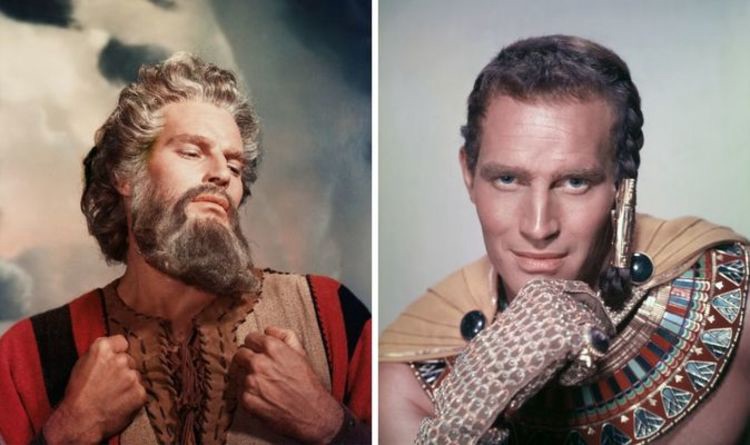
The real Moses was insecure even though he was highly intelligent and educated. You wait ‘n see. That insecurity is going to going to cause problems. It’s one of those temptations common to every human. I challenge you to deal with it if it’s lurking in your heart. If my personal experience is any indicator, you will have to hunt it down and drag it out of its many burrows. Take it to the cross and nail it down. It does not go away on its own. It merely goes incognito. Some of its frequent disguises are: excuses, avoidance, paranoia, blame-shifting, self pity, comparison, victimization, affirmation addiction, self-absorption, and if it’s feeling rather bold- competition, and envy.
Moses packs up the family and heads to Egypt. Two interesting things happen on the way.
The first is this:
“And you must say to Pharaoh, ‘Thus says Yahweh, “Israel is my son, my firstborn.” And I said to you, “Release my son and let him serve me,” but you refused to release him. Look, I am about to kill your son, your firstborn.’ ” Exodus 4:22-23 LEB
Y’all, we haven’t even done the first plague yet and God is already telling Moses how this is going to end. I think we forget that. He even says it as if it’s like the night of the Passover already. It’s no different in your life. The Lord already knows how things are going to play out before they even begin. He’s already there with you in your tomorrow. And I find that extremely comforting.
🤓 Hi. Theology Lacy interrupting here… and if drilling down into gritty theological details isn’t your thing or you’re short on time, just skip this section. Scroll down to the next divider line.
I’m not a Calvinist. I do not believe that God controls humans like a puppet master though verse 21 in this chapter about God “hardening Pharaoh’s heart” leads many to conclude that He does. You are free to believe what you will. Unless I’m mistaken (and forgive me if I am), I think Calvinists believe that the reason God knows what the future holds is because He determines or pre-ordains every human choice. I am not ok with the implications of that line of reasoning. It ends up with God putting on a cosmic Punch and Judy show. With one hand He makes some people do evil and with the other He punishes them for it. I find it impossible to square that view with the God I see revealed in scripture.
There is an alternative. I do not believe that foreknowledge requires causation. Perhaps I’m naive, but I believe that an infinite being outside of time and space not only sees, but can move about in and interact with, an infinite number of possible universes resulting from every possible choice and every possible outcome from said choices. For all time.
My God is not just everywhere right now. And He is not just present in every-when of this realty. I strongly suspect He is actually present (in some way) in the potential – where the quantum realm has not yet collapsed into reality. (Don’t be too impressed. I know just enough of the concepts of quantum physics to get myself in trouble.) Perhaps it is from that realm that He calls us and leads us into the future. (But the future is only the future to us because we are stuck in time. It’s not future to God. He’s not inside time at all so He does not experience past, present, future. I’m not sure what reality looks like from His perspective cuz I’m not God but let’s stop imagining that it even remotely resembles what we experience. K. Mini rant within a rant over.)
God can interact with a person’s future decisions while allowing them the ability to choose. If He desires, He can nullify the consequences of their decisions without impinging on their wills. (Parents do this all the time with toddlers.) He can allow people to do what He already knows they will do and use it to His advantage to further His purpose. Thus He can hold them accountable for a real decision of theirs and not the illusion of a decision for which He then punishes them. By such interactions He can direct history to His desired outcome without micromanaging every human choice. Oh- and He can do all this before even finishing the phrase, “Let there be light.”
If you’re interested in the topics of foreordination and free will, I highly recommend Soteriology 101, with Dr. Leighton Flowers. He’s a former Calvinist who is not an Armenian but lands in a space he calls “Provisionist.” Great channel. And he will do an infinitely better job than me at unpacking the ideas of foreordination and free will.
Ok. Theology talk over. Now back to our regularly scheduled programming. (If you know what that means, you’re old. 😏)
I said there were TWO interesting things that happened on the way to Egypt.
The second is this strange-to-us story of Yahweh coming to kill Moses? And Zipporah circumcises their sons. And something about being a “bloody bridegroom?”
For that, I direct you Dr. Carmen Joy Imes, a professor at Biola University. In this clip from Disciple Dojo she unpacks this passage and also sheds light on the structure of Exodus. Enjoy. And see you in chapter 5.
 To The Reader