Ok y’all, I don’t know how many times I’ve read and heard and watched on film the story of the rod that ate up the other rods. Look at it real close though. It was not Moses’ rod that ate the others. It was Aaron’s. And here’s another thing- it didn’t necessarily turn into a snake.
Say whaaaaaat? 😲
Yup. This is gonna be fun. Buckle up.
Here we go. 🛫
“And Yahweh said to him, “What is this in your hand?” And he said, “A staff.” And He said, “Throw it onto the ground.” And he threw it onto the ground, and it became a snake (nachash), and Moses fled from it.”
Exodus 4:2-3 LEB
Moses’ rod turns into a nachash, a serpent. Aaron and his rod are not here.
Fast forward to chapter 7, God speaking:
“When Pharaoh speaks to you, saying, ‘Do a wonder for yourselves,’ you will say to Aaron, ‘Take your staff and throw it before Pharaoh, and it will become a snake’ (tannin).” And Moses and Aaron came to Pharaoh, and they did so, as Yahweh had commanded. And Aaron threw his staff before Pharaoh and before his servants, and it became a snake (tannin).”
Exodus 7:9-10 LEB
Let’s compare the 2 different Hebrew words. Here are screenshots from my Strong’s Concordance app:
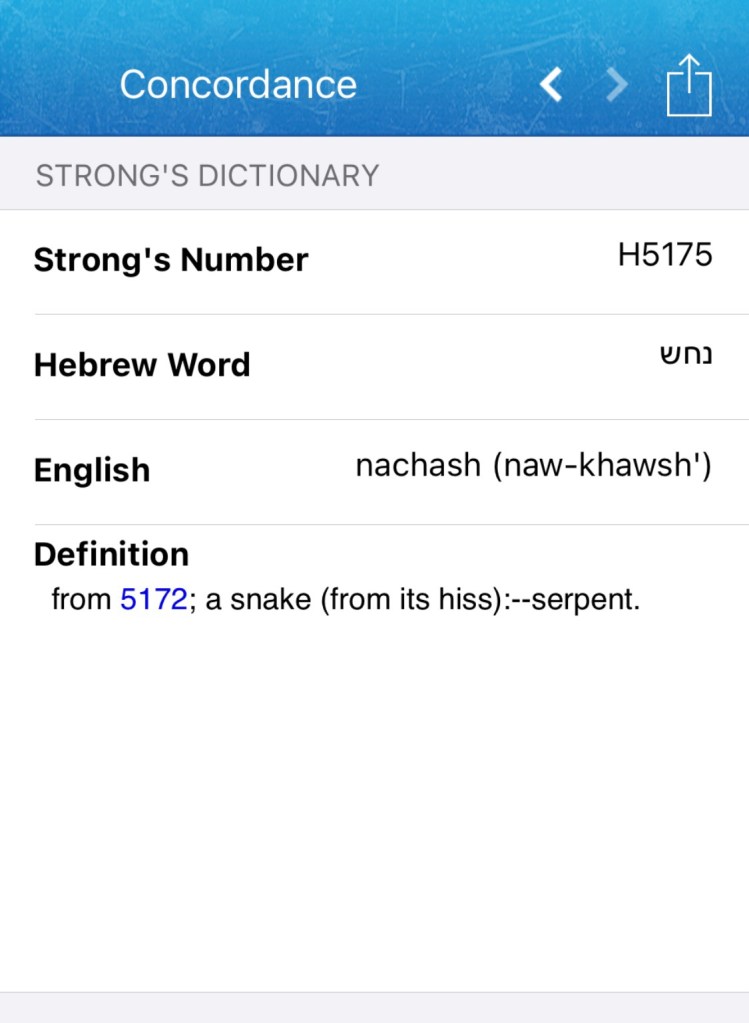
Look at the Hebrew letters closely in the screenshot above. Read from right to left. Each letter is a picture. Even in modern Hebrew you can still kinda see them: a snake, a wall, and teeth.
Nun/Nachash (yes, nachash is an optional name of the letter) – it means serpent, shiny/reflective, spiritual.
Chet (khet) – means wall, end, obstacle, outside
Shin (sheen) – means teeth, bite, cut, chew, destroy, consume, face, front, forward
Put ‘em together: serpent end teeth
Translation: serpent ends you with teeth.
Now in modern pictographs: 🐍☠️🪦🦷
But perhaps another reading is worth considering: the Serpent’s end is destruction.
🤯
You can read that 2 ways:
1. The end goal of the Serpent is to destroy.
“The thief comes only so that he can steal and kill and destroy; I have come so that they may have life, and have it abundantly.”
John 10:10 LEB
2. The Serpent is destined to be destroyed.
“And the devil who deceived them was thrown into the lake of fire and sulphur, where the beast and the false prophet also are, and they will be tormented day and night forever and ever.”
Revelation 20:10 LEB
That’s all encoded in the DNA of the word. 🤯
By the way- here’s my Paleo Hebrew resource so you can do this kind of thing on your own any time: Father’s Alphabet. Watch their videos on YouTube too. They’re fantastic.
Ok, now for tannin…
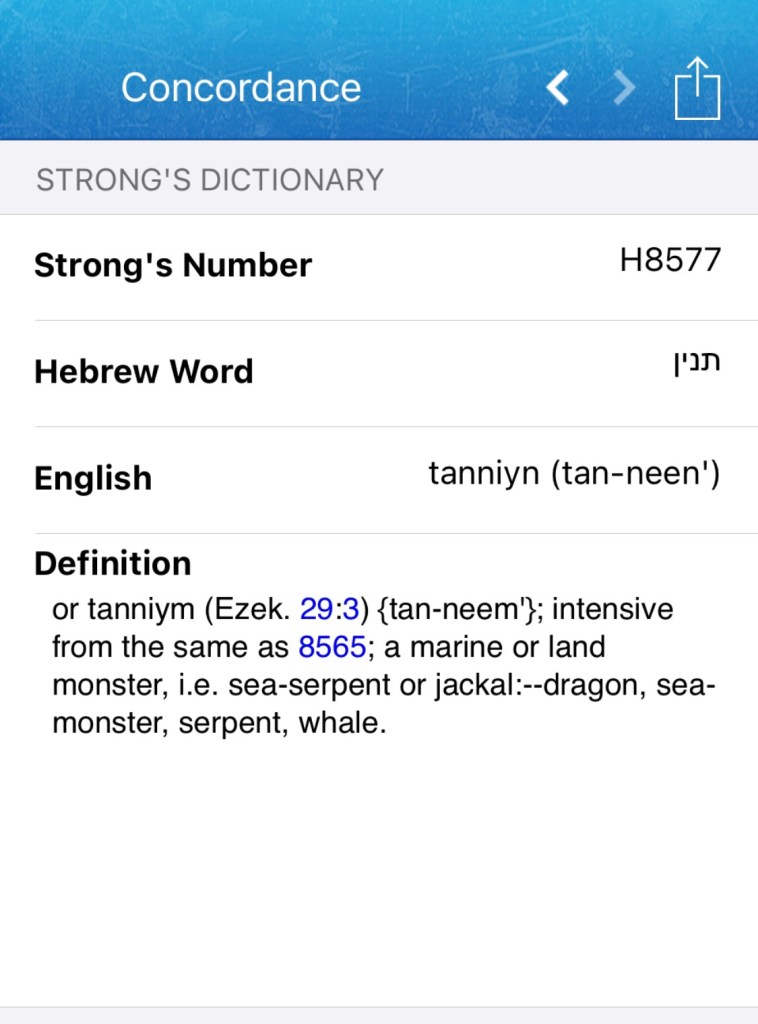
I think we can reasonably rule out tannin as a sea-serpent, sea monster, jackal, or whale in this instance. That leaves us with a dragon. 😯
Never in my life have I pictured Aaron’s rod becoming a dragon! And not only that, but the magicians do the same with their magic arts!! Their rods also become tannin. And then Aaron’s dragon eats their dragons. 😲
Such an idea has never been on my radar but the text supports it. Oh, and if you are stumbling over the idea of dragons being real, let me help you out.
The word “reptile” existed in French and Latin by the late 1300s for creeping things, but was not used in English as we do scientifically until the mid 1700s and even then it included what we now call amphibians. The word “dragon” is much older- existing even in Ancient Greek and carrying the idea of something terrifying to behold. It is not, I repeat NOT a technical term defining a fire-breathing, winged creature with leathery skin. That’s why it’s used to translate the Hebrew word tannin and why tannin can be anything from a whale to a jackal. Terrifying to behold. Heck, that could even describe your spouse first thing in the morning. 😆
Moses had already used the word nachash to describe what his rod turned into. If Aaron’s rod became the exact same thing, why use a different word? Let’s look closer.
Paleo: Tav, Nun/Nachash, Yod, Nun/Nachash
Tav – mark (like a + or x), strong indicator
Nun/Nachash – serpent, shiny/reflective, spiritual.
Yod – hand/arm, make/do, power/authority
Put ‘em together: mark serpent arm/hand, serpent
If I see a snake marked with arms and hands, where I’m from we call that a lizard. 🦎
But if I saw a big shiny, serpenty thing in the ocean marked with a strong indicator of power, I might call it a sea-monster. 🦑🐋
Tannin is a pretty flexible word.
Here’s my best guess at what Aaron’s rod turned into- meet the Nile Monitor…
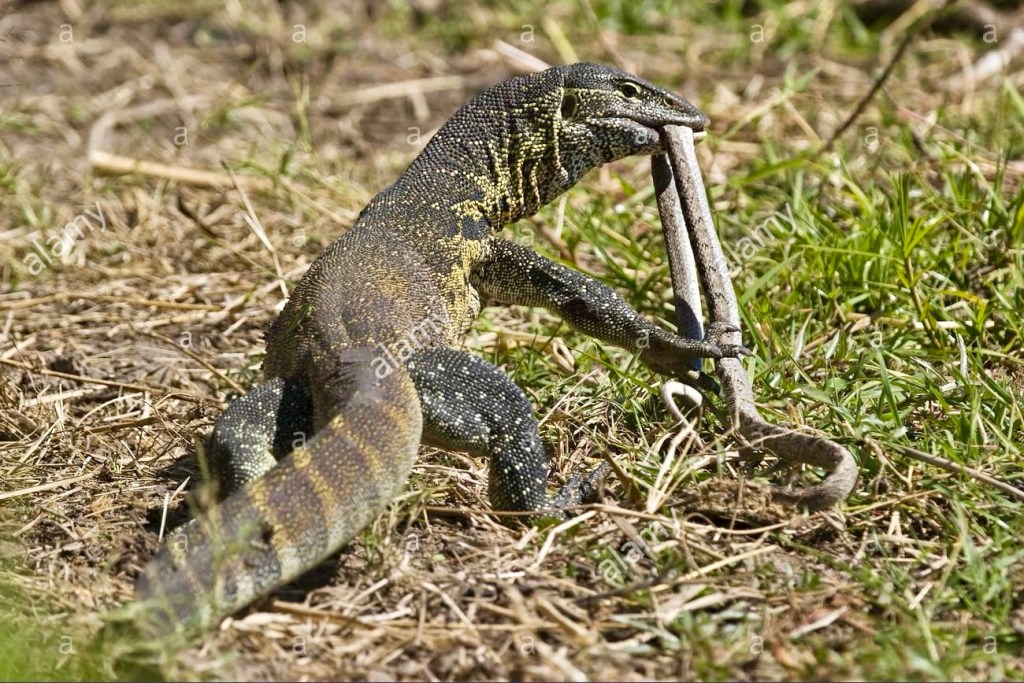
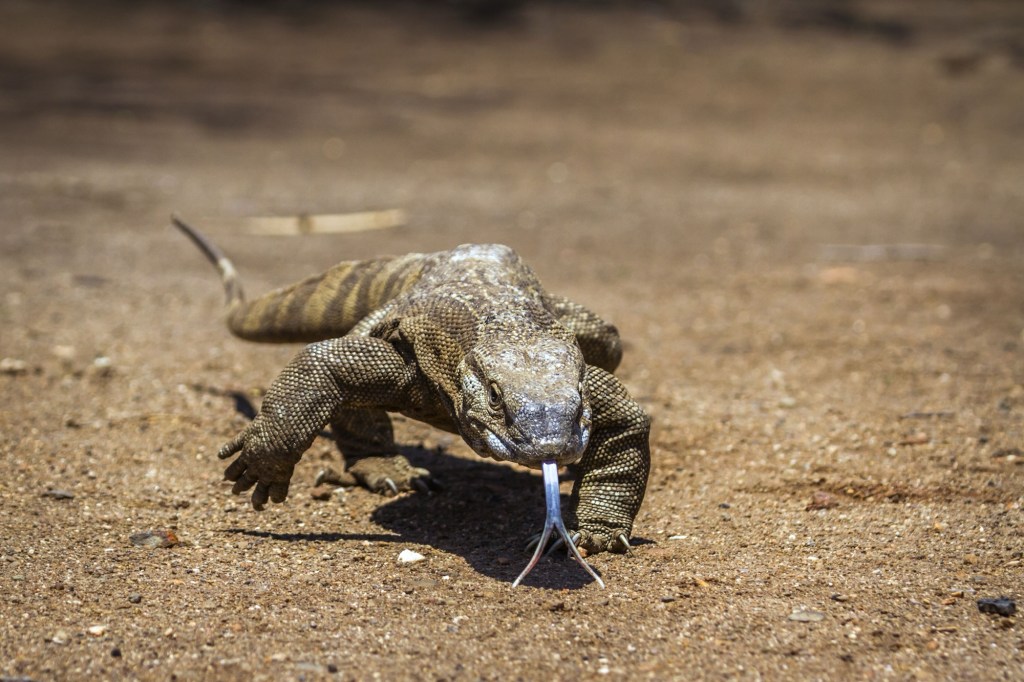
Now that we’ve got it straight which rod became what, let’s see how how both are used in the first plague.
Moses’ rod is also called “the rod of God” in Ex. 4:20. Keep that in mind.
God to Moses: “Go to Pharaoh in the morning. Look, he is going out to the water, and you must wait to meet him on the bank of the Nile, and you must take in your hand the staff that was changed into a snake (nachash).”
God to Pharaoh: “Thus says Yahweh, “By this you will know that I am Yahweh. Look, I am about to strike with the staff that is in my hand the water that is in the Nile, and it will be changed to blood.”
God to Moses: “Say to Aaron, ‘Take your staff and stretch your hand out over the waters of Egypt and over their rivers, over their canals, and over their pools and over all of their reservoirs of water, so that they become blood,’ and blood will be in all the land of Egypt and in vessels of wood and of stone.” Exodus 7:15, 17, 19 LEB
Moses takes his staff- and just… carries it. Aaron raises his staff. But God said that He would strike the waters with the staff in His own hand and turn them into blood.
There are a bunch of Hebrew words translated as rod, staff, stick, branch. But here in Exodus 7 (and the preceding chapters) the word matteh is consistently used.
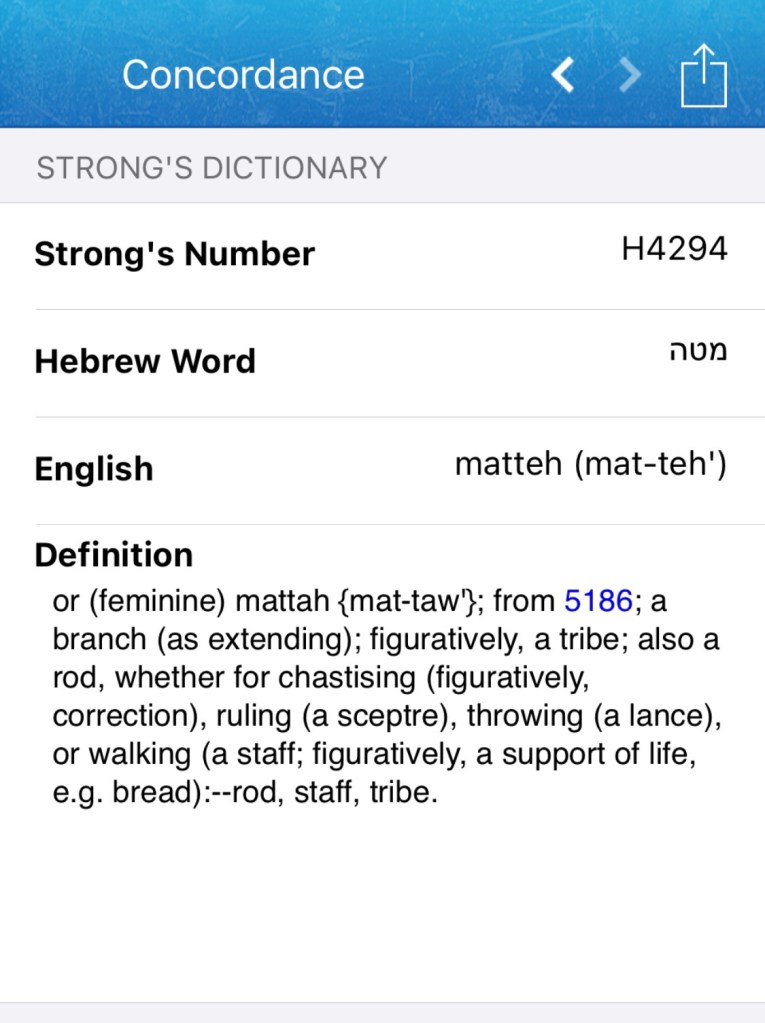
In Hebrew, Matteh is Mem, Tet, Hey
Mem – waters, lift up, many/much, people
Tet – pictograph of a container, means contain(er), store, keep, cover, gather, surround. [basically ancient Tupperware.]
Hey – look! Behold! Life, man/person
Put it together: waters – contain – life
What does the branch of a tree do? Does it not lift up and contain the water-life of the tree?
And what is a tribe if not many people who contain the life of a man; their ancestor?
A scepter is lifted up and people gather around to behold the man who wields it.
“The LORD says to my Lord: “Sit at my right hand, until I make your enemies your footstool.” The LORD sends forth from Zion your mighty scepter (matteh). Rule in the midst of your enemies!”
Psalm 110:1-2 ESV
This is the passage that Jesus quotes to the scribes to shut them down, (Matt. 22:41-46, Lk. 20:41-44). He asks them, “How is this David’s son if David is calling Him Lord?”
Psalm 2 describes the LORD’s Anointed (YHWH’s Son) as having a rod of iron. Matteh is not used. It’s another word: shebet. All the other OT prophecies I could find on the scepter of Messiah use shebet.
Isaiah uses many branch-y synonyms for Messiah- stem, sprout, shoot, bud. None of them are matteh but they are certainly related ideas.
Here’s where I’m going with this now that your head is full of branchy thoughts…
What if Moses’ matteh (rod) is a picture of THE Branch, the Messiah, the Rod of God? Let’s revisit that story from Exodus 4. There are 5 distinct steps.
1. What’s In Your Hand?
The rod starts out as just a normal stick. No different than others. Moses had picked it up and began using it in his shepherding work. In the tabernacle (which we are coming to very soon), wood represents humanity. Christ lived on earth for years as a normal man. Though He was God incarnate, He appeared no different from others. But then He was taken up (at His baptism) and began to shepherd God’s people. And this He did for a time.
2. Throw It Down
God asks that the rod be thrown down on the ground. Humbled. Violently. This is the suffering and cross of Christ.
3. It Becomes a Snake
The rod becomes a nachash. The very symbol of evil. One day Moses will raise such a symbol on a pole and Jesus will later claim that it represented Him- being lifted up on the cross.
“He made the one who did not know sin to be sin on our behalf, in order that we could become the righteousness of God in him.”
2 Corinthians 5:21 LEB
Christ didn’t just carry sin, He became sin as the sin offering.
4. Moses Flees
Moses ran and hid from the snake.
“He was despised and rejected by men, a man of sorrows and acquainted with grief; and as one from whom men hide their faces he was despised, and we esteemed him not.”
Isaiah 53:3 ESV
“…Then all the disciples left Him and fled.”
Matthew 26:56 NASB2020
5. Catch It By the Tail
The rod-turned-serpent was to be “caught by the tail.” That’s not how you catch a snake unless you plan to get bit. People who catch snakes grab them just behind the head so they can control them. It took obedient faith for Moses to lay hold on the end (tail) of certain death only to find that once he had, he held in his hand not death but a rod again. He who loses his life for Christ’s sake will find it. In obedient faith we lay hold on the end of us- the cross: certain death to the sinful nature. And when we do we find that we have laid hold on none other than the Rod of God Himself. Taking up also hints at the resurrection and ascension of Christ.
And what was the whole purpose of this miraculous sign? Moses had asked YHWH, “What if the people don’t believe You sent me?” God’s answer is the rod-serpent-rod sign. Then He says, “so that they may believe that the Lord, the God of their fathers, the God of Abraham, the God of Isaac, and the God of Jacob, has appeared to you.” Exodus 4:5 NASB2020
John said nearly the same thing when he described the rod becoming a serpent then a rod again in his Gospel:
“but these have been written so that you may believe that Jesus is the Christ, the Son of God; and that by believing you may have life in His name.” John 20:31 NASB2020
I think that perhaps Christ is the real Rod in God’s hand that turns the water into wine blood.
“Then the third angel poured out his bowl into the rivers and the springs of waters; and they became blood. And I heard the angel of the waters saying, “Righteous are You, the One who is and who was, O Holy One, because You judged these things; for they poured out the blood of saints and prophets, and You have given them blood to drink. They deserve it.”
Revelation 16:4-6 NASB2020
Oh! And one more thing… Pharaoh’s magicians turned their rods into tannin (dragons) as well with their secret arts. On the surface, they looked like Aaron & Moses; God’s Priest and Prophet, but they got their power from a different place. Made me think of this:
“Then I saw another beast coming up out of the earth; and he had two horns like a lamb, and he spoke as a dragon. He performs great signs, so that he even makes fire come down out of the sky to the earth in the presence of people. And he deceives those who live on the earth because of the signs which it was given him to perform…”
Revelation 13:11, 13-14 NASB2020
This character is known as “The False Prophet” but perhaps we should also think of him as “The False Priest” or “The AntiPriest” because he “causes” everyone to worship the Beast. That’s what priests do. They facilitate worship.
It’s all here. God has given us the pictures. We know what to look for. Don’t fall for the great signs and the dragons produced by dark secret arts. They will all be consumed in the end.
Hmm. Kinda hate to end abruptly with dead dragons but that’s all I got today.
See ya back here tomorrow for plague #2.
 To The Reader