This chapter covers the altar of incense, the census tax (try to remember that one! It’s important later- much later), the anointing oil, and the incense. I’m gonna talk about the incense.
Scent allergies are growing problem for many people. Not sure how well those folks would’ve handled the tabernacle. It was a very scenty place. Animals. Blood. Smoke. Sizzling fat. Burnt liver. Boiling pots of meat. Toasty bread. Burning oil. And incense.
Exodus 30 opens with a description of another altar. This one is much smaller than the one outside. This one is inside. (A fire inside a tent? OSHA would’ve shut down the tabernacle for sure) Every morning and evening Aaron alone will burn incense on it.
The burning of incense coincided with the offering of sacrifice, tending the lamps in the Holy Place, and offering prayer. This was true even in the 2nd Temple period when Zachariah was ministering:
“according to the custom of the priesthood, he was chosen by lot to enter the temple of the Lord and burn incense. And the whole multitude of the people were praying outside at the hour of incense. And there appeared to him an angel of the Lord standing on the right side of the altar of incense.” Luke 1:9-11 ESV
David prayed, “Accept my prayer as incense offered to you, and my upraised hands as an evening offering.” Psalms 141:2 NLT
Most Christians don’t burn incense because it feels kinda froo-froo, or pagan and New Agey. But Hindus didn’t invent the burning of incense during prayer.
According to Revelation 8:3-4, there is incense burned on the original incense altar in heaven. And, somehow, the “prayers of the saints” are an ingredient mixed into this incense which burns on the altar.
The Greek word for “prayers” is proseuche (pros-yoo-kay). This is a compound word. It’s the preposition pros (toward) plus euche (yoo-kay) which is short for euchomai (yoo-khom-ahee) which means “to wish.”
Christians are to direct their wishes toward our Heavenly Father. I hate to break it to you but when Disney tells you, “When you wish upon a star…” that’s shorthand for praying to the host of heaven. 🤔😧😳
I find it quite touching that my wishes (requests, prayers) are a scent. The Father not only hears our prayers, He smells them too.
I wonder if this is literal. Or is it maybe figurative- like when we say, “Something smells fishy about that.”
I wonder if the selfish prayers we sometimes pray are unpleasant smells.
🤔
Y’all, I am totally going to be that annoying kid on the class field trip in heaven.
Angel: Does anyone have any questions? 😇
Heavenly orientation tour group: 😶…
Lacy: 🤚🏻 Excuse me, Mr. Angel. Does the Incense Angel weed out the stinky prayers? What’s the incense made of? Does it smell like the one from Moses’ Tabernacle? Who makes it? Are there perfumer angels? Can we go see the workshop? Can we help make some? Can I take some home as a souvenir? Is there a gift shop at the end of the tour?
☁️☁️☁️☁️☁️☁️☁️☁️☁️☁️☁️☁️☁️☁️
“The Lord said to Moses, “Take sweet spices, stacte, and onycha, and galbanum, sweet spices with pure frankincense (of each shall there be an equal part), and make an incense blended as by the perfumer, seasoned with salt, pure and holy.”
Exodus 30:34-35 ESV
“Sweet spices” may function as a collective term for the 4 specific ingredients that follow: stacte, onycha, galbanum, and frankincense.
The ingredient called onycha, has been much debated. (The link will take you to a sciencey article on what it might be). The best guess is that it is a part of a mollusk shell, made from secretions of the mollusk- similar to an oyster making a pearl. If it is, this is the one ingredient that isn’t a plant resin.
Resin and gum are different. Resin oozes from cuts in tree bark. It hardens and is low in essential oils. Amber is a resin. Gum seeps from broken stems, is softer and has a higher oil content. And there are gum-resins that are apparently a little in between. Frankincense and myrrh are gum-resins. I once chewed some raw frankincense for the entertainment and edification of my friend Erin’s kids. (Thank you, Erin, for that educational experience. 😝)
I found out today what stacte was. It goes by a different name now. It’s called balsam of myrrh. It’s a plant gum that is diluted into an inky brown liquid and is great for scapes and insect bites (and probably much more). I got a couple mystery bug bites or stings on my hand last fall while “exploring” with my nephews. My skin reacted quickly. I had two itchy red bumps- the kind that look like they’re going to be around for a day or two. I told my mom about them while washing my hands not long after. She pulls out a big bottle of balsam of myrrh and I dabbed some of the brown liquid on the bites then headed home. Almost instantly the itching stopped. By the time I got home (about 30min) I couldn’t even find where the bites had been. 😳🤯 That’s liquified stacte. Y’all gotta get cha some!
Wikipedia says that gulbanum is a gum resin of a plant native to Persia. I don’t have a story about that one. Never been to Persia. 😏
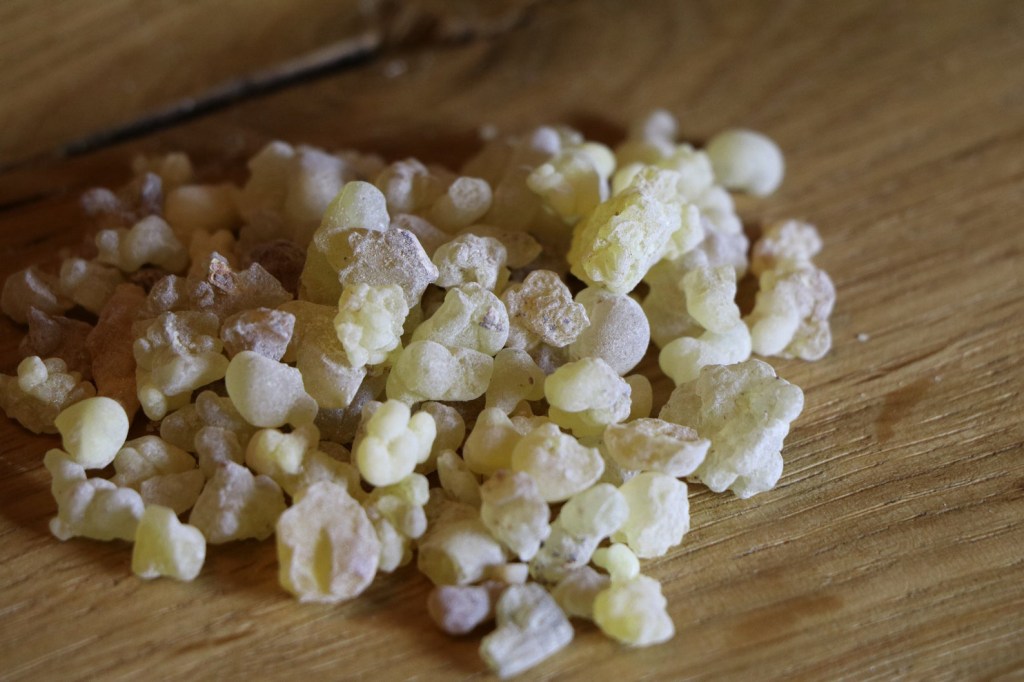
I once burned some frankincense for a Christmas program. I wanted the scene of Simeon and Anna in the temple with baby Jesus to be immersive. It was immersive alright. Some people found the scent very irritating. I thought it smelled rather antiseptic- like an ancient Mr. Clean.
Did you know that the little pebbles of frankincense – and indeed all resins and gums – are called “tears?” It’s like the tree or plant is wounded and crying and their tears become memorial stones.
Even the onycha – the secretion of a mollusk – could be thought of as its tears.
To make incense you start with tears.
Do your prayers move your soul to the point of tears? Whether they are repentant tears of sorrow over sin, tears of travail in prayers of intercession, or tears of joy and relief when the victory is won- the sweet incense of prayer is made from your tears.
And the resin tears are to be “beaten small.” It’s a phrase that means worn down- like how a stream or the surf wears down rocks and makes them smooth. Like erosion turning rocks into grains of sand, and sand into dust.
The Lord will allow hardship and heartbreak and trials of faith to wear down and smooth away our sharp edges. It makes us small. Humble.
I could also see this as a picture of becoming “smoother” in prayer. Many Christians are embarrassed to pray out loud; especially in public. I don’t mean bowing your head over a sandwich and waffle fries at Chick-fil-A. I mean to lay hands on a sick person in a hospital room or at church. Or to confront a problem in your prayer closet with power and authority. Or to lead a gathering in a prayer. Or to pray with a friend or your spouse. How fluent are you in prayer? You won’t get any better by being silent. People who learn languages practice speaking in that language. You can’t just read books about it. You have to do it. Pray a lot. Out loud. You got a solitary 2-hour drive somewhere? Pray out loud the whole way. Practice verbalizing your petitions. Use the Lord’s Prayer. Memorize scripture and pray it. Be as specific in your requests as you can. Offering incense is one of the priest’s main jobs. Yes, God knows your heart. And yes- sometimes all we know how to pray is “Lord, help.” But if you hem and haw and stammer in prayer and stare at your shoes when someone asks, “who wants to pray?”- I’m telling you in love: you need to work on it. Just start where you are. If you’re clumsy at anything- sports, dancing, flipping pancakes, wielding a chainsaw… you only improve by working at it.

Finally, the incense is seasoned with salt.
“Let your speech always be gracious, seasoned with salt, so that you may know how you ought to answer each person.”
Colossians 4:6 ESV
Our prayers should be gracious. The Strong’s Concordance includes this in the entry for charis (grace): “the divine influence upon the heart, and its reflection in the life.” Divinely-influenced and grace-filled. That’s the kind of prayer life I want. Seasoned with salt.
And that’s interesting because salt does not burn. In fact, it can be used to suppress fire. (Just as my mom. 😉) Perhaps the salt regulated the heat and kept the embers from flaming up so the incense would smoke as desired rather than be quickly incinerated. Maybe it suggests a steady-heat prayer life rather than extreme swings from cold ashes to blazing inferno.
I dunno. Something to ponder. 🤔
If you feel that you are between a rock and a hard place, it may help to consider that you are not being pounded for no reason. Might it be a mortar and pestle at work in your life in the process of making incense? I think the answer depends a lot on our response.
Maybe that’s why incense represents the prayers of God’s people. The tears and the smoothing down and the humbling process shapes what you ask for and how you ask it. Next time you find yourself weeping in prayer, take comfort in knowing that you’re just making more incense.
With these final instructions Moses has the plans to make everything needed for the tabernacle. Now he just needs to build all of it. He’s gonna need some very skilled workers. We’ll meet them in the next post.
 To The Reader