Hmm. Make Leviticus interesting…
(Cracks neck. Cracks knuckles.)
Challenge accepted. 🤨
Maybe it would help if we take most of what we think we know about Old Testament offerings and box them up for temporary storage.
It’s easy to get a Sunday School coloring page idea of robed people bringing sheep. And then think that’s all there was to it. It wasn’t. There were sheep. But there were also cattle, goats, doves & pigeons, grain, olive oil, frankincense, and salt. Aside from the frankincense, it kinda reads like a grocery list for a big ol Israeli BBQ.
Chapter 1 covered the “whole burnt offering.” It was called that because it was the only offering where the whole thing was burnt up. For all the other ones, a designated portion would go on the brazen altar and the rest would go to either the priest’s family and/or back to the one who brought it to be eaten like a picnic near the tabernacle.
But I’m getting a bit ahead of myself.
Let’s talk about the Grain Offering.
Let me clear something up immediately for my KJV readers. The KJV calls this a “Meat Offering,” then goes on to describe flour and cakes. No meat. That’s because in 1611, the English word “meat” was not limited to animal products. It just meant “food.” Like this:
“And it came to pass, as Jesus sat at meat in the house, behold, many publicans and sinners came and sat down with him and his disciples.” Matthew 9:10 KJV
This is Old English for eating food. A meal.
The Hebrew word for “Meat Offering” is:
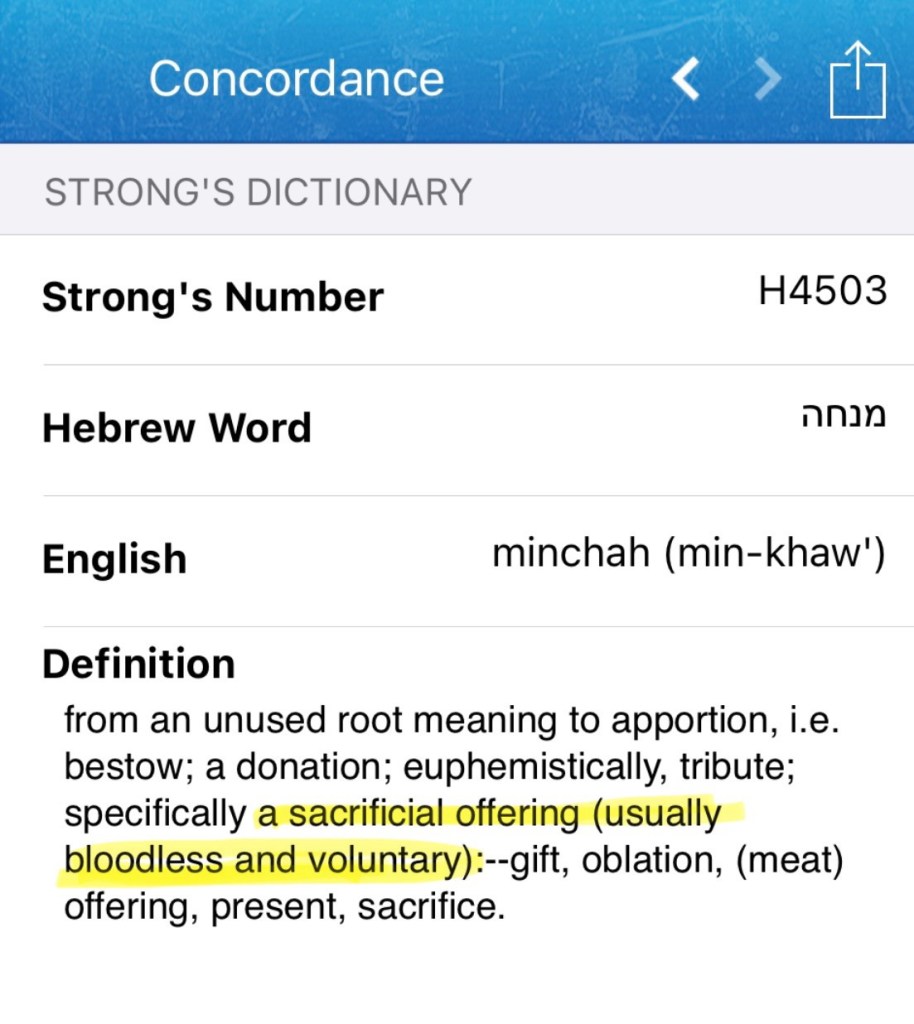
The “Meat Offering” is really a “Food Offering”, or a “Grain Offering.”
It’s easy to get the idea from the Cain & Abel narrative that God only accepts meat 🥩 offerings forever. Not so. The instructions here are broad enough to include any kind of ancient grain.
The Israelites could bring flour as an offering. Just plain flour. With a bit of oil, salt and frankincense sprinkled on. Or the first ripe heads of grain- roasted and also with oil, frankincense, and salt. The priest burned a handful as a “memorial portion” then the rest went to the priest’s family. That was part of their income. They were paid in food.
Most of us buy fluffy white flour in 4lb bags in the grocery store. Or 10lbs if you like to bake. That’s not what this is. First off, ancient flour was made from ancient grains (which have become popular again). It would’ve been stone ground, and certainly not bleached white. Look for some stone-ground einkorn or emmer or spelt for a biblical baking experience.
A group of nomadic shepherds being led by a cloud through a barren desert are probably not growing fields of grain themselves. I suspect they had to trade with other people groups for it before settling in Canaan.
No matter what cooking method is chosen- baked in an oven (pita), cooked on a “flat baking pan” (crackers broken up), or a “cooking pan” (tortilla?) the breads will be drizzled with olive oil and salt.
🤤 that sounds SO good right now…
Here’s a recipe if you want to try it out.
All the bread, and even the plain uncooked flour, is drizzled with olive oil. It is anointed. Set apart. Holy. Basically how we think of Communion bread. It’s special.
“Every grain offering you bring to Yahweh must not be made of yeasted food, because you must not turn into smoke any yeast or any honey from an offering made by fire for Yahweh. As an offering of the choicest portion, you may bring them to Yahweh, but they must not be offered on the altar as an appeasing fragrance.”
Leviticus 2:11-12 LEB
No yeast in the bread that goes on the altar. It’s unleavened. That one’s easy. It reminds them of the night they left Egypt with no time for bread to rise. In the NT, Jesus uses leaven as a metaphor for the pride and hypocrisy of the Pharisees.
And you can’t be a living sacrifice if you are puffed up with pride and hypocrisy.
Why no honey? 🐝 🍯 🤔
Seems an odd prohibition for a people headed to a land “flowing with milk and honey.”
There is speculation that neighboring pagan tribes offered honey in their idolatrous worship and Yahweh wants them to avoid the ways of the heathen. But if that’s so, why were they allowed to bring honey as an offering at all? It was ok to bring. They just couldn’t burn it on the altar.
Maybe the Lord was concerned about botulism. Heating honey above 40 degrees Celsius/104 degrees Fahrenheit, can cause Clostridium botulinum spores to activate and multiply increasing the risk of toxin production. (Thanks, Internet.) Botulism risk is why we don’t give honey to infants. Their delicate digestive systems are more susceptible to this toxin.
Seems reasonable.
But maybe it’s also a hint that if I want to be a living sacrifice, I need to avoid the pursuit of sensual pleasures. Honey is good. But it’s basically candy.
Solomon had some thoughts on honey.
“My child, eat honey, for it is good, and the dripping of the honeycomb is sweet to your taste.” Proverbs 24:13 LEB
“If you find honey, eat what is sufficient for you, lest you have your fill of it and vomit it out.” Proverbs 25:16 LEB
A little honey goes a long way. Likewise, pleasure and “the sweet life” are meant to be consumed in moderation. A life given to the pursuit of ease and pleasure is not a pleasing aroma. Honey (pleasure) isn’t necessarily a sin, but it makes a poor sacrifice.
Grocery List So Far: 📋
Flour, Frankincense, Olive Oil, Pitas, Crackers, Tortillas, Honey, and…Salt
“Also all of your grain offerings you must season with salt; you must not omit the salt of your God’s covenant from your offering.” Leviticus 2:13 LEB
Did you ever see at a wedding where the bride and groom pour sand into a jar? (It was a thing for a while.) I think it was meant to take the place of the “unity candle.” Whenever I saw it, I’d silently wonder if they knew about salt covenants. (I silently wonder about a LOT of things.) 😏
There’s an ancient way of making an unbreakable agreement. Let’s say two men- leaders of their respective tribes- agree to have peace between their tribes. They could spit-shake and pinky-swear. Or they could exchange salt in a salt covenant.
Salt has been used as currency. Roman soldiers were sometimes paid in salt. It’s where the word salary comes from. Salt has always been valued. Sometimes people even carried it in a little pouch on the belt like money.
If you take some of your salt from your bag and I take some from mine, and we exchange… your grains get mixed in with mine and mine with yours… We may break our covenant when you retrieve every last grain of my salt and give it back. And I do the same. That is a salt covenant.
God says He has a salt covenant with His people. Speaking to the Levites He says:
“All the contributions of holiness that the Israelites offer to Yahweh I have given to you and your sons and your daughters with you as an eternal decree; it is an eternal covenant of salt before Yahweh to you and your offspring with you.”
Numbers 18:19 LEB
These 2 verses in Leviticus and Numbers are the only mention of it in scripture.
God put salt in humanity’s “bag.” He put it on earth. And His people put salt in His “bag” when offering their sacrifices. God will break His covenant with His people when both parties retrieve Every. Last. Grain.
Chapter 3 – The Peace Offering
Fat. Liver. Kidneys.
(So… God likes liverwurst?) 🤔
The Peace or Fellowship Offering was offered free-will out of gratitude. It could be a cow, goat, or sheep but whatever it was, the blood was sprinkled and then the fat, liver, and kidneys were removed and burned on the altar. The rest of the meat (as far as I can tell from other passages) was cooked and eaten. The shoulder went to the priest. But if the offerer was ceremonially clean, he (and presumably his also ceremonially clean family) could eat it too.
🐂🐏🐐🌾🫓🧂Offering Review:
- Whole Burnt Offering
- The name says it all.
- Nobody eats it. All burned up.
- Free-will, voluntarily given
- Grain Offering
- Various kinds of Unleavened Bread with olive oil and salt
- Or plain flour or roasted/crushed grain with olive oil, frankincense and salt
- A portion gets burned on the altar and the rest goes to the priest.
- Totally voluntary.
- Peace Offering
- Beef, Mutton, or Chevron (goat)
- Fat, liver, and kidneys are burned on the altar.
- Priest gets a portion of meat. The offerer may also share a portion if he is clean.
- Voluntary.
Next we get to the one everybody thinks about when we talk about sacrifices: The Sin Offering.
It’s kinda technical. Because in order to know if a person needed to bring a sin offering, we first have to be super clear on what sin is and what it isn’t and if it was unintentional.
 To The Reader