Most of us are familiar with the story of the Bible’s most famous Nazarite – Samson. And because of his story, we might think that a Nazarite vow was a permanent thing. It wasn’t.
A quick bit of semantic housekeeping to get out of the way: Nazarite and Nazareth/Nazarene are completely unrelated. They’re as related as pyre and pyrite. A pyre is a funeral fire to burn the body of the dead. Pyrite is fools gold. And a pirate is thief who operates on the ocean. Just because words sound similar does not mean they’re related. They might be. Or might not.
Always do your homework. There’s an internet conspiracy going around that the name of Jesus was borrowed from Zeus because they sound kinda similar in English.
🙄
People who post that kind of nonsense are putting their ignorance on a billboard for all to see. Be careful out there. The internet is the Wild West of ideas – especially when it comes to anything about God and faith. Just like the Wild West there are charlatans and snake oil salesmen and well-intentioned but completely untrained folks who just stick out a shingle and suddenly they’re an expert. (Would you trust a Wild West “dentist”?)🤠
It’s why I will not pretend I’m an expert. Cuz I’m not. I’m what ya call “expert-adjacent.” This is a blog – not a dissertation.
(Whew. Sorry. Just had to get that off my chest. Back to Nazarite vows.) 😅
If a man (or woman!) felt the need to separate themselves to Yahweh for a set period of time, they could take the vow of a Nazarite. It’s unclear from the text how long the vow would last so it was probably left up to the one making the vow.
A good comparison for us might be Lent. Lent is a period of fasting and prayer observed by many Christians for 40 days leading up to the celebration of the Resurrection. While not mentioned in scripture, it can nonetheless be a good period of spiritual growth and discipline.
Lent is supposed to be a time of separation. I think for many, it has become something closer to a spring diet or tech-detox. Those are both beneficial, but skipping beef on a few Fridays or giving up chocolate, sodas, and social media for a little over a month is hardly a real sacrifice. It only feels like a sacrifice because so many of us have become addicts – and Lent feels like going to rehab.
Now I’m meddling. Back to Nazarite vows…
Taking a Nazarite vow had 3 characteristics. These 3 things were observed for the duration of the vow:
- No wine or strong drink. 🍷🍺🍇
- This includes any part of a grape, juice, wine, vinegar, and raisins. It probably included any type of fermented or distilled beverage.
- No contact with the dead. ☠️⚰️
- No cutting your hair. 💈✂️
Kinda weird. What on earth do these 3 have in common? Anything? I can get the first 2 if you’re being specially consecrated to Yahweh, but…
“What’s hair got to do, got to do with it?”🎶
One interesting connection is that the word Nazarite also means “unpruned vine.” The word is used here in Leviticus in that section we read not long ago about the 7th Sabbath year of rest for the land:
“For six years you shall sow your field, and for six years you shall prune your vineyard and gather in its fruits, but in the seventh year there shall be a Sabbath of solemn rest for the land, a Sabbath to the Lord. You shall not sow your field or prune your vineyard. You shall not reap what grows of itself in your harvest, or gather the grapes of your undressed vine. It shall be a year of solemn rest for the land.” Leviticus 25:3-5 ESV
A man who does not cut his hair is like a vineyard that isn’t pruned. And in the 7th year you don’t harvest (or presumably eat) any products of the vine. That just leaves the dead body element. And the data point that my brain connects to is this:
“I am the true vine, and my Father is the vinedresser. Every branch in me that does not bear fruit he takes away, and every branch that does bear fruit he prunes, that it may bear more fruit.”
“If anyone does not abide in me he is thrown away like a branch and withers; and the branches are gathered, thrown into the fire, and burned.”
John 15:1-2, 6 ESV
The flavor I’m getting from the Nazarite vow is one of rest. Like taking vacation time and going off to a monastery and taking a vow of silence for a period of time. The vineyard is left untouched for a season.
I don’t know much about vineyards but it seems like a step of faith to just leave it untended.
Eventually the dead branches will be touched, the hair and vines will be cut. But for a time, it’s allowed to rest.
(If that doesn’t make a lick of sense, don’t worry about it. I’m just processing out loud.)
I’ve wandered again. Back to Nazarite vows:
Samson violated all 3. In Judges 14 we see him scraping honey out of the carcass of a lion (killed in a vineyard no less), then holding a “feast” at his wedding. The Hebrew word is mishteh and means a drinking party. And we all know the part about Delilah and the haircut…
“And he told her all his heart, and said to her, “A razor has never come upon my head, for I have been a Nazirite to God from my mother’s womb. If my head is shaved, then my strength will leave me, and I shall become weak and be like any other man.”
“She made him sleep on her knees. And she called a man and had him shave off the seven locks of his head. Then she began to torment him, and his strength left him.”
Judges 16:17, 19 ESV
The detail about the 7 locks is interesting. They may have been something like dreadlocks or seven special “ringlets” of twisted hair. Sometimes the number 7 is used to imply an indefinite number or a multiple of 7 so he may not have had exactly 7 dreadlocks or something.
Less known is the couple instances of Nazarite vows in Acts:
“Paul stayed in Corinth for some time after that, then said good-bye to the brothers and sisters and went to nearby Cenchrea. There he shaved his head according to Jewish custom, marking the end of a vow. Then he set sail for Syria, taking Priscilla and Aquila with him.”
Acts of the Apostles 18:18 NLT
Then when Paul checked in with the Apostles in Jerusalem after one of his trips, they said,
“Here’s what we want you to do. We have four men here who have completed their vow. Go with them to the Temple and join them in the purification ceremony, paying for them to have their heads ritually shaved. Then everyone will know that the rumors are all false and that you yourself observe the Jewish laws.”
Acts of the Apostles 21:23-24 NLT
I think little details like this are why people say things like: “The Bible is hard to understand.”
I wanna say back: “Well, so is any book if you pick it up and just flip open to random spots and read bits of it but you’ve never read the whole thing through more than once.”
Imagine picking up Anne of Green Gables or a good ol’ Hardy Boys mystery as a kid and instead of starting at the beginning and reading it through like a rational person, you just flip pages and read a sentence here and a paragraph there. And then you have the nerve to complain, “This book is so hard to understand.”

That’s why YOU are NOT going to quit. You made it through Job and Leviticus! Look at you go! You are going to conquer Numbers and read the whole Bible through from cover to cover. No skipping genealogies or the tedious bits. And when we get to Judges and Acts, you’ll go – “Oh yeah – I remember reading about that weird Nazarite hair thing back in Numbers.”
Now every time you run into passages involving long hair or head-shaving in the Bible – like Samson or Absolom or Paul’s 1st letter to the Corinthians (ch. 11) – hopefully Numbers 6 will be included in your matrix of ideas.
Every time you run across passages that highlight touching or not touching a dead body or not drinking wine, hopefully there will be a little mental tripwire that will ring a bell in Numbers 6. Say, something like this:
“I tell you I will not drink again of this fruit of the vine until that day when I drink it new with you in my Father’s kingdom.”
Matthew 26:29 ESV
I’m not saying that Jesus is taking a Nazarite vow here, but it IS interesting that he will also not have contact with dead bodies. And, unless there’s a barber shop in heaven, maybe he’s not getting his hair cut? I dunno. I’m just saying there may be a connection. I mean – Jesus IS separated to God in the most unique way possible.
Moving on…
I promised a visit from Leonard Nimoy. And here he is to help us with what is called “The Arronic Blessing” or the “Priestly Blessing.”

Did you notice the last verse of chapter 6? After giving Moses the words of the priestly blessing, the Lord says, “So shall they put my name upon the people of Israel, and I will bless them.” Numbers 6:27 ESV
One of God’s names is Shaddai. The first letter is shin (sounds like sheen). It’s kind of like God’s initial.
It’s technically 2 letters: sin (seen) and shin (sheen) depending on where a dot is placed. The dot goes above the branch on the right for the SH sound and over the left branch for the S sound.

Shin is also imprinted topographically upon Jerusalem. God does say that He will “cause His name, (His presence), to dwell there.”
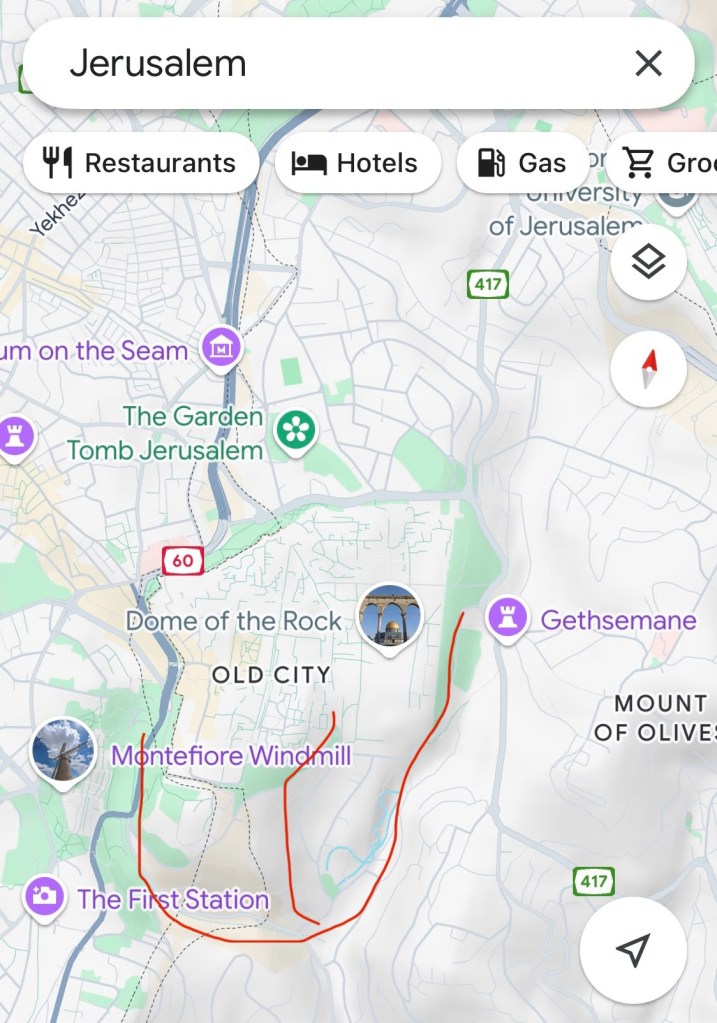
Now that we recognize the letter shin, we can move on.
Leonard Nimoy grew up in a Jewish family. In this clip, he tells the story of having this blessing said over the congregation at synagogue. It’s only about 5min but very powerful and you’ll find out where the Vulcan greeting came from.
Oh – and this is TOTAL conjecture but I wonder if on the Day of Pentecost, the “tongues of fire” looked something like this:

Shin is the paleo pictograph for teeth and means “consume,” “…for our God is a consuming fire.” Hebrews 12:29 ESV
As we go into this Resurrection weekend, I’ll leave you with Paul’s encouragement to “Be filled with the Spirit” and the condensed version of Aaron’s blessing:
“Live long and prosper.” 🖖🏼
 To The Reader