The original “peculiar people.”


(This is a rather densely packed section. Get comfortable. This may take a while. No seriously. Get a comfy chair, a blankie, and something to drink. It might be my longest post yet. And we’re only going to cover chapter 14.)
To understand this section, the opening line is key: “You are children of Yahweh your God; therefore…”
Deuteronomy 14:1 LEB
Bible study tip: When you see the word “therefore,” you need to stop and ask what it’s there for.
Moses is about to go over rules concerning…
- Death ⚰️🪦
- Food 🍔🍟
- Tithing 🍇💰
What’s the “therefore” there for?
It’s there to show the reason for these commands. The reason is because they are “children of Yahweh” and He is their God. They do not belong to the gods of the nations. So they are going to be different than the other nations.
Two inescapable human experiences for which societies have developed cultural practices are: death and eating. Everybody’s gotta eat and everybody’s gonna die.
Why should Israel’s response to death be different than other nations?
Might it be because the God of Israel (alone) is the Living God and the Author of Life?
And the Author of Life, the Engineer of the human body, doesn’t want His people marring their flesh. It could be that the cutting and pulling out of hair to make bald patches were violent signs of mourning or perhaps attempts to appease the god of the underworld in some way. Either way, the LORD won’t have His people participating in behaviors that harm the body.
They are also not to grieve like the other nations, just as the Church is not to grieve in the same way as nonbelievers.
“But we do not want you to be uninformed, brothers and sisters, about those who are asleep, so that you will not grieve as indeed the rest of mankind do, who have no hope.” 1 Thessalonians 4:13 NASB2020
Death is a huge deal to those whose gods can give them no hope. It is THE worst thing that can happen, therefore extreme and violent forms of grief kinda make sense.
But if your God has stated that He will crush the head of the Serpent Death-bringer, then death isn’t the worst possible thing that can happen to your loved one. That’s why you don’t grieve like other people. 🥲
Eating is one of the most fundamental activities of human beings. If we don’t do it, we die.
I’m not a dietician or a doctor. I’m a student of scripture. And one thing I know about interpreting scripture from a Christian perspective is that you gotta read the whole book and let it explain itself.
Scripture is its own best Expositor.
(You should probably put that on a sticky note in your Bible.)
This is especially true when reading the Old Testament and trying to figure out “Does this apply to me?” The shocking answer given to Gentiles in the New Testament is, “Actually, no. Most of this doesn’t apply to you.”
(That doesn’t mean we can just skip the OT. Far from it. We learn a lot about God’s heart from the OT. And the OT informs us that the incarnation of the eternal Word was not a new idea but rather a long-standing promise.)
Back to food… 🍗🍗
The Jewish dietary laws were ultimately for the purpose of making Israel distinct from the nations.
I know that many people attempt to make the case that kosher eating is healthier or cleaner. Like I said, I’m not a nutritionist, and I haven’t read any studies comparing kosher with nonkosher diets. So maybe it is. But… if it is the superior diet or if only those foods are the ones God wants all humans to eat, why does He say this?
“You shall not eat anything which dies of itself. You may give it to the stranger who is in your town, so that he may eat it, or you may sell it to a stranger; for you are a holy people to the Lord your God. You shall not boil a young goat in its mother’s milk.”
Deuteronomy 14:21 NASB2020
So it’s ok for a Gentile to eat it? If it was so toxic, why doesn’t God tell everyone to avoid nonkosher food? Why are Jews allowed to profit from selling toxic food? Is that what a holy, impartial, and loving God does? If not, what might the real reason be for dietary distinctions?
The command about not boiling a young goat in its mother’s milk is where the kosher practice of avoiding all contact between meat and dairy comes from. In a kosher kitchen, there are separate vessels and utensils for meats and dairy. They are never to mix. This goes far beyond God’s command.
One commentary suggested that this command may be aimed at decadence in eating.
Ya know how Cleopatra was said to bathe in milk? That’s an extreme example of living in the lap of luxury. 🥛
In case you’ve never raised goats or haven’t been around a farm enough to know how things work- after a female goat (a “doe”) gives birth, her milk comes in. Unless she gives birth to twins, she may have more milk than the new kid needs. The farmer can milk the doe and enjoy the extra milk. When the kid is old enough to begin eating greens, it is weaned but the farmer continues milking the doe. The family can benefit from the milk and other dairy products. 🐐
If you were to decide to harvest that young goat and eat it, cooking the meat 🥩 in a big ol’ vat of milk would be flaunting wealth in a wasteful way- like the 1920’s tycoons who could burn a $100 bill 💸 to light a $1000 cigar. Or Cleopatra bathing in milk. It’s decadence at the level of waste and indecency. How many hungry (human) kids could you feed with all that milk? 🥛
Maybe it has way more to do with that than mixing protein types. In other words, this command is about your heart, not your stomach.
If you’re still not sure, consider the interpretation of the dietary laws by the Lawgiver Himself:
“And he called the people to him again and said to them, “Hear me, all of you, and understand: There is nothing outside a person that by going into him can defile him, but the things that come out of a person are what defile him.” And when he had entered the house and left the people, his disciples asked him about the parable. And he said to them, “Then are you also without understanding? Do you not see that whatever goes into a person from outside cannot defile him, since it enters not his heart but his stomach, and is expelled?” (Thus he declared all foods clean.)”
Mark 7:14-15, 17-19 ESV (emphasis mine)
Let me revisit and unpack my earlier statement about certain OT commands not applying to NT saints…
We need to remember that of all the Laws we’ve been reading in the Torah, there are two types: Moral and Ceremonial.
The Ten Commandments are moral. The laws about marriage and how to treat the poor and foreigners – moral.
The laws about being “unclean until the evening” are ceremonial. The rules on how to be cleansed, approved foods, and the giving of tithes and offerings and celebrating the appointed times – ceremonial.
The moral laws are restated in the New Testament – sometimes with an upgrade like: “Do not commit adultery” becomes “He who looks on a woman with lust in his heart has committed adultery already (Matt. 5:28). Anything re-commanded by Christ and the Apostles in the New Testament is binding upon the Christian.
The ceremonial laws are not restated in the NT. In fact, Gentiles are clearly told that they are not required to observe these laws that were specifically given to Israel alone.
This would be a good spot to pause and go read all of Acts 10 – the conversion of the first Gentile, Cornelius. If you’re short on time, I’ll summarize:
The (Jewish) Apostle Peter has a vision of non-kosher animals let down from heaven in a sheet and he is told to “kill and eat.” Probably thinking it’s a test, he responds “No way.” The vision repeats 3 times. Then some guys invite him to visit (Gentile) Cornelius. Peter shares the good news about Jesus, Cornelius and his whole household believe the Gospel, and receive the Holy Spirit, and are baptized. (Isn’t that order interesting?!)
Christ accepts them. They are all brought into the family of God without renouncing nonkosher food or having the men get circumcised or taking offerings to the Temple.
As the number of Gentile believers began to grow, the question arises: Must they convert to Judaism in order to participate in this New Covenant that had been promised to, and come through Israel? Some Gentile Christians were being told they needed to be circumcised, eat kosher, observe the festivals, and essentially keep the Law of Moses. This was causing a LOT of tension among the Church. The Apostles met and discussed it and the LORD made His will to the Church known through them. (I highly recommend going and reading all of Acts 15.) If you’re in a hurry, here’s the crucial bit. It’s the letter that was sent to all the Gentile Christians:
“This letter is from the apostles and elders, your brothers in Jerusalem. It is written to the Gentile believers in Antioch, Syria, and Cilicia. Greetings! “We understand that some men from here have troubled you and upset you with their teaching, but we did not send them! So we decided, having come to complete agreement, to send you official representatives, along with our beloved Barnabas and Paul, who have risked their lives for the name of our Lord Jesus Christ. We are sending Judas and Silas to confirm what we have decided concerning your question. “For it seemed good to the Holy Spirit and to us to lay no greater burden on you than these few requirements: You must abstain from eating food offered to idols, from consuming blood or the meat of strangled animals, and from sexual immorality. If you do this, you will do well. Farewell.”
Acts of the Apostles 15:23-29 NLT
Three things:
- Don’t eat food offered to idols.
- Why? Because knowingly doing so is a participation in idol worship. Eating together is literally a form of worship. It’s a covenant meal. Remember the whole Ba’al of Peor incident where Israel ate food offered to Ba’al?
- The Ancient Greco-Roman world was FULL of idolatry and it was standard practice to offer animals to the gods then sell their meat at the “farmer’s market.” For St. Paul’s nuanced counsel on this problem, see 1 Corinthians chapter 10.
- Don’t consume blood. Don’t eat meat from strangled animals. These two things are so connected it’s really one, two-part command. Consuming blood has obvious ties to the occult. The original command to not consume blood was given for all humanity at the time of Noah. An animal killed by strangulation does not have the blood drained properly so it’s impossible to eat the meat without also consuming its blood.
- Don’t engage in sexual immorality. The KJV has it as “fornication.” It’s the Greek word pornia from which we get the word pornography. It’s a general term that includes any and all sexual activity outside of God’s intended (and holy) boundary of intimacy between one man and one woman in the context of marriage.
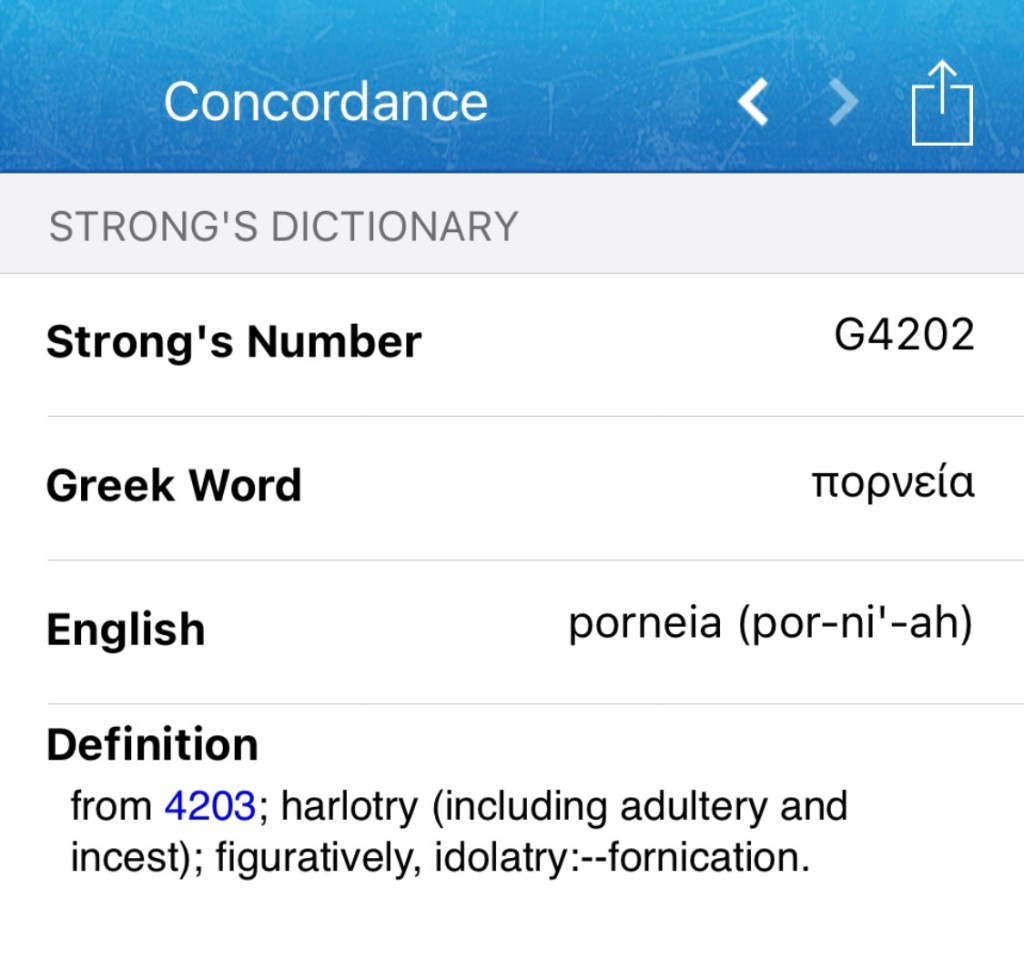
Notice how the Strong’s entry shows that this word is used figuratively for idolatry. Sexual misconduct is a form of worshiping the idol of selfish pleasure. I also suspect that there is something very mysterious and spiritual and powerful about it because sex is so prevalent in both ancient and modern occult practice, rituals, and rites. Of course the holiness of sex is also degraded by carnal materialists who reject any sort of spiritual orientation.
I could keep going from the New Testament about how the Law of Moses has been replaced by the Law of Christ and that Christians are not bound by the Law of Moses. The entire epistles of Galatians and Hebrews are dedicated to addressing this.
But – we need to move on to our last topic from this section in Deuteronomy: tithing.
And I’m about to upset some apple carts. 🍎
Let’s get clear on something out of the gate – nobody today actually tithes according to scripture.
😧 But Lacy! I put my check in the envelope every week! Well – now it’s just drafted from my bank account like my phone bill but still – I give a tenth of what I make to the church! How can you say nobody tithes?!
I said “nobody tithes according to scripture.”
Unless you are hauling a truck full of agricultural products 🚛 to the Temple in Jerusalem once a year and then an extra load of seed every three years – you’re doing it wrong.
🤔 But Lacy, it says that you could turn your tithe into money and bring that.
Ok. Do you take your money to the Temple in Jerusalem?
😐 No. There isn’t a Temple in Jerusalem.
Exactly. That’s why I say we couldn’t tithe biblically if we wanted to.
☝🏼🤓 But isn’t the Church the new Temple. I bring my tithes there.
And when you get to church do you do this?:
“When you arrive, you may use the money to buy any kind of food you want—cattle, sheep, goats, wine, or other alcoholic drink. Then feast there in the presence of the Lord your God and celebrate with your household.” Deuteronomy 14:26 NLT
😲 Wait. That can’t be right. Are you sure that’s right? They could buy a 6-pack of beer and some steaks for the grill and a whole feast for the family with their tithe money?!?
🧔🏻Bubba: Man, that’s what I’m talkin’ about. I’d go to that church! 🍺🥩
That’s what I’m trying to tell you. Nobody tithes biblically. Nobody.
The tithing laws functioned as a kind of taxation system for Israel to support their federal government’s employees. That’s what the priesthood was. The priests and Levites were Congress, the Senate, the Department of Health, the Division of Family Services, the Food and Drug Administration, the Police, the courts, the Bureau of Land Management, the Division of Weights and Measures, The National Archives, just… all the things. And they weren’t allowed to own land. These government workers had to be supported somehow. It is clear from scripture that they were supported by the mandatory 10% “tax” of the nation.
Nowhere in the whole of scripture are Gentiles commanded to tithe.
Go look. I’ll wait.
🕛🕐🕑🕒🕓🕔🥱
That would be like taxing citizens of other countries to support your country’s government. Since the birth of the Church, we do not have this system in place anymore.
😦 But Lacy….
I know all the usual arguments and texts.
Yes, Abraham gave a tithe (1/10th) of the spoils of battle to Melchizedek before he was circumcised. That’s not the same as a command to Gentiles. It was voluntary and it only happened once in his life.
Jacob made a conditional vow at Bethel to give back to God 1/10th of everything God gave him if he returned to his father’s house in peace. He probably did this but it isn’t recorded. It was also voluntary and a one-time thing.
The whole point of the mention of tithes in Hebrews 7 is about the superiority of the priesthood of Melchizedek to the priesthood of Levi. And no where in it is there a command to Gentile believers to tithe. The book is even written to the “Hebrews.”
The famous text in Malachi 3 about “bringing all the tithes into the storehouse” is written – not to Gentiles, or the Church, or even Israel as a whole. Malachi says clearly who it’s for at the beginning of the message:
“Listen, you priests—this command is for you!” Malachi 2:1 NLT
The word tithe only appears 3 times in the Gospels and in each time Jesus is addressing the Jewish Pharisees, who are still under the Temple system and the Law of Moses. He tells them to continue to tithe because they are still under the Law at this point. And their tithing is NOT the point of the passage. Their legalistic loopholes are.
The early church fathers wrote on every topic imaginable related to doctrine and Christian practice. From what I understand, the word tithe or tithing does not even appear in their writings for the first 4 centuries of church history.
The early church did not practice tithing.
They practiced faithful, generous giving.
😠 But Lacy! What about that time Paul told people to set aside money each week to give!
Oh, you mean this one?
“Now regarding your question about the money being collected for God’s people in Jerusalem. You should follow the same procedure I gave to the churches in Galatia. On the first day of each week, you should each put aside a portion of the money you have earned. Don’t wait until I get there and then try to collect it all at once. When I come, I will write letters of recommendation for the messengers you choose to deliver your gift to Jerusalem. And if it seems appropriate for me to go along, they can travel with me.”
1 Corinthians 16:1-4 NLT
(See also Galatians 6:2-10 and 2 Corinthians chapters 8-9 for the rest of the context on this story.)
This is not tithing. Where is the 10%? This is voluntary and it is an unspecified portion. It is also temporary – only lasting until Paul could collect the funds and deliver them to Jerusalem. It’s not going to support the local church. This is a relief fund drive. Jerusalem had been hit with a drought and famine and persecution. This is no different really than what we do today when we donate to Samaritan’s Purse or Convoy of Hope. It is Christians giving to relieve suffering in a crisis situation.
🤔 There’s one… something about an ox eating grain and a laborer worthy of his wages… What about that one?
Oh yes. 1 Timothy 5 – taking care of widows.
🧐 Widows?
Yes. That chapter is primarily about the church distributing support for widows and what the qualifications are to receive that support.
🧐 But it says “elders.”
Yes. The Greek word is presbuteros (prez-butte-er-os). It’s the equivalent of our term “senior citizen.” It is not gender-specific and it is not the title of an office in the church as much as it is a role in the church. It’s a group of people – Older folks. And some of those older folks “stand before” or “preside” before the congregation and they are worthy of respect and financial support from the voluntary gifts of the congregation. In the context, it could be argued that the elders in question are older widows who work hard, using their abundant time to teach and live out a Christlike example before others. Even if the elders here aren’t widows, this text makes no mention of tithing. Only voluntary giving is implied.
There is a word in the New Testament about financial support for those who work in ministry – koinoneo. It’s related to the word koinonia, which is the word for “fellowship.” In the KJV, it is rendered “communicate.” I’m not implying that the early church didn’t offer financial compensation to those who served in ministry. They did. But from what I can tell, it probably didn’t look like a salary. And it didn’t come from a system called “tithing.”
😅 Boy, I’m running out of verses here. What about that one that says something about “pressed down shaken together and running over?”
That’s Jesus in Luke 6:36. The context there is about being generous.
💡☝🏼😃 Oh! What about that one that says God loves a cheerful giver?
I love that one! It’s part of the backstory I mentioned above – the relief drive for Jerusalem. Paul has been traveling and collecting for a year. (Things just took a lot longer then. No ChashApp or Venmo.) When the need to help Jerusalem was known, the Church in Corinth got all excited to help. They started big but the enthusiasm seems to have worn off. Now Paul’s reminding them to finish what they started with their collection. Here are some highlights:
“Now you should finish what you started. Let the eagerness you showed in the beginning be matched now by your giving. Give in proportion to what you have. Whatever you give is acceptable if you give it eagerly. And give according to what you have, not what you don’t have. Of course, I don’t mean your giving should make life easy for others and hard for yourselves. I only mean that there should be some equality. Right now you have plenty and can help those who are in need. Later, they will have plenty and can share with you when you need it. In this way, things will be equal.” 2 Corinthians 8:11-14 NLT
This is not tithing. It’s a donation for disaster relief. And the key is eager generosity. Paul continues…
“So I thought I should send these brothers ahead of me to make sure the gift you promised is ready. But I want it to be a willing gift, not one given grudgingly.
You must each decide in your heart how much to give. And don’t give reluctantly or in response to pressure. “For God loves a person who gives cheerfully.”
2 Corinthians 9:5, 7 NLT
If I had a dollar for every time I’ve been pressured to give, I’d have a lot more to give. 😏 Again, there is no mention of an amount or percentage here. To the contrary, the emphasis is on the giver deciding how much to give.
My personal rule based on this text is: Give what makes your heart happy in the Lord.
And it has made my heart happy to be able to give generously over the years. I’m not a wealthy person by American standards but I’ve been blessed enough to be free to give generously in many ways. And since giving is to be done as discretely as possible, that’s all I’m going to say on that. 🤫
Paul goes on to remind them that God is faithful to bless and provide for those who give generously – which is not an amount but a proportion of your overall wealth. Think of the widow giving her two mites.
🤔 But Lacy, how on earth is a church supposed to upkeep a facility, run its programs, and pay its staff without regular tithing?
Well… that opens a whole other can of even more uncomfortable worminess. Where in the New Testament are we told to Go ye therefore and build and maintain facilities, have programs, and hire staff?
👀 😳
I’m not saying that the Lord can’t or doesn’t use those things. It’s just that the Church (historically) had to co-opt the OT idea of tithing in order to pay for things not specifically commanded of them in the New Testament.
I do realize that this is about as comfortable as sitting in sopping wet clothes outside in the rain on a cold day. 🫤 But my personal conviction is to be as honest with the text of scripture as I know how to be. And when I take these passages in context, and compare them with Deuteronomy 14, I don’t arrive at tithing. Giving, yes. Tithing, no.
Now, if it makes your heart happy in the Lord to deduct 10% of your paycheck automatically from your bank account every pay period and give it to your local church, you go right ahead. God bless you. I’m not your judge and I don’t need or want to know about your giving. That’s between you and the Lord.
All I’m saying is – I do not see any clear New Covenant command to give exactly that way.
And even a surface reading of Paul indicates that if you’re writing a tithe check or putting cash in an envelope out of obligation, or coercion, or guilt – your whole relationship to money and giving needs prayer and heart-work and a reboot. Ask the Lord to help you know first of all who you are in Jesus Christ. Ask the Lord to help you trust Him to provide. Ask for His help with your finances. Maybe start reading Dave Ramsey and get on a budget so you are controlling your dollars instead of them controlling you.
Dave says there only 4 things you can do with money:
- Earn it. 💵
- Give it. 💸
- Save it. 💰
- Spend it. 🍗
My personal budget has those 4 categories every month. I highly recommend it. A little intentionality in each area goes a long way.
This is a huge subject and we’ve only really scratched the surface.
Again, I know some of these ideas might be considered controversial. You might vehemently disagree and that’s ok. We’re all entitled to our own perspectives, as long as we can reasonably support them from a sound and honest interpretation of the text.
All I ask is that you would examine the text in its whole context, on its own terms, and free of preconceived ideas and see what happens.
I literally have been paid – by a church – from our “tithes” – nearly all of my adult life to do ministry. So believe me, it’s a sensitive topic. I get it. I honestly struggle with it at times. If I could figure out a way to do hours and hours of ministry for free and still keep food on the table, that’s what I’d prefer. Freely you have received, freely give.
And that whole freely-give attitude that Jesus showed and taught us to have is what makes the real members of Christ a peculiar people. Jesus fulfilled the requirements of the Law on our behalf, but we are still called to be set apart from the world. We don’t grieve like them. We honor our bodies. We honor Christ with what we eat and how we share our food and finances because…
We are children of Yahweh our God; therefore…
🏆 (Here is your trophy for making it through this marathon of a blog post!)
 To The Reader