Let the punishment fit the crime… ⚖️
Verses 1-3 are actually foundational to America’s justice system – or, at least in theory. Our justice system is pretty hit & miss these days. But the idea originally behind not having “cruel and unusual punishment” comes from this passage.
“An eye for an eye” (way back in Exodus), was about limiting punishment but also about seeing that justice is done. A society crumbles if one person can take advantage of another without any consequences. So if a citizen has been wronged, the law demands that the wrongdoer be punished. You aren’t allowed to look the other way. You aren’t allowed to let the guilty off easy. If he knocked out your tooth, his tooth has to be knocked out in return. 🦷
Now – those like Mahatma Ghandi tried to say this was bad and we should just forgive the evil person. Jesus also said to forgive those who mistreat you and Christians should do that. But this scripture is not talking about your heart toward an evil-doer, it’s talking about the law. You could forgive a violent gang member for shooting someone (and we should) but that will not stop him from doing it again. That’s where a just and righteous law comes in to guarantee a peaceful and safe society.
This is why the LORD commands BOTH forgiveness AND punishment. These are not in contradiction. Forgiveness keeps our hearts free from bitterness and malice. Punishment keeps the streets free from crime. And holding a criminal accountable for his crimes is the kind, loving, and just thing to do. How else is he to know that he is in the wrong? How can he turn around toward the right if he doesn’t know which way is right?
If you’ve ever been around criminals or small children you know that most of them have no idea that it’s not ok to lie and steal or slap, bite, or pinch another person to get what they want. They have to be taught. And reasonably punished.
The Bible does not teach that humans are basically good. That’s the world. The Bible teaches that humans are basically sinful – meaning selfish. Self is god determining good and evil based on how convenient it is at the moment. If it’s not reigned-in, things go really bad really fast. So there MUST be consequences.
But if you go too far with the consequences, and throw someone in prison or execute them just because they shared an idea you didn’t like, or inconvenienced you – then it becomes abusive tyranny and the citizens live in fear. They become cowering slaves afraid to get out of line. The Law says that you can ONLY take 1 tooth for a tooth. You can’t knock out all the teeth and break his leg too.
So God sets a limit on the number of lashes a person can receive: 40. Anything more than that is dehumanizing.
How many lashes were dealt to Jesus? It is often presumed that he received 39, because that was the limit established in Jewish practice (to avoid accidentally breaking the Law). Paul was beaten with 39 lashes 5 times! (See 2 Cor. 11:24). But Paul was lashed at the hands of the Jews, not the Romans who were way more sadistic. Roman scourging had no fixed number of blows and was done with a flagellum not a regular whip. It was far more painful, bloody, and frequently lethal all by itself.
Jesus took the extreme. He had done no sin and was worthy of no stripes. But he was given the maximum punishment – death. So now we, who are worthy of punishment, can be given a verdict of innocence.
Levirate Marriage 💍/👞
First off, the word Levirate is not actually related to the tribe of Levi. And this custom of a widow being married to her brother-in-law has been practiced in many cultures around the world.
In Jewish families today, Levirate marriages are allowed but almost never done. Usually, the brother-in-law and the widow decline to marry and the ceremony of removing the shoe – called halitzah – is performed.
(If you have time, here’s a link to a fascinating Wikipedia article on halitzah.)
This is the ceremony that is performed (in a way) by Boaz in the book of Ruth.
“(Now this was the custom in former times in Israel concerning the kinsman-redemption and transfer of property: to confirm the matter, a man removed his sandal and gave it to his fellow countryman. This was the manner of attesting in Israel.) So the redeemer said to Boaz, “Acquire it for yourself,” and he removed his sandal.”
Ruth 4:7-8 LEB
Since Ruth was a Moabitess, I’m pretty sure she wouldn’t have been allowed to remove the shoe of an Israelite and spit before him. Or it may be that by this time – a couple generations after Moses’ final speech in Deuteronomy – that the Israelites weren’t exactly sure how to do the ceremony. It would be kinda like a game of telephone.
Moses: gives Deuteronomy 25:5-10.
1st Gen Listeners: “Ok. Yeah. She takes off the shoe and spits and says her line.”
2nd Gen: “What was that ceremony? Something about taking off his shoe. And there are magic words, I think.”
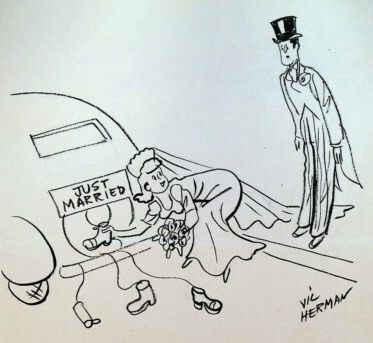
So yeah. That’s the bit on Levirate Marriage. Hmm. I wonder if this is where the practice of tying old shoes to the back of the vehicle of the bride & groom comes from. 🤔👞
Remember the Alamo! I mean, Amalek!
“Remember the Alamo” and other similar rallying cries were meant to help move a group of people to avenge a particularly harsh attack or heroic act of sacrifice.
The tribe of Amalek was mentioned way back in the misty past of Genesis 14 among the giant clans and their lackeys that were attacked by the confederation of eastern kings led by Chedorlaomer. They’re the ones who attacked Israel – unprovoked – when they came out of Egypt in Exodus 17. (That’s the time when Moses had to hold his hands up all day.) Apparently, Amalek attacked from the rear…
Like Grandpa in Chitty Chitty Bang Bang:
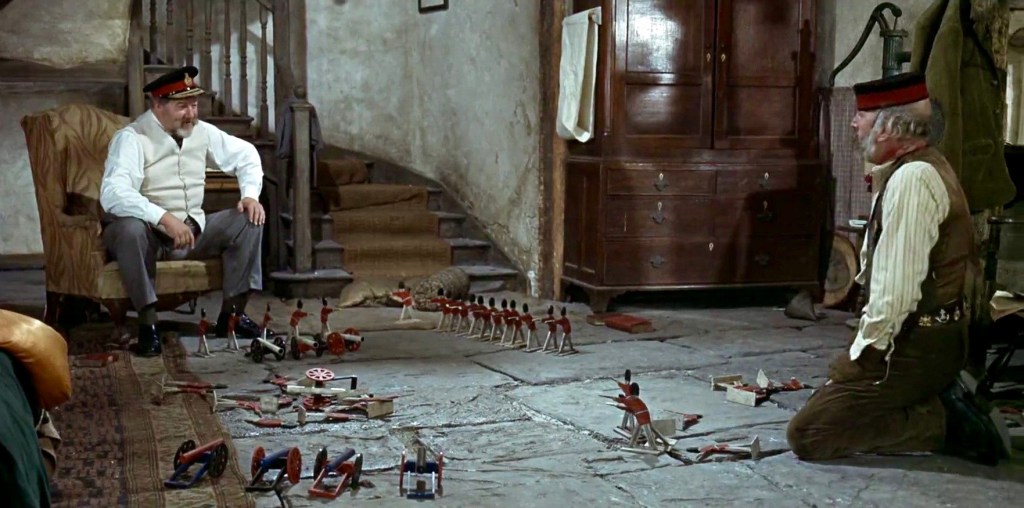
Lord Scrumptious: “Attacking from the reah? That’s dashed unethical.”
“Remember what Amalek did to you on the journey when you went out from Egypt, that he met you on the journey and attacked you, all those lagging behind you and when you were weary and worn out, and he did not fear God.” Deuteronomy 25:17-18 LEB
Ever feel like the kingdom of darkness is kicking you when you’re down? That’s Amalek. They’re the bully on the playground picking on the weak little kids. And God says,
“And when Yahweh your God gives rest to you from all your enemies from around about you in the land that Yahweh your God is giving to you as an inheritance to take possession of it, you shall blot out the remembrance of Amalek from under the heavens; you shall not forget!”
Deuteronomy 25:19 LEB
Once you get bigger and rested, you go beat the livin’ daylights outa Amalek until they are a footnote on the pages of history.
Firstfruits and Tithing…
This basket of Firstfruits seems to be a “memorial portion” rather than an actual tithe. Why would I say that? Because it fits in a (singular) basket. If you had an even a mini-farm, 1/10th of the produce is going to be more than would fit in a single basket. I suppose it could’ve been a huge hamper, but it’s probably a normal basket and the Firstfruits are just that – the earliest grains and fruits that the farm produces.
Then the BIG tithes are given in “the year of tithing” which 26:12 says is “the third year.” And there is regular giving in addition to that- firstborn livestock, freewill offerings, vow offerings, etc.
This chapter just further substantiates my earlier assertion that nobody tithes biblically today, nor should we.
The main differences are:
- It’s fresh produce and grain, not money. And the first of it was sacred to Yahweh, just like the firstborn of the cattle and Israel’s sons.
- It’s every three years.
- The tither literally eats at least some of the tithes himself along with the Levites and his family and neighbors.
There are certainly parallel concepts between OT and NT giving. It’s a good idea to give off the top, not from the leftovers. The giver benefits from his giving as well as the ministers and the community. Giving is an act of faith that God is our provider and an act of gratitude for His provision. It’s also an action that says, “What I have really isn’t mine at all. It is a gift from God and so I can share it with others. I don’t need to hoard it because there’s more where it came from.”
We’re getting down to the last of the Law review. Next, Moses is going to give them instructions on pronouncing blessings and curses when they enter the land.
Moses: I’ve got good news and I’ve got bad news. We’re gonna start with the bad news.
 To The Reader