I’m going to vary from the reading schedule just a wee bit. The schedule had just chapter 4 today, but since chapter 5 is the Song of Deborah and chapter 6 starts the Gideon narrative, I’m going to cover 4-5 together.
The Jewish Historian, Josephus, gives us one little tidbit of backstory that helps. He says that after 20 years of being harassed and taxed by the Canaanite King Jabin, a group of Israelite men approached the prophetess Deborah asking her to pray and ask Yahweh to have pity on them and help them. 🙏
(As a point of Bible trivia – “Jabin” was a dynastic title like Pharaoh rather than a name.)
As Deborah prays, the Lord gives her the direction to call for Barak and appoint him to gather and lead an army to overthrow Jabin.
Before we go any further, let’s see what we can glean about Deborah.
Her name means “bee” in Hebrew. 🐝 And it comes from the root word dabar which technically means “to arrange” but it’s used to mean “speak” because when we speak we arrange words. Bees are great communicators and arrangers. 🍯 Deborah was also the name of Rachel’s nurse back in Genesis.
Deborah was married. 💍 We know nothing of her husband, only that his name was Lapidoth and that he did not forbid or prevent her from doing what Yahweh had called her to do.
There are no children mentioned in connection with her so she either had no children or her children were just completely left out of the narrative. She is called “a mother in Israel” which is a term sometimes still used in churches of a woman who is faithful and leads by a Godly example.
She was a prophetess; meaning – she spoke on behalf of Yahweh. In 5:23 she quotes “the Angel of the Lord” which implies she had encountered Him and received His message.
She was a judge. She could be found in her camp beneath a palm tree giving solutions and verdicts on disputes. (This little detail about the palm tree is important.) 🌴⛺️🌴
Before we get to the battle narrative, I’d like to address a few ideas I’ve come across in the past about Deborah. You may never have encountered these, but there are folks out there so opposed to the idea of a woman in leadership, that they’ve had to invent some twisty notions to explain away the example of Deborah.
- “Deborah’s leadership is a judgement of God.” This is nowhere even implied, let alone stated. Some people think that if you have a woman leading it’s a sign of God’s judgment based on ONE VERSE taken out of context:
- “Childish leaders oppress my people, and women rule over them. O my people, your leaders mislead you; they send you down the wrong road.” Isaiah 3:12 NLT
- This verse is about the coming judgment on Judah – which never had a legitimate queen; only kings. (Athaliah usurped the throne for 6 years, about a century before Isaiah penned the above). Isaiah addresses “the daughters of Zion” many times. They are bad cultural influencers. Shallow and wanton. The men are childish and effeminate. Isaiah 3:12 has nothing to do with legitimate, God-called and gifted women serving His people and it makes for a poor proof-text against Deborah.
- Lapidoth is the prophet and Deborah is “just his wife.” Well… A prophet who never actually speaks for God is like a “swimmer” who never actually gets in the water. Lapidoth never says or does anything to support that view. It’s pure, baseless speculation that contradicts the text.
- “There wasn’t anyone else. God only let a woman lead because there weren’t any capable men.” This is rather insulting to men if you ask me. Judges 5:6 may indicate that Deborah (and Jael) are contemporaries of Shamgar – the battle-axe-wielding judge. Was he not capable? What about the priests at Shiloh? What about Barak? God handpicked him to lead the army. None of those men are capable? Give me a break. Of course they were. But God raised up Deborah (the Queen Bee) “as a mother for Israel” because the people needed her and the Lord chose her and gifted and prepared her for this work.
Barak means “lightning” ⚡️ but also like a flash of light glinting off a sword. 🗡️
We are given no details in the text about whether Deborah knew of him before this or if the Lord gave her his name. Either way, she summons Barak and he agrees to lead the army if Deborah will go along too.
The Septuagint is helpful here. It includes the reason why Barak needs Deborah to go:
“For I am unable to discern the day when the Angel of the Lord will help me.” Judges 4:8 St. Athanasius Academy Septuagint
He needed someone who could hear from the Lord on the matter of the right timing. This is confirmed in 4:14:
“Then Deborah said to Barak, “Get ready! This is the day the Lord will give you victory over Sisera, for the Lord is marching ahead of you.” So Barak led his 10,000 warriors down the slopes of Mount Tabor into battle.” Judges 4:14 NLT
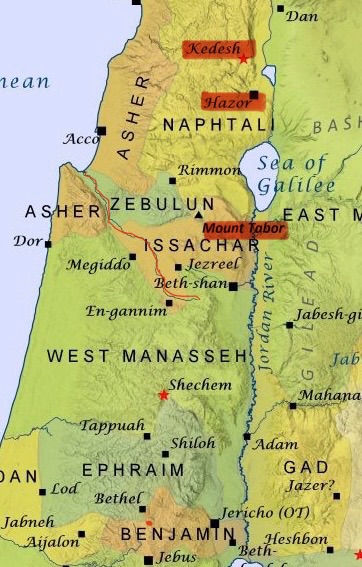
Here’s a map to help us picture the scene. Deborah lives in Ramah – the red spot south of Bethel. Barak is from Kadesh – way up near the top of the map. The Kishon River is marked in red. And Mt. Tabor is just southwest of the Sea of Galilee. The battle started on the great plain of the Valley of Jezreel. Hazor was the home city of Jabin.
Once I was asked to share a Bible story to a group of Sunday School kids and to do it in first person. I was told I could do “any story I liked.” (Never say that to a Bible nerd.) I’m a big time fan girl of Jael because she’s so incredibly courageous and smooth and smart and… just …wow. So I decided to bring a little excitement to Sunday School. It’s not like I was going to actually nail anyone’s head to the floor. I would tell the story alone. Minimal props. Kids watch Marvel movies with people getting blown to bits. I figured they would LIKE to hear a story about a woman who drove a tent spike through a bad guy’s head. That’s way more exciting Ruth or Esther, right?
I wore a flowy skirt and had a huge colorful scarf wrapped around me. I put on the biggest gold hoop earrings I could find and I even fashioned a fake nose ring to try to make myself look more exotic and from the ancient world. (I don’t think it even remotely worked but I did try).
I set up the backstory about how evil the Canaanite Captain Sisera was with his 900 rumbling chariots of iron. How he would plunder and pillage like a pirate. And I told how God had sent Deborah and Barak and the army of Israel to fight with those awful men and how Sisera escaped the battle and showed up at my tent.
And I talked to an imaginary Sisera and opened the flap of my imaginary tent and gave him imaginary milk. (Come to think of it, those poor kids probably hadn’t the foggiest idea what was going on…) Anyway – my imaginary Sisera went to sleep and I took my imaginary tent spike and hammer… (I was kinda whispering this part for dramatic effect until…) “and then… I POUNDED ✊🏼 the spike through his HEAD! And now the evil leader of the evil army was DEAD!” 😵
Dead. Silence.
And dozens of very wide eyes looking at me.😳😳😳😳😳😳😳😳😳😳😳
I stood up from my pantomimed execution and curtsied into an awkward silence while the adults in the room stood gaping and the kids were still staring at me – probably thinking there should be more to the story.
“Wow….. Thank you, Miss Lacy. That was… quite a story. Can you boys and girls say thank you?”
(Mechanically) “thank you.”
Then, and only then, did I begin to question my choice of topic. 🤔
Jael was clever to give Sisera some kind of dairy. (The texts in 4:19 and 5:25 can mean milk, cheese, butter, possibly even yogurt). The calcium is a natural muscle relaxer. But the fact that she had the guts to drive a tent spike through his HEAD is just… wow.
Remember how we talked about the Kenites? They were the descendants of Moses’ father-in-law Jethro. Jael was married to Heber the Kenite. Her name means ibex 🐐 and we’re not sure what her nationality was but she apparently didn’t harbor any warm feelings toward Sisera or the Canaanites.
Oh – and you know how I said earlier that the detail about Deborah pitching her tent by the palm 🌴 was important? Well, it seems to be in juxtaposition with the location of Jael’s tent at the oak tree 🌳 of Zaanannim (4:11). The Septuagint has it as “the oak tree of coveting,” but the Strong’s Concordance has Zaanannim as meaning “removals” (like loading up the donkeys and moving).
Two women. Two tents pitched at two different trees: the Palm of Deborah (dabar) where the prophetess of the Lord gave the word of the Lord, and the Oak of Removals where a courageous gentile woman killed (removed) the captain of the enemy host.
🌴⛺️🌴 🌳⛺️🌳
The Song of Deborah is the longest victory song in the Bible. It’s not as famous as Miriam’s after the Red Sea or the Song of Moses, but it has some interesting lines. Including this one…
“The stars fought from heaven; from their courses they fought against Sisera.” ✨✨
Judges 5:20 LEB
This could simply be poetic and meant to convey the idea that nature itself was arrayed against Sisera. Josephus records that at this battle there was a sudden storm with rain and wind and hail and cold. But that the wind was at the back of Israel and in the faces of the Canaanites, giving Israel an advantage. Josephus also records that the enemy was thrown into confusion – so much that some of them “were killed by their own chariots.”
But I kinda wonder if this line may be referring to angelic assistance. There is a strong connection between astral language and divine beings. The Sons of God are called “morning stars” and when people worship “the host of heaven” it’s not balls of gas ☀️ 🪐 or giant frozen rocks 🌖 that they are worshiping. The “host of heaven” are angelic beings.
And there really isn’t a reason why this line in the song couldn’t be referring to both. We know from Revelation that there are angels in charge of wind and fire. We know that the Lord has storehouses of hail and snow. Perhaps the heavenly host aided Israel on God’s behalf from their respective assigned spheres of influence over wind and rain and cold and such. 🌬️⛈️🌨️❄️
Anyway….
That’s the story of Israel 4th Judge – Deborah. Next up, a favorite of Sunday School teachers everywhere: Gideon. 🎺🔥🏺
 To The Reader