“Now after the death of Samson, Eli the high priest was governor of the Israelites. Under him, when the country was afflicted with a famine, Elimelech of Bethlehem, which is a city of the tribe of Judah, being not able to support his family under so sore a distress, took with him Naomi his wife, and the children that were born to him by her, Chillon and Mahlon, and removed his habitation into the land of Moab; and upon the happy prosperity of his affairs there, he took for his sons wives of the Moabites, Orpah for Chillon, and Ruth for Mahlon.” – Flavius Josephus, Antiquities of the Jews, Book 5, Chapter 9, Verse 1.
‘…and Amminadab became the father of Nahshon, and Nahshon became the father of Salma, and Salma became the father of Boaz by Rahab, and Boaz became the father of Obed by Ruth, and Obed became the father of Jesse, and Jesse became the father of David the king…”
Matthew 1:4-6 LEB
I LOVE this story! So much… 🥰
About a month ago we read the Jericho narrative. In it we see the Canaanite prostitute Rahab put her faith in the God of Israel and she was married to Salma and they had a son whom they named Boaz.
Strong’s concordance says that the meaning of Boaz’s name is “uncertain.” The Brown-Driver-Briggs Lexicon suggests it might mean “quickness?” And Gesenius’ Hebrew-Chaldee Lexicon has it as “fleetness.”
You know me. I gotta look up the Paleo Hebrew letters.
Bet – 🏠: house, in, inside, within
Ayin – 👁️: eye, sight, perception, knowledge, understanding
Zayin – 🌾🚜: plow, plowshare, cut, overturn, make ready, shake
I suppose if you are “fleet of foot,” the objects within your sight will shake and be “cut down” as you “plow” past them.
Or maybe Rahab’s labor and delivery with Boaz went quickly.
But, I kinda wonder if Salma and Rahab name him Boaz because when Rahab was waiting within her house, in the wall, making ready to escape, her inner understanding of everything got overturned when she saw and perceived that the God of Israel was the Most High. Her worldview got shaken up. She was received into the community; taken into the house of Salma.
I dunno. Just spitballing. But it seems to fit.
Pretty sure I’m not spoiling the plot by saying that Boaz is a picture of Christ, our Redeemer. Jesus is the One Who perceives what is within man and plows up the hard ground of our hearts.
Let’s turn now to the beginning of the narrative.
Eli the priest is also the next judge of Israel. He probably overlapped with Samson a little bit. It’s not like there was an election every four years. The story opens with Elimelek.
El-i-melek. Can you work out what it means?
El = God + Melek = king
Whoever his parents were, they were related to Salma and Rahab and they knew Who the true king of Israel was.
Elimelek marries Naomi. Her name means happy or pleasant.
But instead of having sons named “strong” and “capable” they name their sons “weakly sick” (Mahlon) and “failing destruction” (Chilion).
Things are not going well for this little family. The boys are puny and sickly. Maybe they came early. Maybe Naomi didn’t get enough to eat during her pregnancies. There was a famine at some point. Maybe it started a long time before the family moved to Moab.
The political tensions between Israel and Moab that had been back in the days of Ehud are long past. Moab is in modern-day Jordan. And, though it isn’t very far from Bethlehem, times were better there.
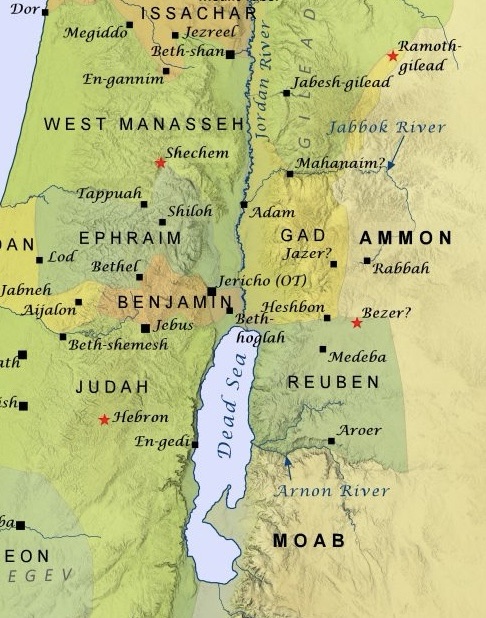
The Moabites were descended from Lot. And they were dreadfully pagan. Their chief deity was Chemosh who was partnered by the goddess Astarte. (She was ALSO the paramour of Baal. Let’s just say that Astarte and her boys have an “open relationship.”)
Chemosh was a solar deity that required human sacrifice. He was known as the destroyer. He was kinda like the Aztec sun-god who also demanded human sacrifice.
Marrying into a household of God-fearing Hebrews must’ve been a life-changing experience for Orpah and Ruth. (By the way, it’s OR-pah, not Oprah.) No wonder they clung to Naomi and wept when she decided to go back to Israel.
Most of us have heard Ruth’s declaration of loyalty read at weddings, but its original context was more like a funeral. Ruth – whose name means “friend” – is a true friend to Naomi and sticks with her even though there is no way Naomi can provide for her. It is enough that Naomi has shared the knowledge of her God.
Ruth, as I’m sure you know, is a picture of the Gentile Church. She has a choice. She can stay with her people and the death-cult of her culture or come out of the world and commit herself to the God of Israel where there is the hope of life. She has no idea (really) what she is signing up for, but she’s all in. Ruth leaving Moab is very similar to the beginning of Pilgrim’s Progress where Pilgrim leaves The City of Destruction.
Naomi and Ruth arrive in Bethlehem at the beginning of barley harvest. We’ve gone over the seasons in Israel before but since those details are kinda hard to remember… the barley harvest begins in April. This story of redemption takes place during the season of Passover. 👀
POP QUIZ: What other biblical events took place in the fields of Bethlehem?
A) David tending sheep
B) The death of Rachel
C) Angels tell the shepherds of Jesus’ birth
D) All of the above
There is a detail about Ruth’s “gleaning” in chapter 2 that Josephus points out and is made clearer in the Septuagint. But first, a bit of context:
“When you harvest the crops of your land, do not harvest the grain along the edges of your fields, and do not pick up what the harvesters drop. Leave it for the poor and the foreigners living among you. I am the Lord your God.”
Leviticus 23:22 NLT
What Ruth intends to do is the welfare system of Israel. It’s not a free handout. The poor must work for their bread, but if they wish to work for it, it’s available to them.
And that’s what Ruth does until Boaz gets involved…
“And Boaz said to Ruth, Hast thou not heard, my daughter? Go not to glean in another field; and depart not thou hence, join thyself here with my damsels. Let thine eyes be on the field where my men shall reap, and thou shalt go after them: behold, I have charged the young men not to touch thee: and when thou shalt thirst, then thou shalt go to the vessels, and drink of that which the young men shall have drawn.” Ruth 2:8-9, Brenton LXX
Boaz’s “damsels” (his female servants) are not gleaners. The gleanings were left for the poor. 🌾 The maidservants are part of the harvest crew. It’s likely that the men were cutting the barley, while the women were gathering it up and tying it in bundles.
Boaz is treating Ruth like one of his people. He lays down the law to his hired men. “Hands off.” (It was normal for foreign women to be sexually harassed in a situation like this.) And she is given access to water (probably from the famous “Well of Bethlehem” that David’s 3 Mighty-Men risk their lives to get water from).
You may want to open your bible to Ruth 2:13 and note the difference in meaning in LXX:
“And she said, Let me find grace in thy sight, my lord, because thou hast comforted me, and because thou hast spoken kindly to thy handmaid, and behold, I shall be as one of thy servants.” Ruth 2:13, Brenton LXX
Ruth recognizes and acknowledges with gratitude the promotion she has been given. She is not being treated like a tramp picking through the McDonald’s dumpster looking for food. She’s just been handed an apron and a hat and told, “You’re hired.”
I do not think that the Masoretic text makes this as clear. But let’s continue…
“And Boaz said to her, Now it is time to eat; come hither, and thou shalt eat of the bread, and thou shalt dip thy morsel in the vinegar: and Ruth sat by the side of the reapers, and Boaz handed her meal, and she ate, and was satisfied, and left.” Ruth 2:14, Brenton LXX
Now why is this little detail in here? Does it not remind you of Jesus at the Passover dipping his bread in the dish with His disciples?
Because we have all grown up in a culture of women’s lib and civil rights, we probably don’t grasp how bold and incredibly kind this is for Boaz to invite Ruth to eat with him. You must always keep in mind that Ruth is a Moabite. An outcast. From a heathen people who descended from incest. Israel harbors no warm feelings toward the Moabites.
It was Moabite king Balak who hired Balaam to curse Israel then seduce them into idolatry. It was Moab who subjugated Israel early on after the death of Othniel. The fat king that Ehud killed was Eglon, king of Moab.
Boaz is the godliest man to grace the pages of scripture since Joshua and Caleb and Phinehas. Let us also keep in mind that Boaz’s own dear mother, Rahab, was also an outcast from a heathen people. If anyone could understand how Yahweh could lift up and redeem someone like Ruth, it’s Boaz. Look at the orders he gives to his harvesters (again from the Septuagint):
“And she rose up to glean, and Boaz commanded his young men, saying, ‘Let her glean even among the sheaves, and do not bring shame upon her. When you carry sheaves, carry them for her also; and when you throw them on the piles, throw them for her also; and let her gather from what has piled up, and do not rebuke her.” – Ruth 2:15-16, St. Athanasius Academy Septuagint.
Picking up bundles of barley stalks in the middle of the field is not gleaning. It’s harvesting. Here is the study note for those verses from my Greek Orthodox Study Bible:
“In Christ, Gentiles are grafted to the tree of salvation (see Rom. 11), and they share equally in the reception of grace. Here Boaz issues an order to his servants ensuring that Ruth, a Gentile, is given equal treatment and an equal share of grain. There is a significant difference between the Masoretic Text and the LXX in v. 16. The former has Boaz merely instruct his servants to let extra grain fall from their bundles, distorting the underlying meaning of his order.”
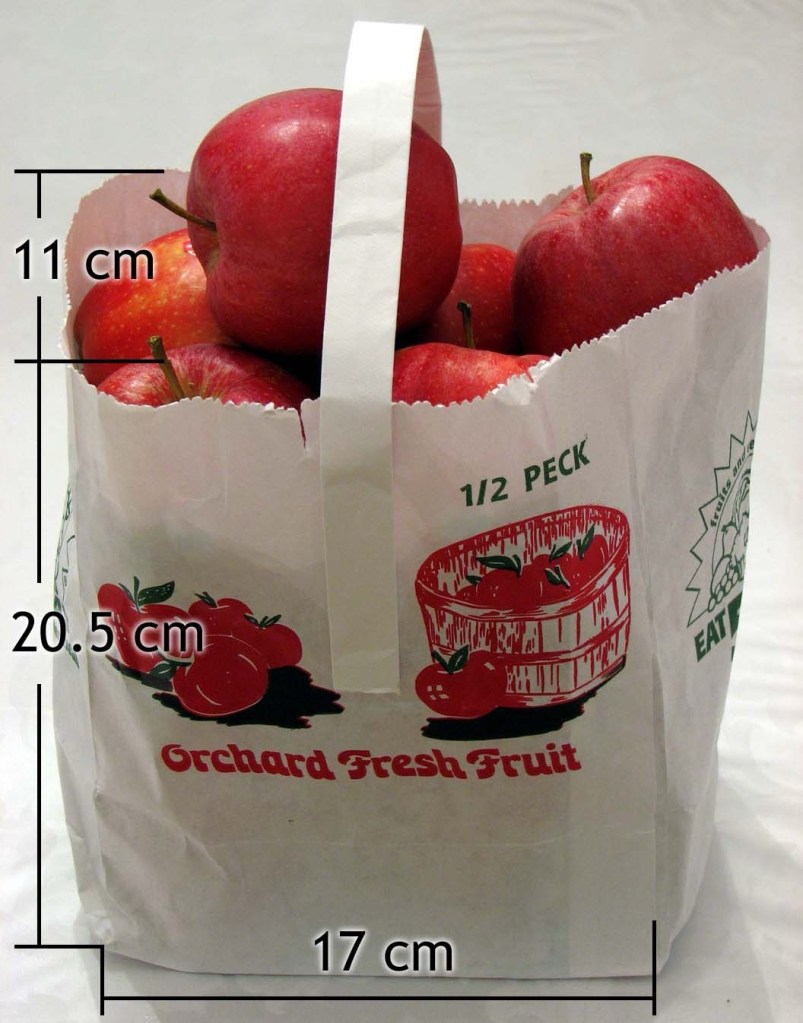
Ruth’s harvest [after she threshed and winnowed it herself] from that day was an “ephah” of barley. That’s about 3 pecks which is just under a full bushel. A bushel is 4 pecks. Three pecks equals 24 dry quarts.
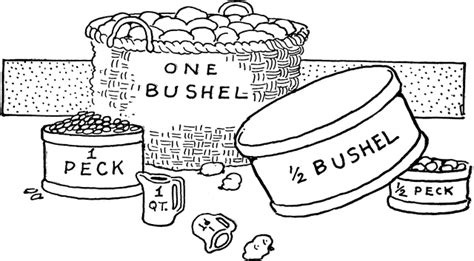
You’ve probably purchased a half-peck of apples in a sack like this:
And I can’t think about pecks and bushels without thinking about this…
Go ahead. Take 2 minutes and enjoy Doris Day singing A Bushel And A Peck. ☺️
I guarantee you Naomi was SHOCKED to see Ruth pack in that much grain, PLUS her leftovers from lunch. You don’t collect nearly a bushel of grain from gleaning the few stalks left at the edges of the field. 🌾🌾🌾
👵🏽 Naomi: Where on earth did you collect all that?!! Whose field did you glean in?
👩🏽 Ruth: I, uh…
👵🏽 Naomi: You DID glean this, right? That’s not hot barley, is it?
👩🏽 Ruth: No! Well, it was hot today and so the grain is warm but it’s not stolen.
👵🏽 Naomi: What a blessing! God bless whoever he was.
👩🏽 Ruth: The man’s name who owns the field is Boaz.
👵🏽 Naomi: Boaz?! 👀 (Throws up her hands and begins pacing the cottage) Hallelujah! Praise the Lord. Oh, bless me… I shall faint for joy!
👩🏽 Ruth: I’ve been invited to work alongside his reapers until the harvest is finished.
👵🏽 Naomi: (still pacing) Oh! Hallelujah! This is wonderful! This is good. This is SO good. Praise the Lord! Heavens to Betsy! Eeeeeee!
👩🏽 Ruth: Okaaaaay… I’m really glad you’re happy about that.
👵🏽 Naomi: oh… my dear girl… you have no idea. But you will. You will.
 To The Reader