Before we dive into 1st Samuel, I’d like to say, “Congratulations!” 🎉 You have made it 1/4 of the way through the Bible. You may want to take a moment to stop and reflect on how the experience has been so far. Has it been different than you expected going in?
If you’ve been reading my blog all this time, bless you. I truly pray that it has given you some insight, maybe demystified a few things, and maybe helped make some parts more accessible. If not, maybe it’s at least been mildly entertaining. 🤓
Let’s dive into the book of 1st Samuel, which the Orthodox Churches call “1st Kingdoms.”
We begin by meeting a man called Elkanah. 1st Chronicles 6:33-38 gives us the information that Elkanah was one of the Kohathites. They were the family among the Levites that were responsible for carrying the most holy objects – the furnishings of the tabernacle – on their shoulders. But the tabernacle is not moving around these days so Elkanah has settled down and married two women. 👰🏽♀️🤵🏻♂️👰🏻♀️
(☝🏼🤨 Remember – historical narrative is descriptive not prescriptive. Just because the Bible describes Elkanah having two wives does not mean God is prescribing “go and do thou likewise.”)
Elkanah’s two wives were called Ruby (Peninnah) and Favored (Hannah). Ironically, the woman named “favored” has not been favored of the LORD with children and Ruby doesn’t let her forget it.
SIDE NOTE…
I cannot, for the life of me, grasp how idiotic a man would have to be to INVITE that level of drama into his home. Seriously. There isn’t a snowflake’s ❄️ chance in the Lake of Fire 🔥 that two women are going to share the same man and NOT have drama.
Elkanah… Bro, I don’t care how bad you wanted both of them, it was a bad idea. 🤦🏻♀️
When the text talks about Elkanah giving Hannah a special or double portion, it’s talking about the meat from the offering. 🍖He really does dote on her, but he is honestly clueless when it comes to the feelings of women.
“So Elkanah her husband would say to her: “Hannah, why do you weep and why do you not eat? And why are you heartsick? Am I not better to you than ten sons?”
1 Samuel 1:8 LEB
Answer: No. No, Elkanah. You’re not. No matter how well you provide and how sweet you try to be, you cannot, under any circumstances, fill the unique void in a woman’s heart when she longs for a child.
This the OT version of this classic:
🧔🏻 “Honey, what wrong?”
👱🏼♀️ “Nothing.”
It’s important to take a moment and picture the setting. Elkanah is camping ⛺️ near the tabernacle in Shiloh. This is an annual trip (v7) so it’s more than likely one of the 3 festivals – Passover/Unleavened Bread/Firstfruits in spring, Weeks (Pentecost) in summer, or Tabernacles (Booths/Sukkot) in autumn. They have probably pitched a tent along with several other families ⛺️⛺️⛺️also camped around the Tabernacle. It’s kinda like when Israel used to travel in the wilderness with the tents all set up around.
Eating the sacrifice was one way you participated in Yahweh’s covenant. Hannah’s refusal to eat is kinda a big deal. Most of us have probably experienced being so heartbroken that you couldn’t force down a morsel if you had to. Hannah isn’t sad. She’s devastated. Grieving. Every year that goes by and she has no child… she can never get that time back. Her biological clock just keeps ticking toward the years when childbearing will be beyond all possibility.
After the family had enjoyed the sacrificial picnic – Ruby with her little brood, and Elkanah trying to be cheerful – Hannah slips off alone to the entrance of the Tabernacle. This is as close to Yahweh as she can physically get. And here she pours out her grief. The KJV says she “wept sore.” Today we’d call it an “ugly cry.” The kind where you hyperventilate and can’t see for the tears. 😭
And Hannah vows a vow – which reminds me of that passage we read about how if a woman makes a vow, her husband can declare it void. But Hannah is alone. Elkanah is not there to nullify this vow. She promises Yahweh that if He will give her a son, she will give him to the Lord as a Nazarite.
We usually don’t think of Samuel as a Nazarite. Most of us only think of Samson as a Nazarite. But here, Hannah commits a future son to the life of a Nazarite. Samson didn’t have a say in his Nazarite vow either. And both Samson and Samuel were judges. So it may be enlightening to compare the two men as we move forward. 🧔🏽♀️👳🏽♂️
Eli the High Priest is the current judge of Israel, but this episode with Hannah shows his lack of spiritual perception. 1 Samuel 3:2 tells us that Eli’s eyesight failed but his spiritual sight is already bad. He can’t tell the difference between a heartbroken woman petitioning the Lord and a woman who has had too much to drink.
Hannah is praying silently. She’s not just thinking this prayer, though. Her lips are mouthing the words but the only sound she makes is her weeping. 😭 Eli confronts her, she explains, and Eli immediately goes from “Put away your wine” to “God grant you your request.”
And that’s it. Hannah takes this on faith that Yahweh has heard her prayer and is going to give her a son. My study Bible has this: “She trusts in God’s answer before receiving it.” And, Beloved, that’s what faith IS.
If you need a song to really bring that home today, I recommend Believe For It by CeCe Winans. You may want to grab some tissues in case you have your own “ugly cry.”
There is a word in verse 16 that stood out to me. Interestingly, I found it this past week before we got to this chapter. In the KJV it’s the word “complaint.”
I was talking to the Lord (as I do a LOT), and I was frustrated. Not whiny. But bothered. And I was thinking about lodging a complaint with the Heavenly Complaint Department. (There IS one, you know.) And I thought I remembered a verse somewhere about “making my complaint” known – or something like that. So I whipped out my phone with my Strong’s Concordance app and typed in “complaint.” It’s only in the Bible (KJV) 9 times. The first use of the word “complaint” is here by Hannah. The next five appearances of “complaint” are in Job. (Shocker. 😏) Two are in Psalms. And one is in Acts where someone was bringing a complaint against Paul. This was the verse that was niggling at the back of my mind:
“I poured out my complaint before him; I shewed before him my trouble.”
Psalm 142:2 KJV
I wanted to know what Hebrew word this was. In every instance of the word “complaint” in the OT, it’s this Hebrew word:
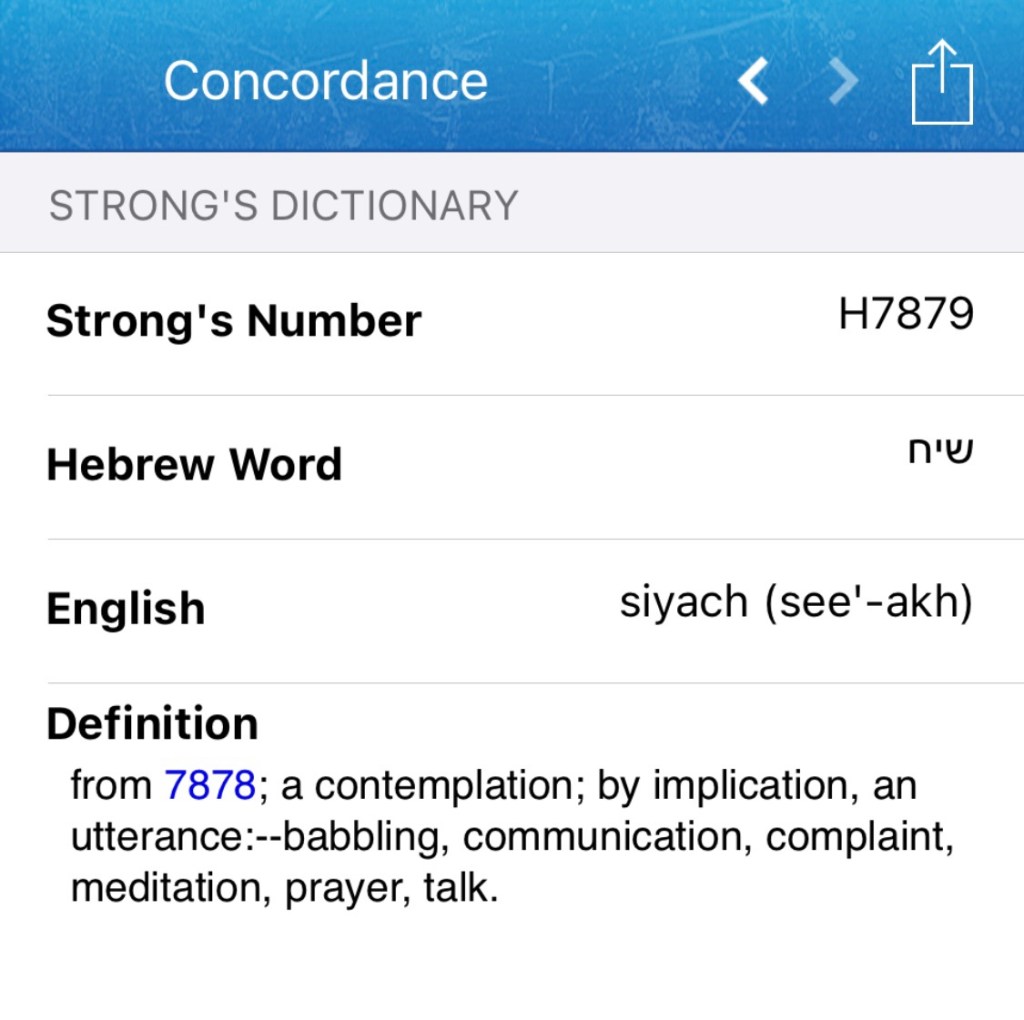
If you tap on the 7878 to see the root you get:
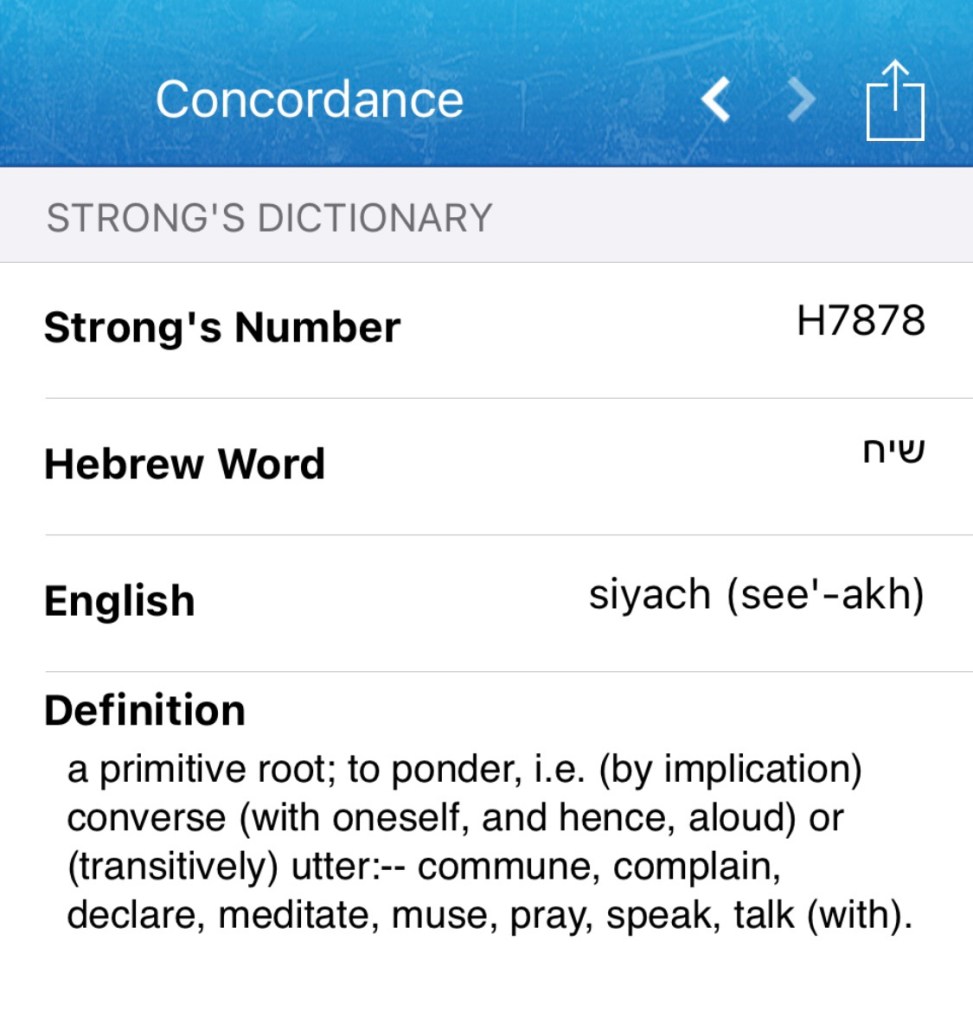
I read that and said…
“To converse with oneself aloud?! 😳🤯
Lord, I guess I complain a lot.” 😏
Some of you will know what I’m talking about when I say that I’m the kind of person that needs to process things verbally. The act of talking through a thing helps me get clear on it. I think there are 3 kinds of people in the world:
- Verbal processors
- Those patient with verbal processors
- Those who avoid verbal processors
This deep introspective processing of the hurt and the grief and the teasing and her longing and what God has said through Moses about the blessing of children… Hannah is pondering and praying, contemplating and complaining her way through it.
David poured out his complaint. Verbally.
I do too. And I hope you do. I mean, who else are ya gonna call? God Almighty is the only person I know who isn’t frazzled and busy and stressed out. I can unload on Him anytime day or night and it doesn’t even phase Him. He can handle all the feels.
This word complaint isn’t how we commonly use it today. The word “complain” today means more like “gripe.” Or the word “murmur” in Exodus when the people “murmured” against Moses. THAT Hebrew word is – I kid you not – “loon.” Yup. They were loony. 🤪 (JK, it sounds the same but is completely unrelated to our word loony which means “crazy.”)
The letters in siyach are:
Shin (teeth)🦷- teeth, front of face, consume
Yod (hand)🫲🏽 – hand, make/do, power
Chet (wall) 🏰- wall, end, obstruction, out
The teeth are doing to the end. Talk it out. Talk your way through it. To yourself. To a plant. To a pet. To a friend. To the LORD.
Pro Tip: If someone comes to you to talk something out, you’re not there to fix it. You’re there to listen, reflect, and ask very thoughtful questions. And then pray with them.
That’s what Hannah is doing. She pours out her grief in a holy complaint. And the Lord hears and is moved and grants her request.
Samuel means “Heard of God.”
How Hannah must have delighted in baby Samuel! 👶🏽🥰 But she does not make excuses, she fulfills her vow and when Samuel is weaned (probably around 3 years old), she brings him to Eli and the priests at Shiloh.
“She said, ‘Excuse me, my Lord. As you live, my Lord, I am the woman who stood with you in this place to pray to Yahweh. I prayed for this boy, and Yahweh has given me my request that I asked from him. I in turn have lent him to Yahweh. As long as he lives he is lent to Yahweh.’ Then they worshiped Yahweh there.”
1 Samuel 1:26-28 LEB
And just like that, Hannah hands him over. This must’ve been challenging for everyone. I’m sure it was hard for Hannah to leave her baby behind. I’m sure the elderly Eli wasn’t too keen on having a preschooler tagging after him all day asking “Why?” every 10 seconds and getting into absolutely everything.
👳🏽♂️ Master Eli, have you seen Samuel lately?
👴🏽 I have not. He has left me blessedly alone for a moment.
👳🏽♂️ The last time it got this quiet, he buried himself to the neck in the basket of grain for the showbread.
👳🏻♂️ Yesterday I found him sitting in a pile of ashes- covered head to foot. I asked him if he was playing Job and offered to get him some sackcloth to wear.
👴🏽 sigh… Let’s go look for him. Maybe he is only making mud cakes again behind the curtains.
👳🏽♂️ At least we’ll know this time to check the collection of unleavened wafers to pull out the ones made of dirt.
In the next chapter we have recorded Hannah’s prayer of thanksgiving, Samuel the pint-sized little priest, and a mysterious visit from a prophet with a warning for Eli.
 To The Reader