DAVID BECOMES A FUGITIVE…
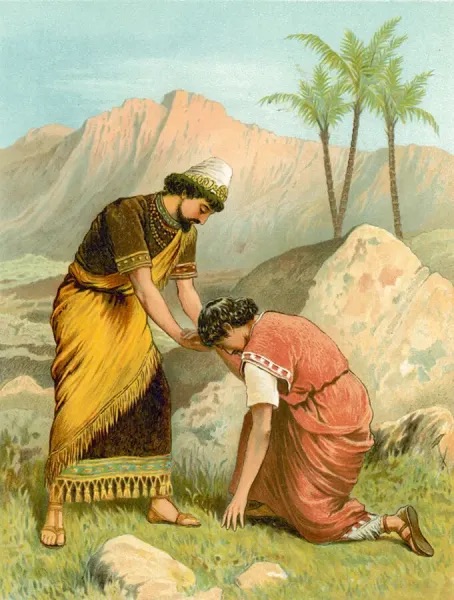
Do y’all have any idea how difficult it is to find an image online of David and Jonathan that is even remotely accurate?
😖 Gaahh! Do a Google Images search of “David and Jonathan.” Most of them are SO effeminate it’s ridiculous. Many depict them as lads who haven’t even developed facial hair yet. And some are just overtly gay. 🙄
Give. Me. A. Break.
David was probably in his late teens when he killed Goliath. And he’s been serving in Saul’s army for quite some time. And he is married. I’m guessing that he’s in his early to mid twenties by this time.
I bet you could really dig on this and reverse calculate dates from David’s later years and come up with a pretty good estimate on how old he is at this moment. Am I gonna do that for ya? Nope. No I’m not. 😏
Jonathan is likely a bit older than David. He’s also married and has kids.
David leaves Samuel at Navith and returns to the Capitol to confer with Jonathan. Jonathan finds it hard to believe but David knows that his life really is in danger.
The two of them come up with a plan. David hides outside the palace and Jonathan gathers information.
In verse 11 when Jonathan says to David, “Let’s go out to the field,” I immediately thought of two other men. “Let’s go out to the field” is exactly what Cain said to Abel. In that case, a murder was done. In Jonathan and David’s case, murder was thwarted. Cain cuts off Abel’s posterity while Jonathan and David promise to save each other’s posterity.
In verses 13-17 Jonathan and David swear an oath. And it flies in the face of ancient custom. Usually, when a new king came to power, he would eliminate all other possible contenders – and their children. As the son of the current king, Jonathan has a claim to the throne of Israel. “King Jonathan.” And he would’ve made an excellent king.
I don’t know if Jonathan knew David had been anointed to be the next king of Israel. I don’t know if Jonathan knew that Samuel had told his father that he and his family would not retain the throne of Israel. But it kinda feels like Jonathan knows. And he asks David to spare his children when he becomes king. This is going to be important.
Saul’s rage at David’s absence is out of all proportion. He basically cusses Jonathan out; calling him the illegitimate offspring of a wayward woman. 😳 And Saul tries to kill his own son. He is clearly mentally deranged.
“For as long as the son of Jesse is alive on the earth, you and your kingdom will not be established! So then, send and bring him to me, for he will surely die!”
1 Samuel 20:31 LEB
He is clinging to a dynasty that he has already been told will not belong to him. Saul is refusing to accept the will of God.
Jonathan gives David the secret signal with the bow-shots 🏹 and they must bid a tearful farewell.
Some people have erroneously tried to read a homosexual relationship between David and Jonathan into this chapter. For heaven’s sake. Yahweh is not going to appoint a man to shepherd His people who is living in a sin for which He destroyed Sodom & Gomorrah.
Jonathan and David are both happily married men. But they have a bond of brotherhood. David wasn’t exactly a favorite of his own brothers. Jonathan had no brothers. I think they found a kinship with each other that each of them needed. What is so messed up in our perverse culture that people feel the need to assume that love has to be sexual? The kiss of farewell is not a romantic kiss but a typical greeting and parting of middle eastern cultures to this day.
They both understand that their lives are at risk. They both understand that they may never see each other again. They entrust the future care of their families to each other should one of them die. And they will keep these promises.
PSALM 11
Verse 3 based on the Masoretic Text reads:
“The foundations of law and order have collapsed. What can the righteous do?”
Psalms 11:3 NLT
Some translations have it as “If, the foundations are destroyed, what can the righteous do?”
The obvious answer would be to trust in the LORD.
The Septuagint has it as:
“For the things You created, they destroyed. But what did the righteous man do?”
The psalm is contrasting the sinner and the upright in heart. The LXX has the sinners destroying something God created. The question that follows feels at first like a “what did the righteous man ever do to deserve that?” And when I read it that way, it makes me think of Psalm 22 and Isaiah 53.
Jesus is “The Righteous One.” And the longer I ponder this verse, the more I think that the balance of the psalm is the answer to the question, “What did the Righteous Man do?”
Well, for starters, the Lord is enthroned in His heavenly temple.
It kinda sounds like a hint that the Righteous Man is the LORD in Heaven. Hmmm… Now I wonder how THAT could be?
Then we note that the Lord (the Righteous Man) observes all men. He knows what’s up.
And, He does something about the sinners destroying His creation. He destroys them.
And the Septuagint ends with an another hint. “The righteous Lord loves righteousness; His face beholds the upright.”
So Who was that righteous man again? We’ve got TWO righteous ones in the text now: the Righteous Lord and the Upright. It just feels like another hint that the Righteous Man in verse 3 is conflated with the Lord.
As we get further into the Psalms, keep an eye out for prophetic hints. The Psalms are highly prophetic in nature and often Messianic.
PSALM 59
This Psalm was written by David when Saul sent soldiers to watch his house so they could capture him and Saul could kill him.
I’m a songwriter. But if I had thugs lurking around my house to kill me, I’m not sure I’d be whipping out my laptop to start making a chord chart.
Michal helped David escape through a window. It reminds me of how Rahab, David’s great-great-grandmother, helped the spies (one of whom could’ve been Salma – her future husband) escape from Jericho through her window with the scarlet chord. And like Rahab, Michal fibs about the missing man to throw off the pursuers.
The song is a prayer for protection. And I wonder if perhaps David wrote it down while at the School of the Prophets in Navith. I mean, prophets did seem to be skilled in music.
In the heading, this psalm is called a “miktam” of David. The precise meaning of this term is unknown but it may mean “inscription,” as if to claim ownership. Kind of like copyright today. Or, it may indicate a specific type of musical piece or instruction for how it is to be used.
The heading also contains an instruction that might be musical information: “To the tune of Do Not Destroy.” Or, that may be the OT equivalent of putting a sticky note on it that says, “IMPORTANT!! DO NOT THROW AWAY!” The Septuagint has it as “Corrupt not,” which is interesting because the only One Who was never saw corruption was Jesus. If you read this Psalm as though Jesus wrote it, it works perfectly.
David’s story is just getting started. And it’s about to get way more intense.
 To The Reader