This is an EPICALLY long post. Get comfy.
Last week we read about the Ziphites blowing the whistle on David’s whereabouts to Saul and how he and his men had to move (again) to hide out in the wilderness. Psalms 54 and 63 were written during this time.
Let’s talk about poetry. Hebrew poetry.
First, what exactly IS poetry?
The Encyclopedia Brittanica has it as:
poetry: literature that evokes a concentrated imaginative awareness of experience or a specific emotional response through language chosen and arranged for its meaning, sound, and rhythm.
Meaning. Sound. Rhythm.
🤓 Allow me to demonstrate with a superbly meta haiku that I have composed for the purpose.
Written words arranged
Small syllables and weak ink
But can move mountains
A haiku poem focuses on rhythm; 3 lines, five syllables in the first and 3rd lines, 7 syllables in the middle.
Then there’s my personal favorite, the limerick. I think I’ve shared this composition of mine in the blog before, but it was months ago and a good limerick is always worth hearing again.
I once knew a girl from Nantucket
Who stepped, by mistake, in a bucket
She was thusly arrayed
When she died an old maid
For her foot always stayed where she stuck it
🤣🤣🤣 😄 😂😂😂
🙄 Ho boy.
Most of us were exposed to nursery rhymes and song lyrics from infancy. The rhyme schemes and meters are embedded in our memories. So much so that you can create humorous lines by deliberately ruining the anticipated rhyme. There’s a fantastic children’s picture book based on this idea, “Chester VanChime Who Forgot How To Rhyme.” Just to show you how strong your internal sense of rhyme is…
Hickory dickory dock, the mouse ran up the timepiece.
Little Jack Horner sat in a corner eating his Christmas pie. He stuck in his thumb and pulled out a plum and said, “What a clever lad I am!”
Humpty Dumpty sat on a wall. Humpty Dumpty had a great accident.
😫 Stop!! Somebody! Help! Make her stop!!
😟 What?! I’m only demonstrating a point.
🤨 No you’re not. You’re indulging in unauthorized literary horseplay. This is what comes of your mother allowing you to take Vocabulary, Spelling, and Poetry every year of homeschool. And now she has foisted you upon the world!
😟 But I was just…
🤨 Nope. No more nonsense. You’re supposed to be telling these fine readers about Hebrew Poetry, not Humpty Dumpty. Focus!
😒 Oh all right….
Hebrew poetry doesn’t rhyme. Not even in Hebrew. Meaning it doesn’t have a certain numbers of syllables or lines that end with matching sounds. What makes it poetry is that the IDEAS rhyme.
It was absolutely ingenious of God to create this kind of poetry because you can translate it into any language and the poem STILL WORKS!
There are 3 types of poetic lines in Hebrew:
- Comparative
- Contrastive
- Constructive
COMPARATIVE
Comparative lines compare two or more things. They typically use the terms “like” and “as.” We see them a lot in Proverbs:
“Like vinegar to the teeth and smoke to the eyes, so is the sluggard to those who send him.” Proverbs 10:26 ESV
The lazy person is compared to the irritations of vinegar on the teeth and smoke in the eyes. The lazy person is being “rhymed” with irritants.
Here is one from the Psalms:
“He is like a tree planted by streams of water that yields its fruit in its season, and its leaf does not wither. In all that he does, he prospers.” Psalm 1:3 ESV
The man who delights in the Law of the Lord is compared to (and rhymed with) a fruitful tree by a stream. 🌳
Comparative poetry abounds in the Song of Songs. The Bridegroom and Bride compare each other to the most gorgeous, captivating things they can think of. 😍🥰
Comparative poetry uses simile (like/as) but it may also use metaphor. Metaphor is when you say “this IS that.”
“The Lord is my rock and my fortress and my deliverer, my God, my rock, in whom I take refuge, my shield, and the horn of my salvation, my stronghold.”
Psalm 18:2 ESV
It doesn’t say that the Lord is like a rock 🪨 and fortress, etc. It says the Lord IS my rock. The Lord IS my shield 🛡️ . Now, we understand that the Lord is not literally a physical hunk of stone or a castle or a metal shield. This is metaphor. And this is why we should be careful about saying things like “I take the Bible literally.” It would be better to say, “I take the Bible seriously.” Sometimes, the literal meaning is not the meaning at all; especially when we’re interpreting poetry.
CONTRASTIVE
The Proverbs excel at this type of poetic structure. You could nearly pick one at random and it’ll be contrastive. The key word for this type of poetic structure is “but.”
“The house of the wicked will be destroyed, but the tent of the upright will flourish.”
Proverbs 14:11 ESV
“The wicked flee when no one pursues, but the righteous are bold as a lion.”
Proverbs 28:1 ESV
Contrastive poetry contrasts two or more opposites. There are often multiple contrasts in one verse. In Proverbs 14:11 above, there are 3:
- House 🏠 & Tent ⛺️ rhyme
- Wicked 😈 & Upright 😇 rhyme
- Destroyed 🥀 & Flourish 🌹rhyme
The nature of the things contrasted can give us insight into God’s mind. In Proverbs 28:1, the “wicked” are depicted as cowards while the righteous are bold. We may not think of cowardice as sinful, but it seems that God does. And if Proverbs isn’t clear enough for ya, here’s this one:
“But as for the cowardly, the faithless, the detestable, as for murderers, the sexually immoral, sorcerers, idolaters, and all liars, their portion will be in the lake that burns with fire and sulfur, which is the second death.” Revelation 21:8 ESV
Ok. One more type…
CONSTRUCTIVE
This type of poetic line is like a 2-story house. It begins with a statement, then constructs an addition on top of it. There isn’t a key word to look for so much as the structure of two clauses. One could typically stand alone, but the second adds more to it.
“Behold, God is my helper; the Lord is the upholder of my life.”
Psalm 54:4 ESV
In this verse, the first clause “God is my helper” could stand alone. But the additional statement “the Lord is the upholder of my life” explains HOW God is David’s helper. Helper and upholder rhyme.
Constructive poetry often answers the questions “how” and “in what way?”
Here’s an example from our other psalm in today’s reading:
“So I will bless you as long as I live; in your name I will lift up my hands.”
Psalm 63:4 ESV
Q: How or in what way will David bless the Lord as long as he lives?
A: He will lift up his hands in Yahweh’s name. 🙌🏼
So these 3 – comparative, contrastive, constructive are the building blocks of Hebrew poetry. Sometimes they will be layered with more than one type compounded together.
I encourage you to try an exercise. Print out Psalm 63 (or another one if you like). Then with some colored pencils underline rhyming words and concepts. Put big idea sections in brackets. Use different colors for comparative, contrastive, constructive.
You’ll notice that Psalm 63 has 3 main sections:
- Longing, v 1
- Remembering and Anticipating, v 2-8
- Contrast
- A: The wicked, v 9-10
- B: Satisfied king, v11
There is another structure found, not just in poetry but in many places in scripture. It is evidence of the intelligent design of the Bible. It’s called chiasmus (key-assmuss) or chiastic (key-astic) structure. It gets its name from the Greek letter Chi (key), which we call X.
It’s an “X marks the spot” structure.
Twinkle Twinkle Little Star ⭐️ has a structure like A A B B A A.
Twinkle twinkle little STAR (A, initial sound)
How I wonder what you ARE (A, same)
Up above the world so HIGH (B, new sound)
Like a diamond in the SKY (B, same)
Twinkle twinkle little STAR (A, initial sound)
How I wonder what you ARE (A, same)
Now, if we had a poem that went A B C B A, that’s a chiasmus.
A. A
B. B
C
B. B
A. A
See? X marks the spot. 🤓
Now, check this out from Psalm 54:
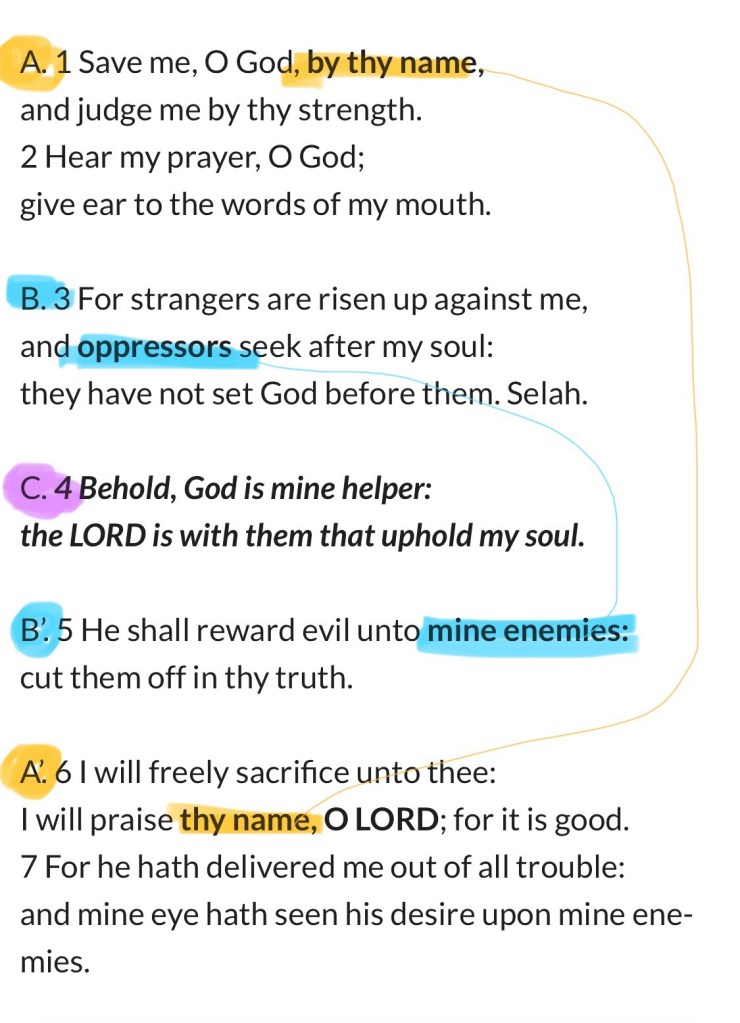
Notice the rhyming and repetition of words and ideas.
The thing about chiasmus is: Whatever is in the MIDDLE is what is most important.
The thing in the middle is what the author is drawing your attention to.
I have a theory that all of human history is a giant chiastic poem.
A. Creation of Heaven & Earth
B. Entrance of Sin & Judgment Pronounced
C. 1000 years, ends with Enoch caught up
D. Fallen angels & humans partner and rebel resulting in global cataclysmic judgment (by water)
E. United humanity, one speech
F. A Father & Promised Son, 12 Patriarchs, OT Church Age
G. JESUS the CHI (X)
F. The Father & Promised Son, 12 Apostles, NT Church Age.
E. United humanity, one speech
D. Fallen angels & humans partner and rebel resulting in global cataclysmic judgment (by fire)
C. Church caught up, 1000 years begins
B. Exit of Sin & Final Judgement
A. Creation of New Heavens & Earth
Make of this what you will.
Coincidence? I highly doubt it.
The thing in the MIDDLE is what the Author is drawing our attention to.
😳🤯
SAUL and the WITCH of ENDOR 🧙🏼♀️
I bet you thought I forgot all about the Bible’s very own “ghost story.” I didn’t. This strange and creepy tale actually sheds some very important light on the meaning of a much-used Hebrew word.
First off, the Endor in this story is not THAT Endor:

Actually, Endor was not far from the location of Nain – the town where Jesus would raise a widow’s son to life. It was in a valley southeast of the Sea of Galilee, not far from Mount Tabor.
Saul goes there to meet clandestinely with a medium – a woman who conjures up the spirits of the dead. 🧟♂️ A necromancer. (So not exactly what we usually think of with the word “witch” – a woman dressed in black casting spells.) This activity is highly illegal because Saul himself made it a law and now he’s blatantly breaking it because the Philistines have amassed their largest army yet and Saul cannot get direction from Yahweh. He has called in the prophets. Nothing. He called in the priests – nothing.
In a last-ditch effort he is going to see if Samuel – who is dead – can help.
Some things to observe:
V.12 – This professional medium, who is used to talking to the dead, has an unexpected experience. She screams. Why? Isn’t this what she does? Why is she so frightened? My best guess is that this experience is not the usual. It seems as though Yahweh has allowed something out of the ordinary to occur and it freaks her out. Samuel actually appears from the realm of the dead.
Samuel’s soul is not in “heaven.” He is in Sheol, the Grave, 🪦 the abode of the dead. But he is allowed to appear to the woman. Saul cannot see him.
“The king said to her, ‘Do not be afraid. What do you see?’ And the woman said to Saul, ‘I see a god coming up out of the earth.’ He said to her, ‘What is his appearance?’ And she said, ‘An old man is coming up, and he is wrapped in a robe.’ And Saul knew that it was Samuel, and he bowed with his face to the ground and paid homage.”
1 Samuel 28:13-14 ESV
The woman says she sees “elohim” coming up out of the earth. This is the Hebrew word translated “god” or “God” or “gods” throughout the OT. From its use here we learn something very important. We learn that the word elohim does not, and cannot mean “uncreated Supreme Being who is omniscient, omnipotent, and omnipresent.”
It CANNOT mean that because Samuel is NONE of those things. This is not a typographical error. What we can logically deduce is that the word elohim simply means an inhabitant of the spirit realm.
🧐 But might the medium have believed she was seeing a god?
🤔 Then why would she say she saw “an old man”?
No. There is only one mysterious word that means “uncreated Supreme Being who is omniscient, omnipotent, and omnipresent.”
🧐 What’s that?
YHWH.
I love this story. It’s so eerie that I hear creepy organ music in my head. Samuel’s voice echos in terrifying surround-sound. The air is cold. And damp. And there is mist and even a few spiderwebs 🕸️ 🕷️ gleaming in the flickering light of a few oil lamps. 🪔

“Then Samuel said to Saul, “Why have you disturbed me by bringing me up?”
1 Samuel 28:15 ESV
Samuel sounds as irritated as any old man would be if forced to get up from a nap. He repeats what he had said to Saul in life – that he disobeyed and that David would be king in his place. Then he drops the bad news:
“Moreover, the Lord will give Israel also with you into the hand of the Philistines, and tomorrow you and your sons shall be with me. The Lord will give the army of Israel also into the hand of the Philistines.”
1 Samuel 28:19 ESV
😟
This bit gives me Ebenezer Scrooge with the Ghost of Christmas Future vibes. It’s as if Saul is being shown his own tombstone. 🪦 Only, unlike Scrooge, there is no waking up and finding that he has time to change. Saul has had plenty of time, but he has spent it trying to murder David.
Samuel’s ghost has disappeared and Saul is left to choke down his last meal.
 To The Reader