PSALM 14
“The fool says in his heart, ‘There is no God.’ They are corrupt. They do abominable deeds. There is none who does good.”
Psalms 14:1 LEB
I don’t know if this psalm has anything to do with the time that Nabal insulted David but it starts with his name. Nabal means fool.
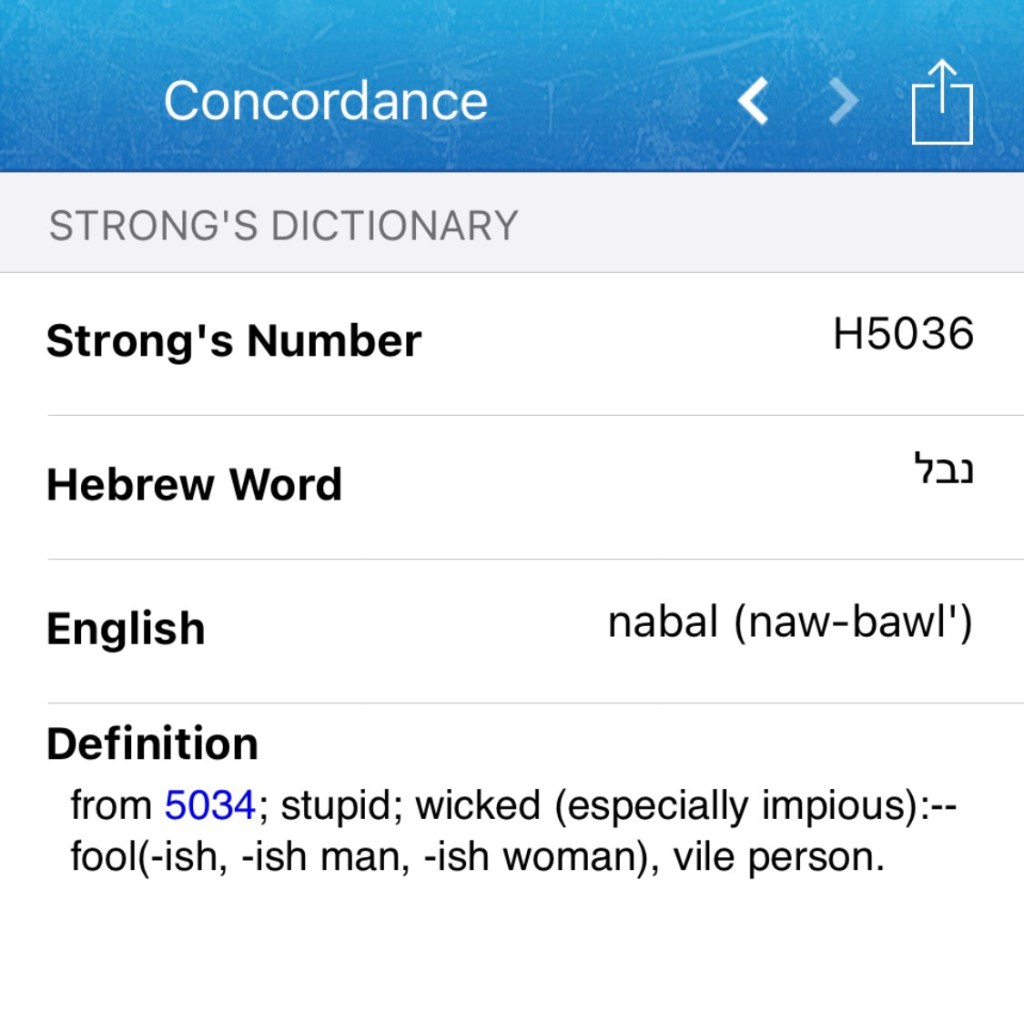
Let’s do a bit of paleo-Hebrew, shall we?
The letters are: N B L
🐍 Nun/Nachash – serpent, shiny, life, wise
🏠 Bet – house, inside
🐏 Lamed – shepherd staff, shepherd, to/toward, guide, teach, lead.
If you went to the White House, you’d go on a tour with a White House Guide. If you went to Graceland, you’d go on a tour with a guide. A fool is a Serpent House Guide. 😳
Beware of anyone who would lead you to the home of the Serpent. 👀
Verse 1 says that anyone fitting this description of God-denying fool is “corrupt” and that they “do abominable deeds.” This is the worst kind of fool; the morally perverse.
This opening line also shows the unbreakable bond between thought and behavior.
Thought is the basis of conduct. Or, as the saying goes, “Belief determines behavior.”
If a person believes in his heart that there is no God – no superior Mind or Morally Perfect Being, no Creator or Sustainer of mankind, then who does that leave as the ultimate authority? Many things will endeavor to fill that void but they will be tried and found wanting. “There is none that do good, no, not one.”
The cure for this delusion is in the final verse:
“Oh, that the salvation of Israel would come out of Zion! When the Lord restores the fortunes of His people, Jacob will rejoice, Israel will be glad.”
Psalms 14:7 NASB2020
PSALM 16
Psalms 16-24 have a special emphasis on the Lord as Redeemer. Psalm 16 is a Michtam of David. Michtam means “engraving.” We mentioned before how it could refer to a kind of copyright or identification, but if that were the case, why don’t all of David’s psalms have it? Perhaps it’s something that David wanted to “engrave” upon his heart.
We know this is a Messianic psalm because of verses 8-11. Peter’s message to the multitude on Pentecost was based on a handful of OT texts and this is one of them. After quoting Psalm 16:8-11, Peter says,
“Dear brothers, think about this! You can be sure that the patriarch David wasn’t referring to himself, for he died and was buried, and his tomb is still here among us. But he was a prophet, and he knew God had promised with an oath that one of David’s own descendants would sit on his throne. David was looking into the future and speaking of the Messiah’s resurrection. He was saying that God would not leave him among the dead or allow his body to rot in the grave.”
Acts of the Apostles 2:29-31 NLT
This is yet another reason to read the psalms as it were with red-tinted glasses. These might as well be red letters. The Eternal Word of God is inspiring these lines. David is simply his Nom de Plume.
PSALM 19
This is one of the famous ones; particularly the KJV wording…
“The heavens declare the glory of God; And the firmament sheweth his handywork.”
Psalm 19:1 KJV
This psalm has 3 distinct sections:
- Revelation through External Creation
- Verses 1-6
- Revelation through Written Word
- Verses 7-11
- Revelation through Inner Conviction
- Verses 12-14
Revelation through External Creation
Paul uses this argument in Romans 10:18 as to why the Gentiles (who did not have access to the Word of God like the Jews) are still “without excuse” when it comes to being able to know the Creator exists.
Revelation through Written Word
The written revelation is described with 7 – yea, even 8 terms and each one has a benefit. And since I went to Bible College each benefit is listed in the margin of my Bible with alliteration. They all begin with E. Here we go, verses 7-11:
- The Law is perfect.
- Encounters (dynamically converts)
- The Testimony is sure.
- Enables (makes one wise)
- The Statutes are right.
- Encourages (gladdens the heart)
- The Commandment is pure.
- Enlightens
- The Fear of the Lord is clean.
- Endures
- The Judgements are true & righteous.
- Exhorts (servant is warned)
- this counts as 6 & 7 making the next one #8…
- BONUS: The Judgements are desirable.
- Enhances (brings great reward)
I expect you to memorize this list. There will be a test on the 7 E’s.
There. Now you’ve had an ice-cream store mini-spoon sized sample of Bible College.
Revelation through Inner Conviction
The final verses, 12-14, delve into the innermost being. David is searching his heart and deepest motives. And he asks the Lord to keep him from “presumptuous sins.” This points to the inner convicting work of the Holy Spirit. David recognizes that sinful action always begins a hidden inner thought.
Let’s look at something in the final verse:
“May the words of my mouth and the meditation of my heart Be acceptable in Your sight, Lord, my rock and my Redeemer.”
Psalms 19:14 NASB2020
Do you remember yesterday how we looked at the Hebrew term Higgaion in Psalm 9? And it means “a murmuring sound.” Well, it’s the word that is translated “meditation” in verse 14.
🤔 So… a… heart murmur???
No no no. Remember how we said that Higgaion meant to talk quietly to yourself? Confession deepens impression? Remember? I also need you to remember what we said about the 3 kinds of Hebrew poetry – comparative, contrastive, constructive.
🧐 Ok. Got it.
This verse is a little more complex than the simpler ones we used as examples but stay with me here.
This phrase, “the words of my mouth” is meant to conceptually rhyme with the phrase, “the meditation of my heart.” It’s two descriptions of the same thing.
😐 I don’t get it.
The words ARE the meditation.
🤔 The words are the meditation?
Yes. I take the soft murmur-like thoughts of my heart and I turn them into words in my mouth. They aren’t two separate things. In our post-modern, scientific, world of classification, dissection and analysis, we read this and we think, “Aha! Two things:
- The words of my mouth
- The meditation of my heart”
But this is Hebrew poetry not American accounting. The meditations become words and the words solidify the meditations. They conceptually rhyme because there is sameness in them.
🤔 Sameness?
Yes. Try thinking a thought without words.
🤔
😐
😵💫
Doesn’t work very well. Thoughts ARE words. Meditations of the heart are words – words that we hold onto by repeatedly having them in the mouth. You recite them.
This used to be called a “confession.”
Con = with
Fess = to admit
To admit means to allow. So a confession is to allow- to come into agreement with. In terms of faith, it is to come into agreement with the Gospel of Jesus Christ as the truth.
“Let’s hold firmly to the confession of our hope without wavering, for He who promised is faithful,”
Hebrews 10:23 NASB2020
We should take what we confess seriously and not “come into agreement” with things that are untrue – like…
- I doubt it will get any better.
- It’s hopeless.
- I’m just too messed up or I messed up too badly.
- I don’t have any talent.
- If I just had XYZ then everything would be ok.
- I’m a failure.
🤔 Interesting that they all start with I.
If I want the words of my mouth and the meditation of my heart to be acceptable in God’s sight, then my words and my heart-thoughts need to be in agreement with Him.
PSALM 21
To follow who’s who in this psalm, pay attention to the pronouns. Let’s make a list. I like lists. They’re helpful.
- The King (He/Him/His)
- The LORD, Yahweh (You/Your)
- The Enemies (they/them)
- David and Friends (we)
David is and isn’t the king in this psalm. He is in the sense of referring to himself in the 3rd person, but if he is the King, who then is the “we” singing at the end?
Not only that, but how can the king be David if…
“He asked life of you; you gave it to him, length of days forever and ever.”
Psalm 21:4 ESV
When did David ask to be immortal? And when did God ever grant that request? Peter was very clear at Pentecost that King David died. While this declaration could be a reference to David’s hope in a resurrection and afterlife, its more immediate sense is this unnamed king.
Moreover, this king…
- Is given everything his heart desired, v2
- Is glorious because of YHWH’s salvation, (salvation is literally Jesus’ name in Hebrew – Yeshua), v5
- Is blessed, or a source of blessing forever, v6
- Is permanent (unmoved), v7
The psalm shifts to the future end of Yahweh’s enemies in verses 8-12. These lines sound like they were lifted out of Isaiah or Revelation. And that makes sense if the king in this psalm is referring to Christ. All of these fiery judgments for the wicked are connected to the Revelation of Jesus Christ.
All told, I feel like this is another psalm that is primarily concerning Messiah and only secondarily concerning David as the humble picture of the perfect King of Israel.
Tomorrow we embark on the hardest test of every person who endeavors to read all the way through the Bible: the genealogies of Chronicles.
😳😬😰
You thought Job was tough and Leviticus was tedious. You ain’t seen nothin yet. We’re about to cross the vast desert 🏜️🐪🐪🐪 of nothing but name after name after tongue-twisting name. Even the brave who have made it this far often bail out in the genealogies. But we’re not quitters. So fill up those canteens and get a good night’s rest for tomorrow because….
We don’t skip genealogies.
🫡
 To The Reader