We have some particularly lovely psalms in this group. Most are not psalms of David and we will look at who might’ve been involved in writing, or at least performing them at the Temple. I know we haven’t gotten to the building of the temple yet, but we will.
PSALM 43
This short psalm is one of David’s cry-for-help psalms.
“Vindicate me, O God, and defend my cause against an ungodly people, from the deceitful and unjust man deliver me!”
Psalm 43:1 ESV
We don’t know exactly which “ungodly people” or “deceitful and unjust man” David is referring to, but his longing for access to the Tabernacle seems to indicate that he wrote it at some point during his exile while being chased by Saul. If I had to guess, I’d say that Saul or possibly his own cousin Joab might be the man to whom he refers.
This psalm also has the distinction of being having a tiny piece quoted by Indiana Jones. (In case you’re interested he reads the middle portion of 43:3 at timestamp 0:46-0:50) 😏
The psalm ends with one of David’s pep-talks to himself; a fine example to follow:
“Why are you in despair, O my soul? And why are you disturbed within me? Hope in God, because I will again praise him, my salvation and my God.”
Psalms 43:5 LEB
PSALM 44
This psalm and the rest that follow were not written by David. They were either written BY or FOR a group called “The Sons of Korah.”
🤔 Korah, huh? That name kinda rings a bell.
It should. We read his story back in the book of Numbers. He led a rebellion against Moses and Aaron in the wilderness. He was a Levite and that wasn’t good enough. He thought the priesthood should be open to anyone. Yahweh basically calls them all to the principal’s office.
“Then Korah assembled all the congregation against them at the entrance of the tent of meeting. And the glory of the Lord appeared to all the congregation. And the Lord spoke to Moses and to Aaron, saying, ‘Separate yourselves from among this congregation, that I may consume them in a moment.’ And they fell on their faces and said, ‘O God, the God of the spirits of all flesh, shall one man sin, and will you be angry with all the congregation?’ And the Lord spoke to Moses, saying, ‘Say to the congregation, Get away from the dwelling of Korah, Dathan, and Abiram.’ Then Moses rose and went to Dathan and Abiram, and the elders of Israel followed him. And he spoke to the congregation, saying, ‘Depart, please, from the tents of these wicked men, and touch nothing of theirs, lest you be swept away with all their sins.’ So they got away from the dwelling of Korah, Dathan, and Abiram.
And Dathan and Abiram came out and stood at the door of their tents, together with their wives, their sons, and their little ones. And as soon as he had finished speaking all these words, the ground under them split apart. And the earth opened its mouth and swallowed them up, with their households and all the people who belonged to Korah and all their goods. So they and all that belonged to them went down alive into Sheol, and the earth closed over them, and they perished from the midst of the assembly.”
Numbers 16:19-27, 31-33 ESV
“But the sons of Korah did not die.”
Numbers 26:11 ESV
Notice that Dathan and Abiram stood at their tent doors with their families. Somehow, Korah’s sons – or at least one of them – escaped the destruction.
The “Sons of Korah” in the Psalms are the descendants of the son(s) who escaped. If you want a Biblical example of “Your past does not define your future,” these guys would be a good option. It is debated whether they wrote the psalms with their name attached or if they were meant to perform the psalms as part of Tabernacle or Temple worship. It could be both. Though their ancestor was a famous rebel, they changed their family tree and became leaders in worship.
David will appoint a trio of men who will be in charge of all the musicians: Asaph, Jeduthun, and Heman.
😧 He-man??! The cartoon hero with the big sword and furry underpants?
No no no. Not that He-man. This Heman was actually a grandson of the prophet Samuel. And he was a prophet as well. He probably went to Samuel’s school of the prophets and learned to play instruments there. We’ll get to all that soon in 1st Chronicles.
🤔 So what about him?
What about who?
🤨 He-man.
Oh – he is one of the Sons of Korah.
🤔 Wait a minute… if He-man is one of the Sons of Korah and he’s also a grandson of Samuel, does that mean that Samuel was a descendant of Korah too??
Yes. And you can find it in 1st Chronicles 6:33-38.
😏 And that’s why we don’t skip genealogies, right?
Right.
Psalm 44 has 4 sections:
- Verses 1-8, God helped us in the past
- Verses 9-16, He’s not helping us now
- Verses 17-22, We don’t deserve this
- Verses 23-26, Lord please help!
Verse 22 is quoted by the Apostle Paul in his letter to the Romans. He is talking about the persecutions that the Church is enduring and asks what could possibly separate the saint from the love of Christ. And the most severe thing would be death itself, to which Paul quotes:
“As it is written, ‘For your sake we are being killed all the day long; we are regarded as sheep to be slaughtered.’ No, in all these things we are more than conquerors through him who loved us.”
Romans 8:36-37 ESV
Being “more than a conqueror” isn’t about overcoming angst because a coworker with the emotional maturity of a 13 year old said something bad about you. It was written about facing a martyr’s death with dignity and faith.
Under the inspiration of the Holy Spirit, Paul applies a portion of this psalm to the Church. It may be a helpful lens through which to read the entire psalm. I think it’s also the lens we need for the next psalm…
PSALM 45
I guess I’m a hopeless romantic. 🥰 For any of you who find this trait of mine annoying, I’m sorry. Live a little! 😉
The title, shoshanim, means lilies. 🌷 It is also a maschil (to be pondered, understood), and “a song of loves.” 🥰
The Septuagint, instead of “lilies” has: “concerning things that shall be changed,” which of course makes me think of the glorification of the Church.
The only places in the Bible where the word “lilies” (plural) is used is Song of Songs and the Gospels of Matthew and Luke where Jesus asks his listeners to “consider the lilies of the field” and how Solomon (the writer of the Song of Songs) in all his finery was not dressed as well as a lily.
I don’t want to steal any uh… “thunder” from the Song of Songs, but in case you don’t know, the term “lilies” is …uh… very loaded language and very intimate. Let’s just say that lilies are the flower of choice in the royal bedroom on the wedding night.
This brings a whole additional angle from which to view Psalm 45.
This is another psalm where tracking the pronouns helps us get a clearer picture of who the psalm is about. They are:
- My, I – the writer
- You, Your (masculine) – the king, a divine man
- You, Your (feminine) – the king’s bride
We also get a big help from the letter to the Hebrews. The writer quotes verses 6-7 of the psalm and tells us that it is about Christ:
“But of the Son he says, ‘Your throne, O God, is forever and ever, the scepter of uprightness is the scepter of your kingdom. You have loved righteousness and hated wickedness; therefore God, your God, has anointed you with the oil of gladness beyond your companions.’”
Hebrews 1:8-9 ESV
And, indeed, it couldn’t possibly be about any other.
The king is both human:
“You are the most handsome of the sons of men…” (v2)
And divine:
“Your throne, O God, is forever and ever. The scepter of your kingdom is a scepter of uprightness;” (v6).
So if the king is Christ, that only leaves one identity for the Bride: The Church.
And if the psalm is about the Bridegroom and the Bride, and hints at the glorification of the Church – that would be the wedding. THIS wedding: 💍
“Then I heard what seemed to be the voice of a great multitude, like the roar of many waters and like the sound of mighty peals of thunder, crying out, “Hallelujah! For the Lord our God the Almighty reigns. Let us rejoice and exult and give him the glory, for the marriage of the Lamb has come, and his Bride has made herself ready; it was granted her to clothe herself with fine linen, bright and pure”— for the fine linen is the righteous deeds of the saints. And the angel said to me, “Write this: Blessed are those who are invited to the marriage supper of the Lamb.” And he said to me, “These are the true words of God.”
Revelation 19:6-9 ESV
The event that follows this wedding announcement is: Jesus as the quintessential knight on a mighty white charger who destroys the evil villains and rescues the damsel. There is a resurrection (hint hint) and the saints are glorified and wedded to the Savior.
So… “Lilies” indeed! The perfect name for the tune of this psalm- if that’s what it meant. Some suggest that it was to be accompanied by lily-shaped instruments. So… bells? Wedding bells?? I lean toward it being the name of the tune.
Let’s take a moment to look at the Bride. Y’all, if you are in Christ, this is YOU. Here we are right in the text:
“at your (the Bridegroom’s) right hand stands the queen in gold of Ophir. Hear, O daughter, and consider, and incline your ear: forget your people and your father’s house, and the king will desire your beauty. Since he is your Lord, bow to him. The people of Tyre will seek your favor with gifts, the richest of the people. All glorious is the princess in her chamber, with robes interwoven with gold. In many-colored robes she is led to the king, with her virgin companions following behind her. With joy and gladness they are led along as they enter the palace of the king.”
Psalm 45:9-15 ESV
The bride is the one who responded to the call to “forget your people and your father’s house.” The father is (in my opinion) a reference to Adam. This call to leave her people behind is like Pilgrim in John Bunyan’s Pilgrim’s Progress who must leave the City of Destruction and everything he knows- even his own family.
The bride is described as dressed in gold which is a material associated with the presence of Yahweh in the Tabernacle. This is a bride clothed in divinity- the perfect picture of the Saints IN Christ.
I don’t think I could offer a better commentary on this portion of the psalm than this glorious work of art by Debbie L. Mayer called The Bride of Christ
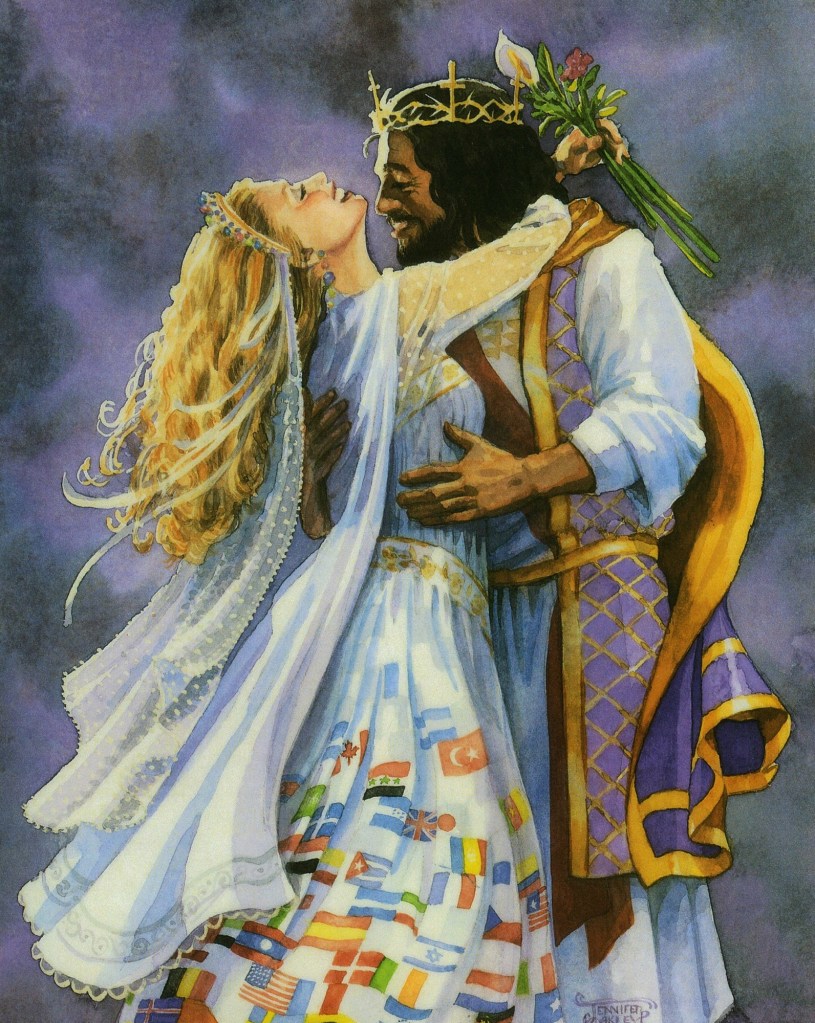
This painting needs to be paired with this song:
If you haven’t figured out yet, the epic story of Redemption is the greatest love story ever told. It’s the reason that within the heart of every man there is an innate desire to fight the dragon, look death in the eye and defeat it to rescue the princess. It’s the reason that within the heart of every woman there is an innate desire to be pursued and rescued and cherished. The Enemy has been working overtime of late to remove or twist beyond recognition those desires.
But… all the way back at the time of the Sons of Korah, (and of course even before), our unstoppable Redeemer knew exactly how the end of the story would be. He is, after all, the Author and Publisher of our story of Faith. And He describes the Bride in all her glory not only here in Psalm 45 and in Revelation 19 but also here:
“Husbands, love your wives, as Christ loved the church and gave himself up for her, that he might sanctify her, having cleansed her by the washing of water with the word, so that he might present the church to himself in splendor, without spot or wrinkle or any such thing, that she might be holy and without blemish.
‘Therefore a man shall leave his father and mother and hold fast to his wife, and the two shall become one flesh.’ This mystery is profound, and I am saying that it refers to Christ and the church.”
Ephesians 5:25-27, 31-32 ESV
🥰
PSALM 49

In Psalm 49 there are two groups of people when it comes to death:
- The Upright who are ransomed from the Grave by the LORD.
- Everyone else.
It opens with a call to listen up and a rather cryptic statement in verse 4 about untangling a tricky riddle with a harp.
😃 Ooo! Ooo! I love riddles. What five-letter word becomes shorter when you add two letters to it?
I don’t think it’s that kind of riddle…
😏 You’re not gettin’ out of it that easy. C’mon…
(Sigh) Let’s see… five-letter word that gets shorter when you add two letters?
😏 Yeah. A five letter word that becomes shorter when you add two letters to it.
I don’t know. You got me on that one. What is it?
😆 Short.
😑 Like I said, this isn’t that kind of riddle. It’s a puzzle, a tricky proverb or maxim. It comes from a root word that means “knot.”
If I were to retell this psalm in a riddle-like form, it might go something like this…
In ancient Israel, a rich man, a poor saint, a wise man, a fool, and a brute all died in a bandit attack and woke up in the grave.
The rich man tried to buy his way out. The Gatekeeper said, “All your wealth isn’t even close. And besides, the bandits stole your treasure and are already busy spending it.”
The wise man tried to reason his way out. The Gatekeeper said, “Surely your wisdom tells you it is better for you to accept your fate than to live longer to see more trouble.”
The fool asked where the entertainment was.
The brute complained that it was too quiet and boring.
Only the poor saint sat patiently waiting.
The Gatekeeper asked why he was so composed.
“My riches and wisdom and most glorious thrills are yet ahead of me,” he said.
“But you’re dead,” said the Gatekeeper.
To which the saint replied, “Not for long.”
This whole psalm hinges upon this verse:
“But as for me, God will redeem my life. He will snatch me from the power of the grave.”
Psalms 49:15 NLT
This is a proclamation of the resurrection. We have the benefit of the Gospels and the whole New Testament and knowing how Christ accomplished redemption and how the saints will rise from the dead. That was still a pretty big mystery in the OT. The faithful trusted it would happen. Somehow. No idea how.
Before the redemption accomplished by Jesus, the souls of the dead did not ascend into heaven. The souls of the OT saints waited in “Abraham’s Bosom,” “Paradise,” “Sheol,” “The Grave.” It was a place of comfort for the faithful and torment for the wicked according to Jesus’ description in the account of The Rich Man and Lazarus (Luke 16:20-31). I’m in the camp that takes this as an actual account rather than a made-up parable.
Psalm 49 is affirming that the righteous dead will not be stuck in the grave forever. God is going to come get them out. And indeed He did when Jesus “led captivity captive” at His resurrection. Jesus accomplished the most epic jail-break ever. He sprung His faithful people out of the prison of Death. And that’s what this psalm is looking forward to.
Because of redemption, we who are in Jesus don’t have to sit in the waiting room of the grave when we die. According to Paul (2 Cor. 5:6-8), the souls of the redeemed go immediately to be in the presence of the Lord at death. It is only the body that goes into the grave.
I think this difference between where the soul went in the OT vs the NT causes a lot of people confusion. In the OT, the souls of the righteous dead went into a place called “Sheol” or “The Grave.” But, in the NT, the souls of the righteous can now go directly into the presence of the Lord at death.
Just remember when you’re reading and interpreting scripture that the redemptive work of Christ changed EVERYTHING – especially what happens to people when they die.
Fallen human souls CANNOT enter the presence of God. Full stop.
God is FAR too holy. His glorious holiness would incinerate you. And that’s not hyperbole. “Our God is a consuming fire.” Even the most powerful angelic beings, the Seraphim, cannot look at Him.
Only the perfect Eternal Son may approach the Father. And redemption brings us INTO the Son. We’re not His pal. We’re not His sidekick. The Church is His BRIDE. We are one with Him and made like Him. That’s the only way we can enter the presence of the Almighty.
The OT saints didn’t have that yet. So when they died, they had to wait. Everyone in heaven and on earth and even in the grave was waiting for the pivotal moment of Christ’s death and resurrection.
We don’t have to wait for that anymore. It’s done. What we’re waiting for now is His glorious revealing and return.
We don’t do soul sleep. Our bodies may wait in the grave but not our souls. The moment your soul leaves your body – if you are in Christ – you go to be with Him. Instantly. But the OT saints had to wait in the grave BOTH body and soul until the atonement of Jesus purified their souls to be fit for the glorious presence of God.
I hope that kinda helps explain some things.
We don’t need to take it with us. Nothing in this world could compare to what is waiting for us. We can let go of FOMO (Fear Of Missing Out). There are riches and fulfillment beyond our wildest dreams ahead of us.
We mustn’t stress out over others who seem to have it all. They will carry none of that success with them.
We need not envy the rich or the wise or the powerful of this world. We outrank them.
They may have it all now, but not for long.
 To The Reader