Both of these psalms are songs of praise.
I know the schedule has 2 Samuel 5 in the plan for today. That’s the part where David becomes king of all Israel. I’ll cover that tomorrow along with 1 Chronicles 11.
PSALM 103
The list of Yahweh’s benefits that starts the psalm is not exhaustive, but it is a GOOD one to remember:
- Forgives all your iniquity
- Heals all your diseases
- Redeems your life from the pit (death)
- Crowns you with loyal love and mercy
- Satisfies your life with good, so that…
- Your youth is renewed like the eagle’s
Some of these benefits (like redeeming life from the pit) happen only in part in this life. And while it is true that the righteous person – by virtue of living a clean, disciplined and moral life – may live longer than someone strung out on sin, the benefits of healing disease and having one’s youth renewed should be understood to not permanently be fulfilled until the resurrection of the saints. In fact, the ultimate fulfillment of this whole list is more part of the future kingdom than the present.
Passages like this (or any other for that matter), should not be ripped out of their context, stuck on the fridge, and taken as the full picture. Psalm 34:19 says “MANY are the afflictions of the righteous.”
🤔 So which is it? Is life satisfied with good or filled with affliction?
Yes.
🤔 Yes, what?
Yes to both. Life is not a one-note song. It is a layering of redemption and affliction and redemption and affliction and redemption.
☝🏼😃 Like lasagne! 🍽️
Uh… sure. Like lasagne.
😄 Well it is. Think about a lasagne. You have all those gooey layers that overlap and kinda get all mixed together. Life, like lasagne is both messy and good.
We’re waxing eloquent on baked pasta now. Charming.
😌 Bet you’ll never be able to eat lasagne again without thinking of affliction and redemption.
Probably not. Anyway… I think that…
🤔 I wonder which part of the lasagne is the affliction and which is the redemption?
☝🏼😊 I think the cheese should be redemption cause it’s on top and it covers everything and because… cheese. 🧀 Maybe the affliction part is making the lasagne. Very involved.
Ok… Can we tap the brakes on the lasagne metaphor? You’re making me hungry.
🤭 Oh. Sure. Carry on.
We have to take ALL of the scriptures together. There’s nothing wrong with writing a verse on a note and putting it somewhere to remind you of the Truth. But one verse does not contain the whole truth.
EXEGETICAL SIDE NOTE 🤓
There is a practice among some Christians to flag certain verses as the ultimate proof for whatever idea they’re teaching.
In some groups, people memorize these key verses and they can quote them (always taken by themselves out of context) and they can make their position sound very convincing.
This is called “proof-texting.”
Just having a verse or two to back something up is not how we establish sound doctrine. If I took Psalm 103:2-3 out of context and paired it with a string of other similar verses that speak of healing and blessing, I could convince someone that God has promised to heal every disease – yea, even every little hangnail – every time, no exceptions. I could use Psalm 103:3 as a “proof-text” for my concept.
People have left the faith because someone told them God would heal their mother and she died from cancer.
It’s more work and requires more humility and courage on our part, but let’s not oversimplify the word of God or the process of living out redemption as kingdom people in a fallen world.
This is very nuanced. I started trying to bullet-point it out and it got real big real fast. All I really want to say is:
Don’t Do Proof Texts.🤓
I find verses 8-13 so encouraging. In fact, compare verse 8 describing what Yahweh does and the text where He appeared to Moses and declared His name:
“Yahweh is compassionate and gracious, slow to anger and abundant in loyal love.” “But the loyal love of Yahweh is from everlasting to everlasting on those who fear him, and his righteousness to their children’s children, to those who keep his covenant and remember to do his precepts.”
Psalms 103:8, 17-18 LEB
“And Yahweh passed over before him, and he proclaimed, “Yahweh, Yahweh, God, who is compassionate and gracious, slow to anger, and abounding with loyal love and faithfulness, keeping loyal love to the thousands, forgiving iniquity and transgression and sin, and he does not leave utterly unpunished, punishing the guilt of fathers on sons and on sons of sons on third and fourth generations.”
Exodus 34:6-7 LEB
And since Yahweh is not only the God of humans, the psalm actually ends with a command to the inhabitants of the invisible realm:
“Bless Yahweh, you his angels, you mighty heroes who do his word by obeying the sound of his word. Bless Yahweh, all you his hosts, you his attendants who do his will. Bless Yahweh, all his works, in all the places of his dominion. Bless Yahweh, O my soul.”
Psalms 103:20-22 LEB
The psalmist sees himself as part of a much bigger picture both material and immaterial. What we see in the world is not all there is. In fact, it’s only a small subset of reality. The permanent reality is the part we cannot yet see.
Next time you’re in a group for worship, try taking a moment to imagine the invisible. It’s not just you and the people you see gathered. There are hosts of mighty warrior angels in the unseen realm blessing the name of the Lord too. We probably look like Hobbits next to them, but that’s ok.

PSALM 104
Psalm 104 opens with exactly the same line as Psalm 103: Bless the Lord O my soul. Only this one is focused on praising God for His wondrous creation.
When reading a text like this it’s very important to remember that the Bible is not a science textbook. While it is accurate in assertions about certain scientific claims (springs in the sea and paths for lightning for example), this psalm is divinely inspired poetry, not science. For example:
“He established the earth on her foundations, so that it will not be moved forever and ever.” Psalms 104:5 LEB
Does that mean the earth is sitting on a cosmic concrete slab rather than suspended in space? No. Because the scripture ALSO says,
“He stretches out the north over emptiness; he hangs the earth over nothing.”
Job 26:7 LEB
BOTH of these descriptions of earth are poetic. They capture different aspects of the physical reality that God made. Neither is trying to be a scientific statement.
The phrase “four corners of the earth” is another one that gets people in trouble. It’s poetry, not science. It’s a poetic way to refer to the 4 cardinal directions. It’s not a scientific claim that the earth is square and flat.
When reading biblical poetry we must remember that we’re getting a lot of similes and metaphors and even anthropomorphisms.
😳 An-throw-what-ism??!
An-thro-po-morph-ism. It’s when human characteristics are described for a non-human.
🤔 So like when it talks about God getting dressed with light like putting on a robe?
Yes. God is Spirit. Spirits don’t wear robes because they don’t have bodies. Sometimes the psalms will describe God as having hands or wings and feathers. He doesn’t ACTUALLY have hands or wings or feathers. It’s a way to describe an infinite, invisible Being in a way that we poor humans can understand.
😅 🔭 So I can put down the binoculars and stop trying to spot God riding around on a cloud-chariot? ☁️☁️☁️☁️☁️☁️☁️
Yes. That’s a way to communicate Yahweh’s dominance over creation.
🤔 But didn’t Jesus go up to heaven on a cloud? ☁️ ☁️☁️☁️☁️☁️
Yes. And that was very much on purpose to help the disciples connect Christ to the OT descriptions of Yahweh as the Cloud-Rider. That’s also why He will return “riding on the clouds.”
Back to Psalm 104… There are 3 foods mentioned: 🍷🫒🥖
“and wine that makes glad the heart of man, so that their faces shine from oil, and bread that strengthens the heart of man.”
Psalms 104:15 LEB
Jordan Rubin, author of the book The Maker’s Diet, has written a new book called The Biblio Diet with Dr. Josh Axe. In it, he looks at the foods mentioned in the Bible and one in particular is bread. The bread most people eat today will not “strengthen the heart of man.” It’s more likely to give you a heart attack. But back when Psalm 104 was written, bread was very different.
Again, this isn’t a scientific statement on nutrition. It’s a song lyric in praise of God’s creation- that He made wonderful things for humans to eat. The psalmist attaches a “why” to each food:
- Wine cheers
- Oil makes your skin shiny
- Bread gives you energy
And he doesn’t just praise the Lord for providing food for humans, he sings about God providing food for the animals too.
- Stork
- Wild Goats
- Rock Badger/Coney/Hyrax
- Lions
- Leviathan

Because cuteness!!
😳 Leviathan?! Wait! I thought that was a mythical creature… like a dragon.
Who told you dragons were mythical?
😰 What!
Well – the text doesn’t treat this “Leviathan” as a mythical creature. All the other animals in this passage are real. Leviathan is treated as real as the normal fish and the sailboats.
“There is the sea, great and broad, In which are swarms without number, Animals both small and great. The ships move along there, And Leviathan, which You have formed to have fun in it.”
Psalms 104:25-26 NASB2020
Leviathan could refer to an extinct animal or perhaps it’s a looser term for a large sea creature. And many of them DO like to play.



But there is some ambiguity in the Hebrew. Apparently the “leviathan” could be the one playing, or it could be this…
“There the ships sail. Leviathan is there that you formed to play with.”
Psalms 104:26 LEB
😲 So like… the ocean is God’s bathtub and instead of boats 🚤 and rubber duckies 🐥 He made whales 🐋 to play with?
According to several translation teams, yes, that is a legitimate way to read the Hebrew.
😯 Whoah… well I like it!
Me too. You know what that means right?
🤔 What?
It means that God likes to play. And that would make wholesome play and recreation a holy thing.
I think that people often lose touch with the ability to play. I don’t mean living in mom’s basement gaming for 8 hours a day. That’s not play. That’s addiction. I mean real get-out-and-create-something play. Get-out-and-explore play.
So we have this lovely psalm of how awesome God is for making an amazing creation, then we get this seemingly abrupt shift at the end:
“Let sinners perish completely from the earth, and the wicked not remain alive. Bless Yahweh, O my soul. Praise Yah.”
Psalms 104:35 LEB
It’s feels like this:
✊🏼😄 God is awesome.
🤩 Beautiful creation.
🥰 Wonderful animals.
😡 DIE YOU SINNERS, DIE!!!!!
🙌🏼 Praise the Lord.
Reminds me of that segment on Sesame Street “which of these things is not like the other one…”
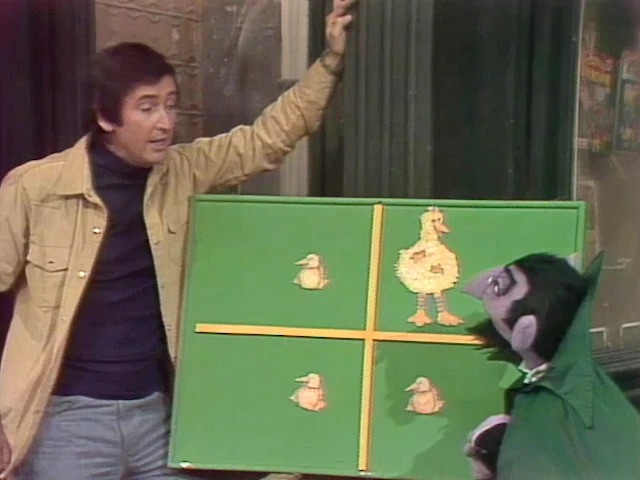
It might appear that verse 35 is the verse that doesn’t belong, but this is God’s Word. There are no mistakes here.
Let’s ask ourselves some questions.
(And don’t cheat. Take time to answer these.)
What was the natural world like before sin?
Was creation better, the creatures better-off?
Will there be a time when there are no sinners in the whole world?
And when is that?
What happens to the rest of creation at that point?
Might we once again have wolves living peacefully alongside lambs?
Ahhh… Might this verse have a bit of a prophetic flavor?
Oh and that final line, “praise the LORD” is actually this in Hebrew: hallel-oo-yah.
Hallelujah.
I hope you will prioritize the enjoyment of and care for creation. The beauty and wonder of God’s world is restorative to the soul – even while currently marred by death and the curse of the Fall. Imagine what it will be when creation is restored to its original glory.
🤩🥰😄
Here’s a song to sum it all up.
 To The Reader