What a glorious quintet of psalms to begin the week! They build upon each other and, taken together, lay out the journey for those who would follow in Jesus’ footsteps. 👣
Let’s go! (It’s kinda a long journey. Might want to pack a travel mug of coffee.)
PSALM 15
The summary of this psalm in my Bible says, “David describes a citizen of Zion.” It opens with the question of who will “dwell” or “abide” in God’s tent on the Holy Hill.
That’s an interesting question. Who exactly is qualified to live with God? When I read the list of perfect qualities that follow, I’m pretty sure that no one makes the cut. I mean, the first item on the list is:
“Those who lead blameless lives and do what is right…” (v2 NLT)
Blameless?
“Uh… Lord, You gonna be living all by Yourself cuz I’m pretty sure that “all have sinned and fall short of God’s glorious standard, Rom. 3:23.’”
Yet Jesus Himself emphasizes this idea of people living and dwelling with God just before He goes to the cross.
“In my Father’s house are many rooms. If it were not so, would I have told you that I go to prepare a place for you? And if I go and prepare a place for you, I will come again and will take you to myself, that where I am you may be also.”
“Jesus answered him, “If anyone loves me, he will keep my word, and my Father will love him, and we will come to him and make our home with him.”
John 14:2-3, 23 ESV
“Abide in me, and I in you. As the branch cannot bear fruit by itself, unless it abides in the vine, neither can you, unless you abide in me. I am the vine; you are the branches. Whoever abides in me and I in him, he it is that bears much fruit, for apart from me you can do nothing.”
John 15:4-5 ESV
Our Church sign this week says, “God wants full custody, not just weekend visits.” The Lord wants His people to live with Him.
I used to hear people talk about “a visitation from God,” in the sense of a powerful revival. The NT doesn’t use such language. He invites us to abide; to dwell. That word means to pack up the Uhaul and move in. (Well – ok… there isn’t really anything in the Hebrew of Greek about a Uhaul but you get the idea.) 🚚
But if the qualifications for dwelling with God are out of reach, what are we to do with this psalm?
While the qualities given are worthy of our aim (and I’ll come back to that idea later), I submit for your consideration that this psalm is not primarily about the saint but about the Savior Who sanctifies us.
Who else could claim to do all of this?
- Walks blamelessly
- Always does what is right
- Speaks the truth
- Never slanders or speaks ill
- Never harms his neighbor
- Never brings up things that would disgrace his neighbor
- Despises flagrant evil-doers, (does not excuse evil)
- Honors the faithful followers of the LORD
- Always keeps his promises – even when it hurts
- Lends without expecting “interest payments”
- Cannot be bribed
This perfect record could only be Christ’s. This is the record that Jesus shares with those who trust in Him.
His perfect record is yours and mine because we are IN Christ. Abiding.
Does this mean we put no effort into growing in grace? Does it mean we continue to live in sin? To quote the Apostle Paul, “God forbid!”
These qualities are attributed to us and we are invited and empowered to strive against sin and grow into these things so that they become a reality in our lives. This is not for attaining salvation (it’s a free gift) but of being conformed to the Savior.
The citizen of Zion is marked by holiness in:
- His WALK
- His WORKS
- His WORDS
There ya go. That’s some fancy Bible college alliteration for your Bible margin by verse 2.
😉
One more thought on verse 2:
“He who walks blamelessly and does what is right and speaks truth in his heart,”
Do we speak the truth IN our own hearts? I think we’re more likely to lie to ourselves than to others. We can pick up ideas along the way – beliefs about ourselves and assumptions about other people and what they think of us and what we have to do to gain or keep their affection. And the thing about believing lies is that you never know you’re believing a lie. If you knew it was a lie, you wouldn’t believe it. But the Lord knows. We can ask Him to expose the lies we have believed so we can disavow them – come out of agreement with them, so that God’s Truth may have full sway in our souls and we can be like Jesus and speak the truth- even in the innermost heart.
PSALM 22
I am inclined to believe (as some scholars propose), that Jesus quoted this entire Psalm from the cross. It’s so obviously about the crucifixion that you really can’t miss it. It’s as if the whole psalm is written in red letters.
Let’s look at a few of the key points.
“My God, my God, why have you forsaken me?“ Psalm 22:1 ESV
These are the exact words Jesus utters from the cross as He experiences, for the first time, a loss of fellowship with the Father.
“But I am a worm and not a man, scorned by mankind and despised by the people.”
Psalm 22:6 ESV
In case you missed the post back in Leviticus 14 on the scarlet yarn 🧶 for the tabernacle and the Scarlet worm, this is the text where the imagery of the blood-stained cross comes together with the picture of sacrifice to give life to one’s offspring. If you missed that one, or need a refresher, you should pause here and go back and read it to understand what kind of worm is in question. It’s amazing.
“All who see me mock me; they make mouths at me; they wag their heads; ‘He trusts in the Lord; let him deliver him; let him rescue him, for he delights in him!’”
Psalm 22:7-8 ESV
Compare:
“So also the chief priests, with the scribes and elders, mocked him, saying, ‘He saved others; he cannot save himself. He is the King of Israel; let him come down now from the cross, and we will believe in him. He trusts in God; let God deliver him now, if he desires him. For he said, ‘I am the Son of God.’” Matthew 27:41-43 ESV
Y’all…. VER-BA-TIM!
Somebody ‘splain to me how King David wrote the exact words spoken by random leaders of Israel ONE THOUSAND YEARS before they said them.
This is not and cannot be an instance of (what the skeptics like to claim) “prophecy” written after the fact. The OT was translated into Greek before Jesus was even born. Nobody went back and edited Psalm 22 to fit the events of the NT. And there’s no way these leaders would be quoting Psalm 22 on purpose here.
People who do not believe the Bible is the inspired Word of God Who knows the end from the beginning… I can’t help them. Here is incontrovertible proof. Why is this even up for debate?
And those Pharisee priests and leaders… Y’all, they KNEW Psalm 22. Ya think any of them realized they were saying it? I suspect they were too caught up in their obsession over stopping Jesus to notice themselves fulfilling prophecy.
“Many bulls encompass me; strong bulls of Bashan surround me,”. Psalm 22:12 ESV
🤔 Wait. So, there were cattle at the crucifixion?
No. No cows. Or bulls.
🤔 Then what on earth is this about?
Well, the hint is Bashan. Do you remember who lived there and Israel had to fight them?
🤔 Hmm… giants?
Yes. Giants.
😐 I think if there had been giants, or giant bulls, at the crucifixion at least one of the gospels would’ve recorded it.
🤔 Are you sure this isn’t just poetic language from David about bullies from the north?
It is poetic language for sure but this whole psalm is so prophetic we can’t just skip over this bit.
Bulls were strongly associated with gods in the OT. Remember the golden calf? Some of the Canaanite idols were human figures with the head of a bull. Like this:
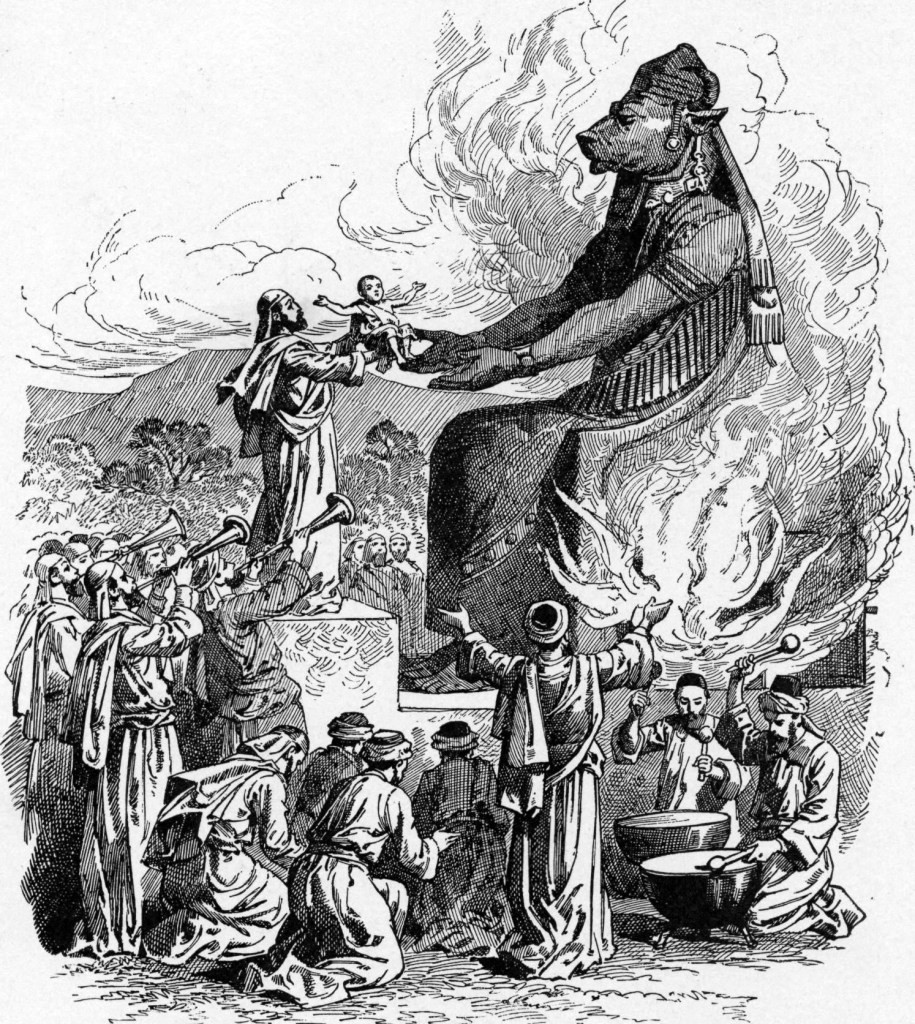
(And we ask why God said to kill these monstrous people.)
😳 So… you’re saying that bull-headed gods were at the crucifixion??? Pretty sure John at least would’ve put that detail in his Gospel.
John couldn’t record what no one but Jesus could see. What I’m suggesting is – this Psalm may be saying that there weren’t just crowds of humans watching the crucifixion. It seems to suggest that Jesus was also being surrounded by fiends of the unseen realm; demons and their fallen fathers. 😈👹👿👺
😧 Whoa. The crucifixion just got creepy.
We generally only think of the experience of the cross in terms of this earthly realm. But the demonic forces were very much aware of Jesus. He had been casting them out and taking territory back.
I could go on and on with the amazing details of this psalm – and even get into the medical suggestion of his heart “being like wax” and the cardiac condition that results and blood and water surrounding the heart… It’s just amazing.
Then we get the details about the pierced hands and feet and casting lots for his clothes. This psalm just stands like a formidable mountain in the way of anyone who thinks the Bible is not inspired. You cannot explain this level of detail away. Oh – by the way – crucifixion hadn’t even been invented yet when this psalm was written. David never conceived of a person having their hands and feet pierced and nailed to a cross. He’s writing prophetically about things he couldn’t even imagine.
Every syllable of Psalm 22 is prophetic of the crucifixion- and yet it is a psalm of David.
I’m not sure what life experiences inspired David to write this song with the tune of “Doe of the Dawn,” but it must’ve been one of his lowest points. He feels forsaken by God and scorned by men. But Yahweh has allowed this brokenness in David’s life so that he can produce this special fruit. How else could he write such agonizing words?
Could it be that our worst experiences, our sorrows, are a way for us to connect with the heart of God for a broken world? To know a bit of the sufferings of Christ? Or, as Paul put it, “to know Him in the fellowship of His suffering?”
Psalm 22 is the Mount Calvary Psalm. ⛰️
Psalm 24 is the Mount of Olives Psalm. ⛰️
Between the mountains we walk through the Valley of the Shadow of Death in Psalm 23.
- Psalm 22 – The Savior
- Psalm 23 – The Shepherd
- Psalm 24 – The Sovereign
These three form a trilogy.
🤓 Like the Lord of the Rings?
Well, actually, that not a bad comparison. The 3rd one is definitely about The Return of the King. Let’s look at them.
PSALM 23 🐑🐑🐑🐑🐑🐑🐑🐑🐑
There have been entire books written about these 6 verses. It’s some of the most beautiful writing in human history. Its translation in the King James Version is particularly epic.
It’s also the first scripture I memorized at the advanced age of 2.
🤯 Two?! You’re joking right?
Nope. I recited it in front of the church – which I also vaguely remember. No one had smartphones or YouTube back then or the video of a toddler reciting the whole 23rd Psalm would probably have “gone viral.”
😲 So you could say the 23rd Psalm – in King James – before you knew your ABC’s??
Uh…. Well… Yeah. I guess so.
🤔 You…are a freak of nature.
Why, thank you. 😌
🙄
So – I cannot remember a time when I didn’t know the 23rd Psalm. It truly feels like it is part of me.
But there was something in it that I learned in Bible college that I had forgotten until I opened my study Bible and read all the finely-penciled notes between the lines.
I also have drawings in the margins. Under Psalm 22 is Mount Calvary – with 3 crosses. The most elaborate miniature drawing is under Psalm 23 with a tiny shepherd – 3/10in tall… yes, I measured it just now – leading a single sheep (1/10in) through a desolate valley in shadow. Next to Psalm 24 is the Mount of Olives – with a tiny-but-kingly Jesus (also 3/10in tall) standing on the summit, scepter raised.
Anyhoo… That is neither here not there. I’m just particularly fond of those drawings. 🥰
Did you know that tucked into Psalm 23 are the 8 “Jehovah” names of God? Well, you’re about to find out. Here we go.
- Jehovah Rohe (shepherd)
- The LORD is my shepherd.
- Jehovah Jireh (provider)
- I shall not want
- Jehovah Shalom (peace)
- He leadeth me by still waters
- Jehovah Rapha (healer)
- He restoreth my soul
- Jehovah Tsidkenu (righteousness)
- He leadeth me in paths of righteousness
- Jehovah Shammah (present)
- For Thou art with me
- Jehovah Nissi (victory banner)
- Thou preparest a table before me in the presence of mine enemies
- Jehovah Mekadesh (sanctifies)
- Thou anointest my head with oil
Isn’t that the coolest!?!?!
And speaking of cool… Eddie James’s version of Psalm 23 is worth a listen. It took a whole semester for our college chorale to learn it. Listen and you’ll see why. Incredible choral arranging and a fantastically tight rhythm section. Bass and drums are CRISP.
PSALM 24
This one is called The Mount of Olives psalm because both the Prophet Zechariah and the angel at the ascension said that Christ would return to the same spot where He ascended – the Mount of Olives. And this psalm hails the returning king by asking the gates be thrown open to the rightful ruler.
Verse 3 of this psalm asks a similar question to Psalm 15:
“Who shall ascend the hill of the Lord? And who shall stand in his holy place?”
Psalm 24:3 ESV
The answer here is shorter than in Psalm 15 – it lists 4 things:
- Clean hands
- Pure heart
- Doesn’t offer up his soul to idols
- Never lies
The list is shorter but, like Psalm 15, only Jesus can claim to have actually done all 4. He is qualified to ascend to the throne of Zion.
This psalm has an interesting structure. Sometimes Most of the time, we read the Bible to learn the content, so we might not notice or bother to look for structure. It’s there, but it’s often invisible until someone points it out. The structure is:
A, B, C (Selah)
A, B, C
A, B, C (Selah)
It’s 3 sets of 3. The A is a statement of Yahweh’s right. B is a question. C is the answer. You may want to write this in your Bible.
1A The earth is Yahweh’s, with its fullness, the world and those who live in it, because he has founded it on the seas, and has established it on the rivers.
1B Who may ascend the mountain of Yahweh? And who may stand in his holy place?
1C He who is innocent of hands and pure of heart, who does not lift up his soul to falseness, and does not swear deceitfully. He will receive blessing from Yahweh, and justice from the God of his salvation. Such is the sort of those who seek him, those who seek your face, even Jacob.
Selah
2A Lift up your heads, O gates, and rise up, O ancient doorways, that the king of glory may enter.
2B Who is the king of glory?
2C Yahweh, strong and mighty; Yahweh, mighty in war!
3A Lift up your heads, O gates, and lift up, O ancient doorways, that the king of glory may enter.
3B Who is the king of glory?
3C Yahweh of hosts, He is the king of glory!
Selah
I highlight this to point out that this pattern didn’t get here by accident. This is intentional.
PSALM 47
We’re at the completion of the journey that I mentioned at the beginning. 👣
✅ Psalm 15 set the qualifications for who could dwell in Zion (Jesus and those IN Him).
✝️ Psalm 22 showed us Calvary.
🐑 Psalm 23 led us through the life of the Shepherd’s flock – both in paths of righteousness and the valley of death to the house of the Lord.
🏰 Psalm 24 showed us the rightful King returning to Zion with the cry “Open the gates!”
👑 Psalm 47 is the enthronement and reign of the King over all the earth.
Psalm 47:1 is, incidentally, the ONLY verse of scripture that tells people to clap their hands. I find it rather odd that many Christians feel very comfortable clapping in Church but would consider dancing or shouting or bowing with faces to the ground to be a bit extreme. There are dozens of verses that exhort God’s people to shout and bow and dance yet we still hold back. And one lonely verse that says to clap and we act like it’s the only verse that tells us what to do in worship besides the ones about singing and making “a joyful noise.” If I started leaping and twirling in worship, I would have FAR MORE scriptural support for that behavior than I would for standing there and clapping. Let that sink in.
Ok. Let me go put that hobby horse back in the stall. 🐴 Moving on…
Psalm 47 fits very comfortably with the books of the prophets foretelling the reign of Messiah and Revelation 19-22. Some additional enthronement psalms you may want to note in your Bible are: 93, 96-99.
I was blessed to grow up in the 1980’s when “scripture choruses” were popular among Charismatics. You can learn a lot of scripture if it’s set to music.
Here is a recording of Psalm 47 by Hosanna Music back in the day. You should listen if for no other reason than to remember that horn sections used to be a thing in churches. Yours was a hot, happenin’ church if you had a horn section. Songs written in minor keys were also a thing. This one has horns in a minor key. Double blessing!
Ya know how the ‘80s looked like this?

Well that’s kinda how this version of Psalm 47 sounds. You could even don a sweatband and leg warmers and do some aerobics to the beat. There are worse ways to start the day.
Until tomorrow, friends.
 To The Reader