We’re going to cover a lot of territory today. I’ve got my mug of coffee at the ready. (My mug says, “All I need today is a little bit of coffee and a whole lot of Jesus.”) Amen to that. Buckle up, Pardner. Yeehaw. 🤠 ☕️
PSALM 39
We left off in the last post with a set of psalms from Book 1 which are mostly written by David. This one is also in Book 1 by David and it is for a man named Jeduthun who was “the chief musician.” Instead of analyzing the psalm, I’d like to take a closer look at the man to whom it was given.
His name possibly means “laudatory.”
🤨 Laudatory? I see you are in cahoots with Dr. James Strong again. Laudation. Laudatory. I still think you guys are making up words. Like – “I think I’ll just step into the laudatorium to do some laudatory laudation.”
☝🏼😌 I never said “laudatorium” was a word, though now that you mention it, that would be the PERFECT word for the place where people meet to praise the Lord. Hmm… I wonder if I can get it added to the dictionary?
😏 That shouldn’t be a problem. They’ll let anything in these days. Literally.
The name Jeduthun seems to be connected to the Hebrew word yadah.

The first mention of Jeduthun is simply his name listed in a genealogy in 1 Chronicles 9:16. We start to get more information about him in 1 Chronicles 16. We learn that his sons are gate-keepers at both the Tabernacle of David and the Tabernacle of Moses (which was still the place of sacrifice) on the high place in Gibeon. Jeduthun and Heman were the musicians there along with their sons (and daughters! Heman’s 3 daughters were apparently involved too, see 1 Chron. 25:4-6).
Jeduthun was able to play multiple instruments. (Laudation with the hands!) We know for sure he played the trumpet. And it’s the specific Hebrew word for the trumpets that were made of metal (like silver) and not the shofar (ram’s horn). He also played the cymbals. We learn in 1 Chronicles 25 that he also played the harp, lyre, and psaltery.
The harp or lyre seems to have been his specialty. And he didn’t just play it well, he played it prophetically. He accompanied prophetic songs with his stringed instrument and he taught all his sons and grandsons to do the same.
“David and the chiefs of the service also set apart for the service the sons of Asaph, and of Heman, and of Jeduthun, who prophesied with lyres, with harps, and with cymbals…
Of Jeduthun, the sons of Jeduthun: Gedaliah, Zeri, Jeshaiah, Shimei, Hashabiah, and Mattithiah, six, under the direction of their father Jeduthun, who prophesied with the lyre in thanksgiving and praise to the Lord.”
1 Chronicles 25:1, 3 ESV
This idea of prophetic music may be new to you but here it is in scripture – in the Old Testament even before the outpouring of God’s Holy Spirit on Pentecost wherein the Word of the Lord through the prophet Joel was fulfilled:
“‘In the last days,’ God says, ‘I will pour out my Spirit upon all people. Your sons and daughters will prophesy. Your young men will see visions, and your old men will dream dreams. In those days I will pour out my Spirit even on my servants—men and women alike— and they will prophesy.”
Acts of the Apostles 2:17-18 NLT
1st Corinthians 14 is the most densely-packed portion of scripture on the exercise of prophetic speaking in the whole of the Bible. Personally, I don’t think this gift of the Spirit is “optional” in the Church. Like – “Oh, we don’t do that kind of stuff in our church.” I’m not saying that every last person in the Church will have this gift, but if you read 1st Corinthians 14, you don’t come away from it feeling like it’s some rare thing accessible only to a handful of saints. Here are a few highlights from that chapter (which follows the famous “Love Chapter.”)
“Let love be your highest goal! But you should also desire the special abilities the Spirit gives—especially the ability to prophesy.
But one who prophesies strengthens others, encourages them, and comforts them.
I wish you could all speak in tongues, but even more I wish you could all prophesy. For prophecy is greater than speaking in tongues, unless someone interprets what you are saying so that the whole church will be strengthened.
In this way, all who prophesy will have a turn to speak, one after the other, so that everyone will learn and be encouraged.
So, my dear brothers and sisters, be eager to prophesy, and don’t forbid speaking in tongues. But be sure that everything is done properly and in order.”
1 Corinthians 14:1, 3, 5, 31, 39-40 NLT
I do not believe that “the gift of prophecy” should be equated with “the gift of gab.” Many people – even rank heathens – can speak well. Paul said that the gift of prophecy was a special ability that the Holy Spirit gives. This is not a natural gift, but a supernatural one. If a person does not have the Spirit of the Lord dwelling within him, how can he do a thing that is a “special ability” given by the Holy Spirit?
Jeduthan prophesies in song. He sings these Spirit-directed words: declarations in praise of God’s greatness and inspired statements of thanksgiving and prayer. And he accompanies these songs with his own hands playing a stringed instrument.
There is something powerful about music. Just look at this instance: The prophet Elisha has been summoned by wicked King Joram of Israel and good King Jehoshaphat of Judah to give them direction from Yahweh on an impending battle with Moab. Elisha has no interest in helping the likes of Joram who has never been faithful to, or interested in Yahweh.
“Then Elisha said to the king of Israel, “What do we have in common? Go to the prophets of your father and to the prophets of your mother.” Then the king of Israel said to him, “No, for Yahweh has called for these three kings to give them into the hand of Moab.” Then Elisha said, “As Yahweh of hosts lives, before whom I stand, surely if I was not regarding the face of Jehoshaphat king of Judah, I would have not looked at you nor even glanced at you. But now, bring me a musician.” It happened that at the moment the musician played, the hand of Yahweh came upon him.”
2 Kings 3:13-15 LEB
See how powerful music is? The musician plays, Elisha receives the word from Yahweh and the battle is won.
That’s why music should not be taken lightly in the Church. It isn’t entertainment to make you feel good or a Christian pep-rally to get you hyped up. If you think anything even close to that, let me be clear:
YOU ARE COMPLETELY WRONG.
And you need to throw those ideas out the nearest window and go to the scripture and let it inform you of the role and purpose of music in worship.
Jeduthun, Heman and Asaph understood worship. They were inspired by God to compose holy scripture. We ought to pay attention to how they approached music.
It was priestly service. They were Levites. And they had to meet the qualifications for entrance into sacred space. In Christ, the whole congregation is a royal priesthood. But just because someone “attends services” that doesn’t make them a priest. I do not care if the world’s most incredible musician or singer asked to be part of the praise team, if they aren’t a member of the priesthood, the answer is “Absolutely not.” Because this isn’t a concert. It’s worship. It is entering into spiritual sacred space and no amount of talent compensates for a lack of holiness and purity that only comes from being in right relationship to our Righteousness – Jesus.
Jeduthun participated in the dedication of the first Temple. This was arguably one of the most powerful manifestations of God’s presence on earth along with Mount Sinai and the Day of Pentecost.
“Then the priests left the Holy Place. All the priests who were present had purified themselves, whether or not they were on duty that day. And the Levites who were musicians—Asaph, Heman, Jeduthun, and all their sons and brothers—were dressed in fine linen robes and stood at the east side of the altar playing cymbals, lyres, and harps. They were joined by 120 priests who were playing trumpets. The trumpeters and singers performed together in unison to praise and give thanks to the Lord. Accompanied by trumpets, cymbals, and other instruments, they raised their voices and praised the Lord with these words: “He is good! His faithful love endures forever!” At that moment a thick cloud filled the Temple of the Lord. The priests could not continue their service because of the cloud, for the glorious presence of the Lord filled the Temple of God.”
2 Chronicles 5:11-14 NLT
Solomon prays and then fire comes out of heaven and consumes the sacrifices on the massive altar. What an amazing experience!
And yet Jeduthun’s story isn’t over. He was a man who instilled loyalty to Yahweh in his family. Every time in Israel’s history when the nation repents and returns to Yahweh and restores worship at the Temple, Jeduthun’s descendants are there leading the way with their music.
“From the family of Heman: Jehiel and Shimei. From the family of Jeduthun: Shemaiah and Uzziel. These men called together their fellow Levites, and they all purified themselves. Then they began to cleanse the Temple of the Lord, just as the king had commanded. They were careful to follow all the Lord’s instructions in their work.” 2 Chronicles 29:14-15 NLT
This was in the days of King Hezekiah; about 250 years after Jeduthun helped dedicate the Temple. The Temple had been polluted and worship neglected. It took the priests and Levites 16 days to haul out all the junk, clean the place top to bottom, and set everything to rights. They restored regular worship and song.
Then, after nearly another century (and the wickedest king in Judah’s history) the Temple is again a wreck. Then young King Josiah comes to the throne and orders the restoration of the Temple. Israel celebrates its first Passover in centuries. And whose instructions are the Levitical musicians following?
“The musicians, descendants of Asaph, were in their assigned places, following the commands that had been given by David, Asaph, Heman, and Jeduthun, the king’s seer. The gatekeepers guarded the gates and did not need to leave their posts of duty, for their Passover offerings were prepared for them by their fellow Levites.”
2 Chronicles 35:15 NLT
And Jeduthun’s influence doesn’t end here.
Five hundred years after his death, Jeduthun’s descendants have returned from the Babylonian Captivity. And they are back in their place at the new Temple, assisting in worship.
“Also Mattaniah son of Mica, son of Zabdi, a descendant of Asaph, who led in thanksgiving and prayer. Also Bakbukiah, who was Mattaniah’s assistant, and Abda son of Shammua, son of Galal, son of Jeduthun.” Nehemiah 11:17 NLT
What a legacy!
Even if you don’t play a harp (or a guitar), we can all take our roles as members of the Royal Priesthood seriously. It is a sacred honor. We can teach the next generation to do the same. We must. The Bible already shows us what happens when a nation lets true worship fall by the wayside. And it has huge geo-political implications.
We cannot go off in our own little corner and hide from a wicked world. The nations need the Light of the Gospel of Jesus Christ. Let’s be like this great and faithful man, Jeduthun who used his hands to play his instruments and serve the Lord.
2nd Samuel 8-9, 1st Chronicles 18
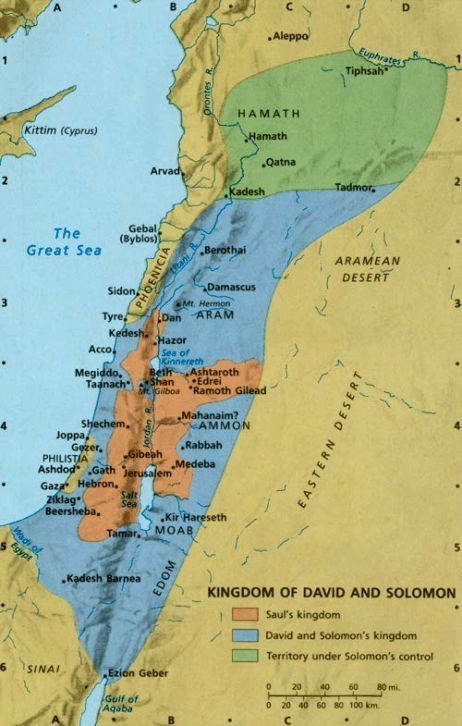
The narratives in 2 Samuel 8 and 1 Chronicles 18 are parallel. They give accounts of David’s military victories. He finally pushes out and back ALL the tribes that have been a problem for centuries; starting with the Philistines. He cuts off the head of the snake when he conquers their capital city of Gath – also the hometown of Goliath, also a place David had spent some time when on the run from Saul.
Then all the nations around them one by one come under David’s control. Just take a look at this map. The orange is the kingdom of Saul. Then look at how it explodes under David and Solomon…
David’s nephews Joab and Abishai are leading this illustrious campaigns. These 2 narrative chapters also give us the names and positions of David’s “presidential cabinet” as it were. His sons, the eldest of whom are grown young men by now, serve as chief ministers. The 2 Samuel passage has them as “priests” but this cannot be strictly so because you HAD to be a descendant of Aaron to be a priest. And the text even tells us who the priests were: Zadok (descended from Eleazar) and Abimelech (descended from Ibiathar). The parallel passage in 1 Chronicles 18 helps us out by saying they were “chiefs” or “chief ministers.”
2nd SAMUEL 9 – MEPHIBOSHETH
This story of how David honors his promise to Johnathan by showing kindness to his crippled son, is a beautiful picture of how Christ, the Son of David, reaches out in compassion and faithfulness to bring children of his Enemy to His table.
We have previously made note of how ancient kings would routinely kill every potential rival claimant to the throne to secure their position. David didn’t need to do that. For one, God had chosen him to be king and promised him a perpetual dynasty and two, his trust was in God to fulfill that promise, not human might. So David does something unheard-of. He brings a potential rival claimant to the throne to his own table.
And friends, that is exactly what Jesus does when He invites us to His table. The number one potential rival claimant to the throne of your heart isn’t Satan. It’s YOU.
Mephibosheth became a cripple in his childhood on the day the news came of the death of his father and grandfather and uncles. He was a boy who in a single day, lost all the important men in his life.
“Now Jonathan, Saul’s son, had a son who was disabled in both feet. He was five years old when the news of Saul and Jonathan came from Jezreel, and his nurse picked him up and fled. But it happened that in her hurry to flee, he fell and could no longer walk. And his name was Mephibosheth.”
2 Samuel 4:4 NASB2020
But we also come to Jesus crippled in our spiritual feet and unable to walk the way we’d like to. And how did that happen? There was thing that happened back in Genesis known as “The Fall.” The Fall happened on the same day that we lost our Father. Only He didn’t die. It was us. Humanity sinned and was separated from our Living Father.
At a more personal level, people are often wounded severely in childhood. It could be something traumatic like abuse or something less traumatic but still hugely impacting like not having a parent who is truly present for whatever reason. For many people, those crippling wounds come to define them and dictate their existence – just like Mephibosheth. But they don’t have to. This story is for you.
Mephibosheth was living in a place called Lo-Debar. Lo is the Hebrew word for the negative; like no or not. Debar means pasture or fold – like for sheep. So, no pasture. No sheepfold. It was a spot in the road. Not even enough of a town to have a pasture for sheep. It was west of the Jordan and south of the Sea of Galilee. It’s actually in roughly the same location as a place we encounter in the Gospels called Gadara or the land of the Gadarenes/Garasenes. That’s where Jesus encountered the man possessed with the legion of demons. And right there in the cemetery, Jesus expelled the demons and restored the man’s sanity.
And that’s where we lived before being invited to the King’s table. We lived in a cemetery. A demon-haunted place of no-pasture. We were lost sheep with no sheep fold and no Shepherd. Jesus knows this. Look what he said:
“And I have other sheep that are not of this fold; I must bring them also, and they will listen to My voice; and they will become one flock, with one shepherd.”
John 10:16 NASB2020
Jesus saw lost humans as “sheep without a Shepherd.” They don’t have a fold or a pasture. They live in no-pasture, no-fold, Lo-debar.
David “sent messengers” to bring Mephibosheth from Lo-Debar to the king’s home. Guess what word “messenger” means in Greek; that is, “one sent with a message.” It’s apostle.
The King of Kings sent messengers (apostles) with the message of the Gospel to bring the lost sheep into his home. You’re not “the black sheep of the family.” That blackness is sin. And it washes off in the atoning blood of Jesus.
Notice that when Mephibosheth comes before King David, he refers to himself in the same pejorative terms that David called himself to King Saul; a “dead dog.”
Jesus experienced being despised and rejected; being “a dead dog.” And He has compassion on those who come to Him in humility – the poor in spirit. Mephibosheth was not entitled. He was grateful.
Mephibosheth identifies himself as the king’s “servant” while simultaneously being served at the king’s table and having his needs provided for.
Those who are servants of Christ are actually elevated – not by men but by the King. Those who humble themselves are exalted. And the King sees to their needs.
Mephibosheth didn’t just eat a meal once in a while at the king’s table. He ate there regularly and was treated as if he were the king’s son.
This is the one that is the most amazing of all. We are invited to feast at the King’s table every day. And God Almighty adopts us and treats us as a son.
“On that day you will ask in My name, and I am not saying to you that I will request of the Father on your behalf; for the Father Himself loves you, because you have loved Me and have believed that I came forth from the Father.” John 16:26-27 NASB2020
“For you have not received a spirit of slavery leading to fear again, but you have received a spirit of adoption as sons and daughters by which we cry out, “Abba! Father!” The Spirit Himself testifies with our spirit that we are children of God, and if children, heirs also, heirs of God and fellow heirs with Christ, if indeed we suffer with Him so that we may also be glorified with Him.”
Romans 8:15-17 NASB2020
“See how great a love the Father has given us, that we would be called children of God; and in fact we are. For this reason the world does not know us: because it did not know Him.” 1 John 3:1 NASB2020
Let me leave you with this wonderful song by Leeland that will help you absorb this profound message: you are invited to live in the home of the king, to sit at His table and be one of His children. I pray that you will accept it. Accept Him and His love.
 To The Reader