Today’s reading puts one in mind of being on Mount Zion with the choir of Levites surrounding the Tabernacle of David.
All but Psalm 66 are attributed to David. That one has more of a 1st Temple vibe with its mentions of burnt offerings.
Pslam 69 is the overlooked Psalm 22.
Let’s get into them, shall we?
PSALM 65
If you ever want to look up these texts in the Septuagint, the link here will take you to a free online version. Just be forewarned that the Psalms are numbered a tad differently after Psalm 10. In the Septuagint Psalms 9 and 10are one psalm, so from 10 on, the psalms in the Septuagint are one number below how they are numbered in all other translations. So, 65 is 64 in the Septuagint.
Right out of the gate, in the opening line, we have a challenging translation. “Praise” (in this instance, laudatory hymns) is in Zion. But is the praise…
- “Due to You” (ESV)
- “Awaits You” (LEB, KJV)
- “Belongs to You” (NLT)
- “Becomes You” (LXX)
- “Silence” (NASB)
Here’s the Hebrew word:
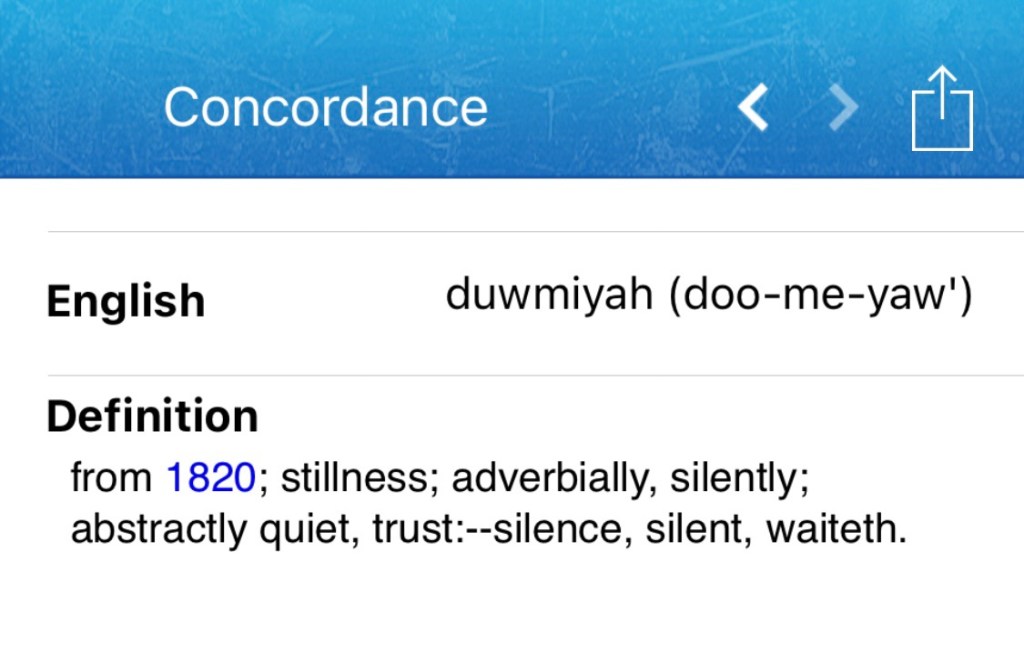
Besides its use here, this specific word only appears in 2 other places in the OT. It makes me think of a waiting room. Or perhaps even a bunch of people at a surprise party waiting for the guest of honor to arrive. I don’t think it’s a matter of contradictory ideas as much as it is a difficulty in finding one word in English that captures this idea that we simply don’t have a word for.
This about the surprise party again. Perhaps the party is for a man who has successfully launched a new company. The group gathers and waits for him to arrive so they can celebrate him. They may wait in silence. The celebration is “due to” their friend. It belongs to him. And it is fitting (becoming, well suited) that they celebrate him for his achievement. When he arrives they will “pop the cork” on all their pent-up praise and the party begins.
In Psalm 65 it’s as if David is reflecting on how Yahweh goes out to answer prayers and care for all of Creation, but Zion is His home. And when He comes home, His people are there to welcome Him like a wife receiving her husband home.
THAT is what praise and worship is supposed to be. It’s not a mere intellectual exercise of singing lofty theological hymns (though I absolutely love me some deep theological hymns!). It’s also not a party for US. It’s a party for HIM.
We love to roll our eyes at the characters in stories who think everything is about them. They are insufferable. It’s the spoiled child who complains about not getting what he wanted at another kid’s birthday party.
When we gather to worship the LORD, let’s always remember –
It’s not my party.
I get to enjoy it, yes. But it’s not FOR me.
I grew up during “The Worship Wars.” Some of you may be veterans of those wars. It was the traditional hymns vs the new praise choruses. Both sides mocked the other. Each thought the other wrong. They wrote books on it. Some churches split over it. Some accommodated. Like this:
- Traditional worship at 9:00 for the ones whose anthem was “ I Shall Not Be Moved”
- Blended Worship at 10:30 for the ones who didn’t have a dog in the fight, were open to both, or wanted to beat the crowd to Luby’s.
- Contemporary worship at 11:45 for the late risers and those who believed newer is always better (gotta have that fresh manna!).
Yeah – these different services weren’t “outreach.” It was a bunch of saints that couldn’t stand each other’s worship style.
I NEVER understood that war. Even as a kid I could tell it was about the grownups caring more about what they liked (in BOTH camps!) and giving up in frustration than finding a way to throw the kind of party that GOD wanted.
“Sing unto the Lord a NEW song” is a 3000 year old command. The Old Rugged Cross was once a “contemporary song.” The most accepted of “traditional music” was once new.
Did you know that Johann Sabastian Bach had the nerve to compose church music using (gasp!) forbidden 7th chords? And it was called “the Devil’s Music.”
If you listen to ancient and Medieval church music you can hear the development of harmony. It started out as chant; very few notes, then growing more complex. Single harmony notes began to be added. But there were a few intervals that were so dissonant that The Church forbid their use.
Then Bach came along writing music “Soli Deo Gloria” (solely for God’s glory) and he knew that life is not always “consonant” (stable and peaceful.) There is dissonance. The dissonance is uncomfortable. It pushes you to get through to what is called “resolution,” where the tension resolves and we are back to stability. It is this dissonance and resolution to consonance that moves music forward like the use of darkness and light moves the viewer’s eye around a painting.
If you zoom out far enough in time, the disagreements over music styles become frankly silly.
It’s not about style. It’s about genuinely pleasing the LORD. If you are doing that, then self-serving music of all styles will not find their way into worship. This is not rocket science. But it requires the DEATH of self. Let’s do that first. Then we can discuss music styles without having an axe to grind.
PSALM 66
Here is a fantastic rendition of the opening verses of this Psalm by Acapella.
Interestingly, the Septuagint’s heading for this Psalm says that it is “a Psalm of Resurrection.” The key verse seems to be 9:
“the one who has kept our soul among the living, and has not allowed our foot to slip.”
Psalms 66:9 LEB
But in the Septuagint, the psalmist doesn’t say that the Lord “kept our soul among the living.” It says the Lord “quickens my soul,” in other words – He makes my soul come to life. Not keeping me alive but making me alive.
I suppose it could also suggest the spiritual birth through faith in Christ – when the one who is “dead in trespasses and sins” is “made alive” together with Christ.
Verses 10-12 describe the refining of the saints through fire and flood and being brought out into “a broad place” or “a place of abundance.” And that is the reason for the sacrificial offerings.
It’s important (and extremely helpful!) in worship that as the “smoke” of our praise offering ascends, we know WHY we are offering it. And it needs to be specific.
“Come and hear, all you God-fearers, and I will tell what he has done for me.”
Psalms 66:16 LEB
If your praise feels kinda dull, perhaps it’s because it lacks focus. The ability to do 2 things at once is key for good worship. As you are singing (thing 1), you should also be thinking (thing 2) about the specific reason that you are giving this gift of praise.
You can even practice this right now.
What has God done for you? Think of something. It can be from a long time ago but recent is also very good. Pick something specific.
Got it? Ok.
Are you thankful? I bet so. Ok – now grab ahold of that gratitude in your heart. Hang on to it.
Is God good? Is He able? Did He come through for you? Do you trust He will continue to be good? Ok – gather all that up too. You should have a whole armload by now. Take a moment to really think about these things. Think about the hard stuff – the fire and flood, the loss and the brokenness. Next, think about how God led out to an open space and has made your soul alive and keeps you alive. This is your offering.
Now we need a fire to put our offering on. Pick a simple song to sing. Here are some ideas:
- Alleluia
- The Goodness of God
- I Love You Lord and I Lift My Voice
- Gratitude (for my younger readers)
- Great Is Thy Faithfulness (if you’re a die-hard hymnist)
Now… with your arms full of the hard experiences and the gratitude and the relief… sing.
Take your time.
Come back when you’re done.
🕰️
I think the reason that many people do not experience deep transformative worship that simultaneously blesses the LORD and blesses themselves is because:
they get more fixated on the fire than the offering that is supposed to go on it.
The songs (fire) are only a way to turn the thoughts and feelings and experiences of your heart (offering) into something that can be experienced. I like to say that when I worship, I’m making spiritual things audible. You cannot pour me a glass of gratitude. You can’t put it on a plate or in a box. You can’t see it, hear it, touch, taste, or smell it all by itself. But gratitude (and other things like adoration and trust) can be given tangible expression in many ways.
In the Temple, the fire turned rams and oxen into smoke that God found pleasing and meat that could be shared to nourish the body.
This is still what is happening in New-Covenant worship. It just doesn’t smell quite so much like a BBQ.
PSALM 67
This psalm is another one of David’s. And it opens with the Reader’s Digest version of the priestly Aaronic Blessing:
“May God be gracious to us and bless us. May he cause his face to shine toward us, Selah”. Psalms 67:1 LEB
Here is the unabridged version for comparison:
“Yahweh spoke to Moses, saying, “Speak to Aaron and his sons, saying, ‘You will bless the Israelites: You will say to them: Yahweh will bless you and keep you; Yahweh will make shine his face on you and be gracious to you; Yahweh will lift up his face upon you, and he will give you peace.’ And they will put my name on the Israelites, and I will bless them.”
Numbers 6:22-27 LEB
Somehow, by saying this over the people, Aaron was putting the name of Yahweh on the people. For the New-Covenant-Christian, the name of the Lord is put upon us when we are baptized into Christ. We bear His name – like a bride on her wedding day has her husband’s name placed upon her and she bears his name from that day forward.
Psalm 67 gives the reason or anticipated outcome of this blessing:
“that your way may be known on the earth, your salvation among all nations.”
Psalms 67:2 LEB
The whole point of being blessed, really is to be a blessing.
PSALM 69
This is like the lesser-known cousin of Psalm 22. It is a Messianic psalm. In it we find several prophetic details concerning Christ on the cross.
- V3 – Throat parched (Jn. 19:28)
- V4 – Hated without a cause (Jn. 15:25)
- V8 – Stranger to His own brothers (Mt. 13:57, Jn. 7:3-5)
- V9 – Zealous for God’s House (Jn. 2:14-17)
- V20 – No comforters in deepest sorrow (Mk. 14:34-41)
- V21 – Given gall (Mt. 27:34)
- This was not the same as the reference in John below. Gall was a very bitter substance extracted from wormwood or myrrh. It was used medicinally to relieve pain.
- In the Matthew reference, Jesus is offered gall mixed with vinegar immediately after reaching Golgotha. When he tastes it, he refuses to drink it. He rejects escape from the pain.
- V21 – Given vinegar (Jn. 19:28-30)
- This happens 6 hours later just before Jesus dies. It is not vinegar like the concentrated stuff we would use for cooking or cleaning today. It would’ve basically been “expired wine.”
- He “receives” this drink and says, “It is finished” and gives up the ghost.
In verses 23-28 there are curses upon the perpetrators of this unjust persecution. Then the psalm ends in a refrain of praise.
There are two places that talk about being saved from sinking into mud and water: verses 1-3, and verses 14-15. And it made me wonder…
When He was arrested, Jesus was first taken to the home of Annas the Father-in Law of Caiaphas the High Priest. Then he was sent to the home of Caiaphas. This is all happening at night. Caiaphas questions Jesus a little. Peter denies knowing him. The rooster crows. Jesus is led to Pilate. In the text this all happens within a few verses. But it actually took hours.
Early Church tradition held that Jesus was kept in a makeshift “dungeon” for some hours at the home of Caiaphas. The Jewish leaders didn’t want him escaping or his disciples to mount a rescue mission. So they lowered Jesus by ropes into an old cistern under the house.
I’ve been there. It was one of the most moving, speech-depriving things I’ve ever experienced.
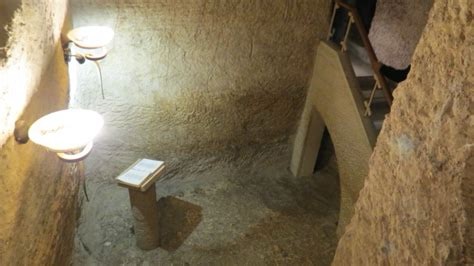
Archeological evidence supports the assertions of early church tradition – that Jesus could indeed have been held here.
He would’ve been lowered down from above. And if the cistern was… well… a cistern, it probably had some water in it. And sediment. It’s very possible – though we cannot confirm it with scripture – that verses 1-3 and 14-15 of Psalm 69 are ALSO prophetic of the sufferings of Jesus.
And they sure do sound a lot like the story of this man:

If you have a minute, go back and reread this Psalm as if Joseph wrote it.
I suspect that the “dry” cistern they threw him in wasn’t dusty. It probably had several inches of nasty sludge in the bottom.
The Caiaphas’ cistern may have even had a foot or two of water in it. Enough so you couldn’t lie fall asleep without risk of drowning. Sinking under water is that now-familiar OT metaphor for death.
This psalm works its way through prayers and petitions for rescue. But there really isn’t a clear answer to those prayers. And yet the psalmist praises the Lord anyway.
Jesus prayed that the cup of sorrow would pass him by. But it didn’t. The Father did not answer that prayer; just as He didn’t rescue Jospeh from being sold into slavery. But the outcome in both events was the salvation of many. And that is worthy of praise.
 To The Reader