Psalm 51 is David’s famous psalm of repentance in response to the visit from Nathan the Prophet when God confronted him about his sin with Bathsheba.
Rather than comment upon it, I’d like to put a musical setting of it on your radar – an arrangement by this man: Gregorio Allegri:

Gregorio Allegri was an Italian Catholic priest and composer. He had an excellent reputation as a virtuous and generous man. He composed this piece of sacred music sometime in the 1630s, to be used in the Vatican’s famous Sistine Chapel on Holy Wednesday and Good Friday of Holy Week. From liveabout.com:
“Pope Urban VIII loved the piece so much, that he forbid it to be performed elsewhere outside of the Sistine Chapel. For over 100 years, Allegri’s ‘Miserere mei, Deus’ was performed exclusively in the church. Anyone caught with a transcription of the piece outside of the chapel could be immediately excommunicated from the church. In 1770, a 14-year-old Wolfgang Amadeus Mozart was present at one of the performances while touring Italy with his father. After hearing the piece, Mozart transcribed the work entirely from memory. He attended one more performance to make his final adjustments. The following year, after meeting with music historian and biographer, Dr. Charles Burney, Mozart gave him the sheet music. Burney took the score to London and published it, which resulted in the papacy lifting its ban.”
Recent scholarship has cast some doubt on some details of the Mozart story but it’s fun anyway.
The piece covers Psalm 51. In the recording linked below (just click on the title in bold), the shorter version is performed with verses 1-6, then 17-19. I’ve included the Latin lyrics (in italics) and translation so you can follow along.
Listen with good headphones for the best experience. These singers are incredible! And this music, in my opinion, is among the finest art mankind has ever created.
Oh – and the super high note you’ll hear…That was actually created by accident by a copyist. But, (to quote Bob Ross), “there are no mistakes, only happy accidents.” And WHAT an amazing happy accident! I think the Almighty was like…
“Think I’ll just distract this guy and… oops! Well… What do ya know? How did that high C get in there?” 😏
Miserere Mei by Gregorio Allegri, c.1630s.
Choir:
Miserere mei, Deus: secundum magnam misericordiam tuam.
Have mercy on me, O God, according to Thy great mercy.
Solo:
Et secundum multitudinem miserationum tuarum, dele iniquitatem meam.
According unto the multitude of Thy tender mercies remove my transgressions.
Ensemble:
Amplius lava me ab iniquitate mea: et a peccato meo munda me.
Wash me thoroughly from my iniquities, and cleanse me from my sin.
Solo:
Quoniam iniquitatem meam ego cognosco: et peccatum meum contra me est semper.
I knowingly confess my transgressions: and my sin is ever before me.
Choir:
Tibi soli peccavi, et malum coram te feci: ut justificeris in sermonibus tuis, et vincas cum judicaris.
Against Thee only have I sinned, and done evil before Thee: that they may be justified in Thy sayings, and might they overcome when I am judged.
Solo:
Sacrificium Deo spiritus contribulatus: cor contritum, et humiliatum, Deus, non despicies.
Sacrifices of God are broken spirits: dejected and contrite hearts, O God, Thou wilt not despise.
Ensemble:
Benigne fac, Domine, in bona voluntate tua Sion: ut aedificentur muri Ierusalem.
Deal favorably, O Lord, in Thy good pleasure unto Zion: build Thou the walls of Jerusalem.
Choir:
Tunc acceptabis sacrificium justitiae, oblationes, et holocausta,
Then shalt Thou be pleased with the sacrifices of righteousness, with small and large burnt offerings,
All:
tunc imponent super altare tuum vitulos.
then shall they lay calves upon your altar.
PSALM 86
This psalm is similar in theme to Psalm 51. In it, David prays for deliverance and praises Yahweh’s mercies.
In this prayer, we again see the use of Yahweh’s revealed name:
“But you, O Lord, are a compassionate and gracious God, slow to anger and abundant in loyal love and faithfulness.”
Psalms 86:15 LEB
Compare:
“And Yahweh passed over before him, and he proclaimed, “Yahweh, Yahweh, God, who is compassionate and gracious, slow to anger, and abounding with loyal love and faithfulness,”
Exodus 34:6 LEB
David is praying God’s name back to Him. This is who Yahweh has revealed Himself to be and so David stands upon that revelation.
Do you do that in your prayer? I think perhaps we should. When we ask God for things, upon what basis do we do so? Let’s look at some potential “reasons.”
- I’m a Christian or I’m a good person
- I REALLY need it! (Or my friend does)
- “Lord, you said if we would ask, we would receive!”
- I’ve been faithful to give and I have faith that God’s gonna reward me.
These all place the basis for asking upon ourselves while David’s prayer in verse 16, “Turn and be gracious to me…” is based on the name and character of Yahweh.
The LORD says He is: “compassionate and gracious, slow to anger, and abounding with loyal love and faithfulness.” Therefore: I can expect Him to respond to me with compassion and grace, patience, loyal love and faithfulness. The LORD gives grace because He is gracious. The motivation comes from within Himself.
We are going to see this play out as we continue through Israel’s history. God will correct and rescue His people (as He has been doing all along) because He is faithful to His promises, NOT because anyone deserved it.
So if the Enemy tries to discourage you when you pray, perhaps include Psalm 86:15 in your prayer. Remind yourself and the powers of darkness Who Yahweh is and upon that basis, you can boldly and confidently ask and know you will receive God’s compassion, grace, patience, loyal love and faithfulness.
The Name of the LORD is powerful. Humans did not make it up. It’s Who God is. And He never changes.
PSALM 122
This is another of the short “Ascent Psalms” to be sung as the visitor walks up the hill to the Temple.
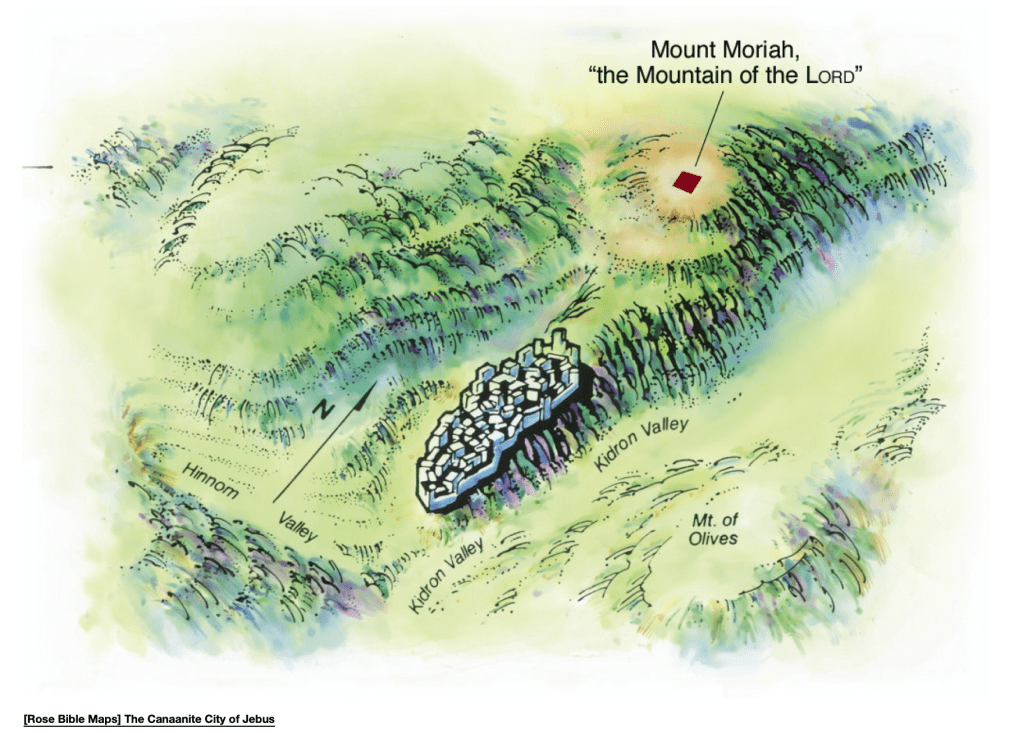
Mount Moriah is where Abraham went to offer Isaac and found the ram with the “crown of thorns.” You cannot get to the summit of Moriah without starting beneath and going up in elevation. This is the spot where the Temple will be built.
“Here stand the thrones where judgment is given, the thrones of the dynasty of David.”
Psalms 122:5 NLT
It’s as if David is visualizing all the thrones of his descendants into the future… But this line also makes me think of this scene in the Heavenly Jerusalem:
“Twenty-four thrones surrounded him, and twenty-four elders sat on them. They were all clothed in white and had gold crowns on their heads.”
Revelation 4:4 NLT
Perhaps David’s words have a touch of double meaning. I have no idea who the 24 Elders are. And neither does anyone else; no matter what they may say. Perhaps they are the 12 patriarchs and the 12 apostles. But they might not be. Would God enthrone Reuben and not Enoch or Noah or Abraham? Just sayin. Let’s not assume things. Anyway…
In verse 6 David says to pray for the peace of Jerusalem and then proceeds to do just that in the form of pronouncing a blessing of peace.
While there are several ideas about where the name Jerusalem came from and therefore, what it means; probably the most straightforward is Ir Shalem, or City of Peace.
Kind of ironic that one would have to pray for peace to be in Peace City. Jerusalem’s history has been anything but peaceful. I recall our tour guide pointing out bullet holes in the ancient walls from the 6-Day War in 1967.
The modern city of Jerusalem is a mishmash of centuries. There are walls built by the Crusaders on top of walls built by the Muslims on top of walls built by the Romans on top of walls build by the kings of Israel. Each built on the rubble of what was torn down in the previous conquest.
I think the name Jerusalem points to a couple things beyond itself.
- It is in Jerusalem that Jesus was crucified for the sins of the world and rose from the dead. This Divine atonement brought peace on earth and goodwill to men.
- It is from Jerusalem that the returned Jesus will reign over the whole earth bringing true world peace.
So even though Jerusalem has been far from living up to its name, City of Peace, in the historical (and even current political sense), it truly is the City of Peace for all those who are truly in Christ.
Real Christians of all races and languages and cultures can and do come together in peaceful fellowship every day in the world; because of what happened in Jerusalem. And in a way, the gatherings of true saints around the world carry the true culture of the City of Peace and model it to the world.
One day, the Eternal City, (which is NOT the Vatican but New Jerusalem), will show up.
“So he took me in the Spirit to a great, high mountain, and he showed me the holy city, Jerusalem, descending out of heaven from God. It shone with the glory of God and sparkled like a precious stone—like jasper as clear as crystal.
The wall was made of jasper, and the city was pure gold, as clear as glass.
The twelve gates were made of pearls—each gate from a single pearl! And the main street was pure gold, as clear as glass.”
Revelation 21:10-11, 18, 21 NLT
Revelation 21 describes the city in great detail. Chapter 22 goes on to tell about the River of Life and the Tree of Life growing there, freely accessible. It’s an amazing place. The chapters describe the righteous among the nations entering that city. And the LORD Almighty and the Lamb live there too among the Saints.
David’s tent on the mountain – with God dwelling among His people – is a prophetic picture of the future reality.
One of these days I FULLY expect to be living in this glorious golden city. And some saint is going to walk by as I’m munching on another helping of fruit from the Tree of Life whilst dangling my feet in the River, nose in a book. Maybe it’ll be one of my favorite women of faith from the Bible like Mary of Bethany or the Prophetess Deborah or Priscilla. Maybe it will be a whole group of all of them plus more. And they’ll say, “Let’s go to the house of the LORD!” And I will be very glad and I’ll get up and join them. Perhaps we will sing this Song of Ascent as we go.
If I have anything to say about it, it might sound a bit like this… ☺️
 To The Reader