Another Rebellion…
Last time, we left the tribes of Israel and Judah fighting over David. Into this unstable situation arises a guy named Sheba (which means 7), son of Bicri (youthful), of the tribe of Benjamin. He is never mentioned before or after this incident.
Sheba blows a ram’s horn and says,
“We have no portion in David, and we have no inheritance in the son of Jesse; every man to his tents, O Israel!”
2 Samuel 20:1 ESV
Talk about fickle! One minute the leaders of Israel are falling over themselves to be first to welcome David back across the Jordan River; even arguing with the leaders of Judah about having 10x the claim on David as king. The next minute they are rejecting David and stomping off in a huff.
It’s rather like we said before – two children fighting over a toy. Only, one of them throws the toy down and says, “FINE! I don’t want your stupid old toy anyway!”
David hasn’t even made it back home to Jerusalem yet, and there’s another rebellion happening.
In the midst of all this political upheaval, we have a very human moment.
The 10 concubines that David left to run the palace – the ones that Absalom basically raped on the roof…
Oh… 😳
It just hit me… David saw Bathsheba from that very rooftop… and he…
(sigh)
… 😔
“And David came to his house at Jerusalem. And the king took the ten concubines whom he had left to care for the house and put them in a house under guard and provided for them, but did not go in to them. So they were shut up until the day of their death, living as if in widowhood.”
2 Samuel 20:3 ESV
I find this both touching and very sad. Touching that they were provided for and protected, but sad that they were hidden away and never able to have homes and children of their own.
The ripple effects of sin are recorded for us so we will understand just how great an impact our choices have. Whether we like it or not, our choices affect other people. And other people’s choices affect me.
🤔 But why didn’t David keep them in his harem? I don’t mean to be rude but, isn’t that kinda the point of concubines? What difference does it make who they belong to? Aren’t they basically sex slaves?
They were concubines in the sense of they had responsibilities in the running of the palace, but they’re also called David’s “wives” by God through Nathan the prophet. So, I suspect that what David does for them has to do with this text:
“When a man takes a wife and marries her, if then she finds no favor in his eyes because he has found some indecency in her, and he writes her a certificate of divorce and puts it in her hand and sends her out of his house, and she departs out of his house, and if she goes and becomes another man’s wife, and the latter man hates her and writes her a certificate of divorce and puts it in her hand and sends her out of his house, or if the latter man dies, who took her to be his wife, then her former husband, who sent her away, may not take her again to be his wife, after she has been defiled, for that is an abomination before the Lord. And you shall not bring sin upon the land that the Lord your God is giving you for an inheritance.”
Deuteronomy 24:1-4 ESV
Those 10 women were David’s wives. He basically abandoned them. Absalom took them as his wives. Then he died. According to the law, David cannot have a marital relationship with them again. But he is good enough to take financial responsibility for them for the rest of their lives.
David sends his cousin and the former General to Absalom, Amasa, to gather the men of Judah to go after Sheba and shut down the new rebellion. But it looks as if Amasa was dragging his feet a bit. Amasa is supposed to be David’s new General in place of Joab.
The text doesn’t say that Joab was replaced because David found out that he killed Absalom, but I don’t know how a thing like that would’ve stayed secret for long. And I can’t think of another reason in that story for David to fire Joab; except for maybe Joab threatening to lead all of Israel away from him if he didn’t go out and congratulate the army on their victory and courage.
So David sends Abishai, his other nephew and second in command to stop Sheba. Joab is still handy with a sword so he goes along as a soldier with all the Mighty Men.
Just as Joab had used the sneaky tactic of setting up a friendly meeting in the gate to kill Abner, Saul’s General, so he fakes a friendly greeting to his cousin, Amasa, when he kills him with a hidden dagger. It’s a gruesome scene with Amasa lying on the road, slowly dying from a gut-wound.
And we’re not done with the gruesome, grisly scenes in this chapter. After mustering an army and cornering the rebel Sheba in a walled city, Joab makes a deal with a “wise woman” to not destroy the whole town in exchange for the head of Sheba – which is promptly taken from his shoulders and launched over the wall. 😳 Eww.
This ended the rebellion and things seem to settle back into some kind of new normal.
Chapter 21:1-14 is a VERY compelling narrative. It proposes an idea which would be considered preposterous to modern minds: that weather phenomena are linked to the breaking of covenant and its restoration.
🏜️🌵
Remember back when the people of Gibeon tricked Joshua and the elders of Israel into making a covenant of peace with them – with the old clothes and stale bread?
I’m sure you also remember the time when Joshua asked the sun to stand still. That was because Joshua and the army of Israel had come to defend the Gibeonites. Some other kings had heard they made peace with Israel and had come to attack them. And because of the covenant, Joshua went to defend Gibeon and God helped them win; even throwing giant hailstones from heaven.
It’s not recorded in the Bible, but apparently Saul ignored the covenant made with them and in his early zeal to drive any non-Israelites out of the land, he attacked the Gibeonites and killed some of them.
So Israel has a famine. For three years. And David asks the Lord why it’s happening. Josephus tells us that he makes this inquiry through the prophets and that the prophets bring the response from the Lord that the famine is a result of Saul’s breach of covenant.
Now, it’s been a LONG time since Saul’s error. Why a famine now – like 20+ (or whatever) years later? And why is David being “punished” for Saul’s sins?
I have no idea.
The best conjectures I can come up with are:
- There is some kind of time lapse between the natural and spiritual realms. We get hints of this in Daniel and the other prophets. Personally, I’ve sometimes prayed about things and felt a solid victory in the spirit that takes years to unfold in the natural. Perhaps it works that way for serious breaches of spiritual agreements too.
- Perhaps David is being held partly responsible because he’s done nothing to right this wrong even though he has been king for quite some time.
- I suspect that a generation has come of age since the attack on Gibeon. That may have something to do with it. Boys who lost their fathers are now men.
We may be tempted to scoff at the idea that the shedding of blood can affect the weather. What a primitive notion! But it may be that those “primitive” people understood some things about the supernatural realm that our modernist world has long forgotten.
The execution of 7 descendants of Saul by the Gibeonites as a retaliation for the deaths of their family members feels barbaric. And it kinda is. This is life before Christ. This was how things worked before the power of forgiveness entered the world.
Rizpah, now an elderly woman, had been a concubine of Saul’s. Two of her sons (by Saul) were chosen to be handed over. Her incredible demonstration of motherly love in keeping a brutal vigil over the bodies of her sons is absolutely unparalleled.
When David hears about it he is moved with compassion and not only sends to have the men’s remains interred in the family tomb but he also collects the bones of Saul and Jonathan and they are finally laid to rest together in the family tomb as well.
And, believe it or not, THIS act, barbaric as it seems to us, brings and end to the famine. 🌧️🌧️🌧️🌧️🌱🌱🌱
The skeptics will say it’s all just a coincidence and this is just ancient people being unenlightened and thinking they could make it rain by killing something. And I would be tempted to agree in most cases. Except that God Himself said that the reason for the famine was Saul’s breach of covenant and that when the retribution was paid, the famine ended.
I suspect we have a LOT to learn about the nature of the universe and how the world really works.
It makes me think of an interview I saw with Dr. John Lennox. He’s a mathematician and a Christian. He explained that if you walked into a kitchen and saw a kettle of water boiling on the stove, science can tell you a lot. You can measure the precise temperature. You can measure how much water is in the kettle and the rate at which it is boiling away. Based on that data and the size of the kettle you can gather a pretty accurate estimate of how much water there was to start and when it began heating. You can find out a LOT with science. And that’s wonderful. Science explains how the water in the kettle is boiling, but it cannot tell you why the kettle is boiling. Only the one who put the kettle on the stove can tell you it’s because he wanted to make a cup of tea.
Science can tell us the “hows” of the universe, but not the “whys.” Only the One Who made it can tell us that.
More Giants…
Everybody knows the story of David and Goliath, but nobody tells the story of David and Ishi-Benob.
The first time David goes to battle as a youth he faces a giant.
The last time David goes to battle, he again faces a giant.
I’m a bookish kind of gal. I like bookends.
Josephus adds the detail that David had put a group of Philistines to flight and was pursuing them alone and grew tired. That’s when Ishi-Benob, a descendant of the Raphaim giants came upon him. Depending on what you read, he was armed with…
- A new sword (Masoretic Text)
- A Club (Septuagint)
- A Spear AND a sword (Josephus)
In whatever case, the giant is wearing armor, and he has caught David alone. That’s not really a problem because… God. And also- it seems fitting that David’s first and last battles should be him facing a giant alone.
But instead of a smooth stone, this time God used good ol’ Abishai to save the day. (I’m tellin’ ya, that Abishai was some kind of warrior!) It was a close enough call that the troops told David it was time to hang up his shield. They couldn’t risk loosing him on the battlefield.
- Sibbecai kills Saph (and Josephus records that he also killed many other warriors who were bragging that they were descendants of the giants)
- Elhanan kills another Goliath (Josephus said that this was in single-combat)
- Interesting that Elhanan was also from Bethlehem like David. Josephus adds that he was a kinsman of David. And he slew a giant named Goliath in single combat too.
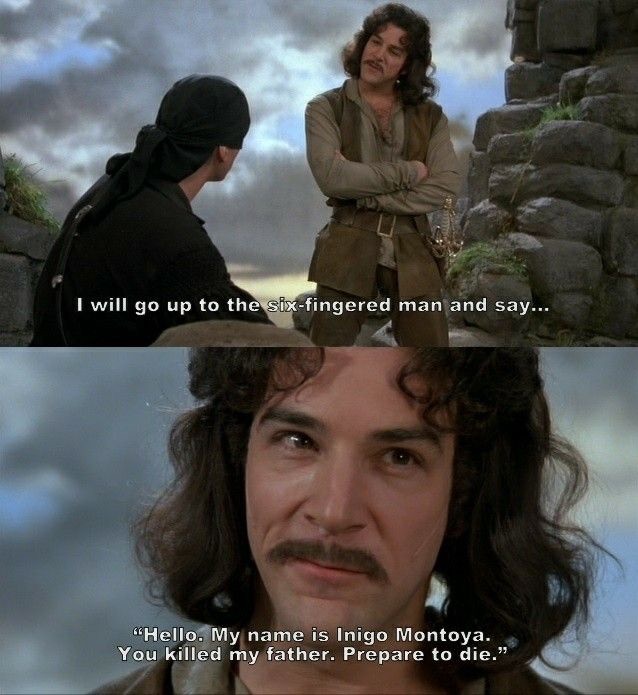
- Jonathan (David’s nephew) kills an unnamed giant with 6 fingers on each hand and 6 toes on each foot.
(And… because it’s been WAY too long since we last had a quote from The Princess Bride)


“These four were descended from the giants in Gath, and they fell by the hand of David and by the hand of his servants.”
2 Samuel 21:22 ESV
So now you know why David picked up 5 stones when he went to face Goliath. One for Goliath, and one for each of his cousins.
🪨🪨🪨🪨🪨
 To The Reader