😅 Oh my… is it warm in here? 🔥 These chapters are steamy indeed. 😶🌫️😳
🤔 Steamy? Sheep 🐑 grazing and more weird comparisons of hair to goats? 🐐
🙄 Oh dear. Do I have to spell it out?
🤔 Probably. I never was a good speller.
Hold on. We’ll get there but first, context.
There is a 3-fold refrain in Song of Songs. The Lexham English Bible puts this excellent heading above it, “Mutual Possession Refrain.” And that’s what is happening in these chapters. The couple in the song can’t get enough of each other and it seems that each (ahem) climactic moment – is marked with this refrain; from the bride. But the wording changes a little each time and shows a development in their relationship; or at least a development of her perspective. The last one does something special that links us all the way back to Eden.
REFRAIN 1
“My beloved is mine, and I am his; he grazes among the lilies.”
Song of Solomon 2:16 ESV
In this first refrain, the bride’s perspective is that 1) she possesses her man and 2) that she belongs to him.
🤔 And… he’s a sheep? Do sheep eat lilies?
😑 Sigh. Time for a spelling lesson I guess.
The lily has long been a symbol of the female because the shape of the flower closely resembles the female genitals.
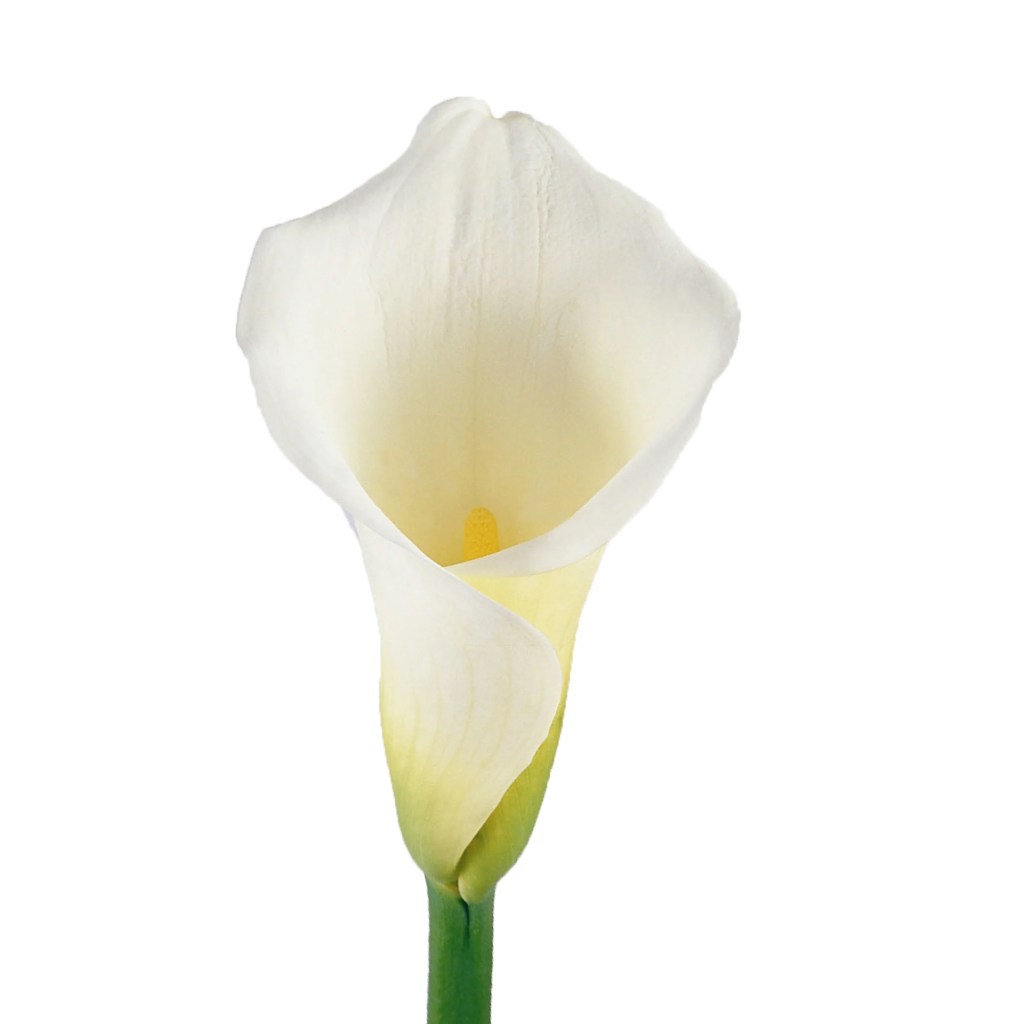
The happy bridegroom is… well… “grazing” (the term that comes to mind when imagining a sheep grazing is “nibbling”) to his and her heart’s delight.
😳 Oh….. Wait. THAT is in the Bible?!
Yes. And the following verse reveals something about the specific point of the bride’s pleasure.
“Until the day breathes and the shadows flee, turn, my beloved! Be like a gazelle or young stag on the cleft mountains.”
Song of Solomon 2:17 LEB
At the “cleft” of the “mountains” of a woman’s vulva is placed the most sensitive structure on her body (or any body) – the clitoris. It has over 10,000 nerve endings. The most sensitive and corresponding area for the man is about 1/3 of that number according to the latest research. As far as medical science knows, the sole purpose of the clitoris – is pleasure.
“I did that.” – GOD.
Now – back to the refrains…
REFRAIN 2
“I am my beloved’s and my beloved is mine; he grazes among the lilies.”
Song of Solomon 6:3 ESV
Since the last refrain the bride has had two dreams. In the first she is searching for her man and finds him. In the second she searches and does not find him and runs around the city in a panic until she meets some women who help her search for him and she finds him “in his garden.” Make of all that what you will.
Notice that in this refrain, instead of stating her possession of him first, this time his possession of her takes precedence. The order of thought is:
- I belong to him.
- He belongs to me.
And he is again (ahem) grazing in the lily.

Ok – before we get to the final refrain I want to address this verse in particular because I’m tired of hearing jokes about it.
“Your navel is a rounded bowl that never lacks mixed wine. Your belly is a heap of wheat, encircled with lilies.”
Song of Solomon 7:2 ESV
Recall Rule #1 from yesterday. He is not saying that her belly looks like a big ol’ heap of wheat. He says it IS a heap of wheat. Apply Rule #2. What is the essence of a heap of wheat? Let’s work this out.
🤓 If a farmer has a HEAP of wheat has the harvest been bountiful or poor?
👋🏼😃 Oh! Oh! Pick me! I can answer this one! It’s bountiful.
🤓 Correct. And if there is a bountiful harvest is the man poor or successful?
😃 He’s successful! And probably wealthy too.
🤓 Right. He has a treasure. And if the harvest is bountiful, would that imply that the land is drought-stricken and depleted or fertile?
😲 Oh….. He’s saying… oh….😳
REFRAIN 3
“I am my beloved’s, and his desire is for me.”
Song of Solomon 7:10 ESV
By this time, the bride’s only thought is being possessed by her man and the focus of his desire.
The word translated as “desire” is Tshuwqah (tesh-oo-kaw) and it literally means “a stretching out after.” In the context of Song of Songs, it’s probably as suggestive as you think it is. She can see and feel the physical manifestation of her man’s desire and arousal.
Interestingly, it is this word that connects us back to Genesis because tshuwqah is only used two other times in the Bible and they are:
“To the woman He said, “I will greatly multiply Your pain in childbirth, In pain you shall deliver children; Yet your desire will be for your husband, And he shall rule over you.”
Genesis 3:16 NASB2020
“If you do well, will your face not be cheerful? And if you do not do well, sin is lurking at the door; and its desire is for you, but you must master it.”
Genesis 4:7 NASB2020
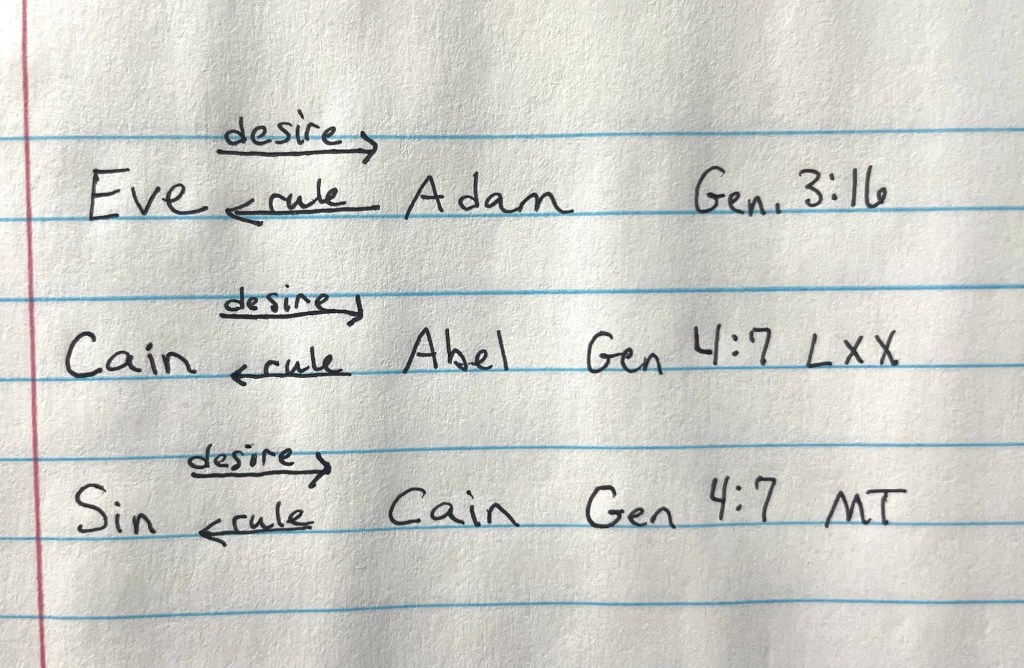
In both of these situations we have desire met with dominion (rule, master).
You might picture tshuwqah as a river overflowing its banks and reaching for higher ground.
God says to Eve that her desire will be for her husband and yet he will rule over her. This is not the original design any more than the curse on the ground and Adam’s fruitless fight with thorns and thistles will be. Eve will reach out in longing and be met with rule. (Keep this in mind)
In the passage with Cain in Genesis 4 it depends on which text you read (Masoretic or Septuagint) to determine who is desiring and who is ruling over whom. In the Septuagint, it seems as though the LORD is involving Abel in some way – like perhaps God is placing Abel over Cain in the same way He placed other younger sons over the older (Isaac, Jacob, Joseph, Judah, Ephraim). Cain has desire toward Abel (he is jealous of him) yet Abel will rule over him. And, in the eternal scheme of things, Righteous Abel will rule over the wicked Cain.
In the Masoretic Hebrew text, however, it is Sin – personified as animal – lurking at Cain’s door, desiring Cain in some way and Cain is charged by God to master it; to not let it have dominion but to exercise dominion over it.
We might diagram it out like this:
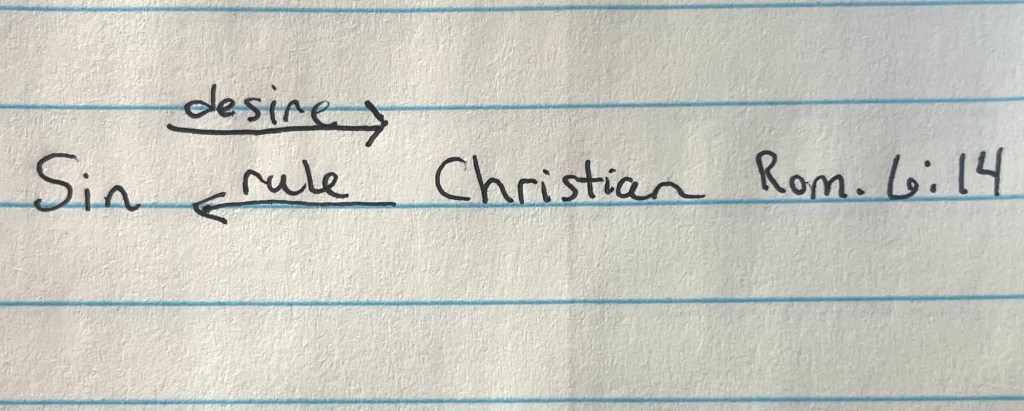
Paul picks up on this thread of mastering sin in his Epistle to the Romans. After explaining how salivation is a dying to sin he says,
“Therefore sin is not to reign in your mortal body so that you obey its lusts, and do not go on presenting the parts of your body to sin as instruments of unrighteousness; but present yourselves to God as those who are alive from the dead, and your body’s parts as instruments of righteousness for God. For sin shall not be master over you, for you are not under the Law but under grace.”
Romans 6:12-14 NASB2020
In the final Mutual Possession Refrain of the Song of Songs, the woman says that her Beloved’s desire is toward her. Instead of Eve desiring her husband and finding a ruler, instead it is the bridegroom desiring the bride. But there is no dominion in return; no ruling over. Instead there is only belonging. It is a hint (along with all the garden and mountain language) that Eden is restored. There is only mutual self-giving love and mutual, joyful service to one another. There is no dominion over one another. When the LORD gave dominion to the couple in Eden, it was over the Creation but not over each other. Here, in the height of married ecstasy, there is a “foretaste of glory divine.”
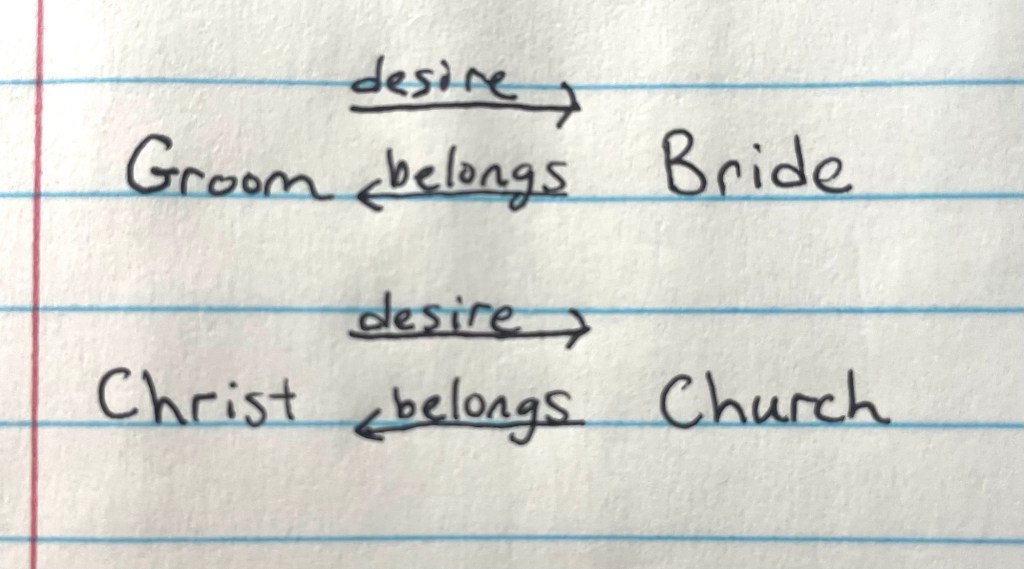
Christ does not eternally lord-over the church. He breaks the curses of sin. Desire is returned to the Groom making the Bride free to rejoice in being desired and possessed. It was the desire and initiative of Christ that made the Church His own.
“We love because he first loved us.”
1 John 4:19 ESV
“You didn’t choose me. I chose you. I appointed you to go and produce lasting fruit, so that the Father will give you whatever you ask for, using my name.”
John 15:16 NLT
The Church does not rule over Christ. She belongs to Him and becomes one with Him and shares His dominion over Creation. Through Redemption, Christ has conquered Sin and undone the effects of the Fall. And perhaps the progression of refrains in Song of Songs offers a small hint toward that.
I think, before we go, we might talk about the Hebrew word for “Beloved.” It’s dowd (rhymes with mode).
😐 Dowd? That’s not very romantic-sounding.
😏 For real, right? Can you imagine? The couple is getting all hot and bothered and she says, “oh! My dowd…”
😆🤣Bah-hahahahahahaha!
All right. That’s enough out of you two.
The letters are:
Dalet (door)
Vav (hook, tent peg)
Dalet (door)
Door + Door. Two tent flaps secured with one stake. Dowd is a broad term and not confined to sexual relationships. It can mean friend or close relative. It implies a close, trusted relationship.
Have you ever stayed in a hotel with adjoining rooms? That’s a door + door situation. In grand old estates, the master’s bedroom had an adjoining door to his wife’s suite.
The Bride, the Wife of the Lamb, will have an adjoining room with her Heavenly Husband. In fact, many rooms…
“In My Father’s house are many rooms; if that were not so, I would have told you, because I am going there to prepare a place for you. And if I go and prepare a place for you, I am coming again and will take you to Myself, so that where I am, there you also will be.”
John 14:2-3 NASB2020
You can call me silly, but I think that’s romantic. 🥰 🌹

 To The Reader