Many of the proverbs in these chapters are about a person’s relationship to money.
We see 2 kinds of people who have plenty:
- The crooked and greedy
- Hard workers who act wisely
We also see 2 kinds of poor:
- Those who are lazy and pursue fantasies and get-rich-quick schemes
- Those who are genuinely oppressed
The financial coach Dave Ramsey says that money is like an amplifier. It doesn’t change the nature of a person. It just exposes and amplifies what is already there. If you were a giving person before you got rich, then when you have wealth you’ll still be a giver but on a bigger scale. People call that philanthropy. If you were a jerk when you were broke, adding wealth only makes you a rich jerk.
Here’s a proverb that sounds an awful lot like a famous parable…
“The man who loves wisdom brings joy to his father, but if he hangs around with prostitutes, his wealth is wasted.”
Proverbs 29:3 NLT
I wonder if Jesus had this proverb in mind when he spun the tale of the Prodigal Son. It’s in Luke 15:11-32 if you want to compare them.
But Jesus takes this proverb – which offers no solution or redemption if the wrong path is chosen – and He kind of turns it around on itself. In the parable, the son who takes his inheritance and wastes it on prostitutes, returns home and (amazingly) brings joy to his father.
The audience listening to Jesus was probably astonished by the way He ended the story. They knew this proverb. The son who wastes his wealth on prostitutes is supposed to be the loser, while the son who loves wisdom is supposed to be the one who brings his father joy. But Jesus knew what He was about.
HE was the Man who loves wisdom and Who brings joy to His Father. And the sinful son who humbles himself to return is covered by the obedient Son’s faithfulness. All who humble themselves and return to the Father, are received with joy, not condemnation.
ECCLESIASTES
If you know a bit of Greek, you probably recognize the word ecclesia in Ecclesiastes.
Ecclesia means assembly. It comes from the words meaning to call out. Like, “Hey! Gather around! I have something to say!”
Ecclesiastes is the Greek term for the person who calls the assembly. The assembler. In Hebrew it is qoheleth, the “preacher.”

The assembler, the lecturer, is Solomon.
If this book had a mascot, it would be Eeyore.

The key verse of Ecclesiastes is:
“Vanity of vanities, says the Preacher, vanity of vanities! All is vanity.”
Ecclesiastes 1:2 ESV
This refrain is repeated several times. But what exactly does it mean?
If you watched cartoons in the 80’s you might remember this guy:

And “excessive pride in one’s appearance” is certainly the primary meaning of the word vanity. But the way it is used in Ecclesiastes is definition #3: “worthlessness, pointlessness, or futility.”
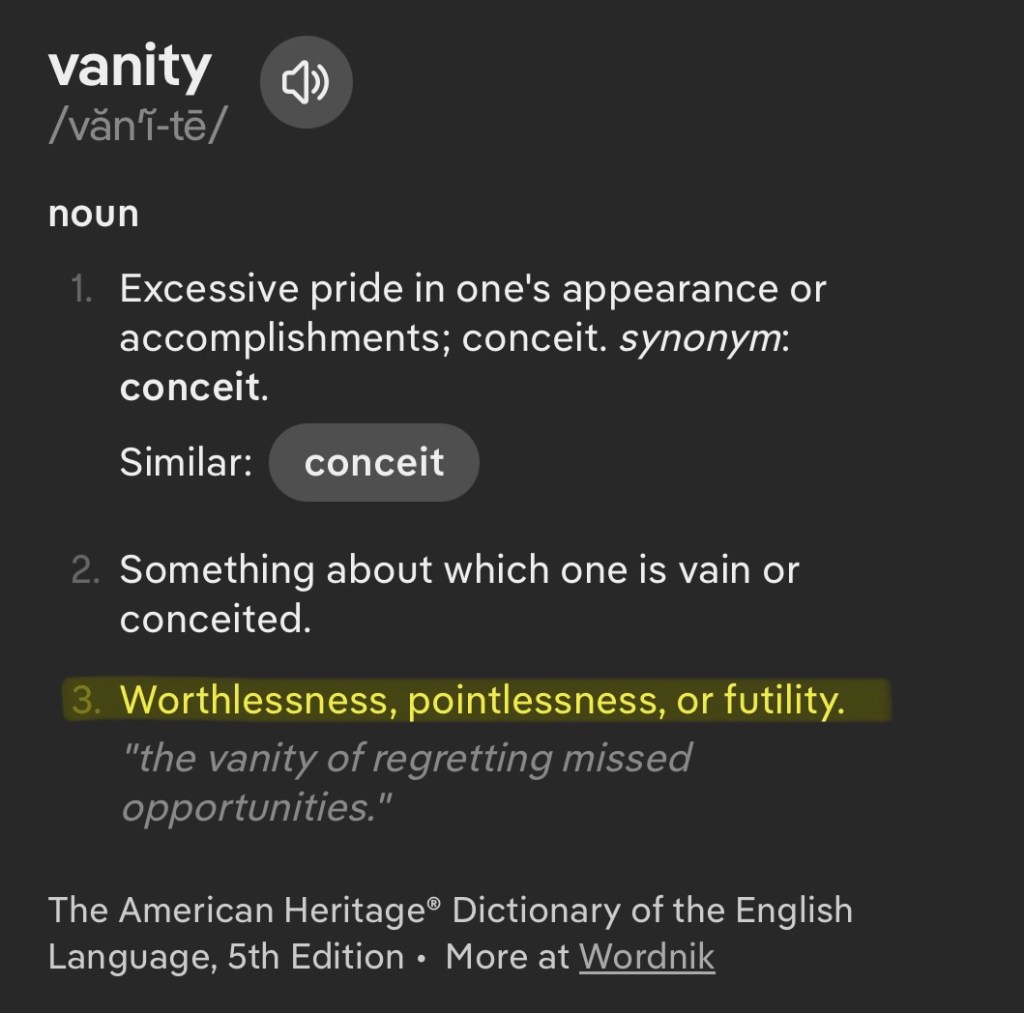
“Futility of futilities,” says the Preacher, “Futility of futilities! All is futility.”
Ecclesiastes 1:2 NASB2020
The NASB rendering is a little clunkier to read aloud, but it’s very clear on the meaning.
The Hebrew word is hebel.
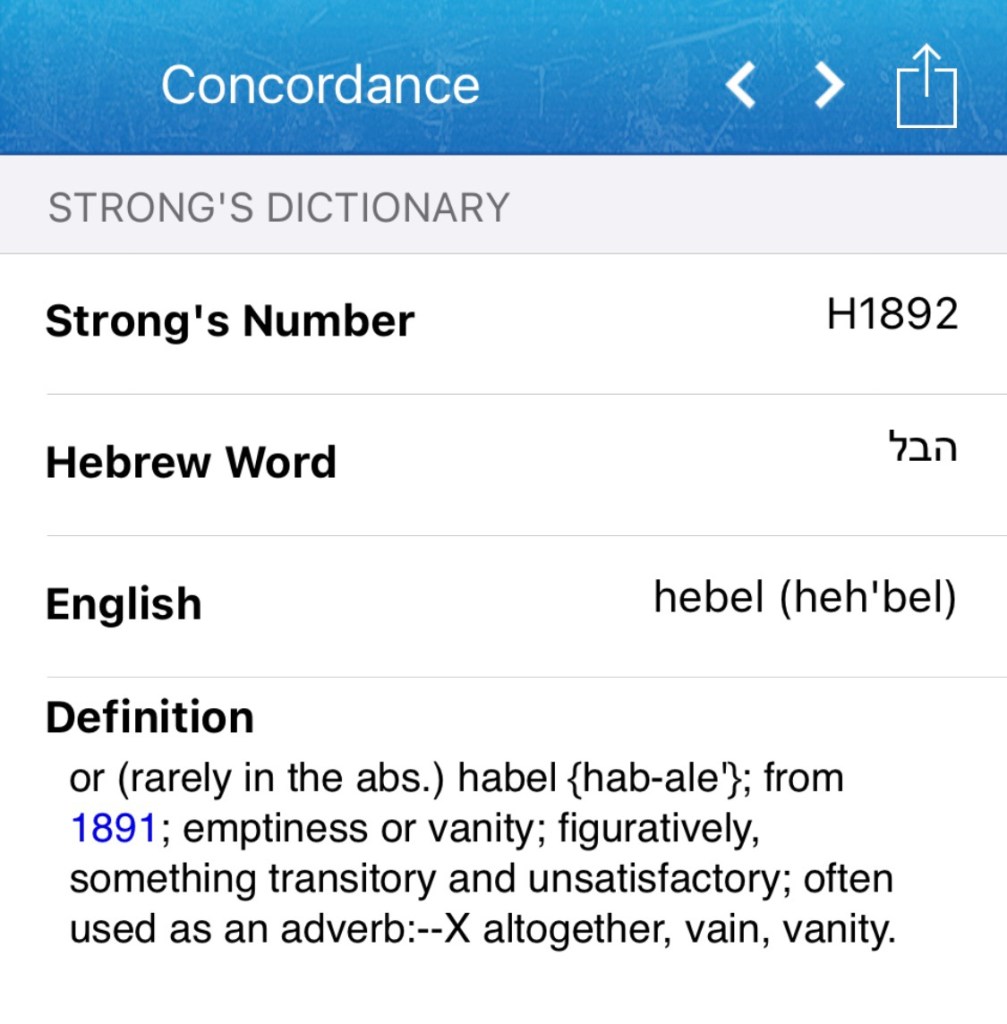
Let’s look at the paleo-Hebrew letters:
Hey – (picture: stick man), look!, behold!, reveal, life, man, existence
Bet – (picture: house), house, in/inside, within
Lamed – (picture: shepherd’s staff), staff, guide, toward, lead, teach, protect
Looking within for guidance = emptiness. It’s transitory. Not solid.
The world in general, and New Age Spirituality in particular, tells people to “look within” for guidance. Solomon did that. He spent years searching out wisdom and knowledge. He gained wealth. He indulged in every pleasure he desired. He did whatever his inner guide wanted. That’s how he figured out that it all ultimately leaves you empty.
The book of Ecclesiastes allows us to vicariously experience having it all and getting to the pinnacle and finding out there’s no “There” there.
This short video by The Bible Project is very helpful for understanding the book of Ecclesiastes. I highly recommend it.
 To The Reader