In general, I really enjoy the New Living Translation for the poetic books and wisdom literature. There are many idioms used in these books and the NLT’s thought-for-thought translation really excels with those. But – I take issue with the choice of word for translating the Hebrew word hebel. It’s often translated as “vanity.” The NLT has it as “meaningless.” But hebel doesn’t really suggest “without meaning.” The ancient scholars who translated the oldest Hebrew texts (which we no longer have) into Greek before the birth of Jesus chose this word to translate hebel: mat-ah-yot’-ace.
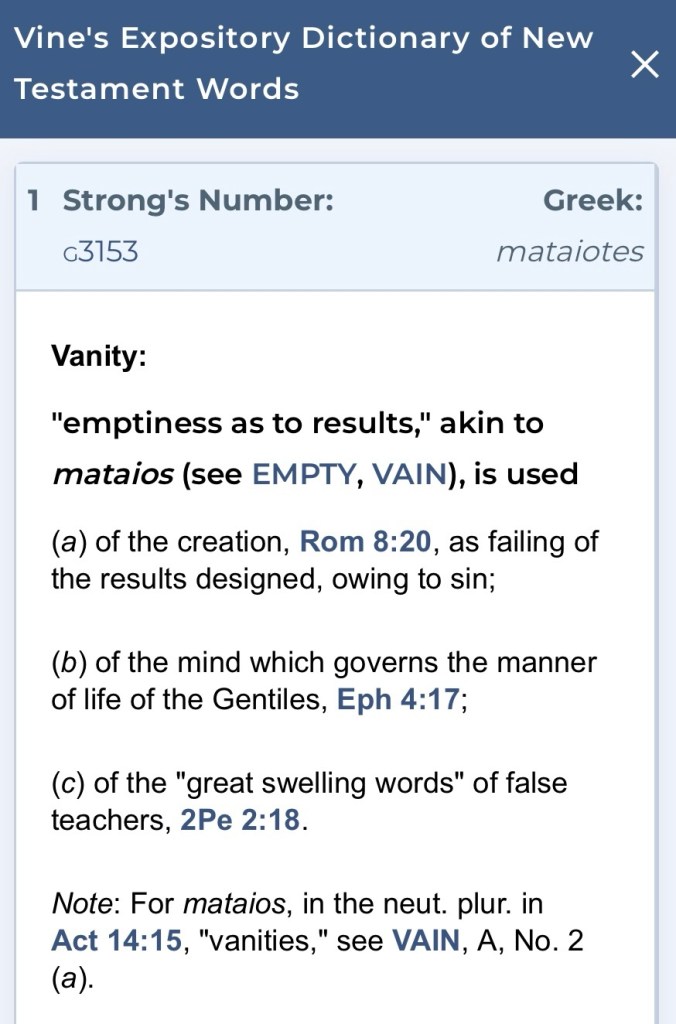
“Emptiness as to results.”
And you can see the references where the NT writers used this same word in various contexts.
There are two concepts coming together to help us grasp hebel. They are:
- Transientness: a) passing into and out of existence especially in a short period of time, b) passing through or by a place with only a brief stay [Merriam-Webster online dictionary]
- Emptiness of results a) empty, profitless, failing, weak, frailty
All of life – whether good times or bad is not meaningless, but it is transient. You go to bed one night as a 25 year old and you wake up the next day and you’re in your 70s.
We pass into and out of life under the sun in a short period of time. And so does everyone and just about everything else around us.

We used to sing a song about the transientness of life… “This world is not my home, I’m just a passin’ through…”
The Epistle to the Hebrews puts it thusly:
“All these people died still believing what God had promised them. They did not receive what was promised, but they saw it all from a distance and welcomed it. They agreed that they were foreigners and nomads here on earth.”
Hebrews 11:13 NLT
But hebel isn’t just about transientness. It also carries the idea of “emptiness of results.” All of the work and accumulation and experiences of a life limited to this world are also unable produce eternal results. Our best efforts fail. No amount of human effort can get humanity out of the pit it fell into that day in the garden. The Word of Yahweh had to come from outside and be born into the human family and He – Jesus Christ – alone was able where we were weak and ineffectual. His life, death, and resurrection got the results to pull humans out of the pit of death.
I am wondering if accepting transientness and emptiness might be the first step toward faith. You can’t trust in the Savior if you think you can save yourself or others. The first step in salvation isn’t “believe God loves you and has a wonderful plan for your life.” The first step toward salvation is despair. It’s realizing that there is nothing you can do to save yourself or fix the broken world. I think that’s why Jesus said:
“Blessed are the poor in spirit, for theirs is the kingdom of heaven.”
Matthew 5:3 ESV
Owning the Kingdom of Heaven begins with spiritual poverty.
It’s upside-down logic. As long as humans optimistically think “We can save ourselves. We can figure this out. We will achieve immortality” then they are lost. But once a person comes to the end of himself, realizes “all is futile,” and gives up in despair, that’s when he is finally poised to receive the grace of God.
I wonder if that’s the point of Ecclesiastes.
Recall that the name Ecclesiastes means “preacher.” Isn’t that the point of preaching? To make people aware of sin and the futility of their own self-righteousness? Look at Peter’s preaching in Acts 2. He brought the bad news before he brought the good news. And it was the bad news that made the crowd say, “What must we do to be saved?!”
I wonder if we have gotten so focused on the Good News (and obsessed with positivity) that we forget the importance of the Bad News. It’s crucial.
As we come to the end of reading through Ecclesiastes I have gained a whole new perspective on this book. I don’t think it’s meant to be depressing. I think it’s meant to get us to the end of ourselves so we will turn to the LORD.
I think it’s meant to help us be realistic about the human condition. We need to be brave enough to face the facts – that there is terrible injustice in the world, and sometimes idiots are in power while good capable people are working for minimum wage. That we are sinful. That everyone eventually dies.
The Epistle of James is the closest thing to Hebrew wisdom literature in the NT. Here’s what James said:
“How do you know what your life will be like tomorrow? Your life is like the morning fog—it’s here a little while, then it’s gone.”
James 4:14 NLT
The “eternity in our hearts” balks against this. One hundred years is not nearly long enough to live. (Though I will probably be ready to shuffle off this mortal coil when I have been on this planet for a century like my Grandmother.) We instinctively know that there is something wrong with the temporary, empty nature of human life under the sun. That’s because even if human minds have forgotten that we were meant to live fully and forever, the heart somehow has not forgotten.
But, oddly, the fact that it’s all very temporary is encouraging too. War? Temporary. Oppressive regimes? Temporary. Economic booms and busts? Temporary. Bad fashion trends? Temporary. (Ok. Sometimes they resurface like zombies.) 🪦🧟♂️🧟♀️🪦
I’m going to leave you with Mark Lowery to wrap up the gloomy Ecclesiastes with a smile and a bit of hope.
You may wonder in the first clip where on earth he’s going but hang in there. At about the 6min mark through the end (just under 9min) he touches on the themes of Ecclesiastes. I won’t spoil it by saying more than that.
The second link is Mark Lowery about 30 years after the first clip singing a song based on his comments from the first clip. Enjoy.
 To The Reader