The opening verse of Proverbs 30 is a little odd. The Hebrew names – Agur, Jakeh, Ithiel, and Ucal can also be understood as words and not names.
Agur (aw-goor) means “collector” or “to gather.” It could be a title rather than a name – like, the guy who collected these lists of wise observations.
Likewise, the other names might not be names. Remember that ancient Hebrew did not have any vowel markers like modern Hebrew. It also had no punctuation or capitalization. The ESV includes a footnote showing the alternate translation options based on if we are meant to understand the Hebrew word massa as a thing (usually translated as an “oracle,” or a “burden), or if it’s a place. Massa was the name of the place with the bitter water when Israel came out of Egypt.

The line about Ithiel and Ucal becomes a declaration of the Collector’s weariness depending on the vowels.
The Septuagint doesn’t include ANY names in its translation:
“My son, fear my words, and when you receive them, repent. The man says these things to those who believe in God, then I cease speaking.” – Prov. 30:1, LXX
It seems to be one of the very difficult passages that make me tip my hat to translation teams. It cannot be an easy job.
I’m going to land on the Hebrew word massa being intended to be understood as “oracle” and not the hometown or tribe of Jakeh. My reason is because Proverbs 30 and 31 seem to be a pair. Proverbs 31:1 also claims that it is an “oracle” of a “King Lemuel” that actually came from his mother.
Some scholars believe that the names Agur and Lemuel (which means “to/for God”), were pseudonyms for Solomon. And that may be. Solomon was a collector (Agur) of proverbs. And he was chosen to be set apart to God (Lemuel) to build the temple. If Lemuel is Solomon, then the oracle (divinely inspired declaration) of Proverbs 31 came from Bathsheba.
Or, Agur and Lemuel may be names or titles of other men who wrote or collected ancient wisdom. In either case, I still think that the use of “oracle” in each opening line links these last two Proverbs. If the LXX is right about Proverbs 30 being addressed to “my son,” then it is an oracle of wisdom from a father to a son. And Proverbs 31 is an oracle of wisdom from a mother to a son.
The father’s oracle includes a large section of lists of “4 things” and they are mostly from the animal kingdom. The mother’s oracle in Proverbs 31 includes a large (and rather famous) section on the ideal wife, known as “The Proverbs 31 Woman.”
Before we move on, I want to look closer at the word massa. It’s interesting.
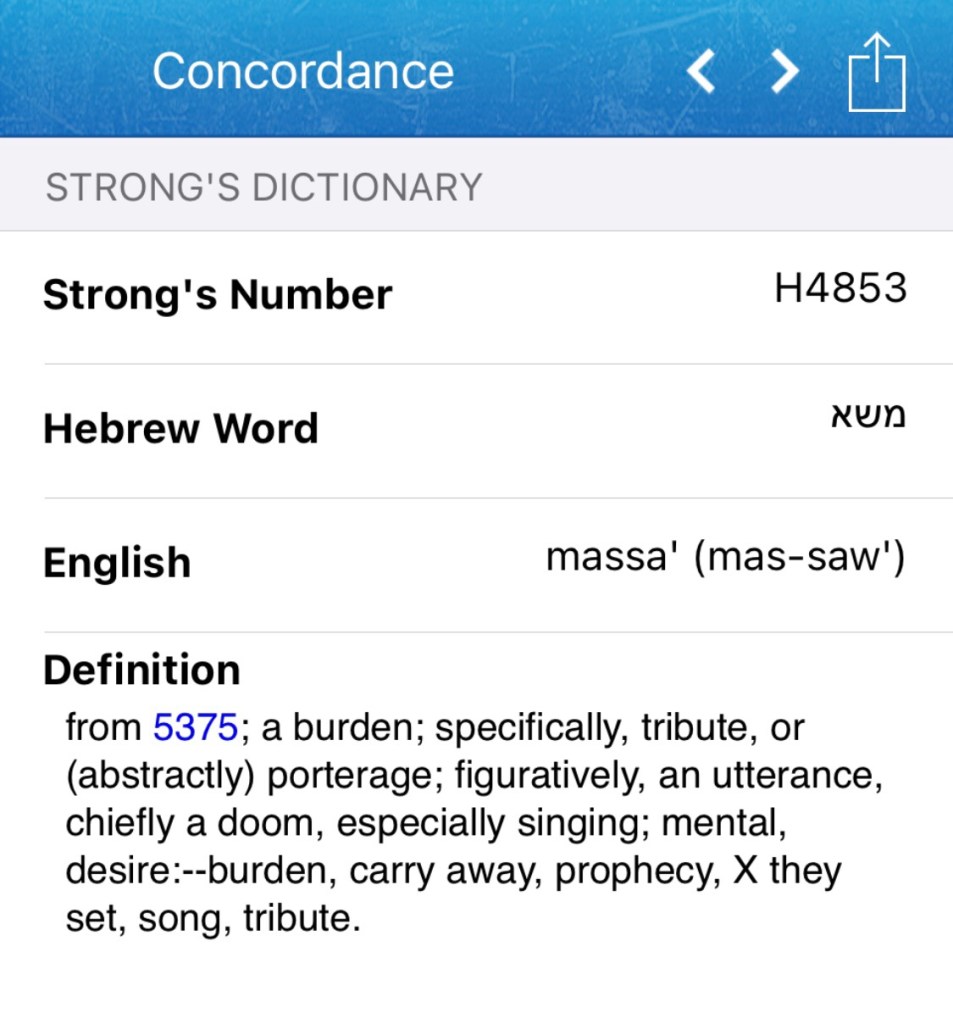
It’s mostly translated as “burden” in the KJV. And sometimes that burden is literal – like a load to carry. But it’s used a lot in the writings of the Prophets to describe the prophetic utterances they give.
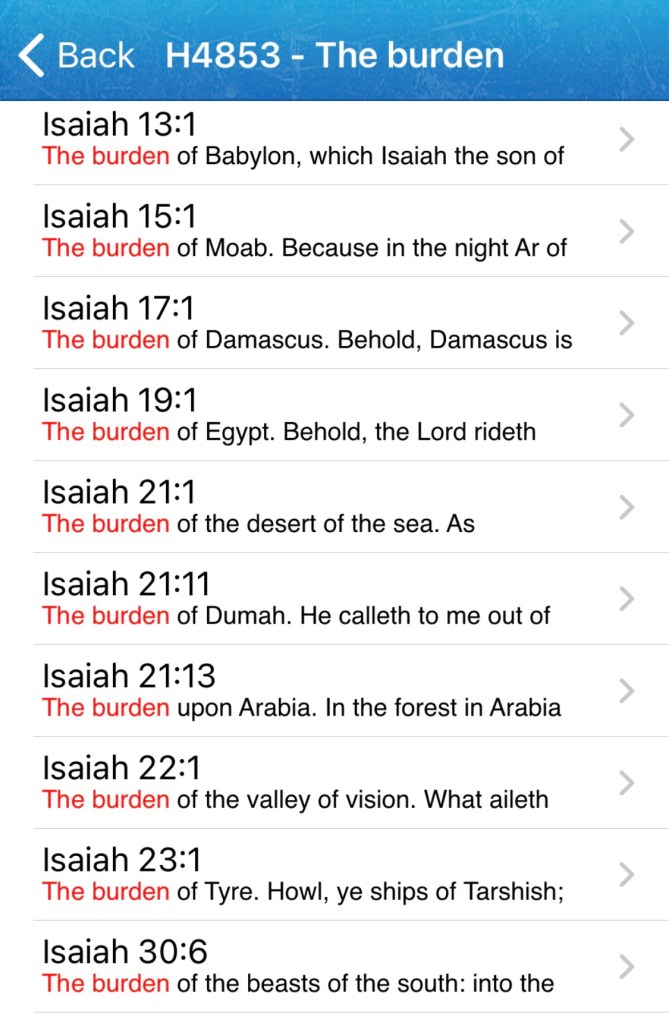
Newer Bible versions might translate massa as “oracle,” “pronouncement,” “prophecy,” or “message.”
The Hebrew letters of Mem, Shin, and Aleph together give us a picture of lift up front strength.

Perhaps the picture above is also an idea of how it feels for the prophet to have a ponderous message of doom from God to deliver to a nation. Maybe that’s why a word that means “burden” is also the word for a serious Divine pronouncement.
A PROVERBS 30 OUTLINE
1-3, Humble introduction
4, Rhetorical questions about GOD
5-14, The Power of WORDS
15-31, Lists interjected with proverbs
Proverbs 30:4 includes a couple questions that seem to have come right out of the NT:
“Who has ascended to heaven and come down? Who has gathered the wind in his fists? Who has wrapped up the waters in a garment? Who has established all the ends of the earth? What is his name, and what is his son’s name? Surely you know!”
Proverbs 30:4 ESV
Like – it’s just right out there. God has a Son.
And I know that some would argue that the OT perspective would be that God called Israel His “son.” And that’s true. And maybe that’s what was originally intended here, but finding this line in the OT… it just really pops.
A LIST OF THE LISTS…
2 leaches
3 things never satisfied
4 sets of 4:
- 4 incomprehensible things
- 4 intolerable things
- 4 insignificant (but wise!) things
- 4 impressive things
😏 Did you make all of those start with an i on purpose?
Of course. That’s why people go to seminary. Alliteration.
Or should I say….
Affirmative. All attendees at academic advancement acquire alliteration.
😑
 To The Reader