Remember how Ben-Hadad was defeated and said he would give back all the cities he captured? Well, he didn’t give back Ramoth-Gilead.
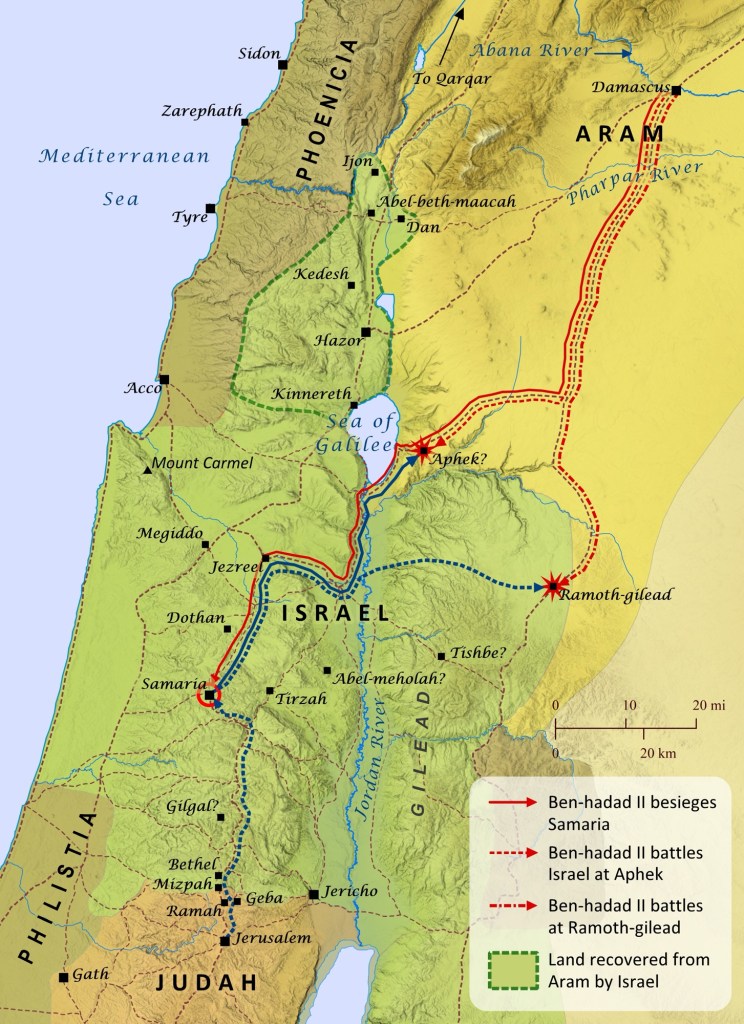
Ramoth-Gilead was a city of refuge and right on the border with the kingdom of Aram/Syria.
King Jehoshophat of Judah has come on a diplomatic visit to King Ahab of Israel. Ahab suggests they form an alliance to retake Ramoth-Gilead. And Jehoshaphat wants to pray about it first.
Ahab invites the 400 prophets of Baal to speak on God’s behalf. And they claim to do so. “No problem,” they say. “Yahweh will give you victory!” And they even dramatize their prophecies with little skits and props.
“But Jehoshaphat asked, “Is there not also a prophet of the Lord here? We should ask him the same question.” The king of Israel replied to Jehoshaphat, “There is one more man who could consult the Lord for us, but I hate him. He never prophesies anything but trouble for me! His name is Micaiah son of Imlah.” Jehoshaphat replied, “That’s not the way a king should talk! Let’s hear what he has to say.””
1 Kings 22:7-8 NLT
Talk about “having itching ears.” Ahab only surrounds himself with people who agree; people who tell him what he wants to hear. That is dangerous. We call this an “echo chamber” today.
So the prophet Micaiah is fetched by a messenger who briefs him on the situation and “suggests” he say something in agreement with what the other 400 guys are saying.
“When Micaiah arrived before the king, Ahab asked him, “Micaiah, should we go to war against Ramoth-gilead, or should we hold back?” Micaiah replied sarcastically, “Yes, go up and be victorious, for the Lord will give the king victory.”
1 Kings 22:15 NLT
I hear him giving this in a rather deadpan, smart-alecky, tone. I can practically hear an eye-roll. It’s obvious to Ahab that Micaiah isn’t being serious.
“But the king replied sharply, “How many times must I demand that you speak only the truth to me when you speak for the Lord?”
1 Kings 22:16 NLT
And so Micaiah delivers the real news: Ahab is going to die and the people will be defeated and scattered.
“Didn’t I tell you?” the king of Israel exclaimed to Jehoshaphat. “He never prophesies anything but trouble for me.”
1 Kings 22:18 NLT
(I just LOVE this dialog! Ahab was a character.)
And then Micaiah pulls back the curtain of heaven and we get a one-of-a-kind glimpse into the inner-workings of the Heavenly Government. This text is phenomenal and should be studied FAR more than it is. Most Christians – even serious ones – have no idea this is even in the Bible and have never wrestled with the implications of this text.
Micaiah says that he observed the heavenly council in session. The members of the host were in a meeting with Yahweh, surrounding his throne. And Yahweh poses this question:
“Who will entice Ahab so that he will go up and fall at Ramoth-Gilead?”
Notice that He has already made the determination that Ahab is going to die in battle at Ramoth-Gilead. But He seems to be asking for volunteers. There is a murmuring as several heavenly beings begin responding. Then a single spirit steps out of the ranks and – rather like Bilbo Baggins offering to take the Ring to Mordor – he says, “I will do it!”
Yahweh asks him how he intended to accomplish this. And y’all, this BLOWS MY MIND…
“He said, ‘I will go out and I will be a false spirit in the mouth of all his prophets.’ And He [Yahweh] said, ‘You shall entice and succeed, go out and do so.’”
1 Kings 22:22 LEB
What’s interesting is the credit for the whole thing is given to Yahweh.
“So then, see that Yahweh has placed a false spirit in the mouth of all of these your prophets, and Yahweh has spoken disaster concerning you.”
1 Kings 22:23 LEB
No one understands the metaphysical mechanics of how a spirit in heaven ends up influencing the speech of 400 men, but that is exactly what we’re told has happened.
What have we just witnessed?
The Almighty is including His heavenly sons in the execution of His plans- even allowing them real input. And this particular input includes tricking Ahab with his yes-men prophets.
Is that how you imagined things worked in heaven?
I think for most of us, the answer is, “No.”
I think most of us tend to think of God sitting on a throne surrounded by cookie-cutter angels that look like they all came out of an angel-factory. No unique personalities. No distinguishing traits. Nothing to do all day except sing praises and – if they’re lucky – maybe get a shift being a guardian angel or blowing a trumpet or something. And then God gives a command in a booming voice and like Yul Brenner in the Ten Commandments says, “So let it be written. So let it be done.” And then, we don’t bother to wonder about what happens next.
That is NOT what we see in this text.
We see something much closer to a General meeting with his military commanders.
Micaiah is allowed a peek into the throne room and observe how stuff gets done. And God is involving His heavenly host. They are given responsibilities. They have ideas. They are actively participating with God in carrying out His plans on earth. And Yahweh wants it this way.
I have taken the liberty of tweaking this week’s reading schedule. On the 20th, the schedule has us covering Psalms 82-83 and 2nd Kings 1. But I’m moving Psalm 82 to tomorrow’s reading because it addresses this whole idea of God’s heavenly council.
For now, let’s go back to earth and the scene before Ahab and Jehoshaphat….
Ahab, ever the petulant child, does not like this prophetic word from Micaiah and throws him in prison to be fed on bread and water “until I return from battle.” And Micaiah reminds him that he won’t be returning from battle.
“But Micaiah replied, “If you return safely, it will mean that the Lord has not spoken through me!” Then he added to those standing around, “Everyone mark my words!”
1 Kings 22:28 NLT
Ahab does indeed die in the battle even though he was disguised as an ordinary soldier. An arrow shot at random (and I would argue, guided by the hand of God) finds a joint in Ahab’s armor and deals a fatal blow.
And just as Elijah prophesied, the dogs lick up his blood when the chariot is washed out back in Samaria.
If we wish to have a truly biblical worldview, that worldview should include biblically-based ideas on the nature of the spiritual realm and how it interacts with and affects the realm we inhabit. We aren’t given tons of information but we are given enough in the text that we shouldn’t have cartoon notions of God and angels.
Tomorrow we will read this narrative again in the Chronicles account and we will look at how it fits with the surprising statements in Psalm 82.
 To The Reader