Let me give credit right up front to the late Dr. Michael S. Heiser for basically all of the concepts and content in this post.
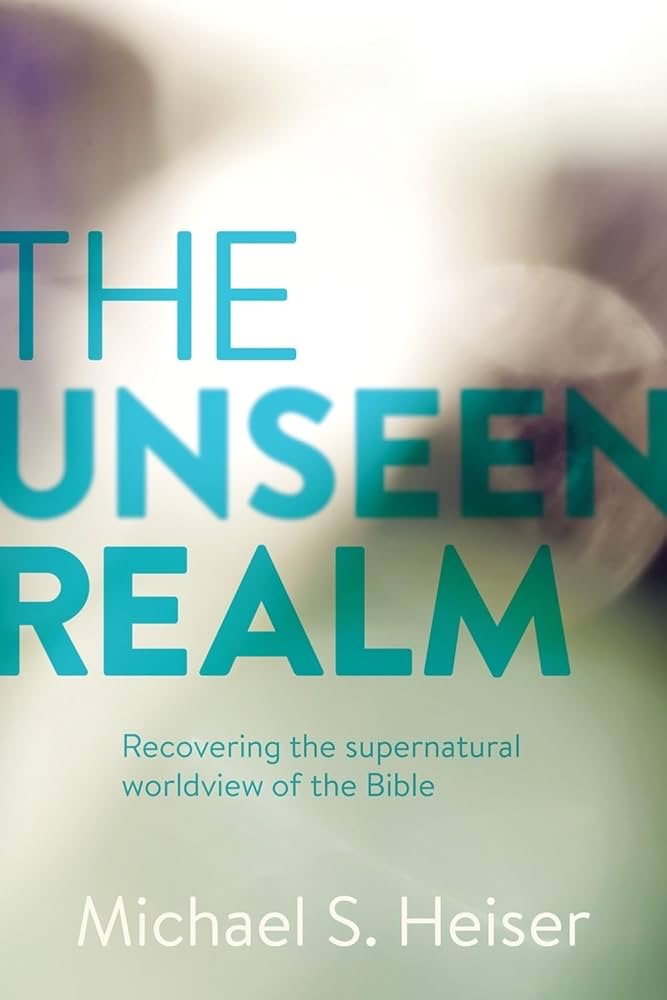
If you’ve never encountered this material before, it can be quite unsettling. So let me start by assuring you of some things from both myself and Dr. Heiser’s material. I have read all 4 of his major theological works, watched many hours of his videos and listened to every episode of his podcast. I know his content.
- This material in no way suggests that Yahweh is one among a pantheon of equals.
- Yahweh is the uncreated Creator and Supreme. No one else in heaven is like Him. He stands alone as the Most High. All others are lesser, created beings.
- No inhabitant of the unseen realm besides Yahweh was or is ever permitted to be worshiped.
I put these here because I’ve read many comments sections on Dr. Heiser’s videos and people immediately jump to conclusions and make wild assumptions before listening to all of the material. There are many videos on YouTube that inaccurately present Dr. Heiser’s views and then go about refuting them. This annoys me and most of them don’t have the academic chops to actually take on his arguments and show why they disagree from scripture.
Psalm 82 was the text that started all of Dr. Heiser’s research on The Unseen Realm and really much of his life’s work. Of course, he was reading the psalm in its original Hebrew but the lines are just as jarring in English:
“God has taken his place in the divine council; in the midst of the gods he holds judgment:”
Psalm 82:1 ESV
In case you’re not sure about that translation, here it is in the Septuagint – translated from the oldest Hebrew manuscripts no longer even available.
“God stands in the assembly of gods; and in the midst of them will judge gods.”
In the opening chapter of The Unseen Realm, Heiser says that those words “had me by the throat, and I couldn’t shake free.” He explained that like most Evangelicals, he had considered the gods of the other nations to be nothing more than idols, blocks of stone or wood. In other words – imaginary. Fake. On par with the Tooth Fairy. But here in this psalm, they are treated as real and Yahweh is taking His place in the midst of them and pronouncing judgment. To quote from The Unseen Realm page 12, “The God of Israel isn’t part of a group of idols. But I couldn’t picture Him running around with other real gods, either. This was the Bible, not Greek mythology. But there it was in black and white.”
Heiser immediately began studying to see what evangelical scholars had to say about the text. The usual answers were that the “gods” in this text were either:
- Jewish elders or judges, or
- The Trinity
Here’s why neither of those can possibly be correct:
- Nowhere in scripture are Jewish elders or judges given authority to rule over foreign nations as the subjects of Psalm 82 are.
- The LORD cannot be railing against the other members of the unified eternal Godhead and telling them they will die.
So… just let me get out my can opener…
And let’s open this can of worms. 🪱🪱🪱
To summarize most of Heiser’s 400-page book and adjacent works:
The gods are also known as “the Sons of God.” They are created beings just as humans are. They are Yahweh’s heavenly sons. At Babel – when humanity again (for the 3rd time) rejects Yahweh in favor of accessing the heavens (and the supernatural beings in them) on their own terms – Yahweh “divorces” the nations and puts them under the charge of His heavenly sons. Since humanity doesn’t want Yahweh to be their God, He in essence says, “Fine. Have it your way. I’m cutting off your direct access to Me and putting you under the jurisdiction of my sons;” much as an earthly king might split up his governance among his sons.
But apparently these heavenly sons – much like the earthly ones – did not do very well with their assignment. And THAT is what Psalm 82 is all about. It’s Yahweh calling them together for judgment. And here is what He says:
“How long will you judge unjustly and show partiality to the wicked? Give justice to the weak and the fatherless; maintain the right of the afflicted and the destitute. Rescue the weak and the needy; deliver them from the hand of the wicked. They have neither knowledge nor understanding, they walk about in darkness; all the foundations of the earth are shaken. I said, “You are gods, sons of the Most High, all of you; nevertheless, like men you shall die, and fall like any prince.””
Psalm 82:2-7 ESV
If the “gods” in this psalm are men, why is their judgment to “die like men?” Men are already sentenced to die. And if you needed more clarity on who is being addressed, Yahweh Himself is speaking through the prophet Asaph and He says that they are “gods, Sons of the Most High.”
Dr. Chuck Missler explained that the term “sons of God” in the Bible is a technical term used to designate “a direct creation of God.” So here is the list of those called “sons of God” in the Bible:
- Sons of God in Gen. 6:2 [personally, I believe these are “the angels which kept not their first estate,” (Jude 1:6)
- Sons of God are spiritual beings in Job 1:6, 2:1, and 38:7. I prefer to not use the term “angel” because that is a job description. It means “messenger.” And not all heavenly beings are messengers. But in layman’s terms, these are angels. They are not born. They are direct creations of God.
- Adam is called “the son of God” in Luke 3:38 because he was a direct creation of God. And frankly, so was Eve. Every human since, except Jesus, is a son of Adam (son of man)
- Jesus Christ is of course, the only begotten Son of God. His human body was a direct creation of God in Mary’s virgin womb. No other son of God was unique like this. And, of course, the Son is the Eternal Word, begotten, not made, and existing eternally with the Father and the Spirit.
- Born-again believers are called “sons of God” in 1 John 3:1 because they are “born, not of blood nor of the will of the flesh nor of the will of man, but of God.” John 1:13 ESV. A real Christian is truly a “new creation;” a direct creation of God. (I say “real” Christian as opposed to those who are Christian in name only. They call themselves Christian but are not born again from above.)
The human son of God – Adam with his counterpart and ally Eve – was given dominion over the earth. They were to exercise authority over the physical creation on Yahweh’s behalf and according to His ways. Only they rebelled when they attempted to “be like God,” (to know/determine good and evil). And the judgment that followed was death.
The angelic Sons of God were to exercise authority over the nations. They were to “Give justice to the weak and the fatherless; maintain the right of the afflicted and the destitute. Rescue the weak and the needy; deliver them from the hand of the wicked.” But they rebelled and attempted to be like God and receive worship. And the judgement that followed was death.
Psalm 82 is to the rebel angels what Genesis 3 is to the rebel humans.
The gods of the nations are not pretend. They’re not imaginary. They are real beings. They are supernatural sons of God. They were supposed to do divine family business but were never supposed to receive worship.
So when the Moabites were worshiping Chemosh, or the Sidonians worshiping Ashtoreth or the Canaanites worshiping Baal – there are real spiritual beings receiving that worship and those (sometimes human!) sacrifices. Illegally. In rebellion. Paul gives this as his reason for advising the Corinthians to not knowingly eat food offered to idols:
“What do I imply then? That food offered to idols is anything, or that an idol is anything? No, I imply that what pagans sacrifice they offer to demons and not to God. I do not want you to be participants with demons.”
1 Corinthians 10:19-20 ESV
An idol is an inanimate object, and so it is nothing in itself. But it is the representation of an evil spiritual reality.
And the spiritual realities are keeping their assigned people groups in ignorance and sinful blindness. Paul and the philosophy-lovers in Athens understood the connection between the gods and their assigned geographic/ethnic groups.
“And he made from one man every nation of mankind to live on all the face of the earth, having determined allotted periods and the boundaries of their dwelling place, that they should seek God, and perhaps feel their way toward him and find him. Yet he is actually not far from each one of us,”
Acts 17:26-27 ESV
The picture is one of the Gentile nations groping in the dark ever since Babel; stuck under the assigned rule of a principality – a son of God. Moses understood this too. We covered it back in Deuteronomy:
“When the Most High gave to the nations their inheritance, when he divided mankind, he fixed the borders of the peoples according to the number of the sons of God.”
Deuteronomy 32:8 ESV
If you have a working knowledge of scripture you probably already have a concept in your mind that some of the angels rebelled. And…that’s about it. From there it gets murky. Did they turn into demons? Did they get sent to Hell? Are they still there? We want a one-size-fits all view about angels. Scripture actually gives us a much more complex and nuanced view.
In Jude there are angels held in chains in gloomy darkness until the judgment day. But Paul writes to the Ephesians of principalities and powers, “cosmic powers over this present darkness” and “spiritual forces of evil in the heavenly places,” Eph. 6:12.
It’s not either / or. It’s both. Some rebelled and are bound. Some rebelled and are still active “in heavenly places” which means the spirit-realm, or what New Agers call “the Astral Plane.”
Most of the sons of God did not rebel and continue to serve. We see them delivering messages to prophets and Mary and Joseph, the women at the resurrection, and the Apostle Paul. We see one literally jail-breaking Peter from prison. We are told that they are active among the saints and offer assistance without the humans being aware of it – Heb. 1:13-14, 13:2. We see them announcing and even actively carrying out Yahweh’s judgments in Revelation.
We saw some of the ones who serve through the words of the Prophet Micaiah concerning the death of Ahab. They participate in the Father’s work just like the saints on earth do; each in their own spheres.
I recommend to you this full-length documentary on the unseen realm created by Faith-Life with Dr. Heiser and other scholars. There is no shortage of material on this available. Dr. Heiser’s 6-hour long Unseen Realm Conference is on YouTube for free.
And don’t just accept something because I or anyone else says so. Feel free to challenge it and study for yourself. Just be sure that you know why you believe what you believe and that it squares with all of scripture and you can defend it from scripture. But I believe that “the divine council worldview” absolutely stands up to scrutiny.
Oh – by the way – Paul’s offhand comment to the Corinthians about judging angels…
“Do you not know that we are to judge angels? How much more, then, matters pertaining to this life!”
1 Corinthians 6:3 ESV
The angels he’s talking about are the rebel Sons of God. If you are in Christ, you and I are going to have a seat in the heavenly court that Micaiah witnessed and we will participate in their judgment just as the angels in Revelation participate in mankind’s judgment.
That means believers will take their places.
Are you preparing for that?
Are you prepared to administrate our Father’s Divine Rule? Are you practicing NOW doing things according to His Way?
And by that I do NOT mean some twisted idea of politically forcing Christian views down the throats of the nation or even your own family and friends. The Law of Love written on the heart trumps the Law of Commandments written in stone. (See: Rom. 10:4, Gal. 3:24, Heb. 8:13, really just the whole book of Hebrews especially chapters 8-10, Romans 3-8, all of Galatians, Lk. 16:16, Acts 13:39, Ez. 11:19, 36:26, Jer. 31:33.)
The first place to practice administrating the Lord’s rule is over our own hearts and lives. And that should be enough to keep us busy until the Lord takes us to glory. Are you practicing using your gifts and abilities and time for His service as He directs your steps? Or are you steering your ship the way you want?
Your whole life here on earth is the womb.
Death is when the child of God is truly born into his eternal life.
The child of God is IN CHRIST- who was for a little while “made a little lower than the angels,” (Heb. 2:7-9). But Christ is eternally exalted “far above all rule and authority and power and dominion, and above every name that is named, not only in this age but also in the one to come. And he put all things under his feet and gave him as head over all things to the church, which is his body, the fullness of him who fills all in all.”
Ephesians 1:21-23 ESV
The body belongs with the Head.
Friend, if you are in Christ, you and I outrank the angels.
We best start acting like it.
2 Chronicles 18-19… EPILOGUE
So Ahab and Jehoshaphat teamed up to fight the Syrians. They each got a visit from a prophet about it.
Ahab heard from Micaiah that he wouldn’t be coming home alive. And so it happened.
Jehoshaphat got home and was confronted by Jehu the son of Hanani. You might remember Jehu from 1 Kings 16:1 when he delivered the message to King Baasha that his whole house would die violently like the house of Jeroboam. Now Jehu has turned up on Jehoshaphat’s doorstep to tell him:
“Should you help the wicked and love those who hate the Lord? Because of this, wrath has gone out against you from the Lord.
Nevertheless, some good is found in you, for you destroyed the Asheroth out of the land, and have set your heart to seek God.”
2 Chronicles 19:2-3 ESV
God was not ok with Jehoshaphat helping wicked King Ahab. It just goes to show you that even people who sincerely and energetically serve the Lord, can sometimes make really bad decisions.
Christians should seek the Lord and pray and search the scriptures before helping the cause of an unbeliever or partnering with “those who hate the Lord.” (I’m looking at you, ecumenical-interfaith-movement). I know that many mean well. I’m sure Jehoshaphat meant well too. But meaning well didn’t make it ok. And this will be a lesson that Jehoshaphat has to learn more than once.
 To The Reader