I’m tweaking the reading schedule again…
And that’s because the narrative of the siege of Samaria begins in chapter 6 and resolves in chapter 7 and I thought it would be helpful to take it all together.
THE FLOATING AXE-HEAD
This was me pondering this story:

I mean, why is it in the Bible? Is it just a cool story and we leave it at that? Possibly.
It may be that I have WAY over-thought this so don’t take my reflections here as Gospel truth. It’s just an observation and some ponderings. And I’m gonna tell you right now- I don’t have a glittering conclusion.
So this is how my brain has learned to work when I’m looking at a narrative passage and trying to understand if it’s meant to connect with another one:
- Is there another story with similarities?
- What are the similarities?
- Are there repeated words in the original language?
- (Bonus) Do the repeated or key elements have spiritual imagery or symbolism and if so, what is it?
And there are 2 stories that I can think of that have similarities to the floating axe head. But first let’s look 2 Kings 6:1-7 and the main elements.
The “sons of the prophets” are young men in training in the tradition of Samuel. About 100 of them live near or with Elisha. He is probably teaching them in some way.
🤓 Can you imagine those classes? Food Multiplication 101. The Spirit Realm: It’s Nature and Inhabitants. Advanced Teleportation. Intro to Speaking for Yahweh. I’d sign up.
Then there’s the Jordan River. It’s the river that the LORD dried up 3 times: once for Israel to cross over, once for Elijah, and once for Elisha. We just saw Naaman baptize himself there. Jesus will be baptized in it.
They are cutting down trees to build a bigger dormitory. Specific mentions of tree-cutting are not terribly common in the Bible. Sometimes enemies cut down trees. Trees were cut for the tabernacle and temple. In the Gospels, John the Baptist tells the religious leaders that they need to repent because “the axe is laid to the root of the tree.”
We have an axe head coming off the handle which (oddly) is the exact scenario used as an example of involuntary manslaughter in Deuteronomy 19:4-6.
We have a prophet of God throwing something into water to change the properties of the water. And that happens in a couple other places.
And finally, we have the axe-head floating. And the Hebrew word for float is only used in 2 other places.
Ok. So that’s that overview. Now let’s go down a level deeper.
There are 2 stories that I can think of that share a lot of points with the floating axe-head.
The first is the waters of Marah…
“Then Moses made Israel set out from the Red Sea, and they went into the wilderness of Shur. They went three days in the wilderness and found no water. When they came to Marah, they could not drink the water of Marah because it was bitter; therefore it was named Marah. And the people grumbled against Moses, saying, “What shall we drink?” And he cried to the Lord, and the Lord showed him a log, and he threw it into the water, and the water became sweet. There the Lord made for them a statute and a rule, and there he tested them,”
Exodus 15:22-25 ESV
The Hebrew word for “log” or “tree” is ets (which sounds like ates.) It’s the exact same word used for the thing that Elisha cuts down and throws in the water in 2 Kings 6:6.
So we have two mighty prophets each cutting down an ets and throwing it into water and something miraculous happens with the water. I don’t think this is a coincidence. God could’ve had Elisha slap the Jordan with the mantle of Elijah and parted the water so the guy could’ve retrieved the axe-head. Elisha could’ve thrown a rock in the water. But he cut an ets, just like Moses and threw it in the water.
Now, there’s a second story that we read just a few days ago where Elisha threw something into water in Jericho. It was a situation nearly identical to Israel at the waters of Marah. Worse actually. The water was causing death. Elisha threw salt in the bad water and healed it, 2 Kings 2:18-22. So Elisha is doing very Moses-like things.
Ok – now hang on to ALL of this…

Does wood have any spiritual/symbolic imagery in the Bible?
Yes. Yes it does. We talked about it back when we went through the Tabernacle- the wood overlaid with gold…
🪵 Wood can be a picture of humanity.
Remember how Moses struck the Rock (that Paul said was Christ, 1 Cor. 10:4)? And water came out of the Rock? Inanimate objects can have tremendous spiritual meaning.
And remember how we’ve talked about water 🌊 being sometimes a picture of death or the grave? It came up in the Psalms- “the depths.” Think of Jonah. Think of Pharaoh’s army in the sea.
What picture are we seeing if Moses cuts down a tree and throws it into bitter water?
I’ll give you a minute…
😏 Cue the Jeopardy music…
What if the tree is a picture of Jesus?
Cutting down a tree is imagery of death. Daniel 9:26 uses the term “cut off” to indicate the death of Messiah.
And being cast into the water is the grave. Sheol.
And with that tree being cut down and cast into the water, the bitterness is taken out of death. It’s actually made sweet. Why?
Well… that’s where Elisha tells part 2 of the story…. (Maybe… I could be seeing shadows here, but it seems pretty consistent with scripture. I leave it to you to judge.)
Elisha puts salt into the bad water and it is made good. The death is removed and the barren land is healed and made fruitful.
And who is the salt of the earth?
And what does the believer do in the world?
Do we bring life? Do we bear fruit? Do we carry the Gospel that brings life to the land that is spiritually dead and unfruitful?
Then we’re back to another ets being cut down and thrown into the very water where Jesus will be baptized; which is a picture for the believer of burial with Christ and…. RESURRECTION.
There is a borrowed, iron axe-head at the bottom of the muddy river. Probably sunk down into the muck and mire.
And interestingly, the prophet Jeremiah finds himself in that exact situation. And in that story we have a rare word-match with the axe-head story.
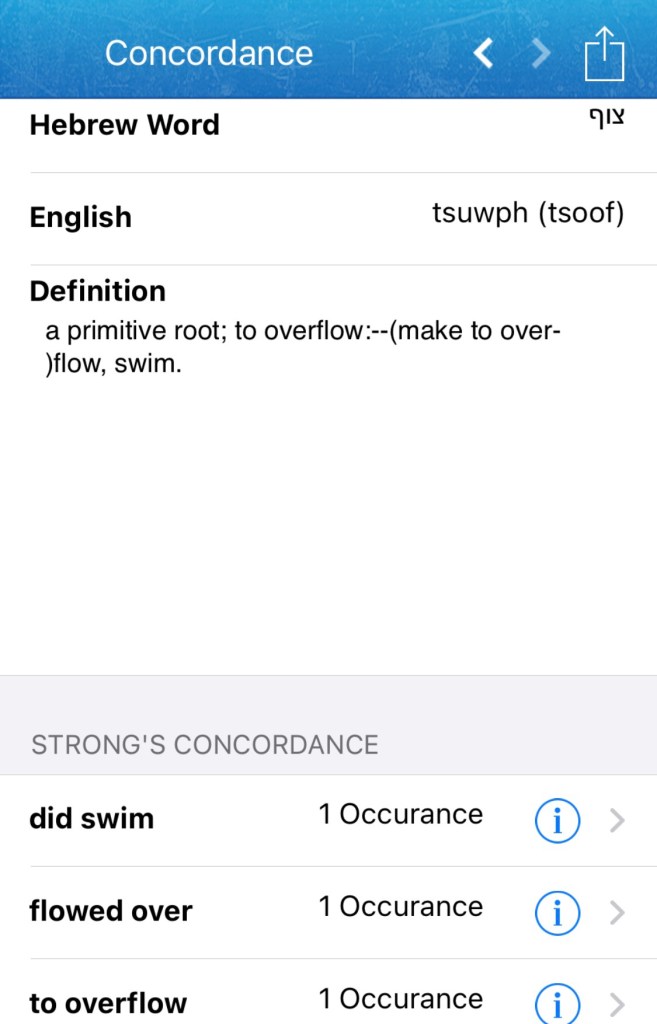
The Hebrew word tsuwph only shows up 3 times in the Bible. Once where “the iron did swim.” Once in Deuteronomy 11:4 where God caused “the water of the Red Sea to overflow” the army of Pharaoh. And once in this passage:
“they flung me alive into the pit and cast stones on me; water closed over my head; I said, ‘I am lost.’ “I called on your name, O Lord, from the depths of the pit;”
Lamentations 3:53-55 ESV
Jeremiah wrote this lament about this experience:
“So they took Jeremiah and cast him into the cistern of Malchiah, the king’s son, which was in the court of the guard, letting Jeremiah down by ropes. And there was no water in the cistern, but only mud, and Jeremiah sank in the mud.”
Jeremiah 38:6 ESV

So two of the three times tsuwph is used, it’s about water flowing over something. They are both contexts of death. Pharaoh’s army died. Jeremiah was meant to die and would’ve had he not been rescued.
In the story of the axe-head it is the iron that flows over the water. It defies the laws of physics and rises up out of the mire and comes out of the watery grave.
It feels like I’m looking at a picture of resurrection- perhaps of Christ, or perhaps of the believer. Both? Neither?
The Hebrew word for the axe isn’t any of the normal Hebrew words for axe: garzen or qardom or maasad. It’s the word barzel: iron.
I could get into the Hebrew letters – they could make something like “in the beginning plow shepherd” – but we’re already pretty far out on a limb of speculation.

At any rate…
I just feel like this story of the floating axe head is part of triangle of stories with Moses and the bitter water and Elisha and the death-water.
If nothing else, wasn’t that a splendid workout for your brain?
💪🏼🧠
ELISHA & THE BATTLES WITH SYRIA
Elisha is like a human-wiretap into the inner-council of the king of Syria. The king thinks he’s got a “mole” on his staff leaking battle plans to Israel.
Nope. It’s just that somehow Elisha knows things. He’s basically an OT superhero.
The Syrians figure out that Elisha is Israel’s “secret weapon” so they surround the city of Dothan where he happens to be.
Now Dothan is interesting. It’s the location where Joseph’s brother’s threw him into a pit and planned to kill him but then sold him into slavery. And that’s where Elisha is. Surrounded by enemies. He can’t get out. He’s about to be either killed or taken as a slave.
But he’s not in the least worried because he can see things that normal people can’t.
Apparently the chariot of fire that appeared when Elijah was taken to heaven was not the only one. There’s a whole heavenly division of them.
🤓 Cool. I wanna ride in a fire-chariot.
Ya know, I think I do too. If we’re allowed.
As the Syrians begin their attack, Elisha prays they be struck blind and they are. Then he does the most ObiWan Kenobi move ever.
“And Elisha said to them, ‘This is not the way, and this is not the city. Follow me, and I will bring you to the man whom you seek.’ And he led them to Samaria.”
2 Kings 6:19 ESV

Elisha leads the blind army straight into the capital and right into the palace and restores their sight.
At Elisha’s advice, King Joram feeds them well and sends an entire army home.
They didn’t come back for a long time…
But when they did, they laid siege to Samaria and it went total Donner-party.
The king blames Elisha. Why isn’t their superhero doing anything to save them? So he sends his captain to kill Elisha but Elisha knows he’s coming, bolts the door, and gives him a word from Yahweh from behind the closed door: Tomorrow there will be plenty of food in Samaria.
This captain has already given up on Yahweh.
“While Elisha was still saying this, the messenger arrived. And the king said, ‘All this misery is from the Lord! Why should I wait for the Lord any longer?’ ”
2 Kings 6:33 NLT
That is a view many people embrace. “It’s God’s fault! Why would I serve a God who allows so much suffering?”
And he cannot believe the word of Elisha. It seems absolutely impossible, “even if God opened the windows of heaven.” But, I will say it again… (and maybe I need to get this printed on a coffee cup or something and set up a merch store for the blog)-
“God does not require
favorable circumstances.”
The LORD causes the Syrian army to hear advancing forces- chariots and horses – probably the fiery ones. And they run for their lives and leave everything in the camp behind. The people of the city go out and collect all the provisions. Suddenly, overnight their situation does a complete turn-around. It’s not foolish to believe for such miracles. In this story, the guy who wouldn’t believe gets left out.
The LORD is not limited. You and I may be small but we are backed by the same unstoppable heavenly army that surrounded Elisha. Perhaps we should pray that our enemies be made to hear the sound of their chariots and horses. The LORD can turn a situation around instantly.
If you feel like you have been under siege for a long time and you are starving inside, may the GOD of Elisha with His armies send your enemies fleeing in seven directions and bring you a sudden deliverance.
 To The Reader