The throne of Israel is a revolving door of assassins. That about sums up most of this chapter.
The 4-generation Dynasty of Jehu comes to an end with the death of Zechariah after a short reign of 6 months. This is followed by a string of cut-throats and brigands that “lead” Israel all the way to the bitter end.
- Shallum (1 month)
- Menahem “the Butcher” (10 years)
- Pekahiah, son of Menahem (2 years)
- Captain Pekah (20 years)
- Hoshea (9 years)
And just like that, the northern kingdom of Israel is finished after Hoshea. A new generation of Assyrians (not the ones that had repented at the preaching of Jonah) have turned the page of their own history and are now back to the old tricks (conquering lands, decapitation, torture), and are ready to deal the death-blow to Israel.
We will unpack this downfall and the many prophecies about it over the course of the next 3 months. This is just the overview.
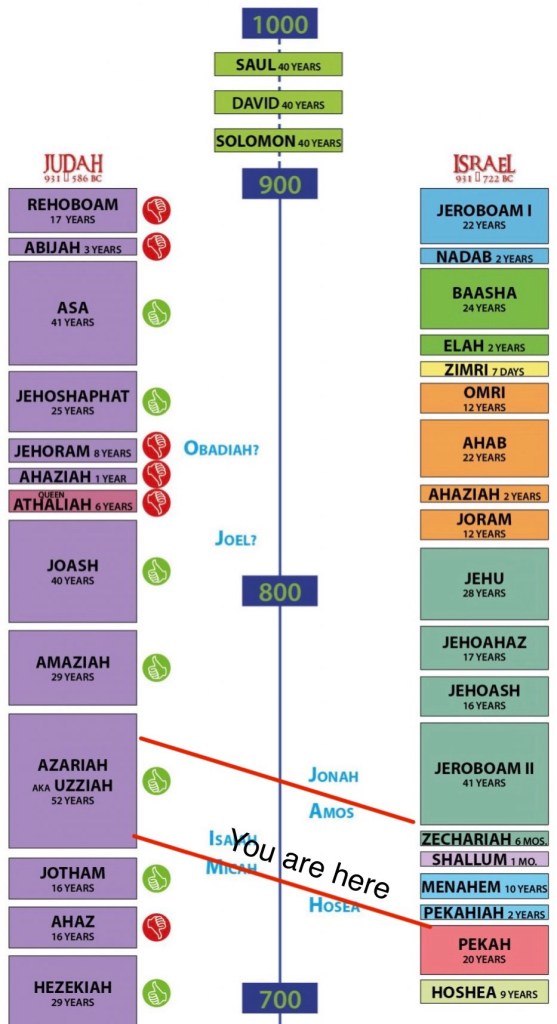
King Azariah is better known as King Uzziah. And…
“In the year that king Uzziah died I saw also the Lord sitting upon a throne, high and lifted up, and his train filled the temple.”
Isaiah 6:1 KJV
That’s when Isaiah has his amazing vision-commissioning-experience.
The Prophet Isaiah begins to receive messages from Yahweh for Judah and Jerusalem near the end of the reign of Uzziah and continues for about 40 years into the reign of Hezekiah.
So we have the cutthroats on the throne in Israel, Assyria circling them like a vulture, kings in Judah, and prophets prophesying in and to both the northern kingdom and the southern kingdom. We have come to the part of the Bible that feels like this…

🤔 Question.
Shoot.
🤔 Why wasn’t the Bible written in chronological order? Like – if the story of Jonah and the prophecy of Isaiah belongs here, why aren’t they here in the middle of Kings and Chronicles? Or even at the end of them? Why are they way off on the other side of Psalms and all that?
That’s an involved question. First, the Bible was written when and how God wanted it to be across more than 1400 years by 40 different main writers plus quotations from others and a number of editors and compilers.
Second, books of the Bible were never bound as a single volume until Jerome published the Latin Vulgate in the year 400AD.
As copying and binding the Bible developed, the books were generally grouped by their genre first and chronology second.
- Historical Narrative, Gen – Esther
- Wisdom/Poetry, Job – Songs
- Prophecy
- Major Prophets, Isa – Dan
- Minor Prophets, Hos – Mal
The books of the prophets were actually written before either Kings or Chronicles; and even before books like Esther and Nehemiah. But we are reading things in the order of the history they cover, not the order of when they were written.
There is no Divine directive on the “correct” order of books. And you can find print and digital editions of the Bible in chronological order; or at least as good an order as scholars can figure. It’s not like the books have copyright dates printed in the front. Some of them give a lot of information about the time of writing (like Isaiah). Others, like Obadiah, not so much.
Tomorrow we look closer at the reign and accomplishments of Uzziah and begin reading Isaiah, the most eloquent and sophisticated book of the OT.
 To The Reader