This description of the reign of Uzziah helps us understand what things were like for a young Isaiah, as he was growing up and developing towards his prophetic ministry.
Uzziah reigned for 52 years. That was the longest reign of any good king. (We haven’t got to the 55-year reign of the evil Manasseh yet.) Isaiah’s ministry was about 40 years, so he was likely born somewhere in the middle of Uzziah’s reign. Those were some of the best times in Judah’s history.
Uzziah brought back the peace of Asa and Solomon. He built a big army but didn’t go around picking fights. He did a lot of infrastructure work, agricultural development and defensive building; even arming Jerusalem with the latest in military technology.
Now, when we read translations that say “engines” or “war machines” in verse 15 we might think of something like this:

You might picture trolls loading huge boulders on such a machine if you’ve seen The Lord of the Rings. But trebuchets and catapults were Medieval inventions.
And while it’s possible that God helped the engineers of 8th century BC Jerusalem come up with the design of early mechanical crossbows and catapults, those machines are generally believed by scholars and archeologists to have been invented in the 3rd to 4th centuries BC in China and Greece.
The text itself in Hebrew is quite unclear. It’s like the writer didn’t exactly have the names for what was built. He just knew they were some kind of defensive military…thingys. The text in Hebrew is (I kid you not):
hishbonot mahashebet hosheb
It’s a tongue-twister of unusual words that are all from the root chashab [kha-shab] or hosheb which means “to weave” or “fabricate.”
- hishbonot– inventions or “little inventions” (the ending can have a diminutive effect, like “nifty little gadget”)
- mahashebet– invented by
- hosheb– inventors, fabricators
So… little inventions invented by inventors.
That’s not exactly a catapult. It could be anything. But here is an Assyrian wall relief from Nineveh that may help.
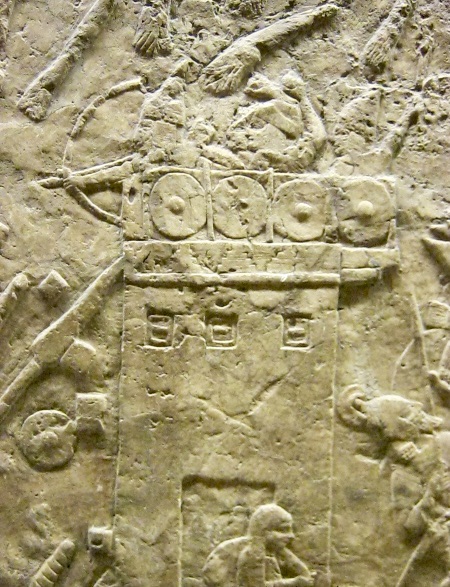
Lachish was city in Judah, southwest of Jerusalem. And though the event portrayed in this relief hasn’t happened yet during the reign of Uzziah, it’s only about 50 years in the future. It’s VERY possible that the defensive structures depicted on the towers of Lachish were like the ones Uzziah’s inventors put on the towers of Jerusalem.
You’ll notice shields to protect the archers on top of the wall. And while that may seem like a no-brainer to us, there was a time in the past when…
🤔 Hey Jo- Ya know how warriors with swords carry a shield for protection? Well why don’t we make shields for the archers?
😐 Martin, archers can’t hold a shield. They need both hands to shoot their bows.
🙄 I know that, Solomon. So what if we attached the shields around the wall so they can shoot from behind them?
🙂 Oh. Yeah. That’s a good idea.
There are also some kind of slit-windows for possibly shooting arrows from (like the “arrow slits” in Medieval castle walls). Notice also that the roof/shield structure extends out over the edge of the tower. This allowed for what were later called “Murder Holes;” openings in the floor that allowed soldiers to drop large rocks (and other unpleasant projectiles) onto the heads of attackers. Dropping rocks on your enemy’s head was as old as having a wall to drop it from, (see Judges 9:50-53). But this little invention of the roof extension allows the stone hurling without exposing one’s self to enemy fire from below.
Anyway… that’s probably more about Uzziah’s military inventions than you ever wanted to know…
Back to the rest of his story which pivots on this verse:
“But when he was strong, he grew proud, to his destruction. For he was unfaithful to the Lord his God and entered the temple of the Lord to burn incense on the altar of incense.”
2 Chronicles 26:16 ESV
Most of us never have the opportunity to find out what our character would be if we were a powerful, popular, and wildly-wealthy king. We tend to assume that we wouldn’t change; that we would be just ourselves. But power and wealth and people fawning at your feet and addressing you with titles of respect has a way of changing a person. Uzziah did so much good it seems he began to believe ALL his ideas were great.
But going into the Holy Place to burn incense? Not a good idea.
🤔 So… why was it cool for David and Jehoiada to do king-priest stuff, but not Uzziah?
Well…
- David never tried to burn incense or enter restricted space. His “participation” as a priest was limited to wearing priestly garments, (the famous linen ephod) and having some level of access/nearness to the Ark in Tabernacle of David.
- Jehoiada WAS the priest and he did not usurp kingship. He advised King Joash who followed his counsel. He never forced his will. He did not demand to be buried with the kings.
Uzziah’s motive was pride, not genuine service. Honestly, this bit about him going into the temple unauthorized and acting like a priest kinda gives me antichrist vibes.
Now here’s something interesting… Uzziah’s other name is Azariah. That’s the same name as the High Priest who WAS authorized to offer incense.
The 80 priests that go with Azariah the Priest to confront Azariah (Uzziah) the King were described as “men of valor.” Ya know why?
☝🏼😌 Cause they knew they could end up like burnt marshmallows?
😯 Wha.. marsh.. why on earth would you…
😦 Cuz the priests dress all in white. And if they get zapped by the LORD like those guys back in the wilderness, they’d look like when I accidentally set my marshmallow on fire 🔥 and it’s all charred… like a little charcoal puff.
😑
😦 What?
😑 Never mind. I can never unsee that now.
I assume you were referencing this verse:
“And fire came out from the Lord and consumed the 250 men offering the incense.”
Numbers 16:35 ESV
😌 Yup. That’s the one.
Well you’re right. And those priests would’ve absolutely had that incident in mind as they went into the temple not knowing if they’d come back out alive. So yes, they were very courageous men.
And when they stopped him from burning incense, Uzziah got angry.
If the leadership – not just one disgruntled person but the whole team of “priests” – is all in agreement that someone is out of line, and they step in to correct that person, and the person responds with anger, “You’re attacking me! I don’t need to answer to anyone but God!- then I think you can be reasonably sure that the problem is pride.
Anger and resistance to correction is a pretty good sign that someone is doing operating in pride.
Genuinely humble people will receive correction. Proud people will argue their position and won’t back down unless God exposes their sin.
And that’s what God to Uzziah. Leprosy is a picture of sin because it brings death to the body even while the person is still alive. And the sin of pride in Uzziah’s heart was – in a way – made visible by the outbreak of leprosy on his forehead.
The forehead is the place where you think, your brain. The forehead is also where the true High Priest wears a golden crown that says “Holy to the LORD.” That crown covers his forehead. It’s like a picture of how sanctification changes the way you think. It suggests having “the mind of Christ.” It speaks of being “transformed by the renewing of your mind,” and “bringing every thought into the obedience of Christ.”
Uzziah didn’t have the right mind; the right attitude. And that’s where the leprosy showed up.
The priests hustle him out and he is taken off to live in a separate house for the rest of his life. No more wife (or wives). No more playing with children or grandchildren. No more mingling with an adoring public.
Sin always costs more than we think it will.
Isaiah grows up with a king that no one ever sees. The country is actually run by the prince, Jotham. King Uzziah still has the final say on big decisions, but the daily administration is done by his son.
According to Jewish tradition, Isaiah was born into a noble family and lived in Jerusalem. So it’s likely that he had a personal knowledge of the royal family.
He was also well-educated as his writing demonstrates mastery of both Hebrew poetry and prose. The book of Isaiah has a larger vocabulary than any other Old Testament book.
There are a lot of ideas out there in academia about the book of Isaiah and we will deal with them when the time arises. For now, one good and helpful observation is that the book of Isaiah can be divided into two sections. Chapters 1-39 might be called “The Book of Judgment.” Chapters 40-66 might be called “The Book of Comfort.”
In the opening chapter of Isaiah, Yahweh compares His people to 3 things:
- Rebellious, estranged children (2-8)
- You are sick, wounded, desolate.
- Sodom & Gomorrah (9-20)
- Your worship is fake. Please stop.
- Jerusalem is a Prostitute (21-31)
- I’m going to destroy then restore.
From the very beginning, Isaiah gives the message from Yahweh. It’s a key verse for the entire book of Isaiah. It’s kind of the whole message of Isaiah in a nutshell:
“If you are willing and obedient, you shall eat the good of the land; but if you refuse and rebel, you shall be eaten by the sword; for the mouth of the Lord has spoken.”
Isaiah 1:19-20 ESV
They still have a chance.
As the messages continue, the LORD will unpack exactly how sick His estranged children are and what they need to do to return to their Father. He will continue to call them out on the “worship” that ticks all the correct boxes but lacks any connection to the heart. And, man-oh-man is He going to pound that message of coming destruction followed by restoration. And it’s going to have a dual meaning. But I won’t get ahead.
😐 Yeah. You’ve done enough damage for one day. How about we call this one done?
Ok. We’re done.
😅 Whew. Good. Made it.
See you tomorrow.
 To The Reader