Micah of Moresheth was prophesying at the same time as Isaiah and Amos and Hosea. His messages were primarily aimed at the southern kingdom of Judah.
I have yet to show you the end of that timeline we’ve been using to know where we are in the history of Israel and Judah. Let’s look at it now.
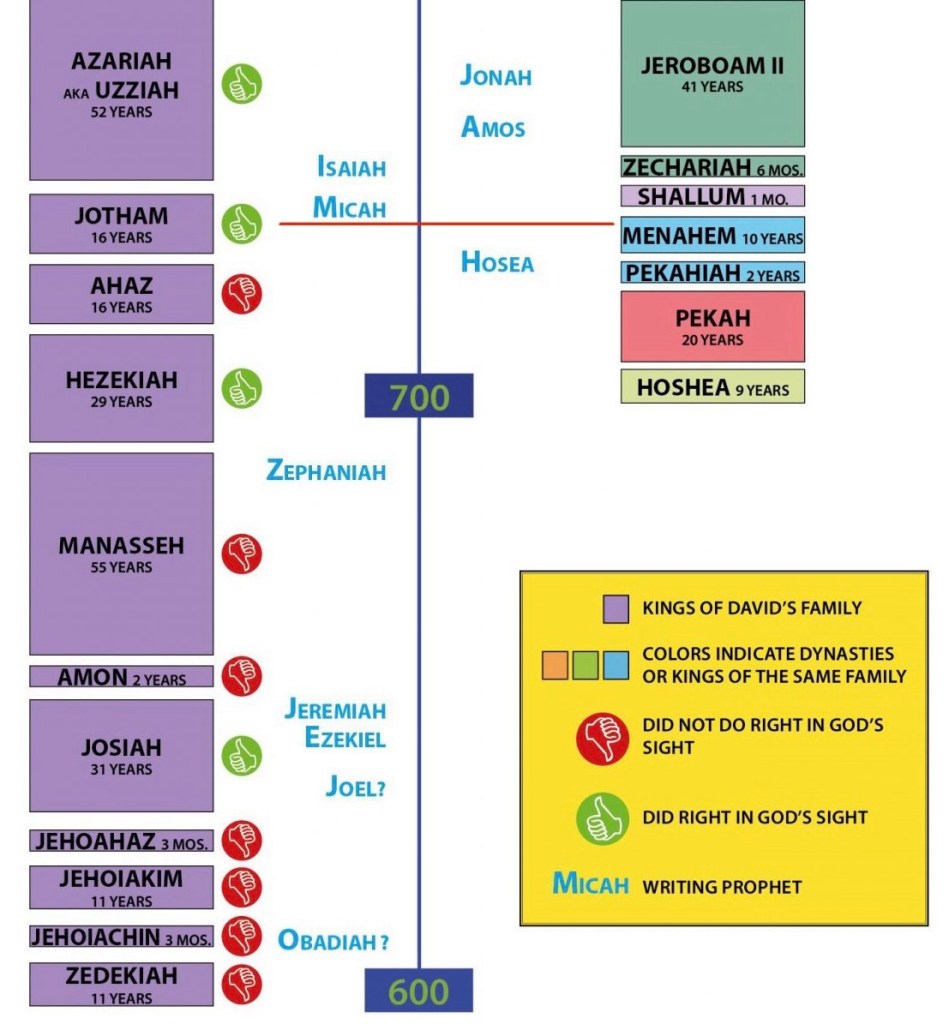
Notice how the northern kingdom of Israel stops after Hoshea. Isaiah, Micah, and Hosea live and prophesy all the way into that period with King Hezekiah of Judah.
I think we’ve read enough in Isaiah and Amos at this point to understand that Yahweh wasn’t just correcting the northern kingdom. The people of Judah – even with good kings like Uzziah and Jotham – were still committing idolatry and corrupting justice and ignoring God’s Law.
Based on timeline above, which kingdom do you think heeded the words of the prophets and repented?
Micah is one of the few prophets that got through to the listeners. And it bought them another century of existence.
One more thing before we look at the content of chapters 1-2… There are a lot of places, phrases, idioms, and other historical references in the Prophets that we don’t understand. This can lead us to impose what we think it means upon the text. Not helpful. Sometimes we just mentally skip over these parts. That’s not really helpful either. I’m not saying that you have to unearth every scrap of meaning for every word, but there are resources that can help us not just skip things or guess at meanings.
I recommend to you, blueletterbible.org. Or, as my friend Dave likes to call it, “the Blue Book.” (Shout out to Dave & Christy for being awesome!) It’s a free online resource. It’s an entire library of helpful Bible study tools. FREE.
You can look up words in the original languages (and I do use this feature a lot). But today I want to encourage you to use the Commentaries. Imagine having a Bible professor you could just call or text any time.
Me: Excuse me, Professor Henry, but what is this passage talking about?
Matthew Henry (17th century theologian): Good day to thee. I will gladly expound upon this passage for thy edification for there is much grace to be ascertained in these desolations and pronouncements of woe.
Me: Excuse me, Dr. Fausset? I read Professor Henry’s commentary on Micah but I could use some further clarification.
Dr. Fausset (19th century Evangelical minister and Bible commentator): I will get straight to the point. Imagery describes Jehovah’s coming judgment. Compare Judges 5:5. Third clause: “wax” answers to the first in parallelism.
Me: Excuse me, Dr. McGee…
Dr. J. Vernon McGee (20th century Bible teacher and radio evangelist): You can call me Vernon. I’m just a plow boy who loves Jesus.
Me: Vernon, I’m having a hard time understanding the importance of all the cities that the prophet Micah is talking about. I don’t get it.
J. Vernon McGee: Well friend, those town names have meanings. Gath means Weep Town. Aphrah means Dust Town. Saphir means Beauty Town. Let’s think about all of them and see what God says to ‘em.
Ok. I’m having a bit of fun with their respective styles, but the commentaries are quite helpful. Here’s how you get there:
(If you already know, feel free to skip down)
In your web browser go to:
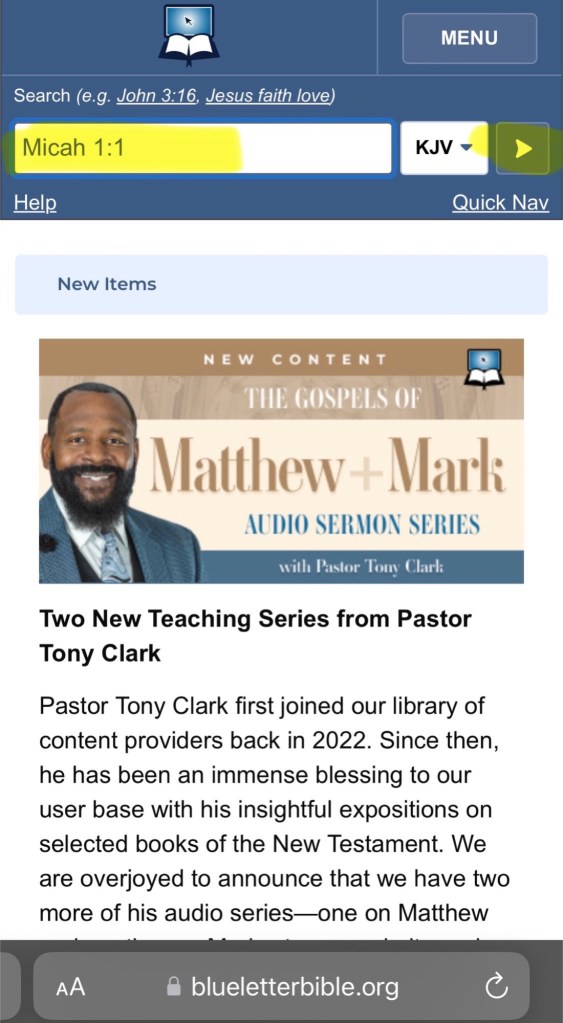
When you get there, type Micah 1:1 in the search box, then click/tap the arrow.
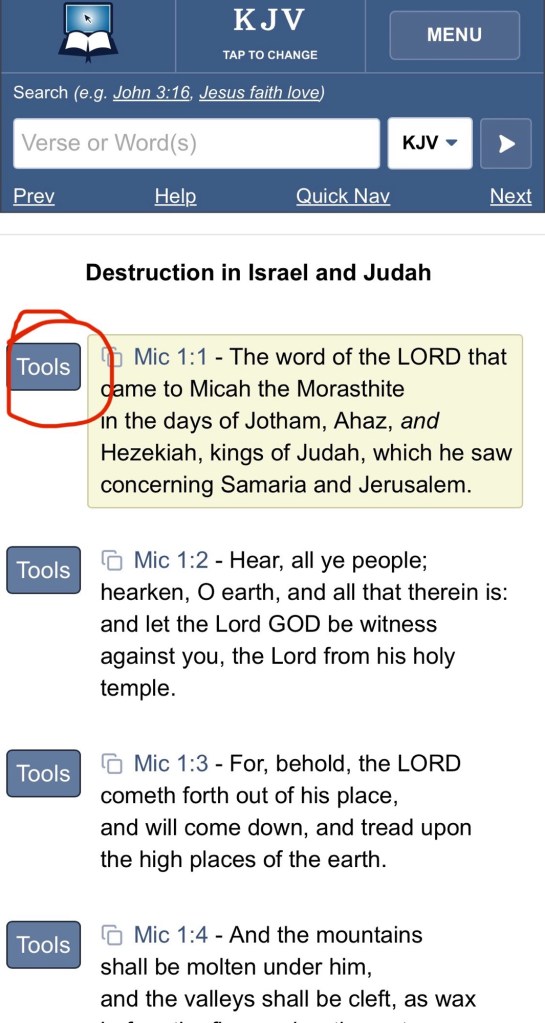
Click/Tap the “Tools” button.
It will open a screen like this:
Click/Tap on “Commentaries”
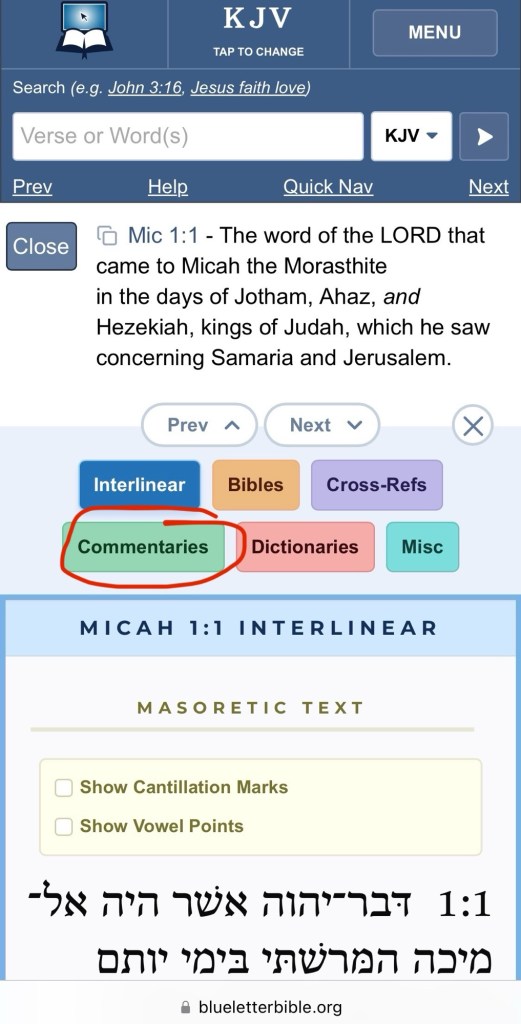
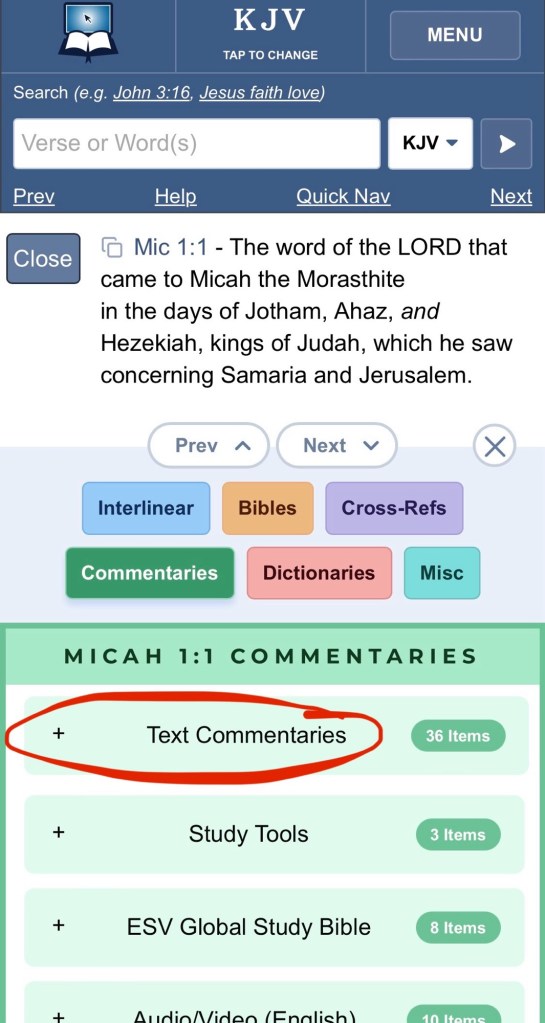
There are a number of types of commentaries, but for this exercise we will select “Text Commentaries.”
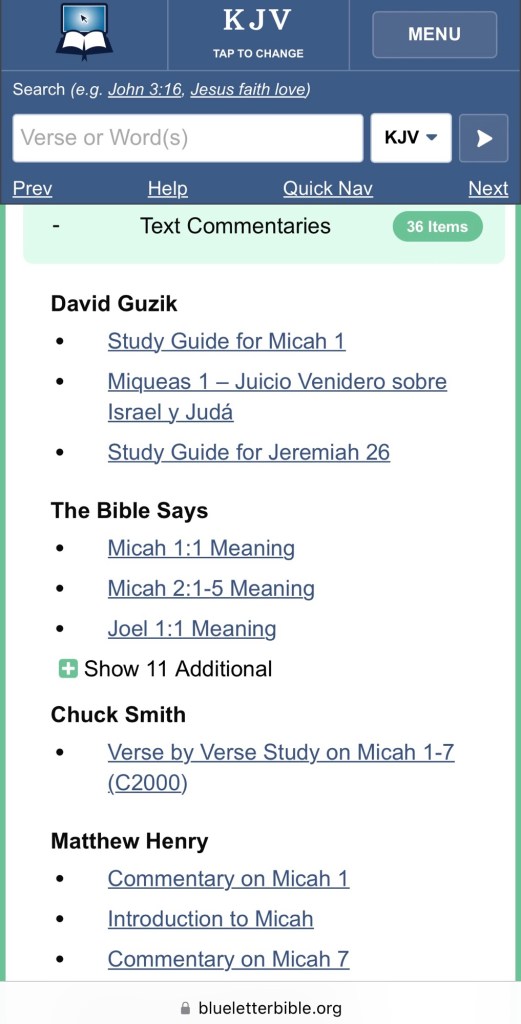
You can scroll down to see all of the various commentaries available.
Matthew Henry is one of the most granular and detailed. But it’s similar to reading the KJV because he wrote in the English of the late 1600’s.
Jamison, Fausset, and Brown is more technical with lots of cross-references.
Dr. J. Vernon McGee gives a more conversational and well-structured approach.
If I select Jamison, Fausset, and Brown then scroll down I find that…
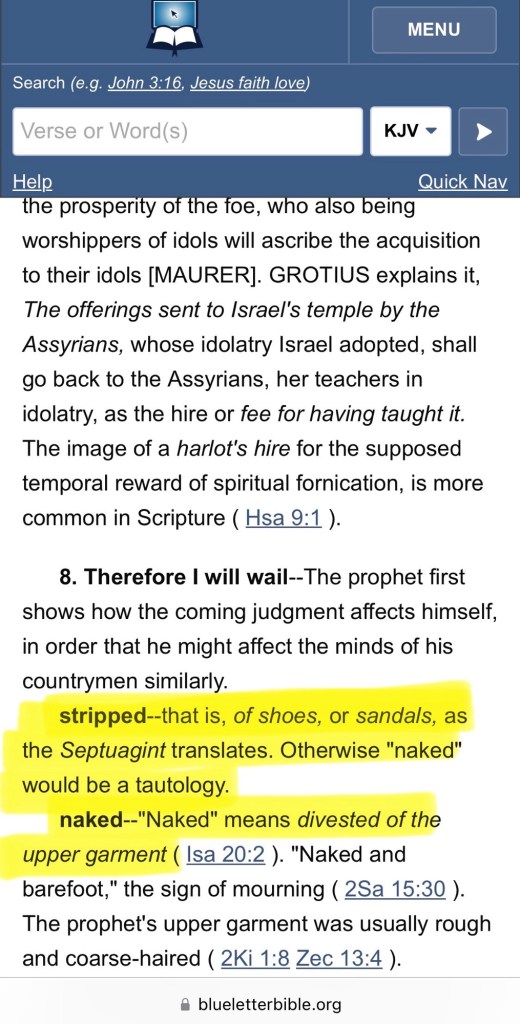
The terms “stripped” and “naked” in Micah 1:8 do not mean what we think they mean in our context and usage of the words. Micah is not saying he is going to turn nudist. He is saying in the cultural idiom of that time and place that he is going to dress and act as if his best friend has died.
I hope you will take advantage of the works of these wonderful men of God. They spent their entire lives devoted to studying the Bible and learning the original languages. And they left behind a treasury of information.
Ok… On to Micah 1 & 2.
“The word of Yahweh that came to Micah the Morashtite in the days of Jotham, Ahaz, and Hezekiah, the kings of Judah, that he saw concerning Samaria and Jerusalem:”
Micah 1:1 LEB
In my head, I think I generally supposed that the northern kingdom (capital: Samaria) got in trouble with God first, then Judah and Jerusalem came second.

They were BOTH in trouble at the same time. It’s just that the southern kingdom repented and were spared for a few more years while the northern kingdom ignored the warnings and went down first.
Borrowing from J. Vernon McGee’s outline of Micah, allow me to paraphrase 1:10-15:
- Don’t weep in Weep Town
- Roll in the dust in Dust Town
- Dress like ragged slaves in Beauty Town
- Don’t go out of Go-Out-to-Pasture Town
- The House-of-Support has no support
- Bitterness awaits the people of Bitter
- Harness your horses and flee, people of Horse Town
- Give the divorce-settlement possessions to the City of Possessions
- Lie Town has lied to the kings
- A conqueror will take dominion over Summit-Dominion Town.
This is VERY bad news for Judah (delivered in a very clever style). They are in just as much trouble as Israel. Micah calls them to mourn in advance for the calamities that are coming.
But there are other voices. They say Micah is wrong. He’s just frightening people with his Hellfire and Brimstone preaching. Imagine being in Judah at that time. Who would you believe? The fringy counter-cultural guy who says bad things are coming and we should repent in godly sorrow? Or the people promoting “positive affirmations” while overlooking sin.
Sound familiar?
Even in God’s impending judgment, there is a promise of hope and restoration. After the Lord scatters the people and demolishes their land, He will gather the few that remain like a Shepherd rounding up lost sheep. The Shepherd-King will restore His flock and lead them out of the wilderness and back to their pasture.
If I had been an inhabitant of Judah then, I would’ve copied that promise down and held onto it for dear life.
 To The Reader