“The oracle concerning Babylon which Isaiah the son of Amoz saw.”
Isaiah 13:1 ESV
🤔 What exactly is an “oracle?”
The Hebrew word is massa and it means “a burden,” or something that you carry. Isaiah and the other prophets were given weighty messages from God to humanity. They had to carry those heavy words and deliver them to the intended audience.
This is a Nepalese porter taking a break from carrying his load. The word massa also means “porterage”- the load that is carried.

And in Isaiah 13, the load that Isaiah is delivering is for Babylon.
Up to this point in our trek through the Bible, Babylon has been a city somewhere off in the desert in the land that Abram left when Yahweh called him. At this time the region of Babylon is not a powerful empire but more like a vassal-state or district within the control of the Assyrian Empire.
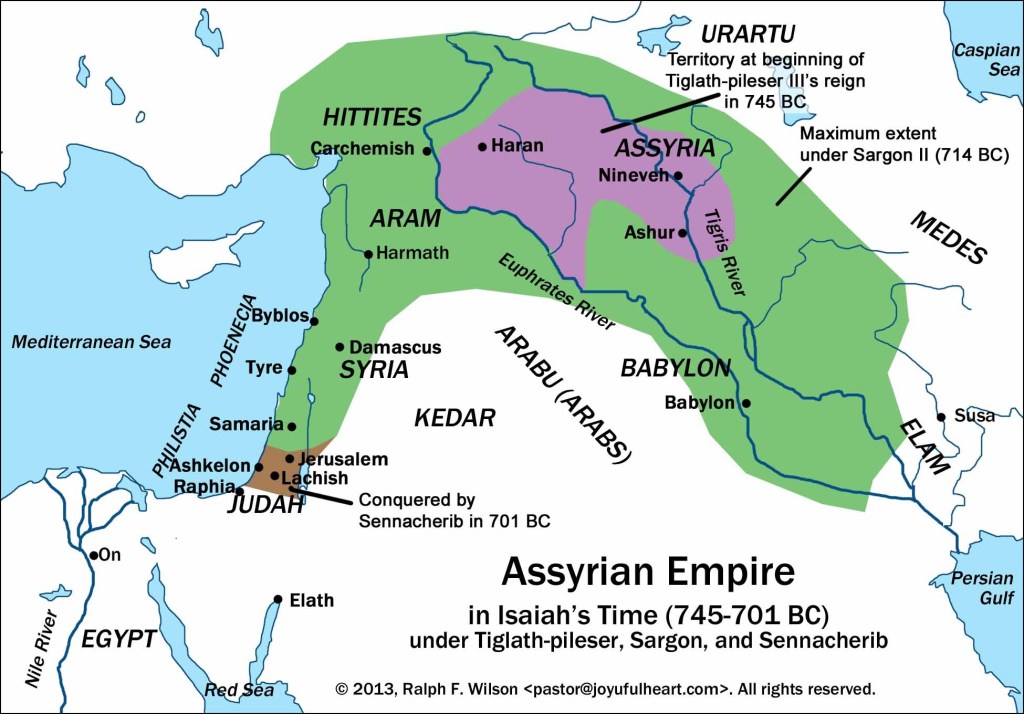
In this oracle concerning Babylon, Isaiah foretells their power as an empire, their use by God as a weapon of punishment on Judah, and ultimately (in verses 17-22) their overthrow by the Medes.
Isaiah is giving this particular prophecy in about 712BC. Nineveh, the capital of Assyria will fall to the Babylonians AND the Medes who team up to overthrow the empire in 612BC. Babylon will fall to the Darius the Mede in 539BC and the first Medo-Persian Empire will stand until Darius III is defeated by Alexander the Great in 330BC.
Skeptics can’t STAND this. It’s an impossible level of accuracy. It must have been written after the fact, they say, and only made to sound like it was written beforehand. All I can say is “The Bible is true. Go pound sand.”
Ok. Moving on…
Remember how the LORD referred to the Assyrians as the axe 🪓 in His hand to cut down the forest of Israel? Well He calls Babylon:
- His consecrated ones, 13:3
- His mighty men, 13:3
- His proudly exulting ones, 13:3
- The weapons of His indignation, 13:5
The implication is that that God will raise up and allow the Babylonians to invade Judah just as He used the Assyrians to achieve His purpose of punishing His people for their idolatry and wickedness.
Then comes another “Day of the LORD” section in verses 6-16. Before we get to the details, I want to emphasize again that there is overlap between the future Day of the Lord and the Day of the Lord in Isaiah’s time: that is, the invasion of Babylon to destroy the temple and take the people into captivity. The day when the Babylonian soldiers break through into the city will indeed be a dark and terrifying day. There will be death and destruction on a scale Israel has never seen before as a nation. It is a model. A miniature.
Humans like doing things in miniature. Tiny homes 🏠 have been something of a global trend. Model trains 🚂 are one of the most well-recognized miniatures. And miniature golf, ⛳️ is much easier than full-sized golf. If you have never seen miniature cooking, 🍳 click on the link and prepare to be delightedly amazed for about 3 and a half minutes. There are whole YouTube channels that just do miniature cooking.
As horrible as it will be, the destruction of Jerusalem is a miniature “Judgement Day.” The full-sized version will affect the whole world, not just Judah and Jerusalem.
With that in mind, let’s look at the characteristics of the Day of the Lord given in this section:
- Key word: “wrath,” v9 & 13
- Destruction of sinners, v9
- Sun, moon, and stars effected, v10
- The whole world punished, v11
- Survivors will be extremely rare, v12
- The heavens “tremble”, v13
- Earth shaken so violently that it is “out of its place” (out of usual orbit? 23 degree tilt changed?), v13
- No safe place to go, no one to trust, v14-15
- Horrible HORRIBLE violence of humanity against humanity, v16
We tend to think of “Judgment Day” as God destroying humanity for its sin. And that’s not wrong. But as we’ve seen in the fall of the northern kingdom of Israel by the “axe” of Assyria, and now God is saying that Judah will fall by his “weapon” of Babylon…
These events didn’t look like judgment day. They looked like one group of people conquering another. And while I totally hold to the idea of the future day of God’s wrath as being just that – God’s wrath, from heaven – I wonder if there will be more of a human vs human element involved than I had considered before. Perhaps part of God’s wrath is letting rebel humanity have what it wants: complete independence from God.
One more note before we move to chapter 14. In 13:19-22 Isaiah foretells the utter overthrow of Babylon and that it will never be rebuilt. He describes wild desert creatures inhabiting the ruins, (and those are not wrong translations) but there are some odd words that suggest another layer of meaning.
Here are verses 21-22 in a combination of the Septuagint and untranslated Hebrew with some clarifying [additions] from me:
“But wild animals of the desert will rest there [Babylon], and their houses will be filled with noise [“howlers”]. Sirens will rest there, and demons/satyrs will dance there. Donkey centaurs [or howlers] will dwell there and tanniyn [land-monsters, dragons] will make dens in their homes. It will come quickly and not delay.”
THAT is a very creepy picture. It’s like a cryptid family reunion. Sirens are traditionally understood as mermaids – half human, half fish. Satyrs are half goat, half man, like the god Pan. A centaur in mythology is a horse-man creature; the Septuagint has it as a half donkey. And to top it off there are nondescript seemingly disembodied “howlers” and dragons. There’s just a lot of demonic and Nephilim imagery here. I would have no desire to set up a tent there and camp overnight.
I don’t think these meanings – the desert animals vs the cryptids – are mutually exclusive; as if one view is right and the other wrong. I think one is natural (actual desert animals) and the other spiritual- and by spiritual, I do NOT mean “esoteric.” I mean it’s describing a reality in the spiritual realm that is connected to the “Mystery Babylon” of Revelation 17-18.
Look what the angel announces at the fall of Babylon in Revelation 18:
“And he cried out with a mighty voice, saying, “Fallen, fallen is Babylon the great! She has become a dwelling place of demons and a prison of every unclean spirit, and a prison of every unclean and hateful bird.”
Revelation 18:2 NASB2020
THAT Babylon sounds an awful lot like the demonic imagery version of Isaiah 13:21-22. I’ve never seen the show Stranger Things and I don’t intend to because I’m super sensitive and don’t do creepy shows. [And also I do not have any kind of television] But they depict a parallel dimension to the world called “The Upside Down” where dark monsters dwell. Babylon is like that. Babylon has an “our-dimension” reality. It is an abandoned city with wild goats and owls and lizards and other harmless solitary desert critters inhabiting its ruins. But in the Upside Down it is the dwelling place of demons and all manner of foul spirits.
Does that make sense?
Good- cause you’re gonna need to keep thinking on two simultaneous planes of reality for chapter 14.
The context of the beginning of chapter 14 is the restoration of the people of Israel from their captivity in Babylon. The chapter also contains oracles against Assyria and Philistia but I’m just going to focus on verses 1-23.
In verse 4 we have a “taunt” – a pithy maxim, a proverb – against the king of Babylon. This is important. The king of Babylon is a man. But the victory speech about the overthrow of the pompous king of Babylon has a fitting application to another figure who also had divine aspirations.
“How you are fallen from heaven, O Day Star, son of Dawn! How you are cut down to the ground, you who laid the nations low! You said in your heart, ‘I will ascend to heaven; above the stars of God I will set my throne on high; I will sit on the mount of assembly in the far reaches of the north; I will ascend above the heights of the clouds; I will make myself like the Most High.’”
Isaiah 14:12-14 ESV
Ok, this is where we HAVE to be persnickety in our interpretation of scripture. Many of us have been told, “This is about Satan.”
That’s not strictly true. The text is quite clear. This is about the king of Babylon. He’s identified as a “man” in verse 16 and a man whose body is thrown out and decomposes.
😐 Yeah – the reference to maggots gave me flashbacks to Job.
Is Satan a human?
😐 Uh… no….
Does he have a physical body to decompose?
🤔 Not that I know of.
Then it isn’t about Satan. Exactly.
The association comes with the term “morning star.” It’s a description used of angelic beings in Job by God Himself:
😏 See? I knew this felt Job-ish.
“Where were you when I laid the foundation of the earth? Tell Me, if you have understanding, Who set its measurements? Since you know. Or who stretched the measuring line over it? “On what were its bases sunk? Or who laid its cornerstone, When the morning stars sang together And all the sons of God shouted for joy?”
Job 38:4-7 NASB2020
The Hebrew poetry has “morning stars” rhyming with “sons of God.”
The Septuagint translates Isaiah 14:12 as “How you are fallen from heaven, O Lucifer, who rose up in the morning!” In Hebrew, “Lucifer” is heylel and it means “morning star.” It’s not a proper name. It comes from the root word halel which means to shine clearly and so it infers boasting or praise. That’s why it’s part of the word halel-u-JAH, which means “praise to YAH (Yahweh). Halel is what the helel did in Job 38. The morning stars sang praises.
The description of the aspirations of the king of Babylon in verses 13-14 are certainly those of a Rebel who will answer to no one. And the description of a character “fallen from heaven” reminds us of Jude’s “angels which kept not their first estate” and the rebel sons of God in Genesis 6.
So even though this passage is technically about a human king, it does carry a definite application to another Rebel.
In this prophecy, the king of Babylon is utterly humiliated and disempowered. He will be “brought down to Sheol, to the recesses of the Pit.” Sheol is the Grave, the realm of the dead, the place of the spirits of the dead. That’s all he has to rule over now.
In verses 16-17 onlookers are shocked to see how pathetic he is. Based on the damage he has done and the fear he instilled, everyone expects him to be ten feet tall and bulletproof. But he isn’t.
This bit reminds me of the scene in The Wizard of Oz when “Oz the Great and Terrible” is revealed to be nothing more than a timid little man using a lot of gadgets to trick everyone into believing he is a powerful wizard.
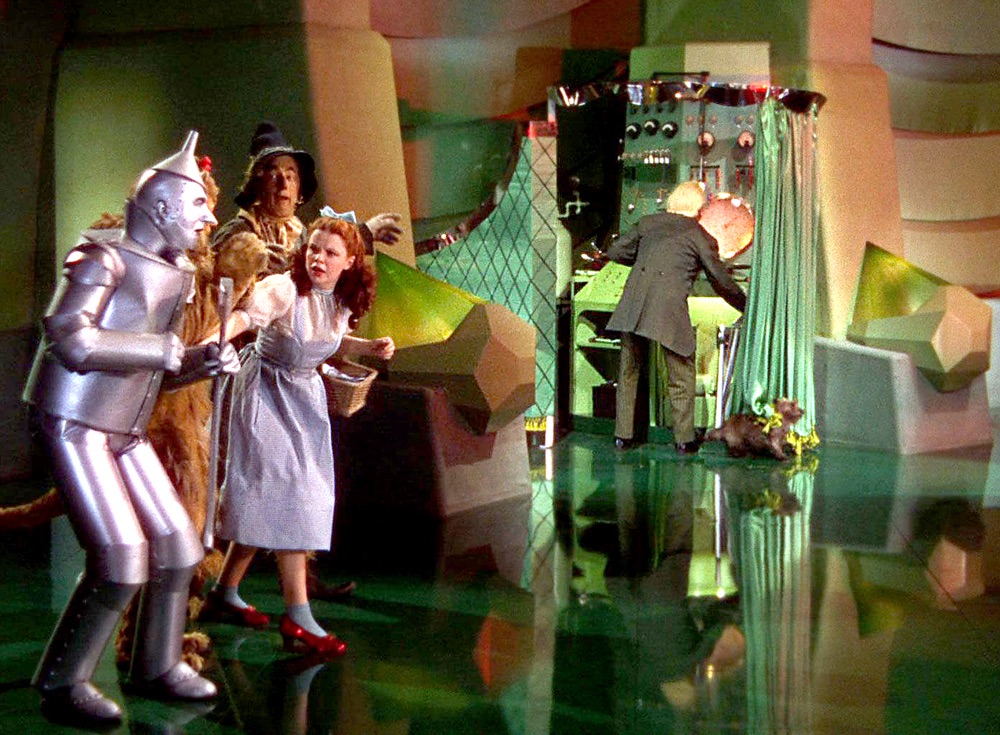
Jesus has all the real power and authority.
Fear and deception are the only “powers” the fallen morning stars have left. They use a lot of smoke and mirrors to keep the nations bound in sin and fear and subjugation. When you hear voices – even ones from Christian circles – saying “Hell isn’t real. Satan is just a figure invented by the Medieval Church,” that is the voice of “the wizard” saying, “Pay no attention to that man behind the curtain!”
 To The Reader