Chapters 15-16 are for the land of Moab, descendants of Abraham’s nephew Lot.
The Moabites have long been deep in idolatry, but there is a sad tone to this prophecy. The LORD isn’t exulting over their destruction. This feels more like grief: 😭
“My heart weeps for Moab. Its people flee to Zoar and Eglath-shelishiyah. Weeping, they climb the road to Luhith. Their cries of distress can be heard all along the road to Horonaim.”
Isaiah 15:5 NLT
Recall that Zoar was the tiny town in the same plain as Sodom where Lot took his family. It was spared in the overthrow. Perhaps that is why the people of Moab flee there again- thinking that it is an ancient refuge.
I was surprised to find a Messianic prophecy right here in the middle of a word of doom over Moab. The prophet is speaking of Moabite women refugees at the border of Moab and Israel who have escaped the onslaught. They have slipped across the border and are asking Israel to not betray their hiding place and to let them stay.
This makes me think of the Moabitess Ruth coming into Israel with Naomi. Though they weren’t refugees from war, they were similarly very vulnerable women. Ruth, of course, is in the lineage of the Messiah, Jesus, who is prophesied here:
“…When oppression and destruction have ended and enemy raiders have disappeared, then God will establish one of David’s descendants as king. He will rule with mercy and truth. He will always do what is just and be eager to do what is right.”
Isaiah 16:4-5 NLT
Like Isaiah, we are still waiting for the time “when oppression and destruction have disappeared.” Those two things are clearly still in our world. And so we still wait for the Son of David to be established as King.
Chapter 17 starts a new prophecy; this time concerning the capital of Syria: Damascus. And it’s again one of those prophecies where we can ask “has this happened yet?”
“This message came to me concerning Damascus: “Look, the city of Damascus will disappear! It will become a heap of ruins.”
Isaiah 17:1 NLT
Here’s your answer:
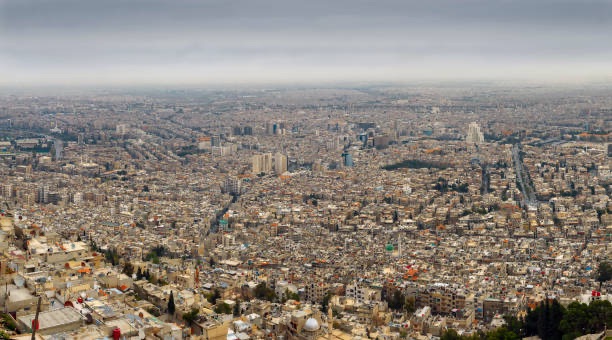
Damascus has a lot of evidence to back up its claim as “the world’s oldest continuously inhabited city.” It’s now a UNESCO World Heritage Site. If this city is the same Damascus that was there in Isaiah’s time, and a prior destruction by the Assyrians is not in view here, then this prophecy has not yet been fulfilled. And the whole world will know when it is.
It’s very possible that a prior destruction by the Assyrians is in view here, and the city eventually rebuilt itself. The prophecy may be pointing to the end of the Syrian kingdom more than some sort of permanent status of the city as a ruin. Verse 3 suggests as much.
“The fortified towns of Israel will also be destroyed, and the royal power of Damascus will end. All that remains of Syria will share the fate of Israel’s departed glory,” declares the Lord of Heaven’s Armies.”
Isaiah 17:3 NLT
Verses 4-6 tell of how deserted the land will be after the LORD allows all these invading armies to conquer and carry away the people. People will be like an overlooked olive here and there on a tree after the harvest. And it starts with an “In THAT day” heading.
Now, remember how the destruction of Israel and Judah and the Temple are a miniature of the BIG Judgement Day? I think these verses may have a dual application to the coming world-wide “THAT day.” It will very likely be a cataclysm on par with the Flood of Noah. Only 8 people survived that. Isaiah has already said that survivors will be as rare as “the gold of Ophir” (Is. 13:12). Of course Isaiah’s immediate application is to the destruction by the Babylonians, but it seems to also hint at the 2nd worldwide judgment.
Verse 9 speaks of large cities becoming “like a deserted forest.” It certainly has a post-apocalyptic vibe. And after all this destruction (both then and in the future):
“Then at last the people will look to their Creator and turn their eyes to the Holy One of Israel.”
Isaiah 17:7 NLT
Which makes me think of:
“For the Scriptures say, “‘As surely as I live,’ says the Lord, ‘every knee will bend to me, and every tongue will declare allegiance to God.’” Romans 14:11 NLT
Paul is quoting Isaiah 45:23.
Up to this point in chapter 17, we have seen Yahweh allowing the utter desolation of His people as punishment for their wickedness, but in verses 12-14 we see a “battle” with a very different outcome.
A vast, multi-national army has arrived to destroy God’s people. It looks like certain doom. And then God just…blows them away. Within hours, Israel goes from waiting for death in the dark to morning light showing all its enemies dead. ☠️
Now, that most certainly did NOT happen at the Babylonian invasion. This reminds me of what we covered in Micah 4 about the LORD “tricking” the nations- letting them come to attack Jerusalem, and then turning the tables and suddenly destroying them. Again, it sounds like a nod to Revelation:
“When the thousand years come to an end, Satan will be let out of his prison. He will go out to deceive the nations—called Gog and Magog—in every corner of the earth. He will gather them together for battle—a mighty army, as numberless as sand along the seashore.
And I saw them as they went up on the broad plain of the earth and surrounded God’s people and the beloved city. But fire from heaven came down on the attacking armies and consumed them.”
Revelation 20:7-9 NLT
Even a city surrounded by a vast army is not a problem for God. He made the universe. He can handle anything. He can handle whatever you’re facing today. Easy-peasy. We can trust Him. He can turn the tables within hours. Or, He can allow hardship for our growth. His answer may not look like what we want or come when we want it, but His ways are higher than our ways. In either case, it doesn’t matter what the odds are because…
“God does not require favorable circumstances.”
 To The Reader