PSALM 46
The opening line should be on your mental speed-dial; ready to quote at any moment.
“God is our refuge and strength, A very present help in trouble.”
Psalm 46:1 KJV
But before the opening line, there is the heading that many of us tend to skip:
“To the choirmaster. Of the Sons of Korah. According to Alamoth. A Song.”
The great translators of the Greek Septuagint rendered it like this:
“For the End; for the Sons of Korah; a psalm concerning hidden things.”
Okay…Curiosity button pushed.
What hidden things? Hmm… Maybe I should read it again…
There are 3 clear sections in this short psalm. They are indicated by the “Selah.”
- Verses 1-4 describe the earth under extreme cataclysmic circumstances. If mountains are moving into the heart of the sea, that’s civilization-ending.
- Verses 5-8 describe the city of God NOT shaking when everything else is. God is present and helps her “when morning dawns.”
- Verses 9-12 reflect on what God has accomplished: He has brought about peace on earth. He is exalted among the nations.
All 3 of these point to “hidden things” which may actually be less hidden to us than they were to the Sons of Korah. They are less hidden because we have the benefit of a book that took off the covering; Revelation.
The Revelation is Apocalyptic writing. This is the Greek word for Revelation:
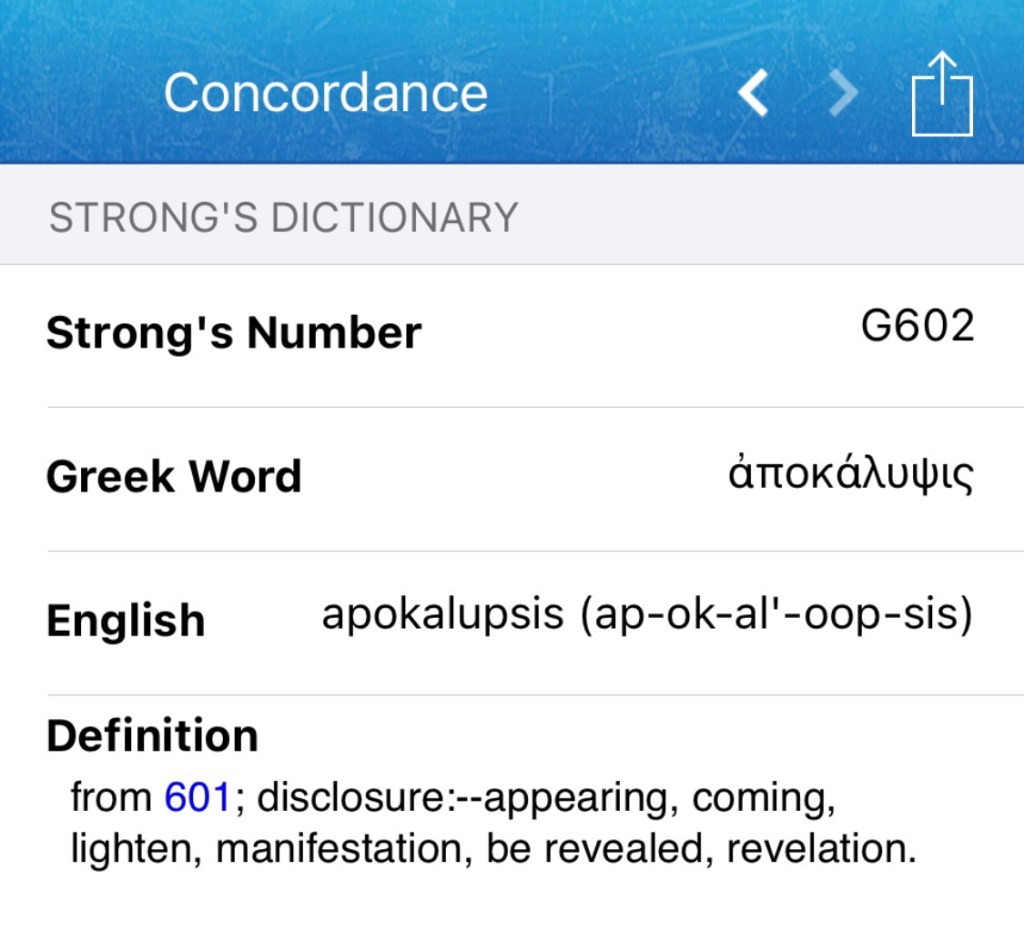
The Revelation (both the book and the events it describes) are the uncovering, the revealing of that which has been hidden. So we might see if it uncovers any of the “hidden things” described in Psalm 46. And, it does.
The only biblical scenario where mountains are shown being moved or removed is this:
“And the seventh poured out his bowl on the air, and a loud voice came out of the temple, from the throne, saying, “It is done!” And there were lightnings and sounds and thunders, and there was a great earthquake, as has not happened from the time humanity has been on the earth—so great in this way was the earthquake.
And every island fled, and mountains were not found.”
Revelation 16:17-18, 20 LEB
No wonder the psalm says it’s for “The End.”This is the 7th bowl judgement. It’s the end.
It also makes me think of what Jesus said:
“Truly, I say to you, whoever says to this mountain, ‘Be taken up and thrown into the sea,’ and does not doubt in his heart, but believes that what he says will come to pass, it will be done for him.”
Mark 11:23 ESV
The Apocalypse also describes a city with God in her midst. The river in that city is rather famous- the River of Life. God helping her at dawn could be like Gandalf showing up at sunrise in The Two Towers…

…or, it may suggest the dawning of the 7th millennium.
🤔 Why would God need to help the New Jerusalem? Isn’t it in heaven?
I can only think of a couple suggestions:
- He is talking about Jerusalem on earth
- The Heavenly Jerusalem is under attack
We do have THIS in Revelation:
“And when the thousand years are completed, Satan will be released from his prison and he will go out to deceive the nations that are at the four corners of the earth, Gog and Magog, to assemble them for battle, whose number is like the sand of the sea. And they went up on the broad plain of the earth and surrounded the fortified camp of the saints and the beloved city, and fire came down from heaven and consumed them.”
Revelation 20:7-9 LEB
The text is clear that this city is on earth. The New Jerusalem doesn’t descend from heaven til the next chapter, but in Revelation there isn’t a strict linear timeline, so make of it what you will. At any rate, the LORD did not make fire fall from heaven in 70 AD to consume the Roman army when they surrounded Jerusalem- so it’s not about that.
Texts like this make me realize: We’re gonna get to see a LOT of amazing things yet- even if they don’t happen for another thousand years. The future will not be dull. You may want to get used to the idea of living forever.
And perhaps those 1000 years of peace is what section 3 is pointing to. Compare:
“He makes wars cease to the ends of the earth; he breaks the bow and cuts off the spear. The wagons of war he burns with fire.”
Psalms 46:9 LEB
“He shall judge between the nations and he shall arbitrate for many peoples. They shall beat their swords into ploughshares and their spears into pruning hooks. A nation shall not lift up a sword against a nation, and they shall not learn war again.”
Isaiah 2:4 LEB
Some people, sadly, will be fooled when the phony- the Antichrist- brings about world peace for a while. The peace that Christ institutes will be lasting. Weapons won’t even be a thing. Imagine generations growing up having no concept of violence.
Incredible.
These texts are one reason why I can’t get on board with Amillennialism, which is a view that says Christ is reigning now in the Church rather than returning for a future reign on earth. What about all these texts that promise the end of war? We would have to interpret those away too.
Ok… moving on…
PSALM 80
This psalm seems to be directed toward the descendants of Jacob by his beloved Rachel. Recall that Rachel gave birth to only 2 sons for Jacob: Joseph and Benjamin. She died from complications in giving birth to Benjamin. Joseph had 2 sons: Manasseh and Ephraim and Jacob adopted them as his own and included them in his will, thereby giving his favorite son Joseph a double-portion.
“Give ear, O Shepherd of Israel, you who lead Joseph like a flock. You who are enthroned upon the cherubim, shine forth. Before Ephraim and Benjamin and Manasseh, stir up your might and come to save us!”
Psalm 80:1-2 ESV
- Ephraim means fruitful
- Benjamin = son of my right hand
- Manasseh means forgetting
We see those 3 concepts in this psalm.
The writer asks Yahweh 3 times to restore His people. He asks how long they will be disregarded (forgotten/Manasseh) by Yahweh.
There is a long section (v 8-16) where the nation is compared to a fruitful vine (Ephraim) which has been ravaged by wild animals, burned, and finally cut down.
You may recall that Jacob compared Joseph to a fruitful vine on his deathbed:
“Joseph is a fruitful bough, a fruitful bough by a spring; his branches run over the wall.”
Genesis 49:22 ESV
The prophecy goes on to describe the vine being shot at and wounded but helped by Yahweh.
Psalm 80 also speaks of the son of the right hand, Benjamin.
“But let your hand be on the man of your right hand, the son of man whom you have made strong for yourself!”
Psalm 80:17 ESV
This seems to be referring to Israel as God’s son, but when you read the title “son of man” it tends to leap off the page because it was Jesus’ favorite self-designation.
The next verse may give a clue:
“Then we shall not turn back from you; give us life, and we will call upon your name!”
Psalm 80:18 ESV
If the LORD puts His hand upon the Son of Man Who is at His right hand, then something happens in the heart of the people. They don’t fall away anymore. Something enables them to remain faithful. The Septuagint has it:
“Then we will not turn away from You; You will give us life and we will call upon Your name.”
And the Son of Man at God’s right hand does indeed give us life when we call upon His name.
By the way- this psalm inspired one of my favorite songs by Phillips, Craig, and Dean: Shine On Us. (In case you’re in the mood for a little music)
PSALM 135
This psalm fits perfectly with what we have been reading in Isaiah- about how the idols are a pathetic excuse for gods and that Yahweh is the only One to be feared and worshiped.
While the psalm includes all of of Israel (and even potentially any Gentiles “who fear the Lord” v20), it is mainly directed at the priesthood. It opens addressing the servants who “stand in the house of the LORD, in the courts of the house of our God.” That would be limited to the priests and Levites. The end of the Psalm picks out the House of Aaron and the House of Levi specifically with a command to “bless the Lord.”
🤔 Why would they need a psalm reminding them how great Yahweh is and that idols are inferior? Wouldn’t they be the most likely to know that already?
Maybe it was to remind the ones serving in ministry that what they were doing mattered.
A lot of people think that ministry is being on a stage with lights on you and people listening to you. And in some churches, that’s part of it. But most real ministry looks suspiciously like being a servant. Stacking chairs. Sweeping floors. Making and serving food. Driving vans full of people. Checking on sick folks. It looks a lot like organizing and making copies and phone calls and listening to broken hearts. Most of it happens out of sight- study and practice, preparation and prayer.
Ministry is not a path to stardom. At least, it shouldn’t be. It’s a path of humility.
Imagine being a Levite whose job was to be a temple gate-keeper. Or the guy who hauled the animal entrails out of town to be burned. Or the priest who went home at night smelling of sheep and blood. It was not a glamorous job.
Priests in idol temples often lived very lavishly- harems, rich food, power, money, influence… You can’t tell me it wasn’t a temptation. We have already read about Levites bailing out on Yahweh to set up their own shrines with a golden ephod or idol calves.
This psalm feels like a reminder that no matter how humble the service, it’s all about WHO you serve. It’s better to be the guy who pushes a broom for the LORD than to be a star for anyone else.
 To The Reader