We left Israel last week with more bad guys on the doorstep. The Anmonites are the descendants of Ammon. Remember how Lot (Lowt) fled from Sodom & Gomorrah and his 2 daughters got him drunk and they each had a child by their father? One of those boys was Moab. The other was Ammon.
Somehow the leaders of Ammon have taken up a misconception that Israel stole some of their ancestral land. Only it’s not true. The contested real estate was what had belonged to the AmORites not the AmmONites.
I know. I know. We all love to hate on all the confusing “-ites.” But think of it like this: each tribe is like a pro sports team. Pick your favorite. Now imagine if someone completely ignorant of your favorite team got it mixed up with a rival.
🤨🏈 So, who do you think will face off with the Cowboys in the Super Bowl?
🤓 Uhh… It’s one of those Indian teams… Chiefs? Seminoles? Braves? Scouts? Redskins? Warriors? I dunno, they’re all tribes right? Aren’t they all basically the same?
😑🏈 Cowboys & Indians? Really?
🤓 Do you know how epic that would be?
The AmORites were the giant clan led by Og and Sihon. The Amorites started the fight, but Israel ended it. Then Reuben, Gad, and half of Manasseh settled there.
The AmONites are descended from Ammon, the son of Lot by incest. God told Israel to leave them alone.
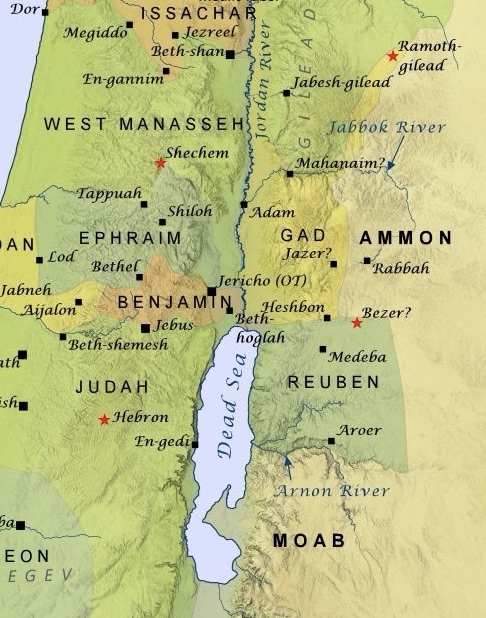
The region of Gilead, where Jephtha is from, belongs to Mannaseh. This area is the modern nation of Jordan. 🇯🇴 Gilead is not only the name of where Jephtha is FROM, it’s also his father’s name- Gilead the Gileadite. That would be like a guy from Scotland named Scot.

As I read the Jephtha narrative, it struck me as a counterpoint to the Abimelech narrative. There are several similarities and some key differences.
SIMILARITIES
- They’re both sons of “other women” who are rejected by the legitimate sons of their respective fathers.
- They both are natural leaders.
- They each assemble their own personal mercenary army.
- Both are asked by family members to take up the role of leadership.
- They are both rather impulsive men whose “big talk” brings them trouble.
- They both win their battles only to have tragedy befall them immediately after.
DIFFERENCES
- Jephtha judged Israel and the LORD gave him victory in battle, while Abimelech manipulated his was into power and the LORD was NOT with him.
- Jephtha goes “before the LORD at Mizpah” and publicly announces the terms of his agreement to lead. Abimelech never acknowledges Yahweh in any way.
- Abimelech exhibits more cowardly behavior, paying or manipulating others to do his dirty work while Jephtha is truly courageous.
- Abimelech murders his half brothers and “burns his bridges” while Jephtha does not and later saves his relatives.
- Abimelech is a cold-blooded killer while Jephtha seeks peace with the Ammonites before fighting them.
JEPHTHA’s RASH VOW
There is only the teeniest amount of wiggle room in the text to allow for the possibility that Jephtha did NOT kill his daughter and burn her body as an offering.
Josephus says that Jephtha “sacrificed his daughter as a burnt offering, offering such an oblation as was neither conformable to the law nor acceptable to God, not weighing with himself what opinion the hearers would have of such a practice.” But we must also bear in mind that Josephus was writing centuries later during the time of the early church and was not an eye-witness to anything in the OT.
I tend to land on the view that Jephtha did indeed kill his own beloved daughter out of a misplaced belief that it would somehow be better to fulfill his rash vow than bear the guilt of breaking it. I think this because, at this point, everyone in Israel is “doing that which is right in his own eyes” and the people have gotten Yahweh mixed up with the rest of the Levantine pantheon of El, Marduk, Chemosh, Baal, Asherah, etc as if Yahweh is just another one among the many who demand child sacrifice for great favors such as victory in battle.
There is a microscopic chance that Jephtha’s “offering up” of his daughter meant dedicating her to the service of Yahweh at the Tabernacle. I don’t think this interpretation accounts for the annual lament by the daughters of Israel though.
You might want to revisit the post on Leviticus 27 about dedicating things to Yahweh and redeeming them. However, Leviticus 27:28-29, (and Numbers 30 on vow-making), make it pretty clear that there wasn’t a “legal” option left open to Jephtha. His vow put him in an impossible situation and is meant to be a cautionary tale for future generations. He should never have made such a vow. How well did he know the Torah? I lean toward “not very.”
Think about it. They have no bibles. They have no “Sunday schools”, no synagogues, no temple. There are priests but they are concentrated in Levitical cities. The worship at the Tabernacle is not accessible to anyone outside the priesthood. You can’t even watch. It was supposed to the be the responsibility of the parents to teach their children the Law of the Lord, but if their parents didn’t teach them…
Jephtha seems more knowledgeable than most. He recounts the history of Israel’s past dealing with the Ammonites and Amorites. But that history is as old to Jephtha as the Revolutionary War is to us. Joshua and Caleb and Phinehas are to him like George Washington, Thomas Jefferson, and Benjamin Franklin are to us.
And just like we may know a bit about our nation’s founding, how many of us know the actual content of, say, the Federalist Papers or have read the debates of the first Continental Congress?
Our leaders do things contrary to our founding document, in complete ignorance, just like Jephtha. The big difference is – we have easy access to read and study ours while Jephtha did not.
And just like ancient Israel, our ignorance of the details of our founding document and history have led to infighting and misguided purpose.
The Ephraimites get a burr under their saddle because apparently they felt slighted that Jephtha hadn’t asked them to go fight the Ammonites. There also seems to be an old tribal grudge going on – a kind of family feud that had probably festered for many years. So Jephtha’s Gileadite army fights with Ephraim in Israel’s first civil war.
Jephtha judged Israel for 6 years. It’s sad that his legacy was not his victory over the Ammonites but the sacrifice of his daughter.
In an echo of a previous judge, Jair, we have another judge with 30 sons: Ibzan. But Ibzan far outdoes Jair because he also has 30 daughters. Ibzan appears to have maybe been a political matchmaker. The marriages he arranged for his children were the only thing noted about his judgeship so it may be that they were how he kept the peace. Josephus says that Ibzan (whose name means “splendid”), “did nothing in the seven years of his administration that was worth recording or deserved a memorial.” Ouch.
After him was Elon (not Musk). He also did nothing noteworthy as a judge for ten years. His name means “oak grove.” He was buried in Aijalon where the moon hung in the sky on Joshua’s long day.
Then we have Abdon who must’ve had a great many wives, babysitters, and stable hands because he had 40 sons and 30 grandsons who rode on 70 donkeys. I guess that’s how they measured prestige at this time. Not “Abdon the CEO of a Fortune 500 company.” Not “Abdon the inventor.” Not “Abdon the decorated military man.” No – it’s “Abdon who has 40 sons and 30 grandsons who ride 70 donkeys.” 🫏
30, 40, and 70 are the “power-ball” numbers in the OT. They come up a lot.
Interestingly, the name Abdon means “servitude.” But he is called a Pirathonite. Pirathon means “chieftancy.” His handle was quite literally, “Servant Leader.”
JUDGE RECAP…
- Othniel the City-Conqueror
- Ehud the Left-handed, Fat King Slayer (that is: Ehud is left-handed and slew a fat king, not that Ehud was fat and slew left-handed kings….)
- Shamgar, Axe-wielding, Giant-slayer
- Deborah the Palm Tree Prophtess
- Gideon the Feller
- Abimelech the anti-judge
- Tola the Scarlet Worm
- Jair of the 30 Sons on Donkeys
- Jephtha the Rash Warrior
- Ibzan, Matchmaker of 60 Children
- Elon the Unremarkable
- Abdon the Servant Leader with 40 sons and 30 grandsons on 70 Donkeys
Up next is the man who some count as the last Judge. And he is – in the book of Judges. But there are 2 more judges not in the book of Judges. And we will get to them eventually.
But our last judge of the book of Judges is probably everyone’s favorite – Samson. 💪🏼
If I were doing a YouTube “ranking” video of the judges I’d probably have a ranking system like this:
Love Them! (Means: I know their name and basic story)
Oh… yeah. (Means: I’ve heard of them and kinda remember they’re in the Bible)
Who? (Means: They’re in the Bible?)
And here’s how I’d rank them:
SAMSON
GIDEON
EHUD
DEBORAH
JEPHTHA
OTHNIEL, SHAMGAR, ABIMELECH, TOLA, JAIR, IBZAN, ELON, ABDON
Samson’s story is going to take us the next 3 days to cover. It’s the longest story of any one judge in the book of Judges.

