Absalom plots a coup. And he does it one person at a time.
“Then Absalom would say to him, “Look, your case is good and right, but for you there is no hearing with the king.” Then Absalom would say, “Oh, that someone would appoint me as judge in the land, that anyone might come to me who had a legal dispute or a case, and I would give him justice.”
2 Samuel 15:3-4 LEB
Absalom is basing his opinion of his father’s reign on his personal experience.
“but for you ME there is no hearing with the king.” There. Fixed it.
There is none so persuasive as one who truly believes what he is saying. And Absalom couples this genuine concern for the people to have justice with a fresh egalitarian posture. He refuses to let them bow to him and instead embraces them as equals.
It’s rather like the motto created by the French Revolutionaries: Liberté, Égalité, Fraternité. 🇫🇷 (“And if you don’t agree, citizen, we will hand you over to Madame Guillotine to have your head removed.” 😵Oh yes. SO much liberty.) 🙄😒 It also smacks a bit of Bolshevism and its dazzling appeal to the common man.
But it worked. Absalom won the hearts of the people by intercepting them and poisoning them with his own bitterness toward his father. But it was done so humbly and authentically that the people had no idea they were on the receiving end of a very sophisticated form of political propaganda. They bought the apparent grassroots movement (which was nothing of the sort) and it split the nation.
Absalom creates a cover for his meeting to establish a new government; a sacrifice to Yahweh. He had probably heard the story as a boy how during the reign of Saul, David had to be anointed by Samuel in secret under the guise of a sacrifice to Yahweh. Interesting how things come back around.
Ahithophel was one of the conspirators that sided with Absalom. He had been a counselor to David, though I’m not sure how anyone with a name that means “Brother of Folly” gets a job as a counselor. 😏
When word reaches David that Absalom has declared himself king in Hebron and is headed to Jerusalem with an army, David packs up and flees.
You’d think the legendary giant-slayer would call his Mighty Men together, raise the flag and say, “They’ll have to take me out of here in a box!” But David is a father and grandfather. His wives and children and grandchildren are all in grave danger if he stays. The families of his men and the priests and Levites are also in grave danger.
“And all his servants passed by him, and all the Cherethites, and all the Pelethites, and all the six hundred Gittites who had followed him from Gath, passed on before the king.”
2 Samuel 15:18 ESV
- Cherethites: non-Jewish people who lived south of, or with the Philistines; may have begun as mercenary soldiers for the Philistines then joined David. Some probably worked in the palace. Some were members of his personal body-guard. Led by Benaiah.
- Pelethites: non-Jewish mercenary soldiers employed by David as body guards and special forces. Led by Benaiah.
- Gittites: non-Jewish people from Gath, probably Philistines or of mixed race. Probably many palace staff and military adjacent servants.
Remember when David had to leave Israel because Saul was so bent on killing him? He moved to Gath and then Ziklag. He built strong relationships with these Gentile neighbors. Think of it. Most of the men of Israel fought for Saul. David’s personal fighting force was mostly made of Gentiles. Kinda makes me think of Jesus, the Son of David. Most of His army is also made of Gentiles.
One man in particular, Ittai, gives a little speech of loyalty that is rather like Ruth’s to Naomi. And he has only just arrived to Jerusalem.
“But Ittai answered the king, “As the Lord lives, and as my Lord the king lives, wherever my Lord the king shall be, whether for death or for life, there also will your servant be.”
2 Samuel 15:21 ESV
That. Will. Preach.
Sometimes we read the Old Testament and don’t realize that we are seeing Gentiles who are faithful believers in Yahweh. Ittai swears by the name of Yahweh. Not Dagon, the Philistine god. The LORD is not the God of the Jews only. He’s not the God of Western Civilization only. He’s for everyone.
In one of the Bible’s most poignant scenes, David, his huge family and household staff and his closest men and their families form a procession to evacuate the city before Absalom and his advancing army arrive.
David says farewell to the Ark of God in the Kidron Valley and climbs the Mount of Olives, weeping.
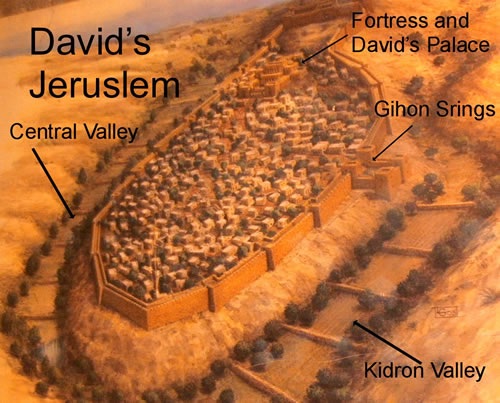
David cannot see Him because he is stuck in 1024BC, but about 1050 years from now in that same spot, David’s greatest Son is also on the Mount of Olives weeping in the middle of a huge parade too. If we could see through the curtains of time, we would probably see the two processions meet on the very same road.
“As he was drawing near—already on the way down the Mount of Olives—the whole multitude of his disciples began to rejoice and praise God with a loud voice for all the mighty works that they had seen, saying, “Blessed is the King who comes in the name of the Lord! Peace in heaven and glory in the highest!”
And when he drew near and saw the city, he wept over it,”
Luke 19:37-38, 41 ESV
Jesus is weeping for the same reason as David. Jerusalem has rejected her king.
 To The Reader