You know those psalms we’ve read where David speaks of those who are trying to take his life? Well, they don’t all refer to Saul. Some could be referring to Absalom. He wants to have his own father killed.
Ahithophel’s advice is to pursue David with 12,000 men immediately.
Hushai is in Jerusalem under cover. He has made grand overtures to Absalom but his loyalty is secretly with David. When asked for his opinion of Ahithophel’s advice, Hushai reminds Absalom what an experienced man of war his father is. He suggests mustering the largest army possible. This will take some time; time that David can use to get far away.
“Then Absalom and all the men of Israel said, “Hushai’s advice is better than Ahithophel’s.” For the Lord had determined to defeat the counsel of Ahithophel, which really was the better plan, so that he could bring disaster on Absalom!”
2 Samuel 17:14 NLT
Some might read this and see Calvinistic pre-determinism in it. I see the Lord helping Hushai and moving hearts and guiding the unfolding of events while still allowing everyone to exercise free will. My view is that the LORD is wise enough to bring His will about without having to micromanage and manipulate all humans as if they were mere puppets.
Anyway – back to the story…
You may recall that David and the priests, Zadok and Abiathar, along with Hushai made a plan to communicate as he left Jerusalem:
“The king also told Zadok the priest, “Look, here is my plan. You and Abiathar should return quietly to the city with your son Ahimaaz and Abiathar’s son Jonathan. I will stop at the shallows of the Jordan River and wait there for a report from you.”
2 Samuel 15:27-28 NLT
To Hushai David said:
“Zadok and Abiathar, the priests, will be there. Tell them about the plans being made in the king’s palace, and they will send their sons Ahimaaz and Jonathan to tell me what is going on.”
2 Samuel 15:35-36 NLT
This is full-on spy craft in the ancient world. And chapter 17 has a kind of James Bond vibe to it. Hushai gets word to the priests. They send a message by a servant girl to their sons. But they are spotted by a boy who is working for Absalom.
(Somebody needs to write a middle-grade novel with these kids – the priests sons, the servant girl, and the other boy – as the main characters! I know plenty of kids who would love it!)
The priests’ sons run to the town of Bahurim where a couple helps them out. I LOVE the idea of hiding them in the well! And the woman putting the cloth with the drying grain over the well to hide them? Genius.
Can you think of another story where 2 young spies were hidden by a woman beneath grain?
In Joshua 2, Rahab hid the 2 spies in Jericho on her roof beneath bundles of flax.
I think this story in 2nd Samuel is meant to remind us of Rahab and the 2 spies. The parallels are too strong to be coincidence. It subtly signals to us that the guys being hidden are on the winning side and the ones looking for them are not.
Just so we get an idea of the movements of the people in this story…
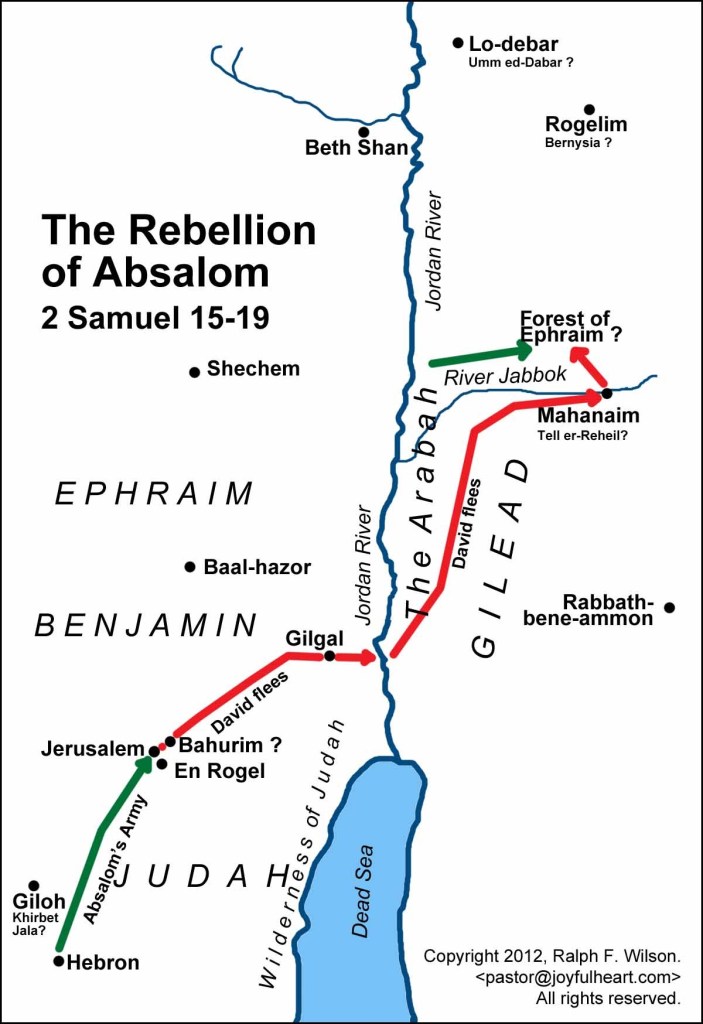
David and his huge caravan of people are waiting at the ford of the Jordan. This is very near the place where Jesus was baptized. Let’s look at couple of other parallels.
- “Baptism” – Jesus and David both went down into and came up out of the Jordan.
- Marked for Death – when Jesus arrived at the Jordan, John the Baptist identified Him as the sacrificial “Lamb of God.” He was destined for death. When David arrived at the Jordan he soon received word that Absalom was coming for him with an army intending to kill him.
- Father/Son – When Jesus came out of the Jordan, The Father affirmed Him saying, “This is my beloved Son in whom I am well pleased.” When David came out of the Jordan he was a father fleeing from a son in whom he could not be pleased.
- Wilderness – Jesus went southwest into the Wilderness of Judah immediately after his baptism; alone without provisions. David went northeast into the wilderness with a large group of people; also with no provisions.
- Hungry – Both Jesus and David (and his people) were said to be hungry after the time in the wilderness. Jesus was tempted by His enemy (Satan) to turn stones into bread while David and his people were brought generous provisions; partly by one man (Shobi, son of Nachash – which means serpent) who’s father had behaved like an enemy to David.
I’m not sure what we’re supposed to do with all that other than wonder at the infinite wisdom and power of God to unfold history like a poet making rhymes that are a thousand years apart.
Three men meet the escaping family and community of David.
- Shobi, son of Nachash. This is probably “son” in the sense of “descendant.” You may recall that King Saul’s first battle was against King Nachash. And that just after David became king of all Israel, Nachash had passed away and David sent representatives to his son, Hanun, to pay his respects. And Hanun cut off their clothes and beards and sent them home in shame. Shobi may be the son of Hanun. The graphic below explains David’s deeper connection to Nachash. Nachash is the father of David’s 2 sisters: Zeruiah and Abigail.
- Makir son of Ammiel of Lo-Debar. If this name sounds familiar it’s because this is the man who took in Maphibosheth. When David asked if there was any descendant of Saul alive, Maphibosheth was found in Makir’s house. He must’ve been a very kind man. And loyal. He knew what David had done for Maphibosheth.
- Barzillai the Gileadite. Barzillai is 80 years young and very wealthy. He has likely provided most of the food and supplies. His name means Iron-Hearted. We will get the rest of his story in a couple more chapters.
Here’s a little detail that we should note in this whole drama.
“Absalom had appointed Amasa as commander of his army, replacing Joab, who had been commander under David. (Amasa was Joab’s cousin. His father was Jether, an Ishmaelite. His mother, Abigail daughter of Nahash, was the sister of Joab’s mother, Zeruiah.)”
2 Samuel 17:25 NLT
This family tree diagram will help:

Y’all… This is basically the Hatfields and McCoys. The Family Feud. The Tudors. (Pick your favorite.) David’s general is Joab, the son of Zeruiah. Absalom’s general is Amasa, son of Abigail. Kinda makes me wonder how the elderly sisters (if they were still alive) handled being on opposite sides of a civil war. It has very North & South vibes. Families split in two.
When Nathan the Prophet said that the “sword would not depart” from David’s family, I was just thinking “violence.” I wasn’t thinking about a sword cutting the family in two. But that’s what happened. Everyone had to pick a side.

