David doesn’t wait around for Absalom to attack the city. Josephus recorded that he had about 4000 men. (See? I TOLD ya it was a HUGE caravan of people! That’s just the fighting men.) There may have only been 4000 but they were the most elite and experienced warriors around. David divides them into 3 companies under the commands of Joab, Abishai, and Ittai; (the guy from Gath who had just showed up the day before David fled). Ittai must’ve been a trusted military leader for David to put him in charge as a commander.
Absalom has tens of thousands. We don’t know exactly how many, but well over 20,000. If I had to guess, I’d say at least 60,000.
60,000 vs 4000.
But what do we say about that, class?
“God does not require favorable circumstances.”
They engage in battle on the edge of a forest. We know from the text that about 20,000 were killed from Absalom’s army.
“The battle there was spreading over the surface of all the land, and the forest devoured more among the army than the sword did on that day.”
2 Samuel 18:8 LEB
I’ve read this verse many times and – I’ll be honest – I imagined something like this:
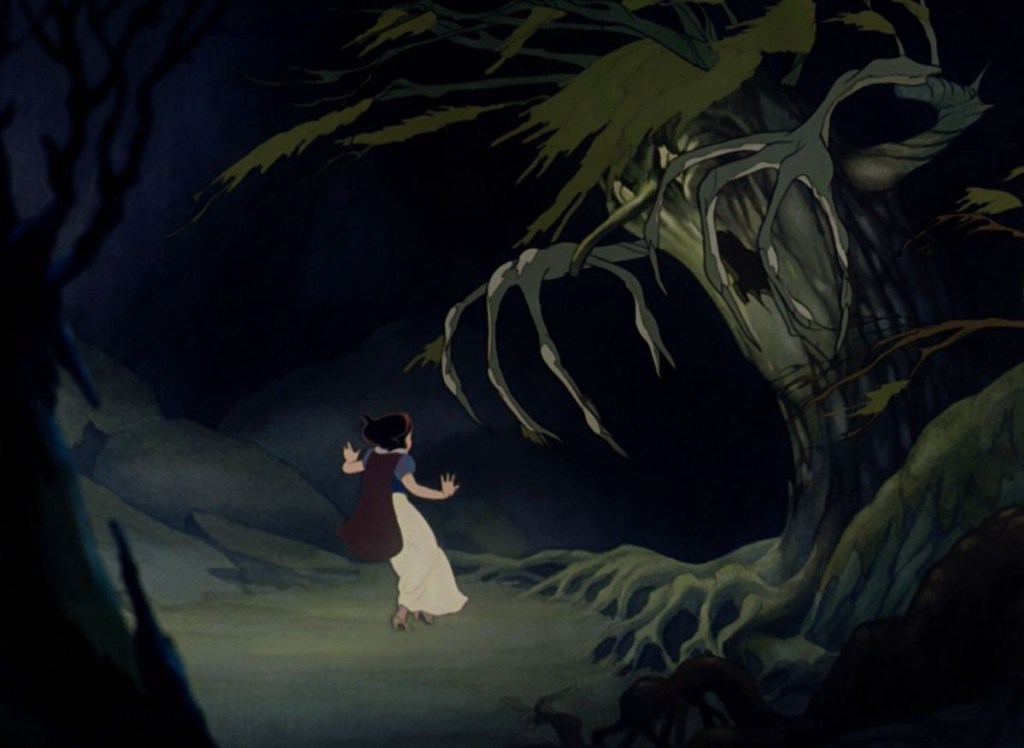
🤨 An enchanted Disney forest? You’re kidding right?
🤔 Well… how else does a forest “devour” people??
☝🏼😌 You’re in luck because I consulted your Mr. Josephus.
🤯 You did?!
☝🏼😌 Yes. I did. You left the bookmark conveniently in the spot where he recorded Absalom’s rebellion.
🤔 And what did he say about the forest? Was it haunted?
😌 Gracious, no. He said that both sides started out on the plain. They fought hard because it was basically life or death – even if they survived the battle, they’d be executed for treason if they were caught. He said that David’s men followed Absalom’s army into the forest as they fled and killed more of them there than on the battlefield.
😏 Oh. Well, forest battles can be deadly. Especially forest moons. Just ask the Empire.

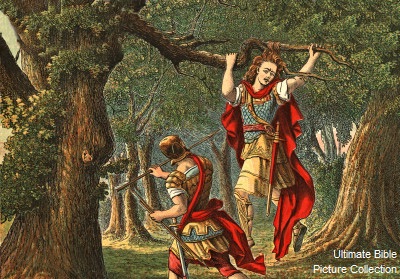
Absalom was retreating too, but his long hair got caught in a tree. Nobody attacked him though because David had given the order not to harm him. But Joab disobeyed the order and killed him with 3 spears to the heart.
I might be seeing a connection where there is none, but, when I read about the son of David suspended between heaven and earth on a tree, pierced by 3 spikes or spears to his heart… it really sounds a lot like Jesus.
Now, Jesus wasn’t a rebel seeking to overthrow His Father, but on the cross, He stood in the place of all of the rebel sons (and daughters) of Adam. Like Absalom, we formed a conspiracy with one (Lucifer) who had formerly been in the Counsel of our Father. We overthrew the rightful dominion of the Father and crowned ourselves kings of our lives. Like Absalom, sinful humanity drove the Father out of our usurped kingdoms and even sought to kill Him.
The name Joab means Yahweh-Fathered. It was Joab who slew the rebel son. Jesus, the One Fathered by Yahweh, destroyed sin in His own body.
“He himself bore our sins in his body on the tree, that we might die to sin and live to righteousness. By his wounds you have been healed.”
1 Peter 2:24 ESV
Christ is Joab and Absalom and David.
PSALM 26
Integrity and Innocence.
Who exactly is David writing about? Himself?
In this psalm, David basically says,
“I don’t cuss or smoke, drink or chew, and I don’t go with those who do.”
We don’t know if he wrote this before or after stealing his pal’s wife and then murdering him. But in either case, David’s confidence is not in his own record but in Yahweh’s faithfulness. Same as you and me.
He “washes his hands in innocence” before going around the altar – much like a priest would wash his hands in the bronze laver before going to the altar to handle the sacrifices.
“If we confess our sins, he is faithful and just to forgive us our sins and to cleanse us from all unrighteousness.”
1 John 1:9 ESV
Somehow, David understood this before the Gospel.
It’s his loyalty to Yahweh that has never wavered. For all his flaws, David never for one moment doubted or walked away from Yahweh. The integrity he speaks of has to do with completeness. David is completely loyal to Yahweh. And it is the LORD’s mercies in which he has such confidence.
“My foot stands on level ground; in the great assembly I will bless the Lord.”
Psalm 26:12 ESV
Perhaps this is the most ancient form of the familiar saying, “The ground is level at the foot of the cross.”
PSALM 40
There is an important distinction between the Masoretic Text and the Septuagint Text in this psalm.
Here is the portion in question based on the Masoretic Text. Whether you’re reading KJV, ESV, NASB, or any of the other translations based on the Masoretic Text, you’ll get some version of:
“In sacrifice and offering you have not delighted, but you have given me an open ear. Burnt offering and sin offering you have not required. Then I said, “Behold, I have come; in the scroll of the book it is written of me: I delight to do your will, O my God; your law is within my heart.”
Psalm 40:6-8 ESV
This is a faithful translation of that Hebrew text. Now let’s look at the same lines in the Septuagint (they are numbered differently but here is the same portion):
“Sacrifice and offering You did not will; but a body You prepared for me. A whole burnt offering and a sin offering You did not require. Then I said, ‘Behold I come (it is written of me in the volume of the book); I willed to do Your will, O my God, and Your law in the midst of my heart.’” LXX Ps. 39:7-9
Now, let’s look at the quotation of this passage by the writer of the letter to the Hebrews:
“Consequently, when Christ came into the world, he said, “Sacrifices and offerings you have not desired, but a body have you prepared for me; in burnt offerings and sin offerings you have taken no pleasure. Then I said, ‘Behold, I have come to do your will, O God, as it is written of me in the scroll of the book.’” Hebrews 10:5-7 ESV
The NT writers read and quoted from the Greek Septuagint. Why? Because the Masoretic Text didn’t exist yet and wouldn’t for about 7-8 more centuries.
Furthermore, the writer of Hebrews attributes the quote from Psalm 40 to Christ. “Consequently, when Christ came into the world, he said…” So Psalm 40 is prophetic (as, honestly, they all are). And in this prophetic psalm, through the pen of David, Christ says “a body You have prepared for me.” This psalm is telling us something about how God is going to accomplish redemption. It won’t be by sacrifice and offerings. Not even whole burnt offerings and sin offerings. No. Someone is coming about whom things have been written in “the book.” And he will have a body prepared by Yahweh. And this coming one will choose to do God’s will and God’s Law will be in his heart.
Now that’s interesting. Because all the rest of humanity have God’s Law written on stone tablets; and even then, can’t keep them. But this coming one will keep the Law because it’s who he is. It’s what’s in his heart.
Not only that, verses 9-10 tell us that this coming one will proclaim the good news of righteousness and salvation.
That would seem like a pleasant place to end it but the mood shifts and the speaker – the coming one promised in the Book – is suddenly surrounded by evils and people trying to kill him and he cries out for rescue.
This is the Word of the Lord. He speaks through His ancestor David about the future and the body that He will have – the body that will be the sacrifice and sin offering that Yahweh DOES desire. This psalm is like the Gospel encrypted 1000 years before the birth of Christ.
Here is a link to a fantastic rendition of Psalm 40 by The Sons of Korah. (The acoustic bass is on point. Use headphones so you can really appreciate it.)
Enjoy.
 To The Reader