Get your Kleenexes. There’s a lot of crying in this chapter.
Jeremiah is known as “The Weeping Prophet.” The opening 2 verses of chapter 9 are probably part of the close of chapter 8. Remember that there are no chapter breaks in the original texts and some of them are stuck in some rather unfortunate places. I think this may be one of them.
Here’s how it would read without a chapter break:
“My grief is beyond healing; my heart is broken. Listen to the weeping of my people; it can be heard all across the land. ‘Has the Lord abandoned Jerusalem?’ the people ask. ‘Is her King no longer there?’ Oh, why have they provoked my anger with their carved idols and their worthless foreign gods?” says the Lord. ‘The harvest is finished, and the summer is gone,’ the people cry, ‘yet we are not saved!’ I hurt with the hurt of my people. I mourn and am overcome with grief. Is there no medicine in Gilead? Is there no physician there? Why is there no healing for the wounds of my people? If only my head were a pool of water and my eyes a fountain of tears, I would weep day and night for all my people who have been slaughtered. Oh, that I could go away and forget my people and live in a travelers’ shack in the desert. For they are all adulterers— a pack of treacherous liars.”
Jeremiah 8:18 – 9:2 NLT
Grief is not just a synonym for sadness. Grief is specifically connected with loss.
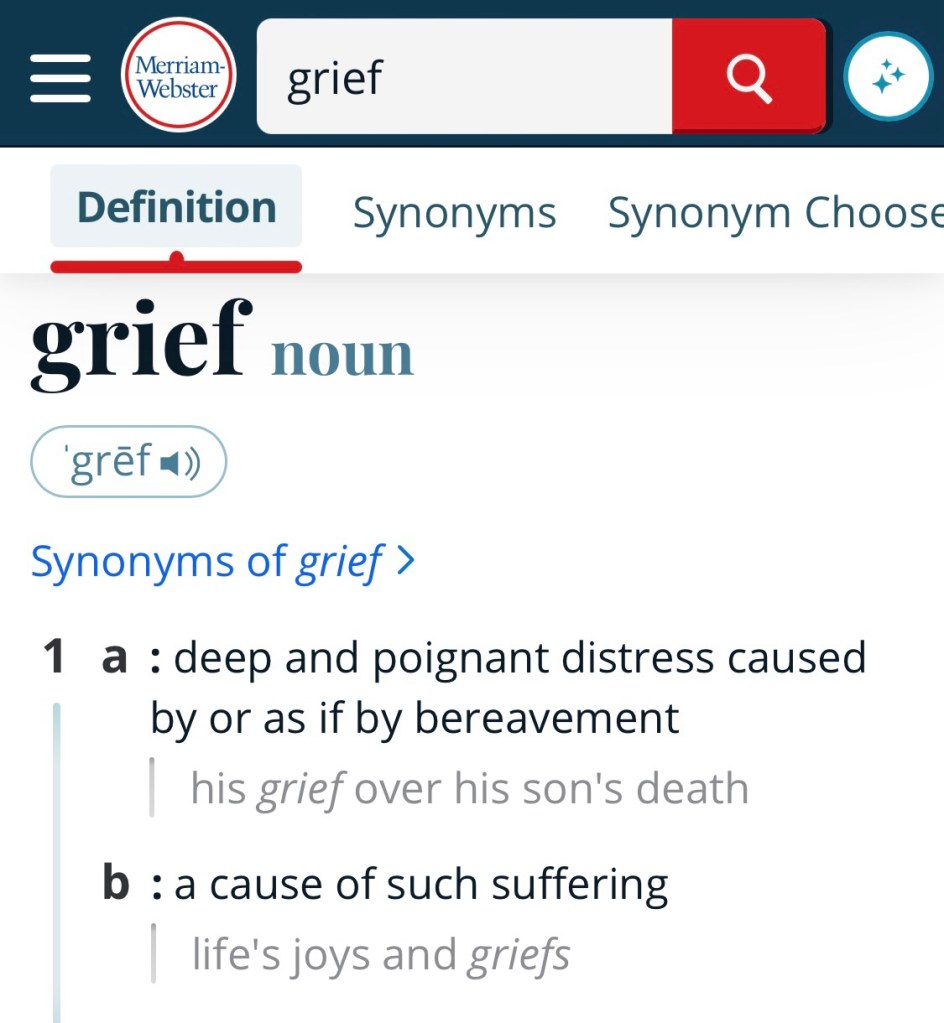
I think the dictionary’s use of “distress” is spot-on. Grief is a distressing sorrow over that which has been lost. Grief says “That which is gone was very precious.” We don’t grieve over things we didn’t care about. So perhaps a better definition for grief might be something like…
Emotional and physical distress and suffering due to the loss of something supremely precious.
Yahweh is lamenting along with (and through) the prophet Jeremiah over the loss of His people. Yes, they will come back from exile. Yes, a second temple will be built. But the throne of David will be empty. They won’t be powerful and prosperous as under David and Solomon and Hezekiah. It will never be the same again. And Yahweh grieves the loss.
Allowing grief – allowing the tears, the pain, and the loss of appetite… giving space to experience and process it… that is a way of acknowledging the value of what was lost. And there is no shame in that.
There are a least 6 different Hebrew words that are translated as “grief” and “sorrow.” They cover a wide range of emotions and responses from hurt and sadness to anger. I’d like to look at just 3 of them. I’ll show them in the Strong’s Concordance, then we’ll look at the significance of the Paleo-Hebrew letters. This is a text I’m sure we all know:
“Surely he hath borne our griefs, and carried our sorrows: yet we did esteem him stricken, smitten of God, and afflicted.”
Isaiah 53:4 KJV
The first thing the text here says that Messiah bore is our griefs, our choliy.
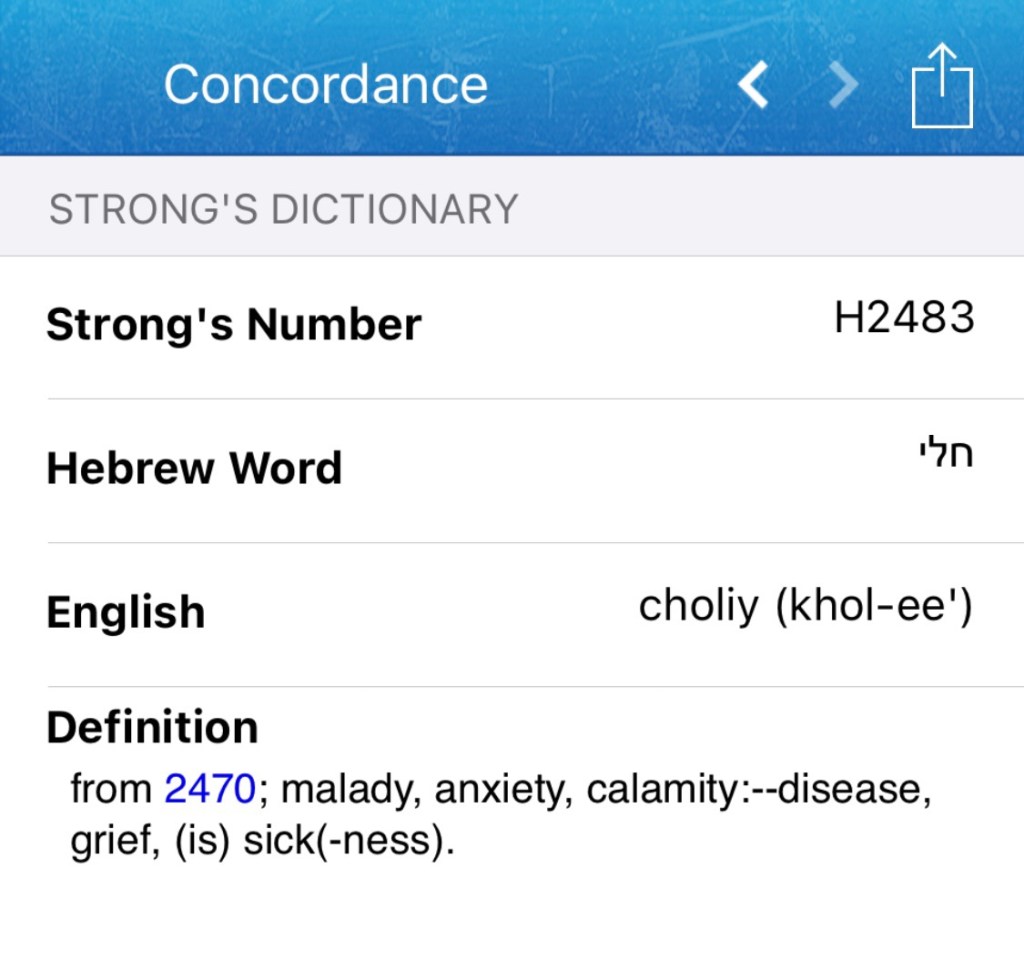
This kind of grief is physical or mental anguish. Anxiety. That’s the only thing that has ever put me in the hospital. I had symptoms similar to a heart attack. Turns out my heart was fine. It was an stress-induced asthma attack.
Ironically enough, I’m writing this as I sit in my town’s storm shelter because the tornado warning sirens 🚨 📢 went off. There are four- count ‘em FOUR 🌪️🌪️🌪️🌪️ tornado warnings in the area. A warning means the radar has spotted rotation.
😰 Four?! At once?!
Yeah. It’s a good thing my heart is in good shape because it’s pounding really hard right now. Pretty sure this qualifies as choliy. Perhaps the Lord wants me to learn something from this. Let’s sit here in the school gym with my neighbors and write a blog post while we wait for either sudden death or the all clear. It’ll be one of the two.
😳🫣 I can’t watch.
The Hebrew letters are Chet, Lamed, Yod.
Chet – Pictograph: wall. Concepts: end, obstruction, outside
Lamed – Pictograph: shepherd’s staff. Concepts: lead, guide, to/toward, protect, teach
Yod – Pictograph: hand & arm. Concepts: do, work, make, help, power, authority
Choliy is when it feels like there’s a wall between you and the Shepherd; something obstructing your access to protection and help. It’s being outside the walls of your safe place.
[And I suppose a tornado is the perfect time to process this.]
It’s that distressed, panicky feeling like a sheep that got left outside the fold and is cut off from the help and protection of the Shepherd. Jesus bore that. When He said, “My God, My God, why have you forsaken me?,” Jesus was experiencing choliy, grief.
Then there is sorrow:
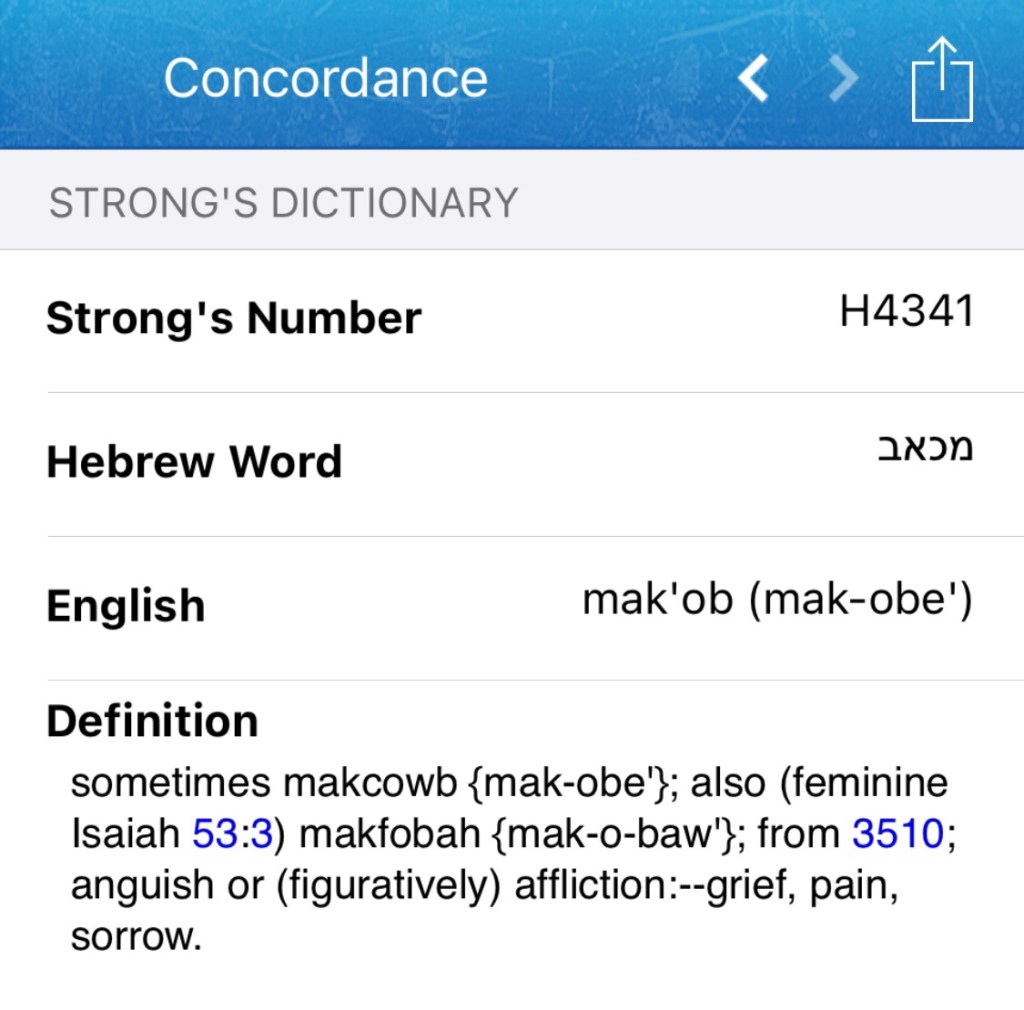
Mem, Kaf, Alef, Bet.
Mem – Pictograph: water. Concepts: waters, sea, drink, tumult, upheaval, lift up, unknown, many people
Kaf – Pictograph: Palm of the hand. Concepts: hand, sole of the foot, grasp/grip, subjugate, crush, cover
Alef – Pictograph: Head of an ox. Concepts: Chief, leader, strong/strength
Bet – Pictograph: house. Concepts: in, inside, within, house/family, Father’s house
There is a tumult, like crashing ocean waves, crushing and drowning the strength inside you. That is makob. That is sorrow.
🌊🌊🌊💔🌊🌊🌊
Then there is one from this verse…
“Be gracious to me, O Lord, for I am in distress; my eye is wasted from grief; my soul and my body also. For my life is spent with sorrow, and my years with sighing; my strength fails because of my iniquity, and my bones waste away.”
Psalm 31:9-10 ESV
Jesus quoted verse 5 from this Psalm on the cross when He said, “Into thy hand I commit my spirit.” Like many Psalms, this one has a prophetic flavor. While Jesus had no “iniquity” of His own, He certainly bore ours. The Hebrew word translated here as “sorrow” is…
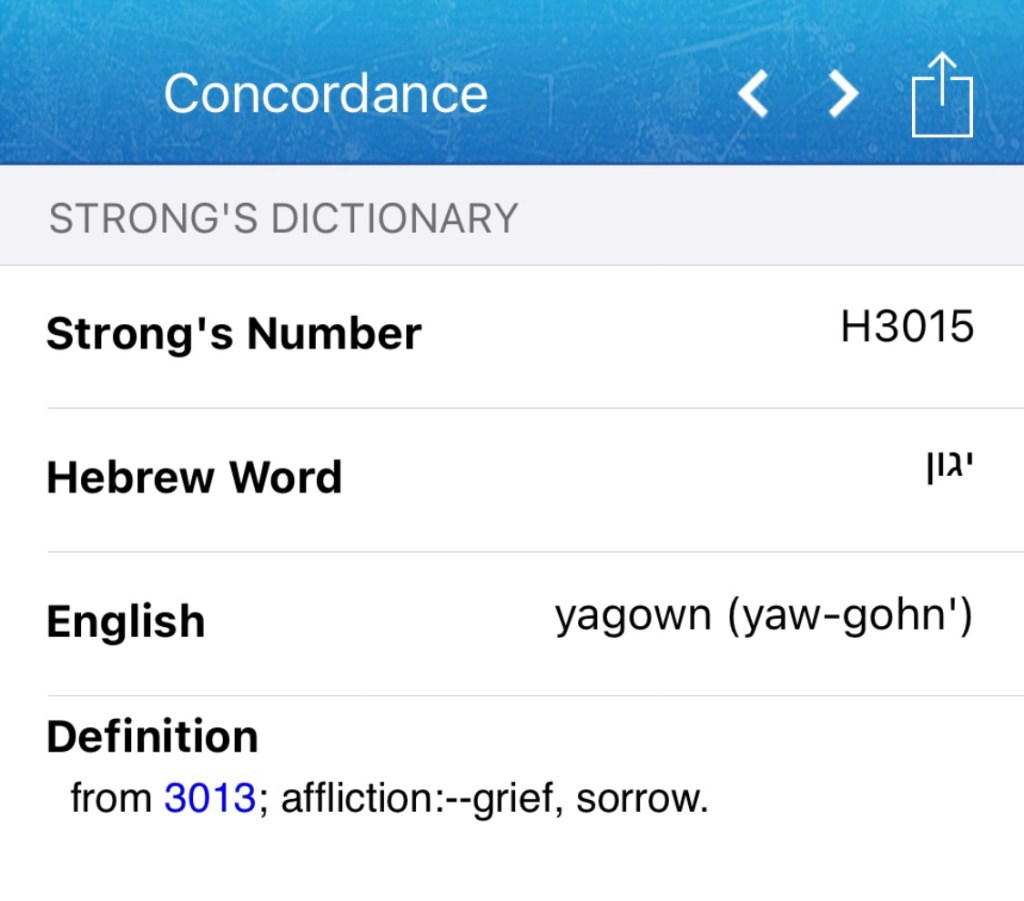
The first time yagown is used is Genesis 42:38 when Jacob says he won’t allow Benjamin to go to Egypt because if anything happened to him, it would “bring down my grey hairs with sorrow to Sheol.”
It is spelled Yod, Gimmel, Vav, Nun/Nachash.
Yod – Pictograph: hand & arm. Concepts: do, work, make, help, power, authority
Gimmel – Pictograph: camel foot. Concepts: lift up, walk, strength, ability
Vav – Pictorgraph: tent peg. Concepts: and, join, (conjunction)
Nachash – Pictograph: serpent. Concepts: shiny, reflect/reflective, life, spiritual
I’m kinda just spitballing here but it seems to suggest a powerful doing 💪🏼 being lifted up ⬆️ and nailed 🔨 to my life. ❤️ I think that’s a fair definition of sorrow. Something huge has overwhelmed me and pierced my heart. But there is more here.
Any time I stumble across a Hebrew word that has:
- A hand ✋🏽
- A foot 🦶🏼
- A tent peg (spike) 🔨
- A serpent 🐍
That gets my attention.
YGVN could also be read as:
Strong-doing is being pegged to the serpent.
That m me think of the seed of the woman crushing the serpent’s head.
On the cross, Jesus had a strong-doing lifted up and nailed to His life. But while that was happening, He was simultaneously performing a strong-doing as He nailed our serpent-led-sin-debt to the cross, (Col. 2;14). The sorrow was a 2-way street. It was inflicted upon the Savior but it was also the Savior’s path to victory.
And the cross actually changed the way those in Jesus face sorrow and grief itself. Paul said that his ministry team was “sorrowful, yet always rejoicing,” (2 Cor. 6:10). And he told the believers that our sorrow over brethren who have died should not be like the world’s sorrow, (1 Thes. 4:13).
In Jeremiah we see a picture of the sorrowful Savior who bore our griefs. He is the one who weeps with us.
He knows what it is to feel like a powerless sheep cut off from the Shepherd. He was acquainted with grief. He well knew the crushing waves that drown the strength right out of you. But He endured and overcame grief and sorrow on our behalf. And one day, they will cease to exist.
“I heard a loud shout from the throne, saying, ‘Look, God’s home is now among his people! He will live with them, and they will be his people. God himself will be with them. He will wipe every tear from their eyes, and there will be no more death or sorrow or crying or pain. All these things are gone forever.’”
Revelation 21:3-4 NLT
🫣 Are we alive? Is the tornado over? You’re reading scripture about heaven. Are we dead? Are we in heaven?
It’s over. You can come out now. We’re alive and back home already. Our trash can was in the neighbor’s yard but other than that, we’re fine.
😅 Whew!
How about a nice cup of cocoa?
😌 It’s not heaven, but it’ll do.

