Chapter 24 is a recap of all the history we’ve been reading in Jeremiah.
I feel like chapter 25 should come with a spoiler warning. Jeremiah is about to live the events and record them in much greater detail. Perhaps consider 2 Kings 25 a “movie trailer” for the next several chapters we will read in Jeremiah.
With a new era of time, comes the need for a new timeline. Behold…
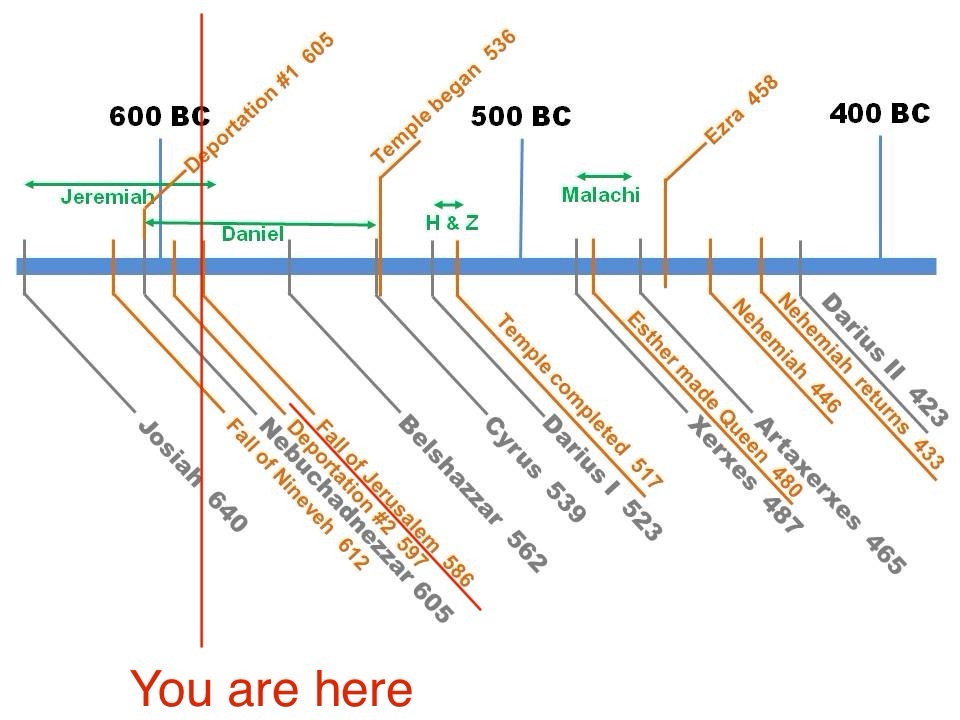
One thing these 2 chapters make clearer is that Jerusalem did not “fall” in a single battle. In the timeline above, you’ll notice that Nebuchadnezzar did 2 deportations PLUS the final destruction of Jerusalem.
The first deportation took place 605 BC in the 3rd year of the reign of Jehoiakim. This is when Daniel was captured and taken to Babylon, (see Dan, 1:1-2), and, according to Josephus, also a young Ezekiel. It’s possible that Jehoiakim himself was taken to Babylon at this time but we’ll cover that later.
The second deportation took place in 597 BC and it’s when Jehoiachin surrendered and a lot more loot was taken from the temple treasury.
It wasn’t until the final fall of Jerusalem that the temple itself was utterly dismantled and every last scrap of valuable metal was hauled off to Babylon.
(Remember those golden and silver cups and bowls and vessels though. They are going to show up again in Babylon.)
“But the poor of the land the commander of the imperial guard left for the vineyards and for tilling.”
2 Kings 25:12 LEB
When we read this, it doesn’t mean that the poor people were suddenly given farms of their own. No. All the land now belonged to Nebuchadnezzar and these poor people were the slave labor.
Gedaliah, the man the Babylonians put in charge of the laborers and tax collecting, is killed and everyone runs off to Egypt. Jeremiah is going to unpack this story in great detail and it’s fascinating.
The thing I find most touching in this chapter is the very end:
Jehoiachin was only 18 years old when he surrendered (along with his mother and other members of the royal family) to Nebuchadnezzar according to the word of the LORD through Jeremiah. He wasn’t exactly a godly young man. 2 Kings 24:9 says that “he did that which was evil in the sight of the Lord according to all that his father had done.”
The word of the LORD through Jeremiah had been severe, (see Jer. 22:24-30). Jeconiah (Jehoiachin) would be handed over to Babylon along with his mother. The prophecy also tells us that he was “fearful” of Nebuchadnezzar. He was not a brash, cocky young king. It seems he was actually trying to do his best and yet, he would never have children and he would die in Babylon. But there are no specific sins attributed to him. Note the question:
“Is this man Coniah a despised, shattered jar? Or is he an undesirable vessel? Why have he and his descendants been hurled out And cast into a land that they had not known?”
Jeremiah 22:28 NASB2020
It doesn’t seem to be fair. He was a sinner, yes. But we read nothing of him “filling Jerusalem with innocent blood” and such. He was, after all, only 18 years old.
SIDE NOTE
2 Chronicles 36:9 in KJV has Jehoiachin as “eight” years old when he surrenders to Nebuchadnezzar but the passage in 2 Kings 24:8 has him at “eighteen” when he began to reign. Unlike English which has unique words for each number, Hebrew has words that can be more than one number.
2 Chronicles 36:9 uses the Hebrew word “shmoneh” [shem-o-neh] and it can mean either 8 or eighteen.
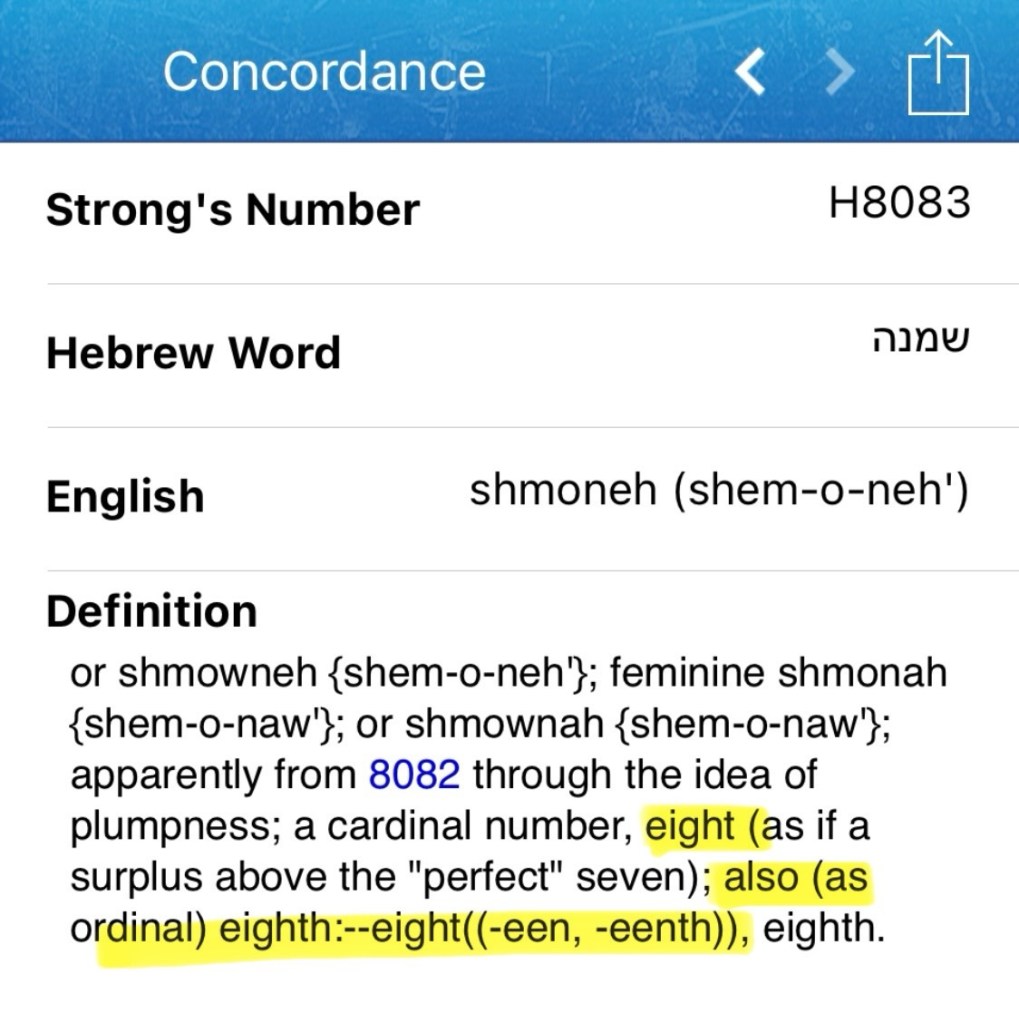
The 2 Kings 24:8 text includes the Hebrew asar which indicates ten or -teen. It is [asar shmoneh]. This clarifies that the shmoneh in 2 Chronicles is intended to be understood as 18 and all modern translations take this into account and translate it correctly as “eighteen.”
Jeconiah/Jehoiachin followed Jeremiah’s instruction from God in going out of the city and surrendering to Nebuchadnezzar. Josephus said “because he was of a gentle and just disposition, he did not desire to the see the city endangered on his account.” So he turned himself and his family and close associates over to the Babylonians. Josephus adds, “that neither should they [the royal family] suffer any harm nor the city; which agreement they [the Babylonians] did not observe for a single year…”
In other words, the Babylonians promised, “If you surrender, we won’t harm your family or anyone in the city.” Then, they broke their promise. It seems as though Jehoiachin was led to believe that by surrendering, the city would be spared. It was for a while. But ultimately, it appeared as though his surrender had been pointless.
🤔 Question. Why would Babylon be ok with accepting Jehoiachin’s surrender but then let Zedekiah be king? Why not just take the city when Jehoiachin surrendered?
Well… 2 things.
First, the Babylonians want wealth and power. Nebuchadnezzar has an empire. The way empire works is to let local governments function as long as they provide tribute and Human Resources (soldiers for war, artisans, field labor, etc) to the empire. Nebuchadnezzar doesn’t mind Judah having a king – as long as that king is chosen by Babylon and does what Babylon says and pays its tribute on time.
Second, the Babylonians brutally killed Jehoiachin’s father, Jehoiakim. Josephus says that they threw his dead body over the city wall. The Babylonians were concerned that the son – as the new king – would rebel and perhaps even raise an army to exact revenge for his father’s death.
Anyway – back to Jehoiachin’s story.
This historical footnote in 2 Kings 25:27-30 shows him again at age 55 in Babylon. He’s been in prison ALL THIS TIME. The best years of his life are gone. He probably never married. He never had children.
We might wonder if he spent many of those years wondering – “What if I hadn’t surrendered? I listened to the prophet – and trusted the message from Yahweh – and look what it got me.”
Then, after 37 years, Nebuchadnezzar dies and his son, Amel-Marduk (or Awil-Marduk, many English versions: Evil-Merodach) takes the throne. Don’t let the spelling of Awil as E-V-I-L confuse you. It actually has nothing to do with the English word “evil.” His name means “soldier of Marduk.” He was actually one of the best kings Babylon ever had. He was known to be just. And he recognized that his father had really done Jehoiachin wrong. It appears that Nebuchadnezzar never got over his fear that Jehoiachin would seek to lead a rebellion to avenge his father’s death.
One of the first things Awil-Marduk did was to not only release the former king Jehoiachin from prison, but to outfit him in some new duds, and give him a permanent meal ticket for the royal cafeteria. It reminds me of the story of Joseph – being released from prison and instantly moved to the 2nd highest position in the land. It took a very long time, but God was faithful and Jehoiachin was elevated above all the other kings and nobles of Babylon. And you can bet he used that new influence to better the lives of the Jewish exiles in Babylon.
Obeying the LORD is always the best choice.
God’s reward system for His children is not instant. The cross precedes the crown. The prison precedes the palace. Humility precedes honor. Do not lose heart. For the child of God, this story DOES have a happy ending; even if the reward doesn’t come until after years of sorrow, disappointment, and even death itself.
“But those who exalt themselves will be humbled, and those who humble themselves will be exalted.”
Matthew 23:12 NLT

