Did you ever hear the story about the city slicker who helped the farmer pull a calf?
The farmer was out in the field with a cow that was struggling to birth a calf. The back legs were out but the rest was stuck. A guy from the city was driving by on the country road and saw the farmer struggling. He pulled over, climbed the fence, and asked if he could help. The farmer had the city fella hold the cow’s head while he pulled the calf out with a device like this:

After the new calf was safely free, the farmer invited the city slicker to wash up in the barn. While they’re getting cleaned up the farmer noticed the man was quiet and troubled.
👨🏻🌾 Farmer: Have you ever seen anything like that before?
👱🏼♂️ City Fella: No sir. I sure haven’t.
👨🏻🌾 Farmer: Well… do ya have any questions?
👱🏼♂️ City Fella: Just one. How fast was that calf going when it hit the back of that cow?
One situation. Two very different ideas about what caused it.
Judah and Jerusalem have been decimated. Jeremiah says (on God’s behalf), that it was because the people were burning incense to other gods and worshiping them.
The people say, “No! It’s because we stopped burning incense to the gods that all this has happened.”
The main entity in question is called “the queen of heaven.” This was a title for the Babylonian goddess Ishtar (possibly also Astarte, Ashtoreth, Asherah).
🙄 Worshiping the goddess of the nation that just wiped out your people… yeah that makes total sense.
Old habits die hard. We find out in 44:17-18 that the people of Judah had been making offerings to Ishtar for a long time. And it was widely accepted in the culture, from commoner to the highest officials in the land. That’s why Josiah’s reforms were so radical.
Jeremiah is the only book where we find this term “queen of heaven.” God mentioned her and her special “cakes” way back in Jeremiah 7:17-18. In this chapter the exiles defend their cake-offerings…
“And the women said, “When we made offerings to the queen of heaven and poured out drink offerings to her, was it without our husbands’ approval that we made cakes for her bearing her image and poured out drink offerings to her?”
Jeremiah 44:19 ESV
The cakes were not “cake” like we would think. They were flat like a cookie and most likely made of fine unleavened flour, and perhaps sweetened with honey. They may have been folded into, or stamped with, an 8-pointed star shape; or perhaps shaped to look like a female figure.
🤔 Like a gingerbread woman?
Uhh… probably more… uh… curvy if you get my meaning…. But yes. A very voluptuous, gingerless, gingerbread woman.
They may have been baked directly on hot coals like ash-cakes. 🫓 And they were served with wine. 🍷
🤔 Wait… unleavened bread and wine? That sounds like… communion.
Indeed. And it was a form of communing with the goddess and seeking her favor.
😒 Copy cats.
Recall that King Josiah tore down all the shrines to other gods and goddesses, executed the priests who served them, and made pagan worship illegal.
It was right upon the heels of Josiah’s early death that the problems with Babylon began. So the people view all of this tragedy as the displeasure of the gods in general, and “The queen of heaven” in particular.
Let’s try to think like ancient pagans for just a second.
😐 Oh dear. Must we?
Yes. Just for a couple sentences.
Every territory has a local deity. 🗿Make it happy and all is well. The god would look after the people in his area and bless them with gifts and favor. 🎁
The implicit suggestion when the people of Israel and Judah burn incense to other gods is: We aren’t really Yahweh’s people and this isn’t really Yahweh’s land. It belongs to Baal and Asherah and Ishtar and the host of heaven. And since we live here, we belong to them so we better keep them happy. Gasp! King Josiah stopped us from worshiping the gods so they got angry!
They were kinda right – somebody “up there” was very unhappy with them. But it’s not the displeasure of the “queen of heaven” that brought on the destruction. It’s the displeasure of the true King of Heaven, Yahweh.
The Promised Land was not the property of the gods of the nations. Over and over from Genesis to the present, the Promised Land is identified as Yahweh’s land. And the descendants of Abraham are His people because He made them from scratch.
Who supernaturally caused their ancestors Abram & Sarah to have a child in old age?
Who rescued them from slavery in Egypt?
Who gave them their Laws?
Who supernaturally gave a bunch of untrained ex-slaves the power to defeat technologically advanced armies of warriors and giants?
Who protected and provided for them for centuries?
Their idolatry is betrayal in the extreme. Yahweh has every right to be angry.
Jeremiah gives them the Word of the LORD which is: you’re all gonna die here in Egypt.
Remember how in the last chapter, they didn’t believe Jeremiah was hearing from God? They said he was just making stuff up. Yeah, they haven’t changed…
“As for the word that you have spoken to us in the name of the Lord, we will not listen to you.” Jeremiah 44:16 ESV
😐 At least they’re honest about it.

Since they refuse to listen, the LORD gives them a sign to watch for as proof that Jeremiah speaks the truth:
Pharaoh Hophra is going to be assassinated.
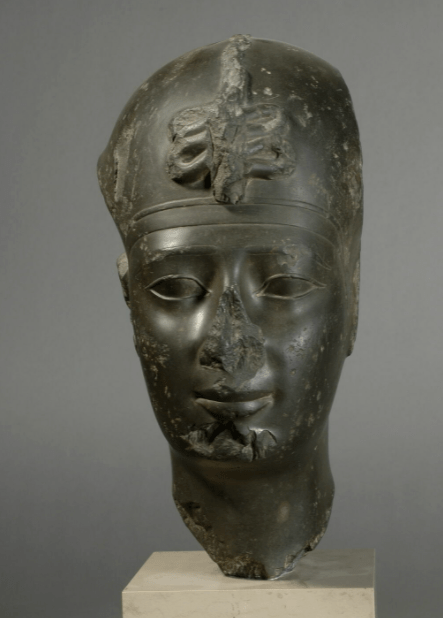
You may remember from Jeremiah 37:5-7 that the Egyptian army had at one point come up out of Egypt to help Jerusalem and successfully deterred the Babylonians for a little while. The Pharaoh leading that army was Hophra.
There are two different versions of the story of how he dies. They both start with a rebellion. I will quote from a very good article on Pharaoh Hophra from Bible Archeology Report:
Hophra sent his commander Amasis quell the rebellion, but the Egyptian army crowned the general king; they then marched against Hophra. When he heard of this, he gathered the foreign mercenaries who were still loyal to him, and met Amasis and the Egyptian army in battle at Momemphis. Herodotus records that Hophra was defeated, taken captive, and “brought to Saïs, to the royal dwelling which belonged to him once but now belonged to Amasis” and that he was eventually killed by the Egyptians while in prison. Other sources, however, indicate he escaped and made his way to Babylon in search of Nebuchadnezzar’s support. In 567 BC Nebuchadnezzar invaded Egypt with Hophra at his side, likely intending to place him on the throne as a vassal king. The Babylonian force was defeated and Hophra was killed. Regardless, both sources agree that Hophra was buried in the royal cemetery at Sais.
Yahweh is the only One Who knows history in advance. He knows all things. And His judgement on events is the correct perspective. So when He tells these Judaean refugees that the reason their nation was destroyed was because they were worshiping idols, that IS the reason.
Based on false assumptions, the world and its religions and philosophers constantly ask, “How fast was that calf going when it hit the back of that cow?” But you won’t get the right answer if you’re asking the wrong question.
This is basically the end of Jeremiah’s narrative. The remaining chapters are like appendices. Some written around or before the 4th year of Jehoiakim, (Jer. 36). That was about 20 years before Jeremiah got dragged to Egypt. That was when God had told Jeremiah to write down all the prophecies in a scroll and Baruch read it to the king and the king did a book-burning. Then Jeremiah re-wrote the entire thing again by inspiration and even added more, (36:32). These remaining parts of Jeremiah (except ch.52) would’ve been written down then (c.607 BC) and added to for the next several years. So, narratively, we’re going back in time about 20 years.
Here is a little table of contents for them. I added estimated dates to help:
- 45 – A Message for Baruch (607 BC)
- 46 – A Message for Egypt (607 BC)
- 47 – A Message for Philistia (600 BC)
- 48- A Message for Moab (600 BC)
- 49 – Messages for Eastern places: Ammon, Edom, Damascus, Kedar, Hazor, Elam (600 BC)
- 50-51 – Message for Babylon (593 BC)
- 52 – Epilogue (562 BC)
Chapter 45 is like a little postcard from God to Jeremiah’s assistant, Baruch. It’s actually like an RSVP.
Dear Baruch, I regret that I cannot attend your pity-party. I’m busy dissolving the nation I’ve poured my heart into for a thousand years. Kinda sad. Don’t really feel like partying right now. But I hope you enjoy the candy and the gift-card I sent. – YHVH