The Temple Vision – Part 7, The Land
We have arrived at the end of Ezekiel.
I feel a bit as though we have been on a journey through the center of the earth.
I honestly had NO idea how much I would discover when we started reading. I feel like we have walked alongside Ezekiel, trudging from Jerusalem to a little make-shift refugee village by the Kebar Canal. We’ve watched him do the most bizarre sign-acts. We’ve watched him pretend he didn’t care when his beloved wife died suddenly. We’ve flown with him in visions to and from Jerusalem. And we’ve tried to wrap our minds around the unusual sights he describes.
☝🏼🤓 We’ve watched him eat Ezekiel Bread baked over poop. 💩
Yes. That too.
Along the way I have wept and pondered and smiled, and laughed with delight at the wonderful sensation of having one’s mind blown. Ezekiel now feels firmly sewn into the rest of the fabric of my understanding of scripture. I now see his place among the prophets much more clearly than I ever did. He feels like a bridge connecting the Old Covenant and the New. He’s in this in-between space; living after the death of one kingdom while announcing a resurrection of one to come.
As far as blogging goes, this has been the most challenging book yet (Job is a close second). So I anticipate it will be all downhill from here. Even Revelation will be easier. I have WAY more marginal notes in Revelation. They crowd basically every page. Ezekiel was nearly empty.
So I have learned a LOT! I hope you have too. One final post on Ezekiel and next we will take the short book of Joel and then launch into the amazing book of Daniel.
Let’s go. 🚥🏁
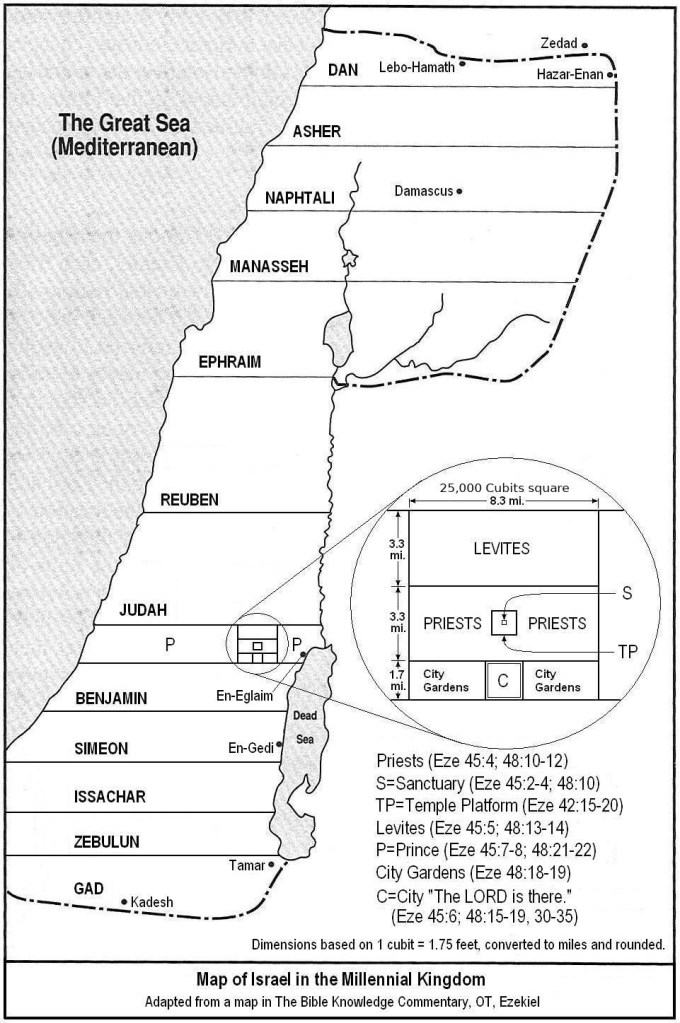
The vision of the temple ends with information about the division of the land. That portion of the text actually begins in 47:13.
There are many diagrams of the land online; some more accurate than others. I thought this one did a pretty good job.
Compare the above to the land allotment from the book of Judges:
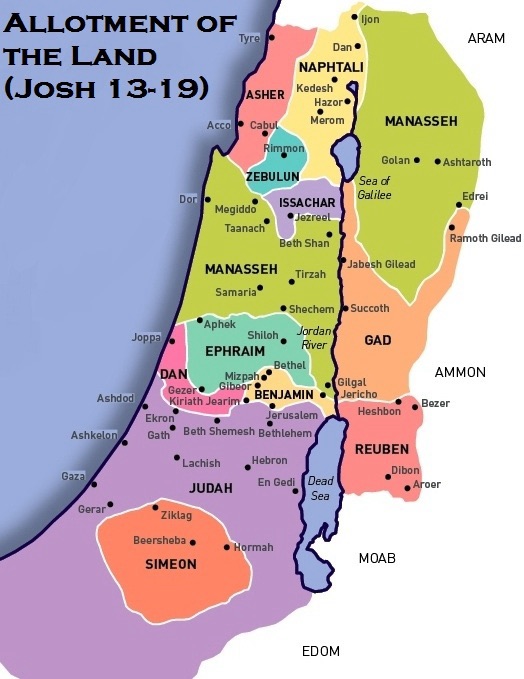
Ezekiel’s land allotment is completely different. It’s like God reshuffled the deck.
😏 And all the people who prefer neat lines over willy-nilly chaos will like the second plan much better.
Now think about this from the perspective of an exile. At the time Ezekiel writes this down, there is NO tribal leadership structure, NO borders, NO government in the lands formerly known as Israel and Judah. If they get back at all (which at that time seemed impossible) they would’ve had to start from scratch. Would there even be representatives from the northern tribes, exiled to distant lands these 125 years? This land allotment is yet another impossible scenario. Are there even any Danites left? Simeon kind of got swallowed up by Judah. Is there anyone alive who can say, “I’m a direct descendant of Simeon.”?
In this vision, the tribes are not inheriting the land originally given to their particular ancestors. None of them. It’s still “the land of their fathers,” but they’re getting a brand new inheritance. It’s like a re-do of the book of Joshua. (Which is a HUGE clue. IYKYK) Except that now, they aren’t driving out the Gentiles or turning them into slaves. The Gentiles are going to be their kinfolk.
““So you shall divide this land among yourselves according to the tribes of Israel. You shall divide it by lot for an inheritance among yourselves and among the strangers who stay in your midst, who bring forth sons in your midst. And they shall be to you as the native-born among the sons of Israel; they shall be allotted an inheritance with you among the tribes of Israel. And in the tribe with which the stranger resides, there you shall give him his inheritance,” declares the Lord God.”
Ezekiel 47:21-23 NASB2020
This is, by far, THE most shocking statement in this final part of the vision.
There are many scriptures about how the Israelites were supposed to treat “the stranger.” They were not to oppress the stranger or take advantage of them in any way. They were treat the stranger the same way they would a fellow Hebrew but the stranger was always that. A stranger. Not a fellow-inheritor of the land. A stranger could only rent. He couldn’t own. The stranger was a visitor. He had a green card, a work visa, permanent residence even, but was never a citizen.
God says, that is going to change.
And the Apostle Paul unpacked it beautifully.
I think it’s the PERFECT text with which to wrap up all that we have explored in this epic vision of God’s dwelling place among His people. I’ll leave you with Paul and see you in Joel.
“Therefore remember that at one time you Gentiles in the flesh, called “the uncircumcision” by what is called the circumcision, which is made in the flesh by hands— remember that you were at that time separated from Christ, alienated from the commonwealth of Israel and strangers to the covenants of promise, having no hope and without God in the world.
But now in Christ Jesus you who once were far off have been brought near by the blood of Christ. For he himself is our peace, who has made us both one and has broken down in his flesh the dividing wall of hostility by abolishing the law of commandments expressed in ordinances, that he might create in himself one new man in place of the two, so making peace, and might reconcile us both to God in one body through the cross, thereby killing the hostility.
And he came and preached peace to you who were far off and peace to those who were near. For through him we both have access in one Spirit to the Father. So then you are no longer strangers and aliens, but you are fellow citizens with the saints and members of the household of God, built on the foundation of the apostles and prophets, Christ Jesus himself being the cornerstone, in whom the whole structure, being joined together, grows into a holy temple in the Lord. In him you also are being built together into a dwelling place for God by the Spirit.”
Ephesians 2:11-22 ESV

