First off… it’s not this kind of trumpet. 🎺
It’s a shofar. (Click to hear a clip of a shofar blown in Jerusalem).
When I was a kid, we used to sing this song based on Joel 2:1, 9, and 11. It’s very catchy but rather strange to me (now) that people were singing a peppy song about death and disaster. I suspect that many of the people in the churches that sang this song…
- Never read this scripture in context and so had no idea there was anything wrong with it. To them, they were just singing scripture.
- Heard and believed the “Joel’s Army” teaching. In which case, they saw themselves as being in God’s mighty army triumphing over the forces of evil. And this song celebrates that (though the Joel’s Army teaching is a complete mid-interpretation of this text).
- Just enjoyed the music and didn’t even notice the lyrics. Very easy to do, especially if you were fortunate enough to have a really good worship team WITH a trumpet player in your church.
If you could’ve seen the destruction unleashed on the land of ancient Israel, a bright peppy song would’ve been the LAST thing on your mind.
This is a trumpet (shofar) of warning.
The modern equivalent is an air-raid siren.
✈️💣🚨☢️📢📻🔊
“The word of the Lord came to me: “Son of man, speak to your people and say to them, If I bring the sword upon a land, and the people of the land take a man from among them, and make him their watchman, and if he sees the sword coming upon the land and blows the trumpet and warns the people, then if anyone who hears the sound of the trumpet does not take warning, and the sword comes and takes him away, his blood shall be upon his own head. He heard the sound of the trumpet and did not take warning; his blood shall be upon himself. But if he had taken warning, he would have saved his life.”
Ezekiel 33:1-5 ESV
“Is a trumpet blown in a city, and the people are not afraid? Does disaster come to a city, unless the Lord has done it? “For the Lord God does nothing without revealing his secret to his servants the prophets.”
Amos 3:6-7 ESV
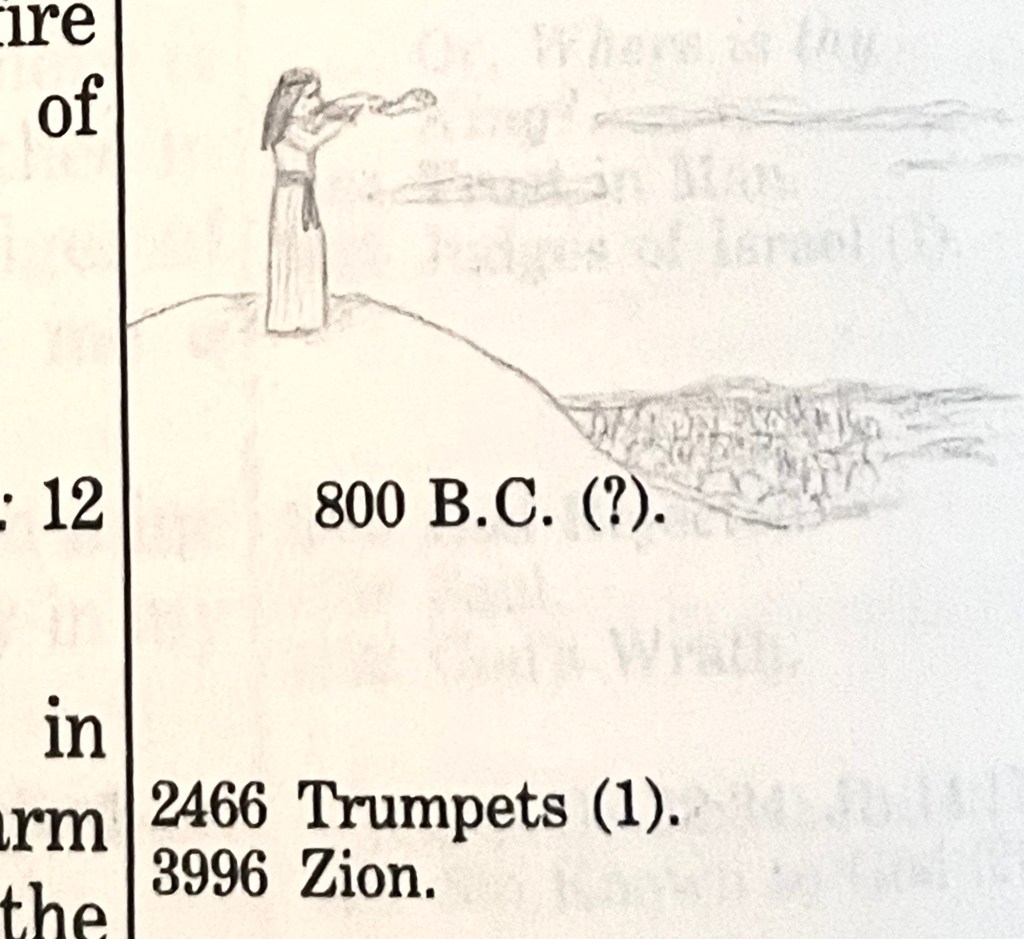
😯 You have tiny drawings in your Bible?
Yes.
😐 Is that normal?
I don’t know. Most of them happened as doodles during Bible College lectures.
😏
I’ll try to remember to share more of them. You missed my T-Rex Leviathan in Job. 🦖He’s big though. An inch and a half tall. Wait til you see Paul in Acts 20. He’s only 1/8in.
😲 You have an Apostle Paul… as tiny as me?
Yup.
😏 This is gotta see. 🔎
Ok. But first…Joel.
One thing that stands out to me is how similar the description of the locust army is to the “locusts” in Revelation.
“Their appearance is like the appearance of horses, and like war horses they run. As with the rumbling of chariots, they leap on the tops of the mountains, like the crackling of a flame of fire devouring the stubble, like a powerful army drawn up for battle.”
Joel 2:4-5 ESV
“In appearance the locusts were like horses prepared for battle: on their heads were what looked like crowns of gold; their faces were like human faces, their hair like women’s hair, and their teeth like lions’ teeth; they had breastplates like breastplates of iron, and the noise of their wings was like the noise of many chariots with horses rushing into battle.”
Revelation 9:7-9 ESV
I don’t think this is mere coincidence. I suspect that Joel’s locust army is a foreshadowing of the final Judgement Day locust army. And, like Joel, the Revelation locusts might be actual insects or an invading human army or both in some way.
🤔 Locusts- with human faces and long hair? Sounds like a lab experiment gone wrong.
Remember how we learned back in Song of Songs that the Hebrew mind does not describe a thing as it looks but according to its essence?
😐 Uh… sort of. Vaguely.
Ok. Joel and John said the locusts were like war horses. Forget about what a war horse looks like. What is its essence? What feelings does a war horse evoke?
😐 Existential dread?
A war horse is imposing. Looming. Unstoppable. Bred and trained to be fearless. In the ancient world, if you saw a mounted army approaching, you knew your death was imminent. THAT is why Joel describes them like an army of war horses.
They may have looked like this:

But seeing them felt like this:

I’m not sure about the locust army in Revelation- if it’s something natural, demonic, or a devilish combination of the two. One day we will find out.
In Joel 2:10 we also get similar end-of-days language with the sun, moon, and stars being darkened. Yet another evidence that the OT Day of the Lord is the model for the future one.
And then, the trumpet is blown again… But this time it’s to assemble the people to repent and fast and pray. Even at the last possible moment, the opportunity for repentance is extended. I expect it will be the same in the final hours and days before the judgment of all the earth.
The LORD has compassion on His people and the land. The tone shifts dramatically starting in 2:18. He is going to bless the land with food and peace again.
“I will remove the northerner far from you, and drive him into a parched and desolate land, his vanguard into the eastern sea, and his rear guard into the western sea; the stench and foul smell of him will rise, for he has done great things.”
Joel 2:20 ESV
This verse is one of the reasons scholars consider an early date of around 800BC. The “northerner” may be referring to Assyria.
But even if this is speaking of Babylon, they also approached Judah from the north and their territory included the northern lands formerly part of the Assyrian Empire. Greece and Rome are also north of Israel. For that matter, it’s not a stretch to add Gog from the land of Magog or Mount Zaphon to this list.
We get a whole section celebrating restoration and the famous prophecy that Peter said was fulfilled at Pentecost.
“And it shall come to pass afterward, that I will pour out my Spirit on all flesh; your sons and your daughters shall prophesy, your old men shall dream dreams, and your young men shall see visions. Even on the male and female servants in those days I will pour out my Spirit.”
Joel 2:28-29 ESV
Afterward. After what? After the army of destruction and the restoration to the land. It took centuries for this to unfold. But on the Day of Pentecost, Peter said that this event of the giving of the Spirit was what Joel prophesied. We are not waiting for this scripture to be fulfilled (as some charismatic preachers might suggest). At least, not exactly. It was future to Joel and past to us. But I do think it is a pattern that repeats after the locust army of Revelation. When that destruction is past and God restores the land (lion and the lamb lie down, mountains dripping sweet wine and such), then the Lord will dwell among His people in such a present and powerful way that it will make Pentecost look like the Costco sample.
Indeed, Paul even speaks of the Holy Spirit given at Pentecost as “the down payment.”
“In him [Christ] we have obtained an inheritance, having been predestined according to the purpose of him who works all things according to the counsel of his will, so that we who were the first to hope in Christ might be to the praise of his glory. In him you also, when you heard the word of truth, the gospel of your salvation, and believed in him, were sealed with the promised Holy Spirit, who is the guarantee of our inheritance until we acquire possession of it, to the praise of his glory.” Ephesians 1:11-14 ESV
Back to Joel…
After the promise of the Spirit, it’s as if the text summarizes the entire Age of Grace in one sentence, then jumps smack into the middle of Revelation.
“And it shall come to pass that everyone who calls on the name of the Lord shall be saved. For in Mount Zion and in Jerusalem there shall be those who escape, as the Lord has said, and among the survivors shall be those whom the Lord calls.”
Joel 2:32 ESV
Paul quotes this verse in Romans 10:13 in the context of the salvation of both Jews and Gentiles. The SAVED people are the Church.
The Church is “those who escape” the judgment. We are the “survivors.” Did you notice how the text said “Mount Zion AND in Jerusalem” as if they were two distinct places? We’ve already noticed in prior scriptures how “Zion” can refer to the heavenly city. Zion where those who escape can be found. In Rev. 7:9-17 John sees a great throng in Heaven dressed in white. The angel tells him that they are the ones who have escaped great tribulation.
Recall that there are no chapter breaks in the original text. The context places these escaped survivors just before “the great and terrible day of the Lord,” (2:31). We have saints in Zion escaping the judgment and the very next verse says…
“For behold, in those days and at that time, when I restore the fortunes of Judah and Jerusalem, I will gather all the nations and bring them down to the Valley of Jehoshaphat. And I will enter into judgment with them there, on behalf of my people and my heritage Israel, because they have scattered them among the nations and have divided up my land,”
Joel 3:1-2 ESV
The prophet Isaiah has used this same terminology. In fact, it’s the same word in Hebrew, shaphat: to judge, pronounce sentence. This is describing Judgment Day.
“For behold, the Lord will come in fire, and his chariots like the whirlwind, to render his anger in fury, and his rebuke with flames of fire. For by fire will the Lord enter into judgment, and by his sword, with all flesh; and those slain by the Lord shall be many.”
Isaiah 66:15-16 ESV
The Valley of Jeho-shaphat is a play on words. It means Jehovah Judges. It’s where the nations are going to be judged. There is no valley named “The Valley of Jehoshaphat” anywhere in the Bible other than here. King Jehoshaphat did have an interesting situation in 2 Chronicles 20 where a confederation of armies was marching toward Jerusalem. The King and all the people prayed for a miracle. This is the famous battle where Jehoshaphat sent the singers first. And when they reached the battlefield, the whole army was dead already. They spent days collecting the plunder and called the place The Valley of Barachah (Blessing), not the Valley of Jehovah Judges. But, from the perspective of the invaders, it was a valley of judgment, so maybe there is some connection there. That valley’s location is about 20 miles south of Jerusalem.
In a reversal of Isaiah 2:4 and Micah 4:3, the LORD taunts the rebel nations to “Beat your plowshares into swords, and your pruning hooks into spears; let the weak say, “I am a warrior.”” Joel 3:10 ESV
The nations assemble and God is basically saying,”Bring it.” He shows up ready to rumble with His “mighty ones,” coming out of heaven which sounds suspiciously like Revelation 19:11-21 and Matthew 25:31-32.
😐 Don’t bring a pruning hook to a supernatural sword fight.
Right.
Interestinly, the judgment is loaded with harvest imagery.
“Put in the sickle, for the harvest is ripe. Go in, tread, for the winepress is full. The vats overflow, for their evil is great.”
Joel 3:13 ESV
“Then I looked, and behold, a white cloud, and seated on the cloud one like a son of man, with a golden crown on his head, and a sharp sickle in his hand. And another angel came out of the temple, calling with a loud voice to him who sat on the cloud, “Put in your sickle, and reap, for the hour to reap has come, for the harvest of the earth is fully ripe.” So he who sat on the cloud swung his sickle across the earth, and the earth was reaped. Then another angel came out of the temple in heaven, and he too had a sharp sickle. And another angel came out from the altar, the angel who has authority over the fire, and he called with a loud voice to the one who had the sharp sickle, “Put in your sickle and gather the clusters from the vine of the earth, for its grapes are ripe.” So the angel swung his sickle across the earth and gathered the grape harvest of the earth and threw it into the great winepress of the wrath of God. And the winepress was trodden outside the city, and blood flowed from the winepress, as high as a horse’s bridle, for 1,600 stadia.”
Revelation 14:14-20 ESV
Joel and Revelation are parallel in their descriptions of the Judgement and the end.
- All nations assemble for battle
- Joel 3:2, 9-11 & Rev. 16:13-14
- The LORD and His mighty ones come down out of heaven
- Joel 3:11, 16 & Rev. 19:11-14
- The sun, moon, and stars are dark
- Joel 3:15 & Rev. 6:12-13, 8:12
- The final judgment is described in grain and grape harvest language
- Joel 3:13 & Rev. 14:14-20
- After the Judgement, there is restoration and eternal peace with the Lord dwelling among His people
- Joel 3:17-21 & Rev. 21-22.
I do not doubt that the prophecies given through Joel were intended to both challenge and comfort the original audience. “Judgment is coming but you can repent and call upon the LORD for salvation.”
That which has been before, shall be again.

