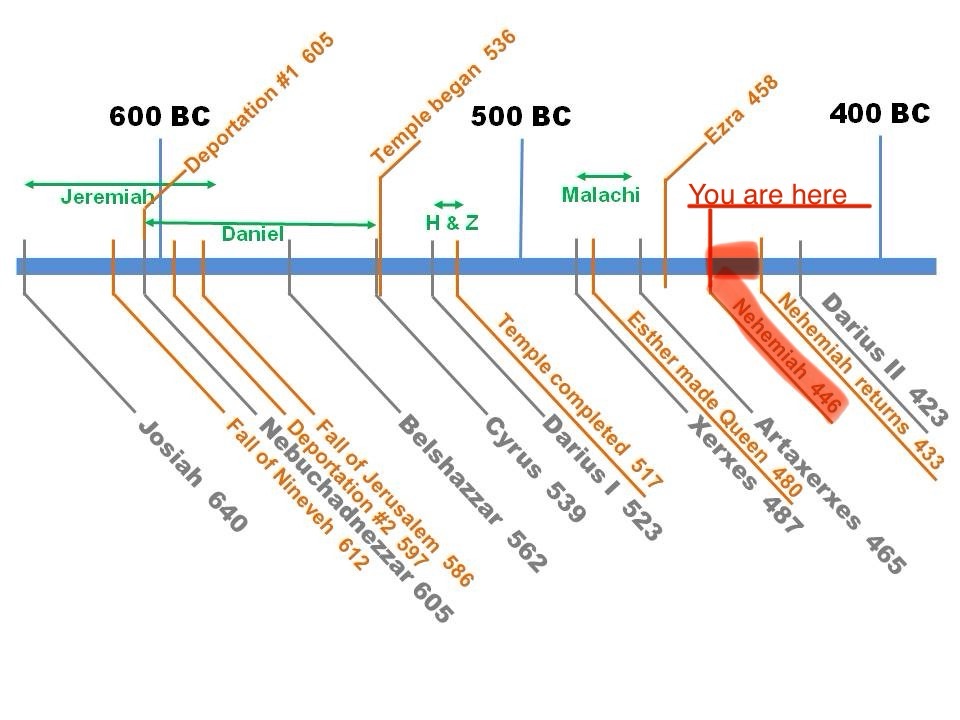
And just like that, we have come to the end of the Old Testament narrative. Ezra and Nehemiah were originally a single book. Jerome who translated the Bible into Latin was the first to split them in two.
Nehemiah is the last book of Old Testament history. It’s been 100 years since Cyrus decreed the exiles could return and the first group moved back and began to rebuild.
Ezra and the group that went with him have been in Jerusalem for 13 years now.
🤓 So is little Mahetabel is all grown up now?
🙂 And did she marry Ezekiel?
I have it on good authority that Mahetabel and Ezekiel were married about the same time as the events of Nehemiah 2. She wore a crown of flowers.
😯 You do?!
🤓 How do you know that?
When one is an author one is also an authority.
😏 I think that means she made them up.
It’s called “artistic license.”
Back to Nehemiah.
He’s in Susa working as cupbearer to king Artaxerxes. Artaxerxes sits on the same throne in the same court where Esther came in uninvited. It’s the same palace where Morecai (the Jew) was made second-in-command of all of Persia. So Nehemiah (also a Jew) is working in a very high position of the king’s security.
🤔 Security? I thought he was like a waiter.
🤓 Yeah. Isn’t he the guy who brings the king his cup of wine or something?
Well yes, he does do that. But think back to the book of Esther. Remember how Mordecai overheard and stopped an assassination plot?
😐 Yeah.
The bad guys, Bigthan and Teresh…
🤓 Great names for a pair of baddies…
They were the king’s “chamberlains.” They “guarded the door.” These were guys with close access to the king. I bet that after that close call, the “interview process” for royal jobs got much more stringent. It would make sense to hire Jews whose God commanded them, “Thou shalt not murder.”
Anyone with close access to the king had to be very trustworthy. It’s very possible that Mordecai himself set up the requirements for employment in the palace.
Nehemiah was the king’s personal bartender. The Hebrew is a very basic word that means “to water or irrigate.” If the king needed “watering” – sounds as if he’s a house plant – that was Nehemiah’s job. It’s like those people in your life who ask you if you’re drinking enough water.
🧔🏽♂️ Nehemiah: Are you staying hydrated, my lord?
🤴🏽Artaxerxes: I had spiced wine at breakfast. Does that count?
🧔🏽♂️ Nehemiah: No, my lord. That does not count. I will bring you water. You need to drink more.
🤴🏽Artaxerxes: But I don’t like the taste of water.
🧔🏽♂️ Nehemiah: Then I will put some cucumber and mint in it. Very refreshing.
🤴🏽 Artaxerxes: Got anything stronger? I have a meeting with the royal bean counters this afternoon.
🧔🏽♂️ Nehemiah: I’ll add a squeeze of citrus.
🤴🏽 Artaxerxes: (rolls eyes)
I was once on a cruise where there was a bar (which I did not visit), that boasted that if you told the bartenders a little about yourself and your mood, they would mix up the perfect personal drink for you. I like to think that’s what Nehemiah did. Whether it was pomegranate-lemonade or wine or even a glass of milk to go with some fig newtons, he was keeping the king safe and hydrated.
If anyone had the access to slip “something” (poison) into the king’ drink, it would the royal bartender. They had to be trustworthy. In the days before refrigeration, canning, bottling, preservatives, and scientific knowledge of yeasts and bacteria, you could also easily kill someone accidentally from food poisoning or bad water. You had to know your stuff so well you would bet your own life on it. Because the royal chef or bartender had to sample their offerings before they went to the royal family. If anyone was going to die of poisoning it would be them first.
Nehemiah was not only competent he was trusted to protect the king. They would’ve interacted on a daily basis.
And around November, Nehemiah’s brother, Hanani, returns from being in Jerusalem. There IS a Hanani mentioned by Ezra (10:20) in the lists of men who had to put away foreign wives. If I’m understanding the text correctly, he was a member of a priestly family; descended from an earlier priest mentioned by Jeremiah by the name of Immer. I don’t know if that Hanani was Nehemiah’s brother, but theoretically, it could’ve been.
At any rate, Nehemiah’s brother has been in Jerusalem and has made the trip back and tells Nehemiah how Jerusalem’s walls are badly broken down and the gates nonexistent.
Nehemiah’s response to this news is prayer. And in his prayer he says, “even I and my father’s house have sinned,” (1:6). While this could be a general confession, it may be an acknowledgment of his brother’s having taken a pagan woman as a wife. And so much the more if they were of a priestly family.
The dates (which are unfamiliar to us) tell us something. Nehemiah’s brother arrives with the bad news about Jerusalem in the month of Chislev/Chileu (Nov-Dec). Nehemiah prays and asks God for favor with the king. But he doesn’t speak to the king about the situation until the month of Nisan (Mar-Apr).
Nehemiah didn’t immediately begin badgering the king for help. It’s more likely that he spent about 4 months praying and thinking about the situation. When the opportunity finally comes to speak to the king about it, Nehemiah has a whole plan mapped out. This is not spur-of-the-moment. He has been thinking about every detail and even anticipating potential problems and he already has ideas for how to address them.
Sometimes Dave Ramsey jokes that successful people “work hard for twenty years then are suddenly an overnight success.” He’s poking fun at the idea that people just suddenly become successful for no reason. People who succeed at things generally devote a GREAT deal of time and effort and energy and commitment to that one thing to get really good at it. But no one sees that part.
I don’t think anyone saw the late nights the Nehemiah stayed up praying and planning. No one told him to do this. He didn’t get a vision or a visit from an angel. He just saw that something needed doing and he had the skills to do it.
I know that sometimes the Holy Spirit will prompt and direct and lead in specific ways. I’ve heard testimonies of radical obedience where a Christian man went and bought specific items at a store and drove to a specific address – all prompted by the Holy Spirit – to find that there was someone at that location praying “God, if you exist, send me one of your followers with a gallon of milk and a loaf of bread.” And no sooner were the words uttered then this saint pulls up in a car and steps out with a gallon of milk and bread. I love those stories. And I know God does stuff like that.
But not every decision has to be – “Thus saith the LORD, thou shalt get butter pecan ice cream instead of the chocolate.”
🙄 Well… obviously. God would never tell someone to get butter pecan if chocolate was available. 🍦🍫
Nehemiah doesn’t get a heavenly commission like a prophet but he still recognizes that “the good hand of my God was upon me” (2:8).
So Nehemiah goes – with the king’s blessing. He keeps his mission a secret until he has personally inspected the walls.
Funny thing about telling people what you plan to do… They have ideas about it. What they think you should do differently, how it needs to be done.
If any of the guys in Jerusalem were gonna tackle the project of rebuilding the walls, they’ve had plenty of time. Nearly 100 years.
When he is finally ready, Nehemiah reveals his plan and rallies the residents to get on board.
You know who’s not on board?
The neighbors.
Sanballat – Satrap/Governor of Samaria
Tobiah – An Ammonite official with personal ties to leaders in Jerusalem. Both he and his son have married into prominent Jewish families related to Eliashib the high priest.
Geshum – Arabian King of Kedar (a vast stretch of country east of Ammonite lands, he was confederate with Samaria and Tobiah.
These three are like bullies on a playground. And Jerusalem is the new nerdy kid.
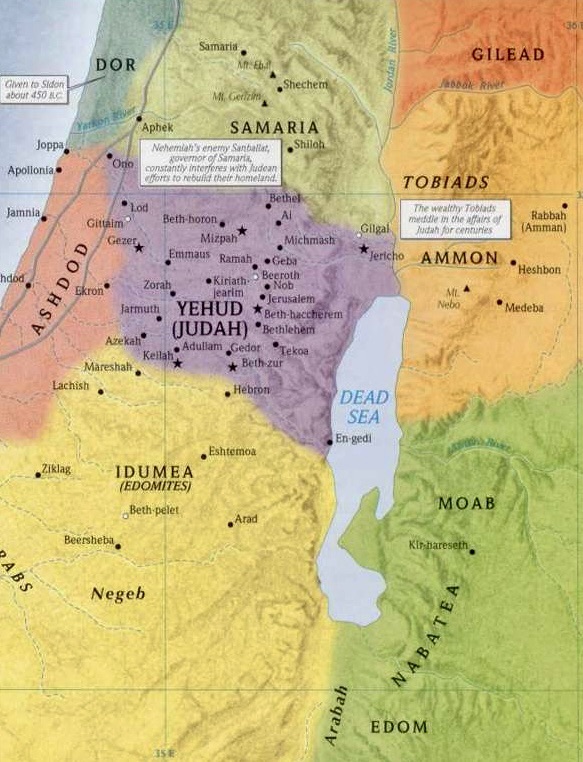
That little patch of purple is all that is left of Israel. And they are surrounded by hostiles.
Jerusalem building defensive walls is like Daniel LaRusso taking lessons from Mr. Miagi in The Karate Kid. The tough guys from Corba Kai think it’s a joke and enjoy making fun and picking on him.

Sanballat, Tobiah, and Geshum are about to meet a Jerusalem that decides to stand up for itself. Nehemiah is kind of like their Mr. Miagi.
☝️🤓 Don’t ever underestimate the power of “wax on, wax off.”
 To The Reader