“In October, when the Israelites had settled in their towns… (7:73)
“all the people assembled with a unified purpose at the square just inside the Water Gate. They asked Ezra the scribe to bring out the Book of the Law of Moses, which the Lord had given for Israel to obey. So on October 8 Ezra the priest brought the Book of the Law before the assembly, which included the men and women and all the children old enough to understand.”
Nehemiah 8:1-2 NLT
If your church has a platform from which the scripture is read, you just might have Ezra to thank for it.
If your congregation observes the practice of standing when the text for the sermon is read, that comes from Nehemiah 8:5.
Ezra read from the Pentateuch, (the first 5 books of the Bible). Most of these people had never heard the actual text read before. And even when they heard it, they probably only understood a word here and there. Ezra was reading Hebrew, the people grew up speaking Aramaic. So there were 13 bilingual Levites who served as translators in the crowd. They could also answer questions about the text.
“They read from the Book of the Law of God and clearly explained the meaning of what was being read, helping the people understand each passage.”
Nehemiah 8:8 NLT
And what they heard made them weep.
The Word of God shows the unflinching truth. And its light exposes the darkness of our hearts and deeds.

It is THIS context of grief – over mistakes made in ignorance, over past sins, over present tendencies – THIS is the context for:
“And Nehemiah continued, “Go and celebrate with a feast of rich foods and sweet drinks, and share gifts of food with people who have nothing prepared. This is a sacred day before our Lord. Don’t be dejected and sad, for the joy of the Lord is your strength!””
Nehemiah 8:10 NLT
The joy is the LORD’s. The strength is yours.
I want to explore these two words.
JOY
Hebrew: chedvah, (rejoice, gladness, joy)
Chet – wall, end, obstruction, outside
Dalet – gate/door, (tent flap), move, hang down, low
Vav – hook, tent peg, and, with, join
Hey– man with arms raised, look!, reveal, life, man, existence
So first, there’s a wall.
And then we come to a gate in the wall.
But not just any gate, ‘cause the gate is joined to a man. A gate-man.
Now let me see… A man who is a gate…
“so he explained it to them: “I tell you the truth, I am the gate for the sheep. All who came before me were thieves and robbers. But the true sheep did not listen to them. Yes, I am the gate. Those who come in through me will be saved. They will come and go freely and will find good pastures.”
John 10:7-9 NLT
The biblical idea of joy involves strong safe walls and a gate that leads to life. That is gladness.
And this Gate-Man-in-the-wall belongs to the LORD. He is the LORD’s Gate-Man. And He is your…
STRENGTH
Hebrew: maowz [ma-oze], fortified place, defense, fortress, rock, strength, stronghold.
Mem – waters/sea, lift up, unknown, tumult
Ayin – eye, sight, knowledge, understanding, perception
Vav – hook, tent peg, and, with, join
Zayin – plow, edge, cut, overturn, prepare, make ready
Lifting up the eyes is a very familiar idea. Look up. But not just your physical eyes. The understanding – the mind, the soul – is being lifted up.
🤔 And joined to a plow?
More like what a plow does – which is prepare.
A stronghold is Bible-speak for what we would call a Doomsday Bunker. People who build and stock them are called “Preppers.” They are prepared for both the unknown (Mem) and the things that can be seen with the eye (Ayin) and perceived.
😐 How is joy a doomsday bunker?
The word for joy is a picture of safe walls and a Gate-Man-in-the-wall that opens into life. HE is your fortress. HE is your Stronghold.
“The Lord is good, a stronghold in the day of trouble; he knows those who take refuge in him.”
Nahum 1:7 ESV
When we find ourselves in a place of grieving over our ignorance of God’s Word and sadness over how we have fallen sort, we ought to remember that Christ is the Gate-Man Who opens and welcomes the wandering sheep into the safety of the fold of God where there is eternal life.
“And the Levites, too, quieted the people, telling them, “Hush! Don’t weep! For this is a sacred day.” So the people went away to eat and drink at a festive meal, to share gifts of food, and to celebrate with great joy because they had heard God’s words and understood them.”
Nehemiah 8:11-12 NLT
If you are in the habit of “Sunday dinner” – be it at a restaurant with friends or a meal at home with family, or a quiet bite in your own company, I think we should bring back the practice of celebrating because we got to hear God’s words and understand them.
I think we take that WAY too much for granted. As of 2026, Wycliffe Bible Translators estimate there are 3,200 language communities in the world that currently have no translation of the Bible. About half of those have a sizeable population of speakers who need the Bible translated into their language as they don’t know a second language which does have a translation of the Bible. Many of these 3200 languages may not even have a written form yet.
If you have a Bible to read in your own language and people and resources around you to help you understand it, you have MUCH to celebrate.
The Festival of Booths (Tabernacles)
On the second day of this fall-fest, Ezra “just happens” to read the part of the Torah that commands the people of Israel to observe the Feast of Tabernacles. It may have been Leviticus 23:33-44, but what we see Ezra and the people doing looks an awful lot like this:
“Then Moses gave them this command: “At the end of every seventh year, the Year of Release, during the Festival of Shelters, you must read this Book of Instruction to all the people of Israel when they assemble before the Lord your God at the place he chooses. Call them all together—men, women, children, and the foreigners living in your towns—so they may hear this Book of Instruction and learn to fear the Lord your God and carefully obey all the terms of these instructions. Do this so that your children who have not known these instructions will hear them and will learn to fear the Lord your God. Do this as long as you live in the land you are crossing the Jordan to occupy.””
Deuteronomy 31:10-13 NLT
Y’all, in Nehemiah’s time it’s been more that one THOUSAND years since this commandment was given and actually kept.
And finally there is a group of Israelites who are truly serious about DOING what God commanded their people to do. And they are super stoked to observe it.
Now, I happen to believe – based on scripture – that the 7 festivals are prophetic pictures. Each feast IS a prophecy; an annual prophetic reenactment. Jesus fulfilled the 3 Spring festivals in person, on the actual days in His first coming. The Holy Spirit fulfilled the lone summer festival (Weeks/Pentecost) in person on the actual day. The 3 Fall festivals remain:
- Trumpets (Rosh Hashanah)
- Atonement (Yom Kippur)
- Tabernacles (Sukkot)
And based on the biblical pattern, I fully anticipate that Jesus will fulfill the prophetic meanings of these feasts in person and on the actual days of those feasts.
Of those three, recall that the prophet Zechariah said that when the LORD reigns from Mount Zion, all the Gentile nations will come to Jerusalem to keep only 1 feast: Tabernacles. So, as a Gentile, I feel very snugly included in this particular feast.
Nehemiah records (8:17) that the feast had not been observed “since the days of Joshua the son of Nun.” That observance is not specifically noted in the book of Joshua. (Though Joshua 8:30-35 may suggest it.)
The book of Joshua has strong prophetic parallels to Revelation. Joshua leading the people in to drive the giants out of the land is a picture of the 2nd Joshua (Yeshua/Jesus), leading His people into Yahweh’s land (all the earth) and driving out the giants (the humans partnered with the fallen realm) and the tribes committed to worshiping fallen beings.
It seems to me like a prophetic hint that the only 2 times the OT records the observance of Tabernacles is:
- In the days of Joshua, and…
- After the faithful remnant has survived the “day of the Lord” and is settled in a renewed Jerusalem
I find this pairing very telling. Like it’s communicating something about the ultimate fulfillment of the feast.
Here are some other interesting things that the Bible records as having taken place “in the seventh month” during the season of Tabernacles:
- Noah’s Ark came to rest during what would become the Feast of Tabernacles (Gen. 8:4) It was the end of the first global cataclysmic judgment.
- Solomon’s Temple was dedicated, God moved in to dwell among His people on earth in Jerusalem during the Feast of Tabernacles (1 Kings 8:2), 2 Chron. 5:3)
- It was the first thing the returned exiles did (Ezra 3:1-4)
- It’s one of the 2 feasts mentioned in relationship to “Ezekiel’s Temple” (Eze. 45:25)
- The prophet Haggai received a message from the LORD during Tabernacles that “the glory of the latter house” would be “greater than the former house” (Hag. 2:1-9). This was a reference to Christ entering the 2nd temple, and probably also the temple of the Church.
Tabernacles is a harvest festival that celebrates a few things:
- Thankfulness for a good harvest
- How Israel lived in temporary structures for 40 years in the wilderness and God protected them
- The reading of scripture
The key feature of Tabernacles is living in temporary dwellings decorated with greenery (called sukkah [soo-cah]). If you’d like to read more about the modern observance of Tabernacles, click here for an article.
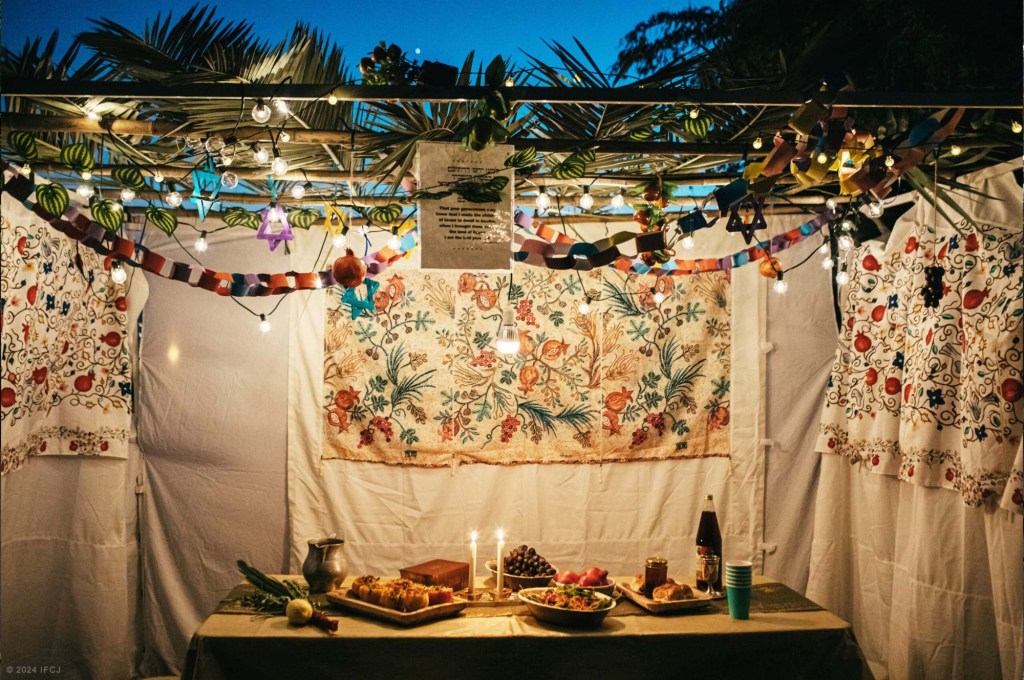

🤔 It looks like Palm Sunday.
I know, right?
They have the branches because of this:
“He had said that a proclamation should be made throughout their towns and in Jerusalem, telling the people to go to the hills to get branches from olive, wild olive, myrtle, palm, and other leafy trees. They were to use these branches to make shelters in which they would live during the festival, as prescribed in the Law.”
Nehemiah 8:15 NLT
The Hebrew word (shemen) being translated as “wild olive” here is nearly always translated as “oil.” As in, “thou anointest my head with oil.”
The “wild olive” branches stood out because that’s exactly what the Apostle Paul called the Gentile believers. 🌿
“But some of these branches from Abraham’s tree—some of the people of Israel—have been broken off. And you Gentiles, who were branches from a wild olive tree, have been grafted in. So now you also receive the blessing God has promised Abraham and his children, sharing in the rich nourishment from the root of God’s special olive tree.”
“You, by nature, were a branch cut from a wild olive tree. So if God was willing to do something contrary to nature by grafting you into his cultivated tree, he will be far more eager to graft the original branches back into the tree where they belong.”
Romans 11:17, 24 NLT
Branches from oily (anointed) wild olive trees were used to make the house where the people of God would dwell as they celebrated the final harvest.
Go back and read that again slowly.
If that’s not a prophetic picture of the Church, I don’t know what is.
And these shelters were all within the walls of the “new Jerusalem.” Are we paying attention yet?
And they lived in these shelters and feasted and rested (no work!) for 7 days.
On the 8th and final day, they gathered for a solemn assembly which is recorded in the next chapter.
I’m telling you, this quiet little out-of-the-way text about the observance of Tabernacles in Nehemiah is heavy with prophetic imagery.
If you thought we were just gonna die and then go float on a cloud for eternity strumming a harp… Nope. I’m quite certain it will be VASTLY more interesting than that.
We will be more gloriously alive than we have ever been. We will have luminous bodies and we will eat (hallelujah!) and laugh and enjoy music and pristine nature and live in a realm governed by the King Who made it all and never does anything wrong.
There will be no more stress or anxiety. No more sin or selfish people. No violence or death or loss or destruction.
It will be (in a word)… perfect.
And I think this bit from Ezra will apply to us in that day:
“So everyone who had returned from captivity lived in these shelters during the festival, and they were all filled with great joy!”

