There is something squirrelly going on with the chronology of Nehemiah in the last 2 chapters. When I read chapter 12, I assumed it happened shortly after the walls were completed. And, indeed it may have,
BUT…Chapter 13:1 (“on THAT day”) seems to link the events of chapter 13 to chapter 12 with the dedication of the wall. Both chapters address the issues with collecting and distributing the tithes so that the Levites could do their temple ministry. The prophet Micah will also address this subject strongly.
Nehemiah 13:4-6 says that the problems with Eliashib and the failure to provide the tithes for the Levites had arisen while Nehemiah was away to see king Artaxerxes for an extended time (probably 2-3 years). Verse 4 particularly states that this happened BEFORE the reading of the Law on “that day.” It’s the “before” that throws a wrench into the sequence. It suggests the issues with Eliashib took place before the walls were dedicated but 13:6-7 makes it clear that it happened while Nehemiah was in Susa in the 30th year of Artaxerxes.
This leads me to consider two possibilities:
- The walls and gates were purified (12:30) and dedicated (12:27) shortly after they were finished and the events of chapter 13 happened years later. We would assume that 13:1 “on that day” is NOT referring to the day of dedication just described in the text.
- The walls and gates weren’t purified and dedicated until after Nehemiah had gone away and then returned to Jerusalem (about 15 years after the walls were built) and found that the Levites, and consequently the temple service, had been neglected. The purification and dedication would then be viewed as Nehemiah “jump-starting” the Levitical ministry after a period of neglect.
I’ve checked the Septuagint. It doesn’t differ from other texts. Josephus’s chronology is not much help. It’s wildly different. He has Nehemiah in the days of king Xerxes and said it took over 2 years to build the wall.
You read it for yourself and come to your own conclusion.
I don’t have a strong opinion, but I lean toward a long-delayed dedication of the walls upon Nehemiah’s return from Susa.
Now… on to the story…
Every year that I possibly can, on Thanksgiving morning I try to watch the Macy’s Thanksgiving Day Parade- mainly because it feels nostalgic. But I’m also fascinated by the caliber of the marching bands, the sophisticated floats, and of course, the big balloons.

The 2 parallel parades around Jerusalem for the dedication of the walls was not quite so large a Macy’s but I think the general effect it would’ve made was similar in spectacle.
They had 2 marching bands and 2 choirs of singers and I’m sure there was much waving and dancing and smiling and good wishes toward the crowds of spectators. The priests and Levites would’ve been dressed in their white tunics. Maybe they even tossed little cakes of figs or raisins to the kids. (I doubt it, but it’s fun to imagine)
Instead of walking down a wide street, they paraded on top of the newly completed walls, which were approximately 6.5 feet (2 meters) wide. Not exactly as broad as 6th Avenue in New York, but still wide enough for a couple of people to walk side-by-side.
Here are the parade routes:
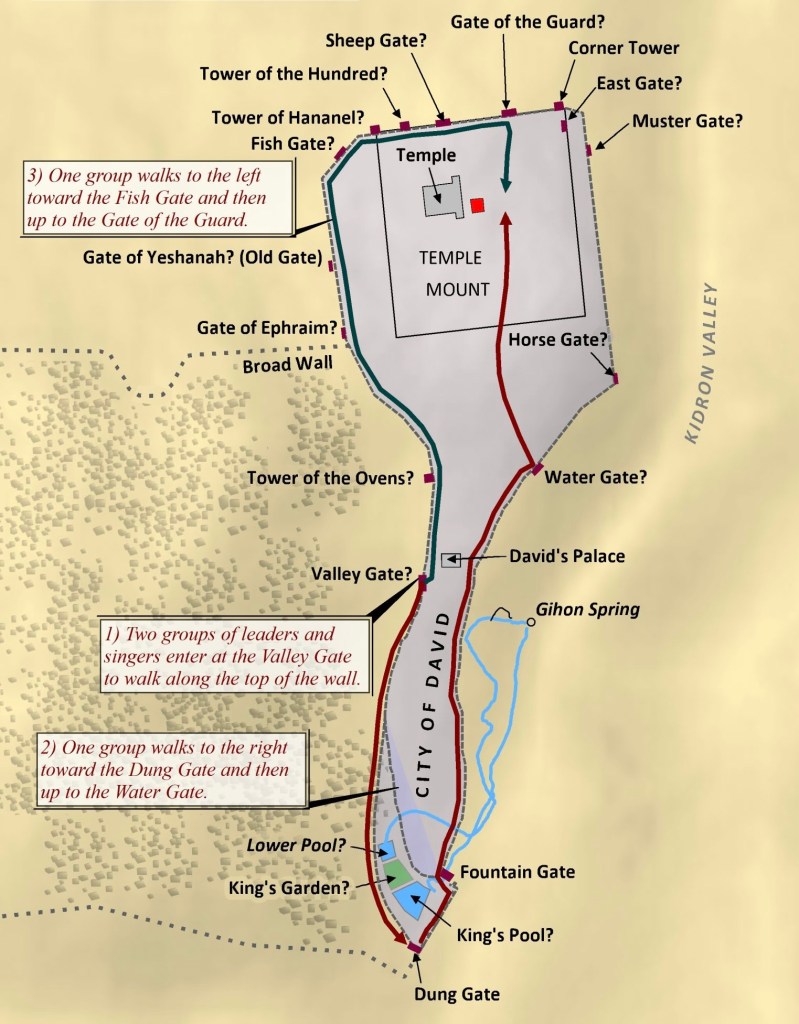
They began either at the Valley Gate with one group taking a much longer route as the illustration above indicates. Or, (as I am slightly more inclined to think), they began at the southern point and split into 2 groups as this illustration below suggests:

Nehemiah went at the end of the group on the left. Whichever way the route was, both groups ended up in courts of the Temple singing and playing instruments.
The text calls them “the musical instruments of David the man of God,” (Neh. 12:36). I’ve always wondered if that means some of these instruments had been made by or belonged to David – which would be a rather big stretch seeing as David has been dead for about 500 years. Very few instruments survive that long.
There’s a playable 600-year old pipe organ in Switzerland and even a playable 500-year old harpsichord in a museum in South Dakota (of all places). But hand-held harps?
I don’t know. Maybe. But that statement may also point to instruments designed and invented by David. The Septuagint contains an additional psalm; Psalm 151. It’s a short (7 verses) psalm of David written when he was a young man after he killed Goliath. Verse 2 says, “My hands built a musical instrument; my fingers tuned a lyre.”
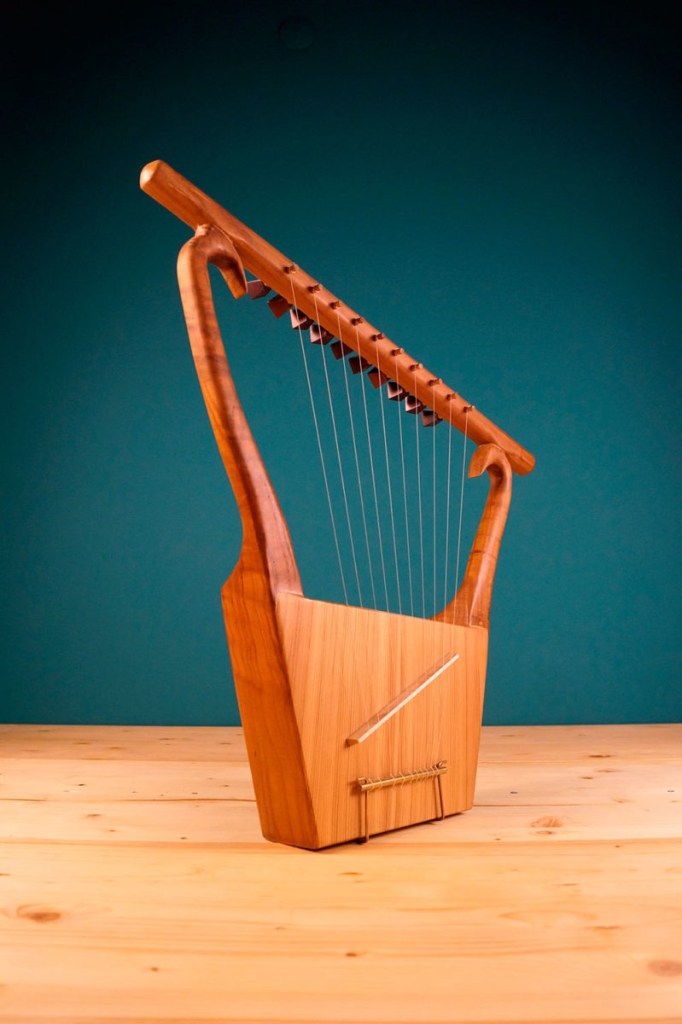
The Lyre of Megiddo is based on an ivory carving depicting a lyre dated to the time of David. It is generally thought of as the type of lyre David would’ve played. The link here will take you to a video of a man playing a reproduction of this ancient lyre. He plays remarkably well, even accessing string harmonics.
Josephus (book 7, ch 12, sec. 3, v305-306) records 3 types of instruments constructed by David. They weren’t inventions exactly. More like improved designs.
- KINNOR – Josephus’ translators called it a “viol.” It had 10 strings. Josephus said it was played with a “bow” but I believe “bow” is a mistranslation and what Josephus meant was something more like a plectrum – what we now call a “pick.” Bowed instruments weren’t invented until the 8th century AD.
- NEVEL – The translators called this a “psaltery” but in Hebrew the word is Nevel which suggests a hide or skin-covered resonator and not the wooden box style psalteries that developed in Medieval Europe. The Nevel had 12 strings and was plucked and/or strummed with the fingers
- CYMBALS – described as large and “broad” and made of brass.
To watch a 12.5min video of a man descended from the Levites demonstrate the kinnor and nevel, click here.
“And they offered great sacrifices that day and rejoiced, for God had made them rejoice with great joy; the women and children also rejoiced. And the joy of Jerusalem was heard far away.”
Nehemiah 12:43 ESV
The sounds of their trumpets and singing and shouts echoed through the hills.
I was in San Antonio, Texas in 2003 when the Spurs (led by David Robinson and Tim Duncan) won the NBA Championship. It was only the 2nd time they had won; the first being in 1999. The fans went wild. I happened to be on top of one of the highest hills in San Antonio, and you could hear the entire city celebrating. It was surreal. Car horns were honking wildly. You could hear music and faint echoes of people shouting. Even the dogs were barking and howling. Every so often a vehicle would drive by Spurs flags waving, music cranked, horn blaring, and excited fans yelling out the windows.
Of course I hopped in a car with friends and we drove around a bit to see all the excitement. There were literally people dancing in the streets. It was one of the most jubilant things I’ve ever witnessed.
I suspect that the celebration in Jerusalem was like that.
And why not? After 70 years existing as nothing more than a heap of ruins and another century of modest rebuilding efforts, the city of Jerusalem is officially BACK.

