LUKE 15
Lost Sheep, Lost Coin, Lost Son
These 3 parables are a response to the Pharisees who were not happy about the tax collectors and sinners who were following Jesus. We need to keep this in mind. The text is clear that Jesus is speaking TO the grumbling Pharisees. These 3 stories are Jesus’ defense for why He is happy when sinners come to Him.
LOST SHEEP 🐑
The lost one represents 1% of the whole. We’ll notice that number grow in each story.

The shepherd leaves the 99 in the “wilderness” and (according to the parallel story in Matthew. 18:12) he goes to the mountains to search for the sheep.
The shepherd finds the sheep and brings it home on his shoulders. You may have heard someone say that the shepherd would break a leg of a wandering sheep to keep it from wandering away again. This is rubbish. It’s a myth based on a misunderstood word.
Some shepherds might put a kind of “brake” (not a break) on their sheep or goat’s legs called a hobble.

If you break a farm animal’s leg, you might as well kill it. For a sheep, it would be a death sentence. They would be completely immobile and coyote bait; if they didn’t die of infection first. Shepherds do not now and never have broken the legs of wandering sheep. They might’ve killed and eaten a problem sheep, but they wouldn’t create a HUGE problem for themselves by breaking a sheep’s leg. The point of the parable isn’t even about the sheep. It’s that the shepherd in the parable wants others to be happy when the wayward sheep is found.
The Pharisees would surely have picked up on the shepherd/sheep imagery which is used a lot in the OT. Yahweh spoke of His people as a flock many times. Jesus is telling them that the God Who they claim to serve is glad to gather His lost sheep and He wants them to rejoice with Him instead of being holier-than-thou critics.
THE LOST COIN 🪙
In this parable, the lost item is 10% of the total. One out of ten. The Greek text names the coin specifically as a silver drachma. And I did some poking around online and actually found an image of the exact coin Jesus was talking about.

The drachma [drok-mah] was a Grecian coin, not Roman, and this one was minted by the neighboring Nabateans in 16-30AD. The faces are of their king and queen. The Nabateans are the people who built this:
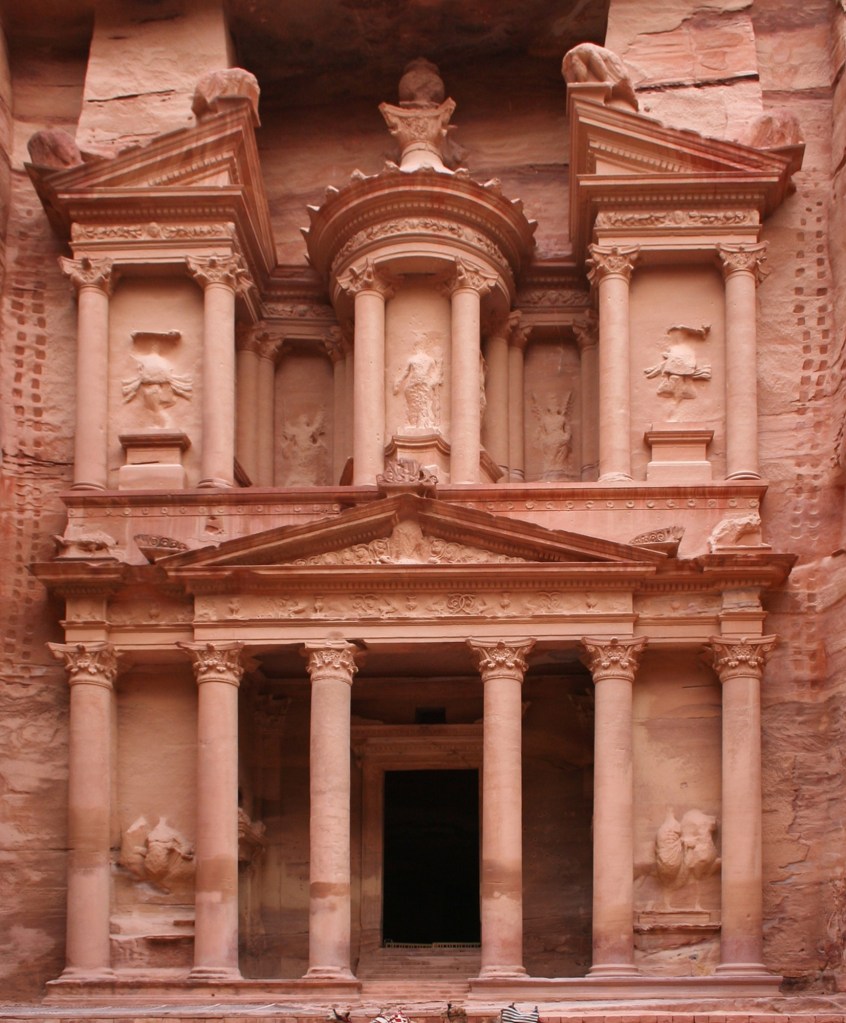
Depending on the economy, a single silver drachma would be worth somewhere between $150-$450 in today’s money, or a full day’s wages.
Jesus didn’t elaborate on the woman in the parable and I’ve heard a lot of speculation about what kind of woman she is (new bride, recent widow) and what the 10 drachmas represented. Let’s not get so far into those weeds that we miss the point.
Unlike the shepherd whose sheep wandered away and he had to go off to find it, the coin has not wandered away. It has been dropped and rolled into some dark corner and possibly covered with debris or ashes. She does not have to go out looking for it, she has to search in dark, dirty crannies. When she finds it, she also wants her friends to rejoice.
Image the Pharisees hearing this while looking across into the smiling faces of a prostitute, witch, or crook.
THE LOST SON 🧑🏽🦱
We’ve gone from 1% to 10% and now the lost son is HALF of the father’s sons; 50%.
He blows through his inheritance living a dissolute lifestyle; probably parties, fancy clothes, fast horses, gambling, booze, and prostitutes.
But the money ran out and he ends up with a job feeding pigs. This is like the first century edition of Mike Rowe’s “Dirty Jobs,” especially for a Jew.
Here are a few random facts I dug up.
The Greek tells us what the “husks” were that he wanted to eat. And he may have indeed snatched a few from the piggies. And why not – they taste like chocolate. 🍫


🤔 Is this the plant that grows M&M’s? Cuz that looks exactly like a pod of M&M’s.
No. But the seeds are famously consistent in size and weight. So much so, that the Greek name for them karation, is where we get the word carat – as in, the unit of measurement for precious gems. The weight of precious stones were measured against the number of carob pod seeds.
🤔 So, a 1-carat diamond 💍 weighs the same as 1 carob seed?
Yes. A carob seed weighs 200 miligrams (0.2 grams). That’s how much 1 carat is.
😐 Too bad one is so much more expensive.
Right. Carob was a cheap agricultural product and the pods were mainly used for animal food. Funny that their seeds were used to measure gems.
Unlike the shepherd and the woman who both search for their lost item, in this parable, the lost son finally comes to his senses in the pig pasture and he is the one who decides to go home and be found.
The indignant and jealous reaction of the older son probably resonated with the Pharisees for whom the story was intended. That’s how they had acted towards the sinners listening to Jesus.
In each parable the lost thing gets a little lower and dirtier. And I think there may be something of “kinds of lost people” in the parables.
The sheep wanders. It’s not being a rebel, necessarily. Sheep are rather dumb. One dumb choice leads to another and the next thing you know the sheep is lost. People wander. They didn’t set out to be far from God, but one thing led to another and here they are. Lost. And they can’t find their way back. They need a Savior to come to where they are, pick them up, and carry them all the way back to the flock.
Coins don’t have feet. They don’t wander off on their own. They have to be dropped and roll off into a dark corner. That happens to people too. They weren’t trying to be lost either. Someone in their life dropped them in the dirt and they rolled off into a dark corner. They aren’t going to just roll out into the light. Those lost people have to be searched out with the light of the Gospel sweeping into the dark, dirty, neglected corners of the world.
The son isn’t exactly “lost” in the same sense as the sheep or the coin. He leaves. He is young, cocky, and eager to get away from the restraints of home to experience the pleasures of the world. Then reality hits like freight train. All the pride and pleasure have to be stripped away before he can think straight. Some people (very sadly) have to find out for themselves that the world really does not satisfy and that life really is best in the Father’s house.
We might take a moment to think about the lost people we know- family members, coworkers, friends… Are they a sheep, a coin, or a son? Did they wander away, get dropped, or leave on purpose? They all need to be found but perhaps we might pray in unique ways for each one. Perhaps the LORD might have us partner with Him in finding the lost ones.
LUKE 16
Wealth & Righteousness
This whole chapter rotates around ideas about wealth. Here’s a quick outline:
- Parable of the Shrewd Manager, 1-13
- Jesus confronts the Pharisees, 14-18
- Story of the Rich Man & Lazarus, 19-31
PARABLE OF THE SHREWD MANAGER
Ever since Jesus began teaching He has repeatedly told people not to “lay up treasures on earth,” (Mt. 6:19). He will soon tell them that “it is easier for a camel to go through the eye of a needle than for a rich man to enter the kingdom of heaven,” (Lk. 18:25, Mk. 10:25, Mt. 19:24). Jesus has told listeners that selling their possessions and giving generously is how you build eternal wealth, (Lk. 12:33) and “where your treasure is there will you heart be also,” (Lk. 12:34).
This kind of teaching will continue in the formation of the early Church. See 1 Tim. 6:17-19.
Jesus tells a story about a rich man who had a dishonest manager. The manager was wasting his possessions.
Now, if Jesus follows the usual pattern, this parable might be aimed at the scribes, Pharisees, and other Jewish leaders. We might want to ask if the description of the crooked manager fits them at all.
😐 Uh… like Cinderella’s slipper.
Exactly.
God has given them influence and even wealth and instead of using it to serve their LORD, they are wasting it on themselves. And they are about to get fired, like the guy in the story.
The dishonest manager decides to create some favors for people to owe him. It won’t bring a profit, (in fact, the boss is going to lose money and he won’t get a commission), but by cutting the debtor’s bills in half, he creates something just as good as wealth… open doors for himself.
The dishonest manager is not exactly a good guy, but at least he’s smarter than the Jewish leaders.
If the Pharisees were smart, they’d give up their wealth to gain the kingdom of God. The eternal kingdom is worth more than all the riches of this world. The choice to forsake their riches and prestige won’t bring them an earthly profit but it will open the doors to an eternal home with God.
JESUS CONFRONTS THE PHARISEES
“The Pharisees, who were lovers of money, heard all these things, and they ridiculed him. And he said to them, “You are those who justify yourselves before men, but God knows your hearts. For what is exalted among men is an abomination in the sight of God.” Luke 16:14-15 ESV
The Pharisees do not understand the nature of the Kingdom of God. It is spiritual. It seems to me that that Pharisees would like the kingdom of God to be a powerful earthly government like the glory days of David and Solomon where even the servants dressed like kings and every meal was a royal banquet. They can only think of wealth in terms of money and physical possessions.
The kingdom of God has arrived on their doorstep. The downtrodden are lined up and shoving their way in like shoppers on Black Friday, while the Pharisees cannot perceive what is right in front of them. It doesn’t look ritzy or glamorous. It’s just an obscure rabbi from the country with a bunch of uneducated country bumpkin followers. It’s all unfolding as the scriptures foretold, except that it doesn’t look like what they thought it would.
It may seem rather abrupt that Jesus suddenly pivots from money to divorce until you consider that the character flaws of selfishness, discontentment, and greed are what lead a man to dump his wife for a “newer model.”
Women could not file for divorce. In this time and culture only a husband could do that. In Matthew 19:3 the Pharisees ask Jesus if He thinks it’s ok to divorce a woman for “every cause.” Meaning, she’s not as young as she once was or she’s not a very good cook, or he found a hair in his porridge. The oral law said this was fine. Any cause was justification for divorce. This could easily be exploited so that a man could have many sexual partners – any woman he wanted – and then when he got bored, just divorce her and get another. Never mind that the women are left destitute and ruined.
THE RICH MAN & LAZARUS
Just so we’re clear, the Lazarus in this story is NOT the Lazarus that Jesus will raise from the dead. And there is a perennial debate among scholars as to whether this story is a parable or something that actually happened that Jesus knew about. People in parables don’t have names. In this story we have a guy with a name: Lazarus.
When this story was translated into Latin, the Greek word plousios (rich) was translated as dives [DEE-vess] which also means “rich.” Over time, the Latin word came to be used as a name for the rich man: Dives [now generally pronounced like DYE-veez].
The Pharisees are very much like the rich man in the story. They have everything they could want. The poor and sick are begging at the gates every day. And many of those poor sick folks are far more righteous than the scripture-quoting scholars.
SIDE NOTE TO EXPLAIN THIS PICTURE OF THE AFTERLIFE
Jesus has not gone to the cross and risen from the dead yet. That fact makes a HUGE difference. From the time of Adam until the resurrection of Jesus, people do not “go to heaven” when they die. Why? Because it isn’t possible for the blood of bulls and goats to remove sin, (Heb. 10:4).
Sinful people CANNOT be in the presence of a holy God. Not even good old Abraham. Sheol, “the grave”, the place of the righteous dearly departed, was like a very large waiting room. When Noah, Abraham, Joseph and David (and all the rest who trusted God under the old covenant) – when they died, their souls went to Sheol to wait until the Messiah could accomplish the once-for-all sacrifice that would actually REMOVE sin. And, according to Jesus’ story, they could see and speak to one another. No “soul sleep.”
What Jesus is describing was true THEN, but it is no longer true NOW because at His resurrection Jesus “led a host of captives,” (Eph. 4:8). What “captives” could Jesus possibly be taking with Him into heaven if not the righteous dead waiting with Father Abraham in the place called Sheol?
Jesus’ atoning blood and resurrection changed the very landscape of the after-life. Paul said that (for the believer) to be “absent from the body” is to be “present with the Lord,” (2 Cor. 5:6-8). There is no more waiting room at death. Jesus makes those who are in Him fit for heaven. And that’s where the saints go when we die.
The wicked still go to Hell like the rich man.
The rich man asks Abraham to pull some strings with God and get Lazarus resurrected to go warn his brothers to change their ways lest they end up in Hell. Abraham’s response is, “They have the scriptures. They already have a warning if they will hear it.”
“And he said, ‘No, father Abraham, but if someone goes to them from the dead, they will repent.’ He said to him, ‘If they do not hear Moses and the Prophets, neither will they be convinced if someone should rise from the dead.’”
Luke 16:30-31 ESV
Jesus already knows what the Pharisees’ response to His resurrection will be. They STILL will not believe. Like I’ve said before, it’s not an evidence problem. It’s a heart problem. They don’t WANT it to be true. No amount of signs or miracles will convince the one who is not open to the idea of giving up his position as lord of his own life.
That’s why it’s harder for the rich to enter the kingdom. It’s not their kingdom. They’re not used to being someone else’s subject. They are used to being in control and having power to do as they please. The poor and disadvantaged have had to be dependent on others and are quite familiar with powerlessness and know better than to bite the hand that feeds them. They are not bothered by the idea of someone else making decisions about their lives – someone else being their Lord – as long as that Lord is benevolent.
Jesus is turning up the heat on the Pharisees. The time for them to repent and receive Him as Messiah is now. The door will soon be closed.
 To The Reader