The Temple Vision – Part 2, The Temple
In this chapter Ezekiel is shown the Sanctuary proper; the holy place (v1-2) and the most holy place (v3-4).
And it’s quiet. Too quiet. And rather…plain.
All of the walls are paneled with wood that has a repeating, wallpaper-like pattern carved into it: a 2-headed cherubim (lion and man) and palm trees. This design is very like the interior of the most holy place in both the Tabernacle and Solomon’s Temple. But the most notable difference is, it’s empty.
“This is the most holy place,” his guide says.
That’s it!
It’s like a real estate agent showing a house and saying offhand, “This is the master bedroom,” and then continuing down the hall. It’s SO weird. Ezekiel is a member of the priesthood, and he has to be told which room is the Most Holy place? Why? Maybe because it doesn’t look much like the spaces he knows from the scripture and descriptions shared by the priests who got to see it.
No shining gold. No glory of God. No smoke of incense. No giant carved cherubim- though they would certainly fit. The space is, after all, roughly 34-35ft cubed! It’s HUGE! And empty. No embroidered veil. And, most importantly, no ark of the covenant. (Which begs the question of how sacrificial atonement could even be accomplished if there is no Mercy Seat to sprinkle.)
In the sanctuary there is no golden menorah, no altar of incense, and no table of showbread. It’s just empty space.
I find it…slightly unsettling; like touring a house with no furniture.
The only furnishings we’ve seen up to this point are some tables in the court for cutting up sacrificial animals (40:39-42.)
On the “tour” as we come out of the sanctuary (as it were) we encounter one of the strangest things of all…
“…in front of the Holy Place was something resembling an altar of wood, three cubits high, two cubits long, and two cubits broad. Its corners, its base, and its walls were of wood. He said to me, ‘This is the table that is before the Lord.’”
Ezekiel 41:21-22 ESV
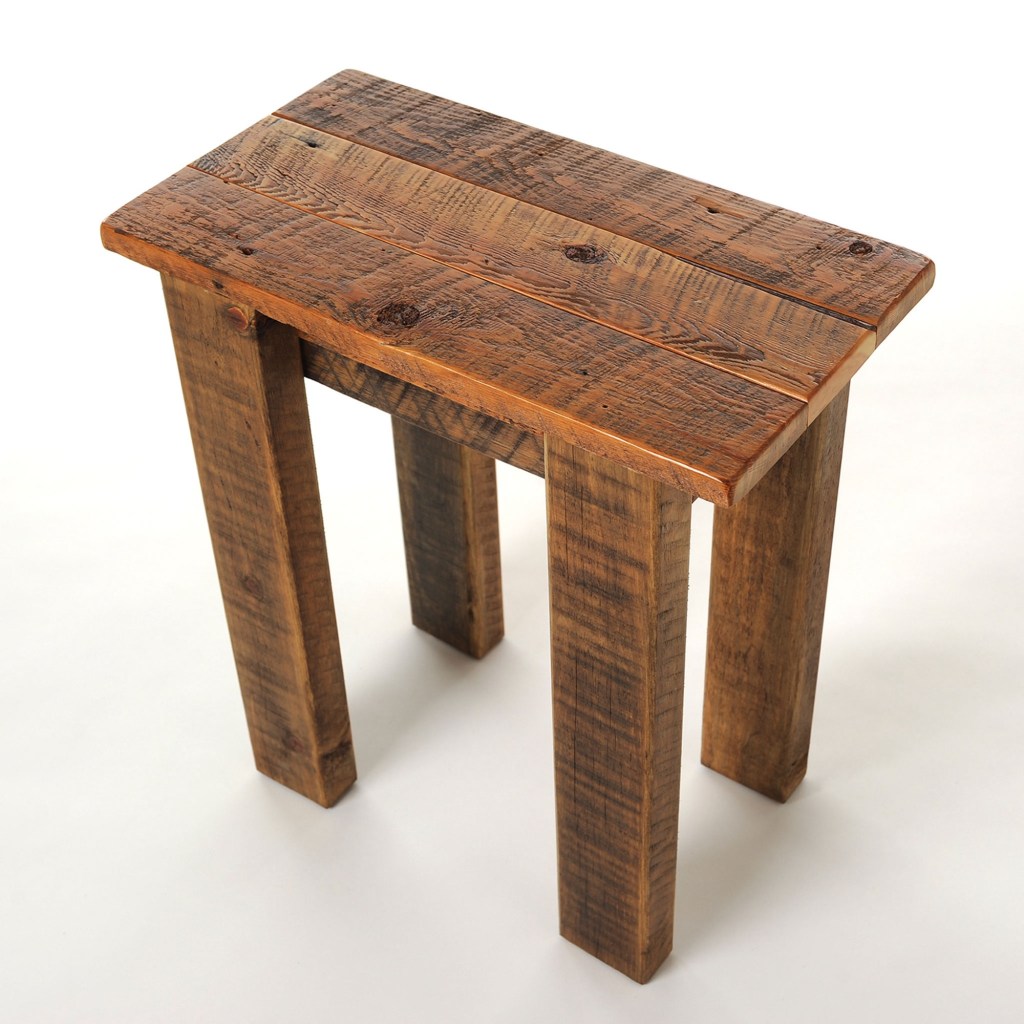
You can’t burn anything on an altar of wood.
And no average human can eat at this table. Under the table maybe, but not at it. It’s 5ft, 4in high. These are royal cubits (Eze. 40:5) which are 1 handbreadth longer than a usual cubit of 18in; so 20.4-21in x 3. But this table is only 3.5ft wide and deep. If it is constructed like a usual “table” (i.e. 4 legs, flat top), then its proportions are more like a tv tray for a giant.
Ezekiel said it “resembled an altar” which makes me wonder if it probably looked more like a box – but made of wood. I went looking online for images of wooden boxes about 5ft tall and 3.5ft square. And… well… the proportions look suspiciously like…
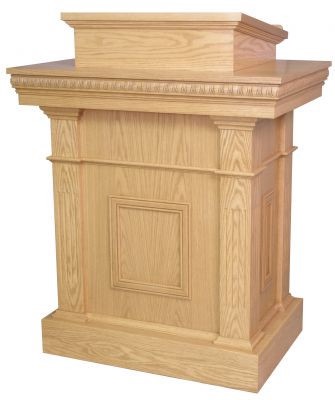
😯 A pulpit?
🤓 Well, it IS a table for the bread of life.
The table stands out. It’s called “the table that is before the Lord.” It’s the only piece of furniture. It’s not even inside the sanctuary.
😉 I guess God likes to dine al fresco.
And why not? 🧺 Eating outdoors is lovely – if the weather is nice 🌤️ and you don’t have to fight bugs. 🐜🐜🪰🦟🕷️🐝🐝🦗
This is the text I felt nudged to dig into. And here is what I found…
It takes quite a few English words to translate the Hebrew. I’m going to leave out the supplied English words and just share the basic meanings of the Hebrew words in the order they appear (I have them in bold in the verse below). Here is a link to the text if you’d like to dig into this yourself. I’m not a real Hebrew scholar. I’m just a Bible nerd with a Strong’s Concordance and an internet connection. I went by the KJV because that’s what the Strong’s is based on.
“The altar of wood was three cubits high, and the length thereof two cubits; and the corners thereof, and the length thereof, and the walls thereof, were of wood: and he said unto me, This is the table that is before the LORD.” Ezekiel 41:22 KJV
ALTAR – means altar, place of sacrifice
WOOD – Hebrew: ets, common word for wood/tree/carpenter/timber
I can think of an altar of wood that was made of timbers where a carpenter was offered as a sacrifice.
THREE – three, thrice, third
Three crosses. Peter denied thrice. Jesus rose on the third day…
CUBITS – mother, forearm, post… I’m including a screenshot on this one in case you don’t believe me.
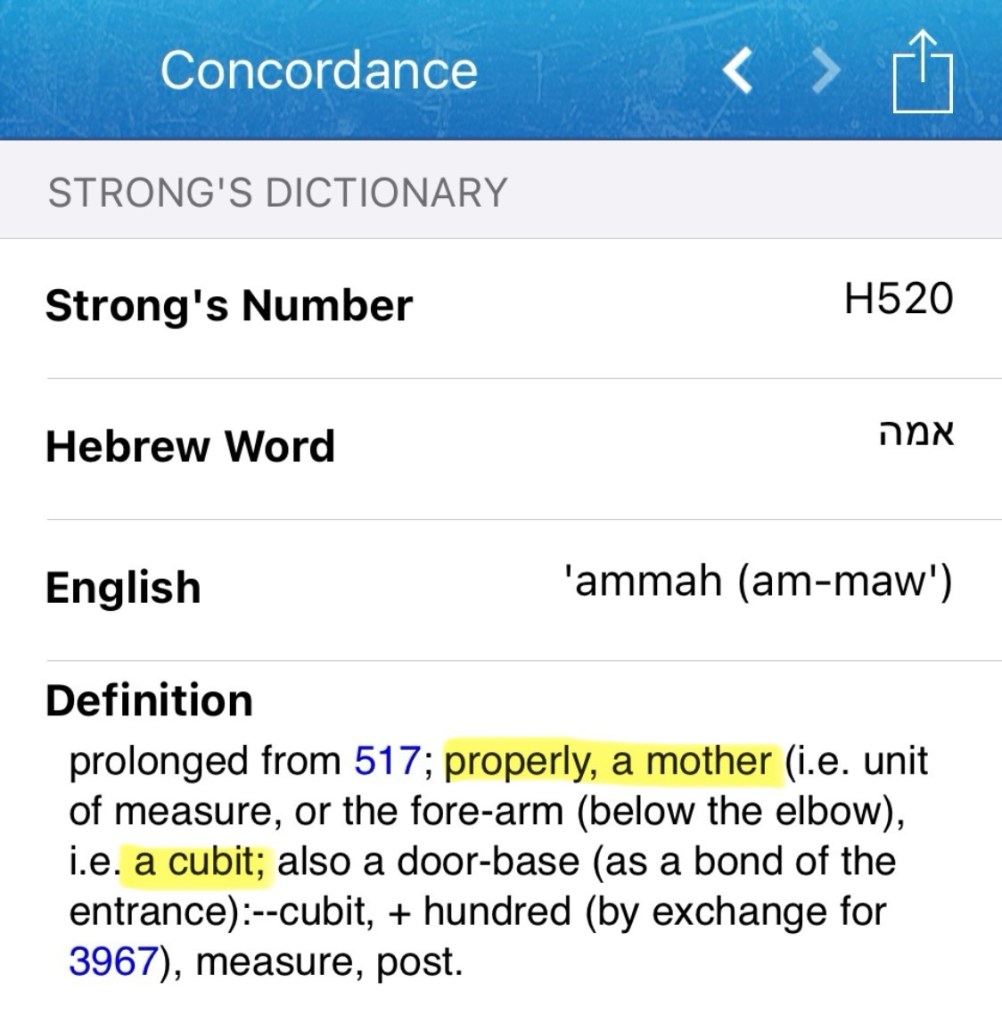
There was also a mother present at Golgotha (John 19:25). If you consider “three cubits,” (three mothers), three of the women were named Mary like the mother of Jesus. There were 4 women total. Three of the them were mothers of apostles.
What part of Jesus was nailed to the post? The cubit is the distance between the elbow and the tip of the finger. Jesus was pierced in His cubit as He poured out the love of God without measure.
HIGH – elevated.
“And I, when I am lifted up from the earth, will draw all people to myself.””
John 12:32 ESV
Here is the Hebrew word translated as “high” and its root word:
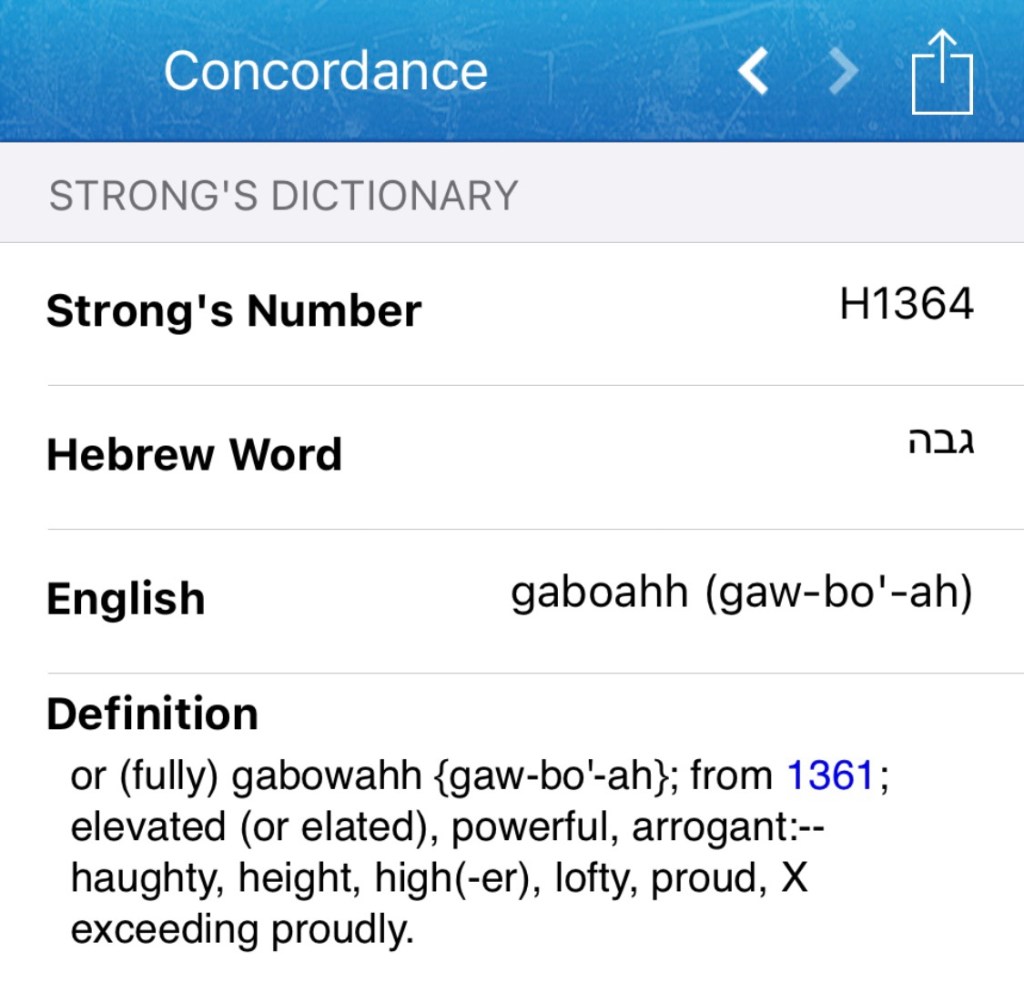
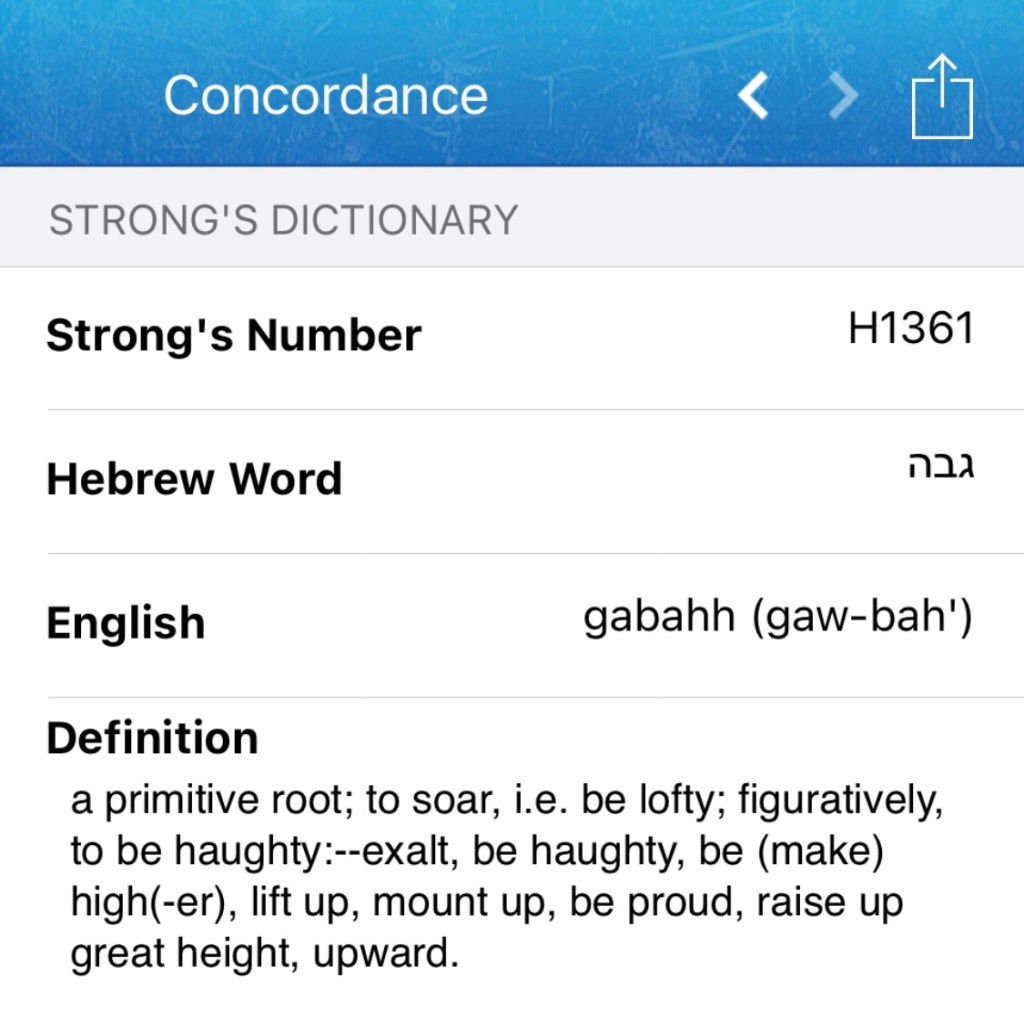
When I read this, a mental bell 🔔 of recognition went off… for this:
“So when Pilate heard these words, he brought Jesus out and sat down on the judgment seat at a place called The Stone Pavement, and in Aramaic Gabbatha.”
John 19:13 ESV
Gabbatha comes from the same root word, gabahh. It meant “knoll” and was the vernacular for the Roman Tribunal. It’s where Jesus was condemned to die.
LENGTH – Hebrew word is orek (like the vacuum) and it means length. The root word is arak and it means to make long or prolong. Which sent me to…
“Yet it was the will of the Lord to crush him; he has put him to grief; when his soul makes an offering for guilt, he shall see his offspring; he shall prolong [arak] his days; the will of the Lord shall prosper in his hand.” Isaiah 53:10 ESV
TWO CUBITS – two/twofold/couple/double, and cubits can also mean posts. Here’s what Google says about the two posts involved in crucifixion: “In Roman executions, a standard cross was a two-piece structure. The vertical upright was the stipes, while the horizontal crossbeam was the patibulum.”
CORNERS – a picture (or screenshot) is worth a thousand words… Here’s the word translated “corners” and its root.
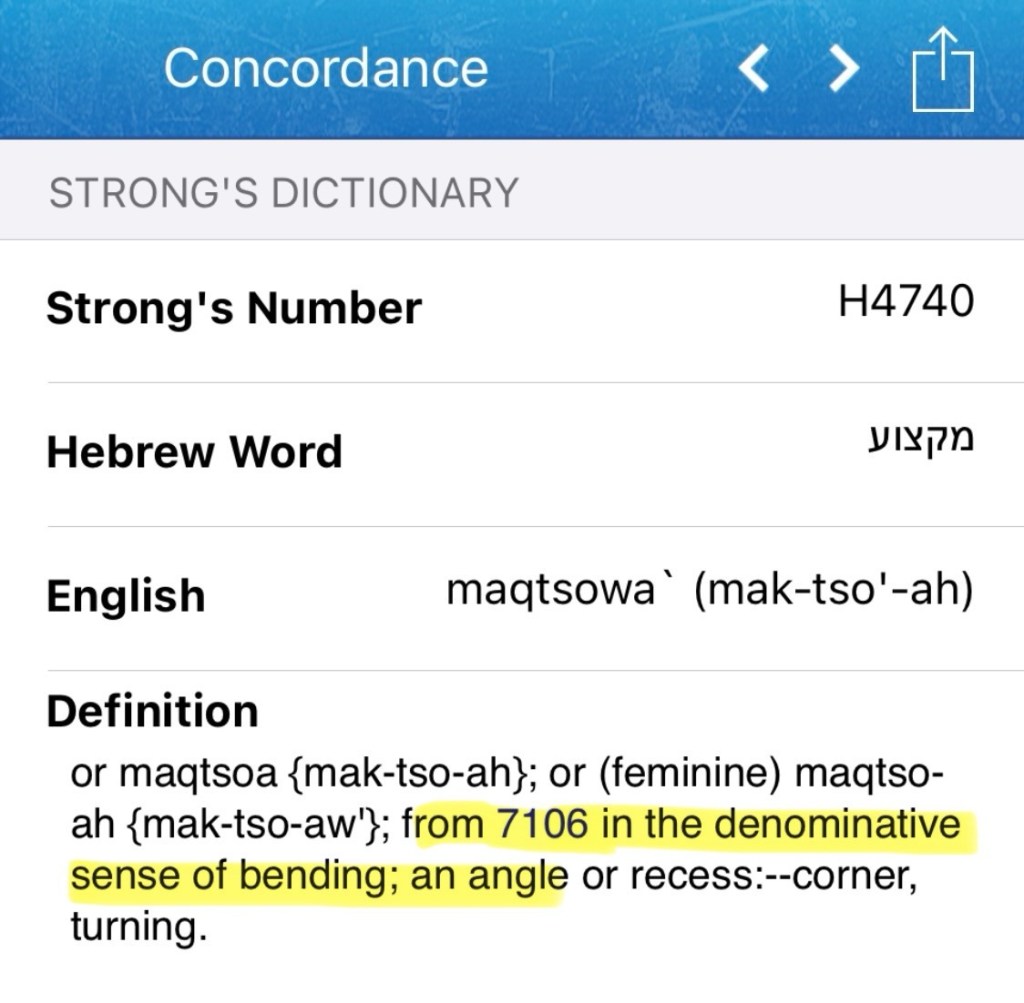
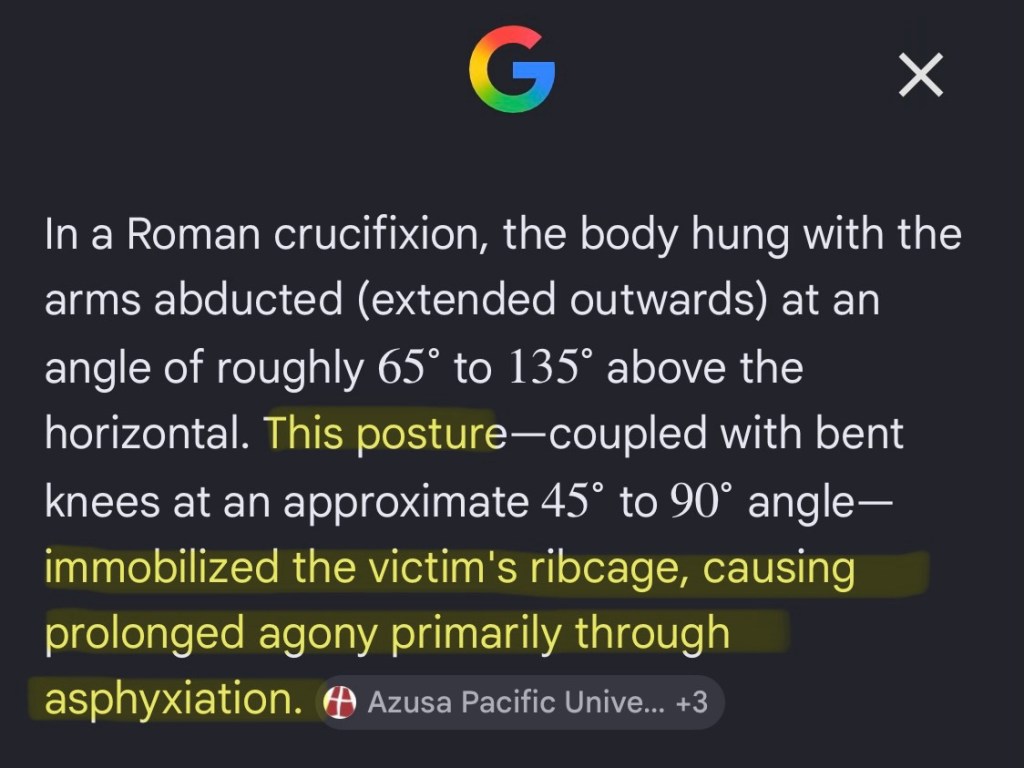
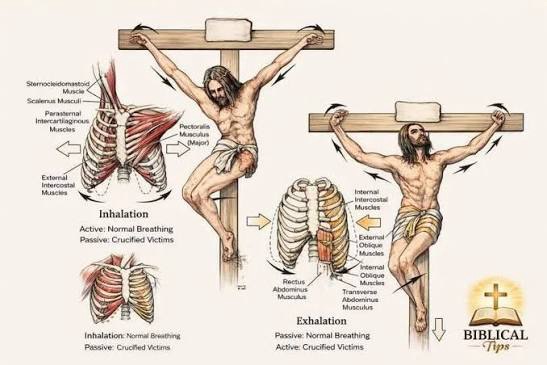
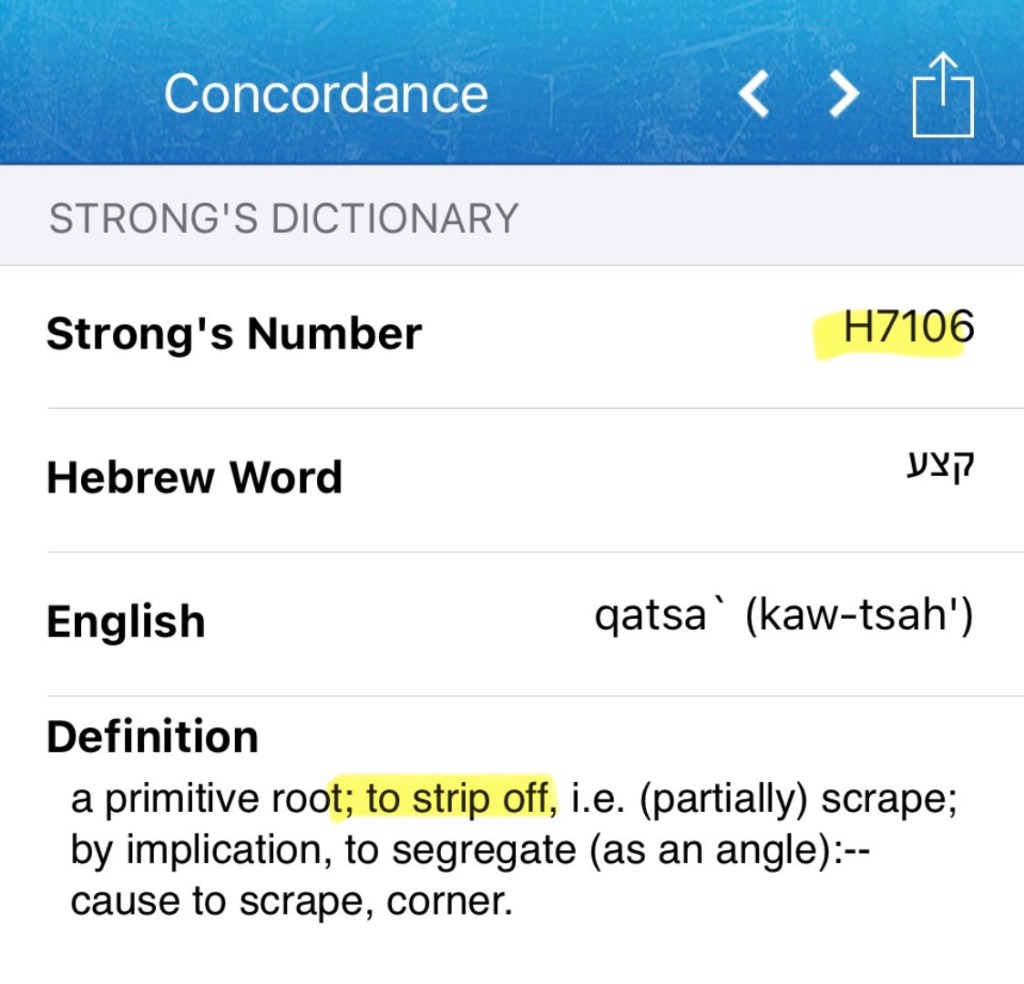
Jesus was stripped of his clothing and hung at particular angles. His very flesh was stripped and scraped off His body by the Roman flogging. This word qatsa is used in Leviticus 14:41 when the priest goes into a house that has “leprosy” (a picture of sin), and scrapes off the plaster and scours the stones. Jesus, the very temple of God, who became sin, was scraped like a leprous house.
LENGTH – Jesus hung on the cross for 6 long hours. And I bet it felt like forever.
WALLS – this refers to the sides of the table but it is a standard word for walls. Jesus was crucified just outside the city walls of Jerusalem.
WOOD
AND HE SAID – This is the Hebrew word debar – to speak. It encompasses many different kinds of speaking; mostly speech that has authority like “command, declare, promise, pronounce, teach.”
Jesus spoke from the wood. There were 7 sayings from the cross recorded in the Gospels.
TABLE – the Hebrew word for table comes from the concept of spreading out. If you put your hands in front of you and then spread them out, you’ll notice that you are also performing a motion of “away.” Like a swimmer pushing water away. You send your hands out away from you.
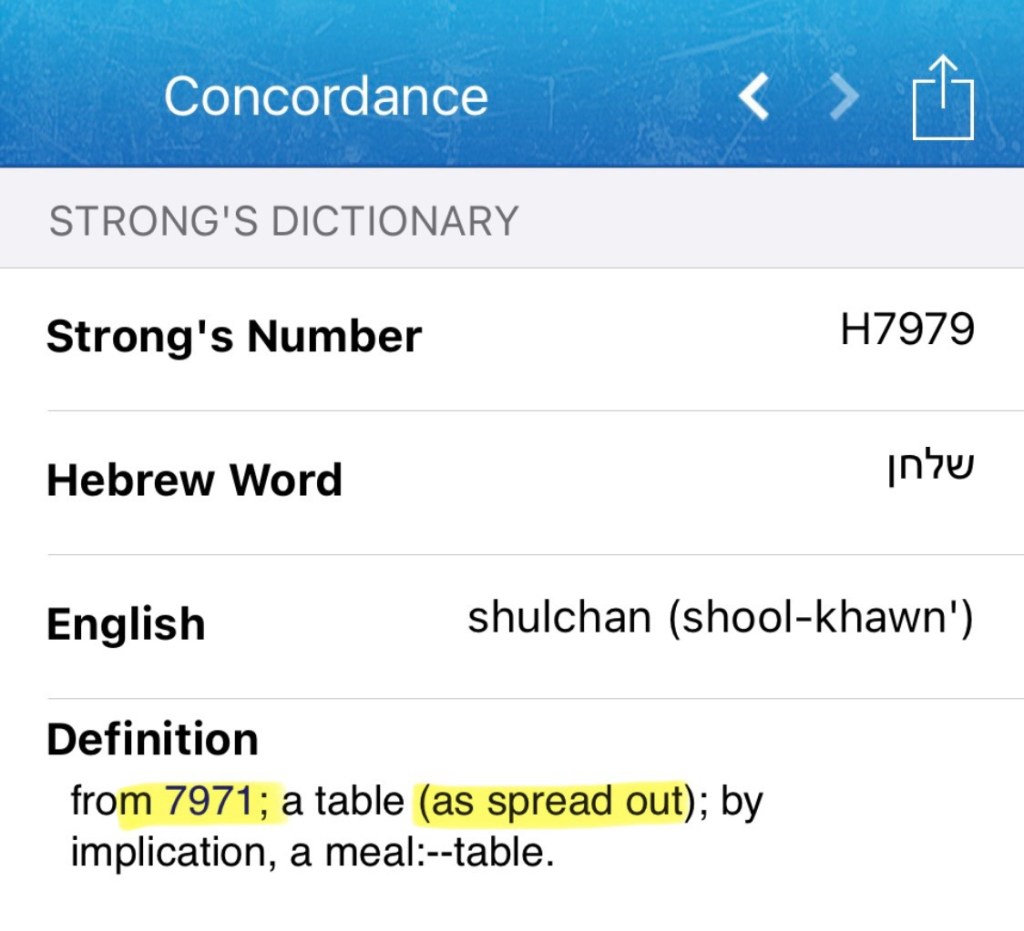
Here’s that root word:
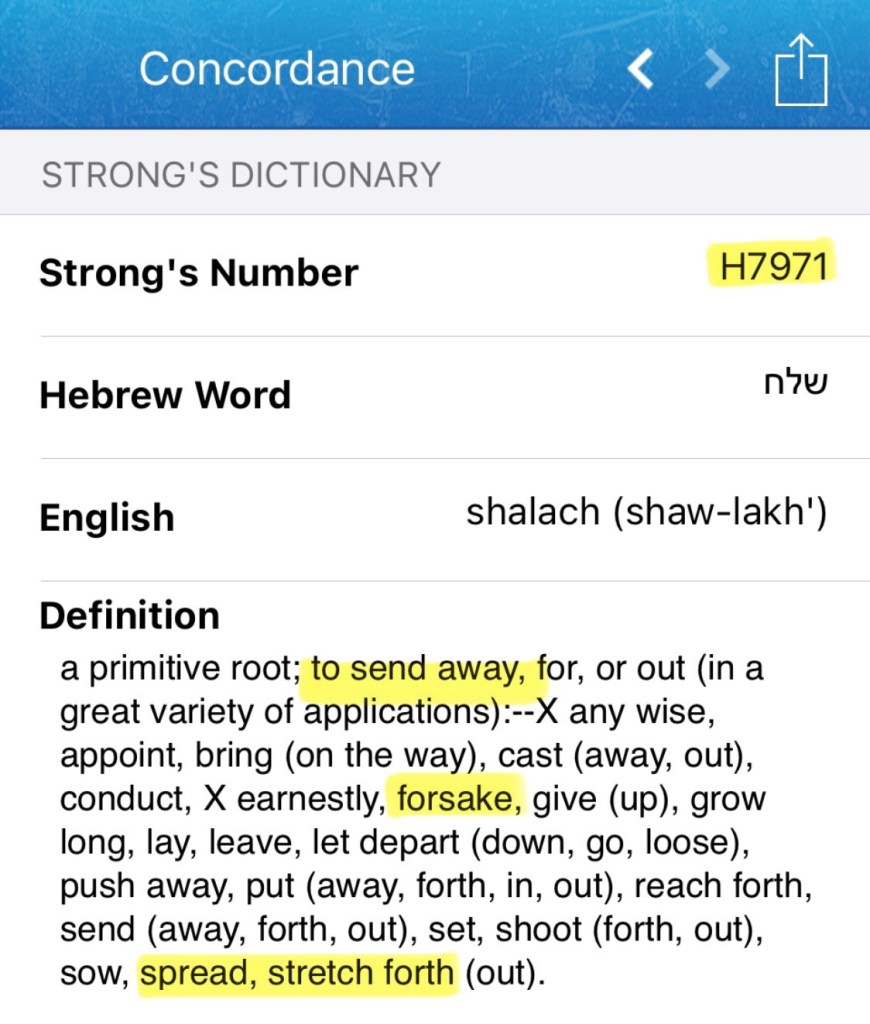
Jesus’ arms were spread out on the cross. And in His crucifixion He sent away our sins even as He was forsaken.
And the word TABLE is followed by…
BEFORE – (as in… “You prepare a table before me in the presence of my enemies,” from Psalm 23). The word “before” in Hebrew is paniym and it means face. If you are before someone, you can see their face. And whose face is the table before in Ezekiel?
YHWH – Yahweh, the LORD. This is His table. His altar. His wooden place of being exalted and spread out and nailed through His cubit. It is His table. He set it up.
This level of prophetic detail in a single verse is not coincidence. It’s ALL HERE! Stripped, taken outside the walls, the two posts, the angles, the 3 crosses and 3 mothers… I’m absolutely mind-blown! 🤯
Jesus is the Lamb of God which the LORD Himself provides. The Passover Lamb is served on this simple, ungilded, unadorned table. And it is THE central piece in this vast, 8-mile square, holy space.
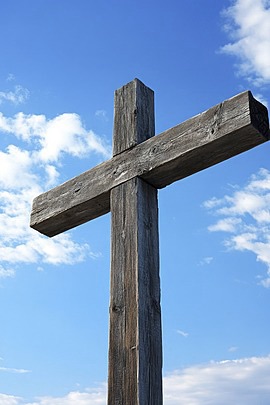
“…in front of the Holy Place was something resembling an altar of wood, three cubits high, two cubits long, and two cubits broad. Its corners, its base, and its walls were of wood. He said to me, ‘This is the table that is before the Lord.’”
Ezekiel 41:21-22 ESV

