The Temple Vision – Part 5
The Portion, The Prince, and The People
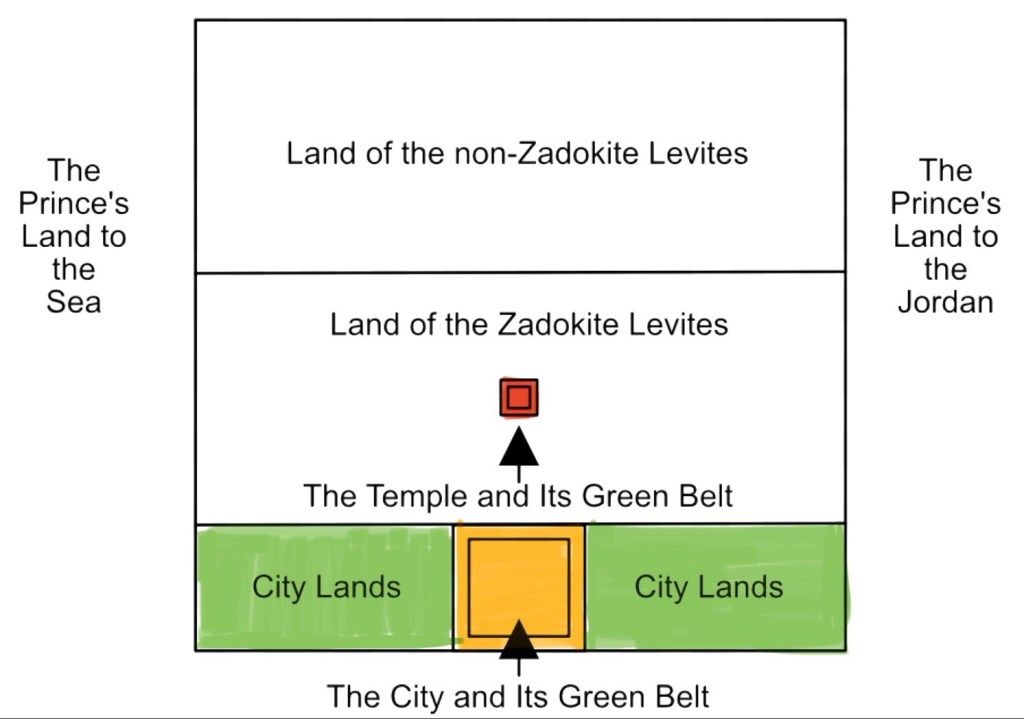
Every bit of ground inside this vast space is HOLY. This was probably shocking to the original hearers. Think back to when we read through Leviticus and all the ways a person could become ceremonially unclean during the course of a normal day. An unclean person could not enter sacred space.
⛔️ anyone who has touched a dead thing
⛔️ anyone who has had sex or an emission
⛔️ menstruating women
⛔️ anyone who has touched anything a menstruating woman has touched
⛔️ women who have given birth in the past 1-2 months
⛔️ anyone with a skin problem (acne, warts, psoriasis, rashes, open sores, infections, athlete’s foot, toe fungus, etc.)
⛔️ anyone who has had a bodily discharge of any kind
⛔️ anyone who has been touched by a person with a bodily discharge or who has sat on a seat where they sat
😐 Question. Does “bodily discharge” include…ya know, taking care of one’s bathroom business? 🧻🚽
I don’t think it does technically, but bathroom business wasn’t allowed even in the camp (Deut. 23:12-14), and certainly not in sacred space.
😲 Wait… so there are no bathrooms here? At all? In the whole city? For 8 square miles?! 😰
It would seem so.
😧 That’s impossible!
Exactly. Who on earth is going to qualify to live a normal life in a city on Holy Ground?
WELCOME TO THE HOLY CITY
POPULATION: 1 (Yahweh)
Remember that the whole point of this vision is to make Israel “ashamed of their sins,” (Eze. 43:10-11). The first step toward salvation is recognizing one’s inability to meet God’s HOLY standard.
“for all have sinned and fall short of the glory of God,” Romans 3:23 ESV
I suspect that the people were meant to hear this description of a holy city and think, “Wow… I guess I couldn’t live there.” It seems to be aimed particularly at the leadership (the “princes”) who set the example of wickedness, but still felt entitled to access holy ground.
One of Israel’s problems that led to the Exile had been not taking sin seriously. Idolatry was overlooked. They were having sex with prostitutes IN the temple. Adultery, rape, and even murder became common. Oppression was normalized. And yet they STILL brought offerings to the temple and prayed to Yahweh among other gods. They weren’t repentant. They had no business treading holy ground, but they tread on it anyway with their muckety, sin-covered boots.
This vision makes you stop and realize, that you LITERALLY can’t get within a mile of this new temple unless you are purified and stay that way.
☝🏼🤓 And don’t mind walking 2 miles to the nearest bathroom.
😐 That leaves me out.
Me too.
The only person qualified to live in the holy city truly is Yahweh. That’s why texts like this become very important:
“My old self has been crucified with Christ. It is no longer I who live, but Christ lives in me. So I live in this earthly body by trusting in the Son of God, who loved me and gave himself for me.”
Galatians 2:20 NLT
“For you died to this life, and your real life is hidden with Christ in God.”
Colossians 3:3 NLT
The saved person is IN Christ, and Christ is IN GOD. Therefore, the saved person is qualified to live IN the Holy City. We are hidden inside God and His robe of righteousness and He brings us into His sacred space.
☝🏼🤓 Kinda like smuggling candy 🍫 into the movie theater. You hide it in your coat pocket.
🤨 That’s a weird analogy.
🤓 Just trying to help.
Let’s talk about the offerings. They are noticeably different from the ones prescribed in the Torah.
There is no mention of tithes for the Levites or priests. Instead…
“You must give this tax to the prince: one bushel of wheat or barley for every 60 you harvest, one percent of your olive oil, and one sheep or goat for every 200 in your flocks in Israel. These will be the grain offerings, burnt offerings, and peace offerings that will make atonement for the people who bring them, says the Sovereign Lord.”
Ezekiel 45:13-15 NLT
1/60th of the grain
1% of the oil
0.5% of the sheep and goats
And they do not go to the Levites. They go to “the prince.”
The tithes in the Torah were not designated “to make atonement” but these offerings are. And I’m not sure that “tax” is the best word for it. The Hebrew calls them “presents.”
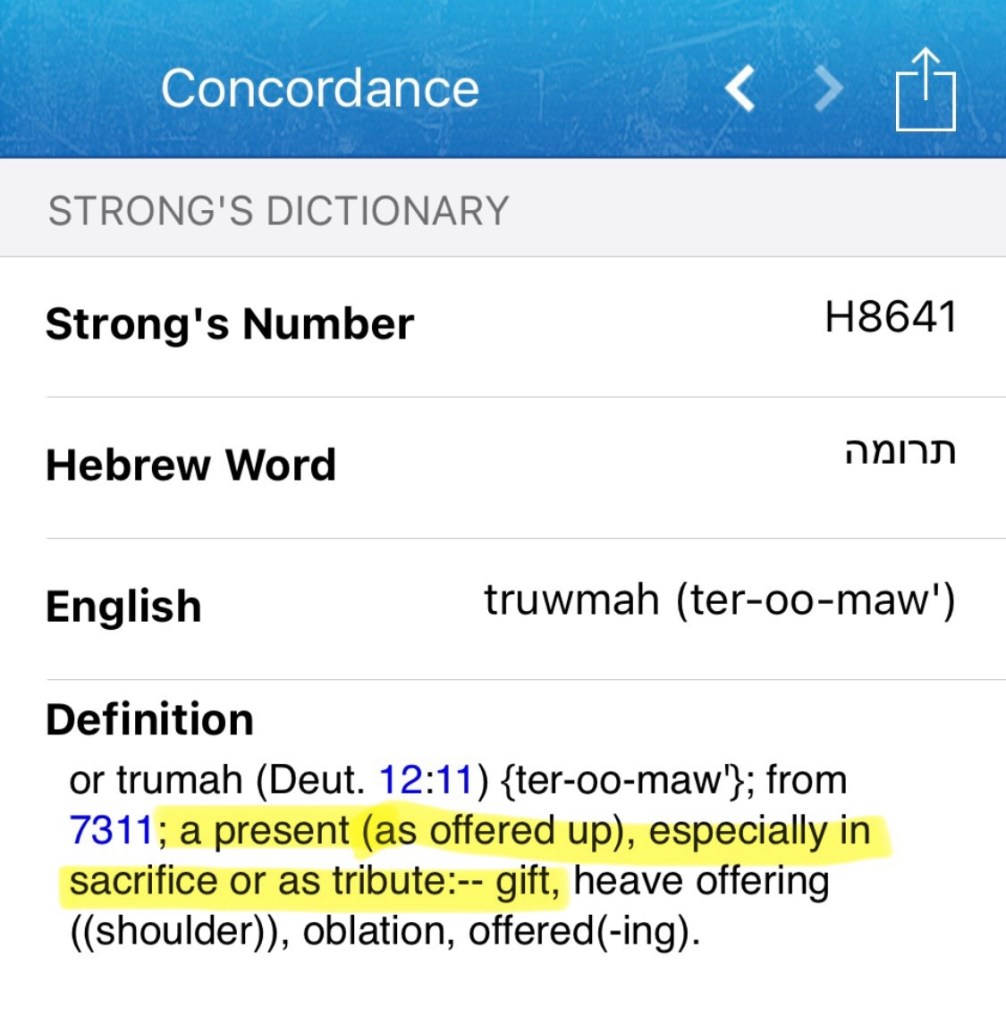
This word is used a lot in the Law to describe freewill offerings and offerings where a portion was “heaved” or lifted up before the LORD and then the rest was cooked and eaten by the offerer and his family and whoever else he wanted to share it with, so long as they were clean.
This word is used a LOT in Ezekiel; mostly describing the designated portions of land; suggesting that the land is viewed as a gift.
So the people bring their small gift-portions to the prince, and the prince does the rest.
“The prince will be required to provide offerings that are given at the religious festivals, the new moon celebrations, the Sabbath days, and all other similar occasions. He will provide the sin offerings, burnt offerings, grain offerings, liquid offerings, and peace offerings to purify the people of Israel, making them right with the Lord.”
Ezekiel 45:17 NLT
Who provides the offerings that make the people right with God? The prince.
If I were put in a Time Machine and sent back to Ezekiel’s day to preach the Gospel, I could use this text.
Christ – our Prince – has provided all the offerings we will ever need to make us right with God. It reminds me of the miracle of the loaves and fish. We bring him our little 1% and He provides a feast.
Speaking of feasts…
On Passover, there is (very oddly), no mention of a Lamb. Instead, there is a bull for a sin offering. The usual sin-offering was a goat or ram. A bull is the kind of sin offering associated with the consecration of a priest.
The offering of “7 bulls & 7 rams” every day during the 7 days of Unleavened Bread is not associated with any of the usual feasts or festivals. (Believe me. I spent hours looking.)
🐂🐂🐂🐂🐂🐂🐂
🐏🐏🐏🐏🐏🐏🐏
Here is where this unique offering appears (chronologically):
- It is the offering God commands of Job’s friends (Job 42:8).
- Balaam asked 7 altars to be built and he offered a bull and a ram on each and received a prophetic blessing each time (Num. 23).
- When David brought the Ark to Jerusalem, after “God helped the Levites” (no one was struck dead) and they had taken 6 steps, David offers this exact offering (2 Sam. 6:12-13, 1 Chron. 15:26).
- Hezekiah offered 7 bulls and 7 rams when they rededicated the Temple and the nation (2 Chon. 29:20-21)
These are the only times in scripture (outside of here in Ezekiel) that I could find where this particular offering is given.
This same 7 bulls & 7 rams offering is given in Ezekiel’s Temple during the Festival of Shelters (Tabernacles/Sukkot).
These are not the normal, Torah-commanded offerings. Why are rules different? Why is the Law of Moses not in use? I suspect that this might explain it:
“If the first covenant had been faultless, there would have been no need for a second covenant to replace it. But when God found fault with the people, he said: “The day is coming, says the Lord, when I will make a new covenant with the people of Israel and Judah. This covenant will not be like the one I made with their ancestors when I took them by the hand and led them out of the land of Egypt. They did not remain faithful to my covenant, so I turned my back on them, says the Lord.
But this is the new covenant I will make with the people of Israel on that day, says the Lord: I will put my laws in their minds, and I will write them on their hearts. I will be their God, and they will be my people. And they will not need to teach their neighbors, nor will they need to teach their relatives, saying, ‘You should know the Lord.’ For everyone, from the least to the greatest, will know me already. And I will forgive their wickedness, and I will never again remember their sins.’
When God speaks of a “new” covenant, it means he has made the first one obsolete. It is now out of date and will soon disappear.”
Hebrews 8:7-13 NLT
If you have a few minutes you really should pause here and read Hebrews 8:1 – 10:18. And then it will make more sense why this temple in Ezekiel’s vision does not function according to the first covenant; the covenant that was broken.
To me, this feels like further evidence that the vision of Ezekiel’s Temple is meant to be picture of the New Covenant.
CHAPTER 46 – The Gateways
There are 3 outer gateways; one facing east, one facing north, and one south. The east outer gate is the one that stays shut because Yahweh entered through it. The prince has the honor of eating his sacred meal inside the gate enclosure, but he does not enter or exit through it. Everyone coming into the temple comes in from north or south. (Ezekiel. 44:1-3)
There are 3 inner gateways that lead up to the inner court; one facing east, one facing north, and one south.
The east one stays closed except for Sabbath days and New Moon festivals at the beginning of each month. The prince may go inside the gatehouse and up to the threshold and eat the sacrificial meal there but he cannot enter the inner court. The common people gather outside this gate to worship on Sabbaths and New Moons.
The people enter the courts during the appointed feasts. The only ones specifically mentioned in Ezekiel are Sabbath, New Moon, Passover, and Tabernacles. They enter the outer courts by either the north or south gates. But there is a peculiar command about how they must leave.
“When the people of the land come before the Lord at the appointed feasts, he who enters by the north gate to worship shall go out by the south gate, and he who enters by the south gate shall go out by the north gate: no one shall return by way of the gate by which he entered, but each shall go out straight ahead.”
Ezekiel 46:9 ESV
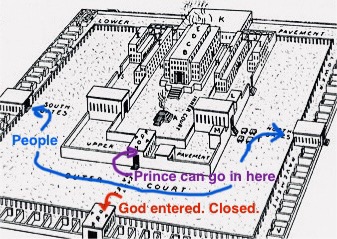
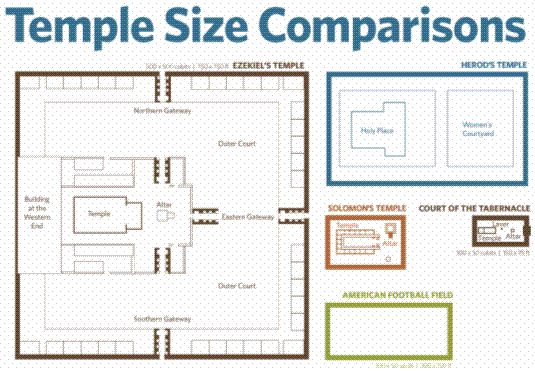
Why are the people required to trek more than 300 yards across the vast outer courts? Why can’t they turn around and go back out to Parking Lot G where they left the wagon?
😐 That’s like exiting the mall through Macy’s when you came in on the other end through J.C. Penny’s. It’s a long walk back to the car.
I have no idea why this is a rule but I can observe a few outcomes:
- Once you enter, there is no “turning back” (the literal meaning of the word “return” in Ezek. 46:9).
- This process means everyone knows that there is no such thing as dropping by the temple for a quick in and out. You go understanding that it will take time. You don’t do this in a hurry.
- The worshiper must enter fully. They cannot sneak into the back pew (as it were) and slip back out without anyone noticing. This rule forces the people to encounter each other face-to-face, walk amongst one another and rub shoulders with the community.
- The people must pass by the gate where Yahweh entered and so cross His very path of entry.
- This path through the courts makes the worshiper observe the sanctuary from different places. Their perspective on God’s dwelling cannot remain stagnant. They will see it from all available angles by the time they have been through.
New Daily Sacrifice
Ever since the Tabernacle of Moses in Exodus 29:38-42, the people of Israel were to offer 2 daily sacrifices, one in the morning and one in the evening. The instructions are repeated in Numbers 28:3-8. Here’s what they offered:
- Morning: 1 lamb a year old, 2 quarts of fine flour (1/10 ephah) mixed with 1 quart of olive oil (1/4 hin), 1 quart of wine (1/4 hin)
- Evening: 1 lamb a year old, 2 quarts of fine flour (1/10 ephah) mixed with 1 quart of olive oil (1/4 hin), 1 quart of wine (1/4 hin)
In Ezekiel’s Temple, they aren’t following the Law of Moses. Here’s what the new daily sacrifice looks like:
- Morning: 1 lamb a year old, 3.3 quarts of flour (1/6 ephah) mixed with 1/3 gallon of olive oil (1/3 hin, 1.16 quarts, about 1 liter).
I spent WAY too much time down the rabbit hole 🐇🕳️ on what kinds of bread 🥖 would result from the above ratios of flour and oil. Turns out you don’t get “bread” at all.
The ratio based on Exodus and Numbers gives you a gooey paste.
From the ratio in Ezekiel you get, (and I quote The Google), “an extremely crumbly, wet-sand-like mixture that never forms a cohesive dough.” It called my ratio of fat to flour “astronomically high” and said that the mixture “would behave more like a liquid-saturated crumble” than a bread dough.
I can’t say that I’ve ever seen a “liquid saturated crumble” before and, were flour and olive oil not so expensive, I might be very tempted to mix up a batch just to see what its like. Google assures me that this mixture could be rescued and turned into pie crust or focaccia bread with a few additional ingredients. If you’re a curious baker with time to experiment…
👩🍳 Challenge accepted! 🥧🥧🥧🥧🥧
The glaring difference between the Torah daily sacrifice and the one in Ezekiel is that there is only one daily sacrifice in the morning in Ezekiel’s Temple. And it doesn’t include wine. There is no evening sacrifice.
I wonder if it’s because Jesus died at the time of the evening sacrifice and His blood is the wine. Perhaps this description is intended to make us look at what’s in the negative space and see what message is hidden in what isn’t there.